Table of Contents
false0002073537FYtrueCANet Exposure represents the net receivable/(payable) that would be due from/to the counterparty in the event of a default. Exposure from the Borrowings and Other Financing Transactions can only be netted across transactions governed under the same master across transactions governed under the same master agreements with the same legal entity.Inclusive of shares issued pursuant to the Company’s Distribution Reinvestment Plan.Investments for which fair value is measured using NAV per Share (or its equivalent) as a practical expedient are not categorized within the fair value hierarchy. The fair value presented in the table is intended to permit reconciliation of the fair value hierarchy to the amounts presented in the Combined Statement of Assets and Liabilities and Combined Statements of Changes in Net Assets.All investments are U.S. domiciled, unless otherwise indicated.Represents personal loans held through a joint venture between the Company and multiple funds affiliated with the Operating Manager. Weighted average interest rate is 12.29% and weighted average maturity is 12/10/2027. Through these investments in an affiliate, both Series and the Company indirectly owned other investments in affiliates. In aggregate, each Series proportional share of the market value of individual issuers does not exceed 5% of the respective Series’ net assets.Only issuers that exceed 5% of net assets are presented.Affiliated to the Company. As of December 31, 2025, Series I owned 1.07% and Series II owned 20.19% of the PIMCO Private Mortgage Opportunities Fund Onshore, L.P. Through these investments in an affiliate, both Series and the Company indirectly owned other investments in affiliates. In aggregate, each Series proportional share of the market value of individual issuers does not exceed 5% of the respective Series’ net assets.Represents auto loans held through a joint venture between the Company and multiple funds affiliated with the Operating Manager. Weighted average interest rate is 15.94% and weighted average maturity is 57 months. Through these investments in an affiliate, both Series and the Company indirectly owned other investments in affiliates. In aggregate, each Series proportional share of the market value of individual issuers that exceed 5% of the respective Series’ net assets were as follows:Represents aircraft loans held through a joint venture between the Company and multiple funds affiliated with the Operating Manager. Loan interest rates range from 6.78% to 6.91% and loan maturity dates range from 12/13/2033 to 12/18/2037. Through these investments in an affiliate, both Series and the Company indirectly owned other investments in affiliates. In aggregate, each Series proportional share of the market value of individual issuers does not exceed 5% of the respective Series’ net assets.Affiliated to the Company. As of December 31, 2025, Series I owned 0.02% and Series II owned 0.35% of the PIMCO ABS and Short-Term Investments Portfolio. Through these investments in an affiliate, both Series and the Company indirectly owned other investments in affiliates. In aggregate, each Series proportional share of the market value of individual issuers does not exceed 5% of the respective Series’ net assets.Represents auto loans held through a joint venture between the Company and multiple funds affiliated with the Operating Manager. Weighted average interest rate is 14.40% and weighted average maturity is 73 months. Through these investments in an affiliate, both Series and the Company indirectly owned other investments in affiliates. In aggregate, each Series proportional share of the market value of individual issuers does not exceed 5% of the respective Series’ net assets.Investment is Cayman Islands domiciled.Pool of residential fix-and-flip loans acquired through a domestic common law trust, with a federally chartered bank serving as trustee. The Company accrues interest income at the pool level at the rate indicated, which represents estimated loan interest net of certain service provider fees. 0002073537 2025-03-11 2025-12-31 0002073537 2025-12-31 0002073537 2025-01-01 2025-12-31 0002073537 2025-03-10 0002073537 ck0002073537:SeriesIMember 2025-12-31 0002073537 ck0002073537:SeriesIIMember 2025-12-31 0002073537 ck0002073537:SeriesIEntitiesMember ck0002073537:AnchorISharesMember 2025-12-31 0002073537 ck0002073537:SeriesIEntitiesMember ck0002073537:AnchorIISharesMember 2025-12-31 0002073537 ck0002073537:SeriesIEntitiesMember ck0002073537:AnchorIiBSharesMember 2025-12-31 0002073537 ck0002073537:SeriesIEntitiesMember ck0002073537:StandardASharesMember 2025-12-31 0002073537 ck0002073537:SeriesIEntitiesMember ck0002073537:StandardBSharesMember 2025-12-31 0002073537 ck0002073537:SeriesIEntitiesMember ck0002073537:ESharesMember 2025-12-31 0002073537 ck0002073537:SeriesIIEntitiesMember ck0002073537:AnchorISharesMember 2025-12-31 0002073537 ck0002073537:SeriesIIEntitiesMember ck0002073537:AnchorIISharesMember 2025-12-31 0002073537 ck0002073537:SeriesIIEntitiesMember ck0002073537:AnchorIiiSharesMember 2025-12-31 0002073537 ck0002073537:SeriesIIEntitiesMember ck0002073537:StandardASharesMember 2025-12-31 0002073537 ck0002073537:SeriesIIEntitiesMember ck0002073537:ESharesMember 2025-12-31 0002073537 ck0002073537:SeriesIIEntitiesMember 2025-12-31 0002073537 ck0002073537:SeriesIEntitiesMember 2025-12-31 0002073537 ck0002073537:SeriesIMember ck0002073537:AnchorISharesMember 2025-12-31 0002073537 ck0002073537:SeriesIIMember ck0002073537:AnchorISharesMember 2025-12-31 0002073537 ck0002073537:AnchorISharesMember 2025-12-31 0002073537 ck0002073537:SeriesIMember ck0002073537:AnchorIISharesMember 2025-12-31 0002073537 ck0002073537:SeriesIIMember ck0002073537:AnchorIISharesMember 2025-12-31 0002073537 ck0002073537:AnchorIISharesMember 2025-12-31 0002073537 ck0002073537:SeriesIMember ck0002073537:StandardBSharesMember 2025-12-31 0002073537 ck0002073537:SeriesIIMember ck0002073537:StandardBSharesMember 2025-12-31 0002073537 ck0002073537:StandardBSharesMember 2025-12-31 0002073537 ck0002073537:SeriesIMember ck0002073537:ESharesMember 2025-12-31 0002073537 ck0002073537:SeriesIIMember ck0002073537:ESharesMember 2025-12-31 0002073537 ck0002073537:ESharesMember 2025-12-31 0002073537 ck0002073537:SeriesIMember ck0002073537:StandardASharesMember 2025-12-31 0002073537 ck0002073537:SeriesIIMember ck0002073537:StandardASharesMember 2025-12-31 0002073537 ck0002073537:StandardASharesMember 2025-12-31 0002073537 ck0002073537:SeriesIMember ck0002073537:VSharesMember 2025-12-31 0002073537 ck0002073537:SeriesIIMember ck0002073537:VSharesMember 2025-12-31 0002073537 ck0002073537:VSharesMember 2025-12-31 0002073537 ck0002073537:SeriesIMember ck0002073537:AnchorIiBSharesMember 2025-12-31 0002073537 ck0002073537:SeriesIIMember ck0002073537:AnchorIiBSharesMember 2025-12-31 0002073537 ck0002073537:AnchorIiBSharesMember 2025-12-31 0002073537 ck0002073537:SeriesIMember ck0002073537:AnchorIiiSharesMember 2025-12-31 0002073537 ck0002073537:SeriesIIMember ck0002073537:AnchorIiiSharesMember 2025-12-31 0002073537 ck0002073537:AnchorIiiSharesMember 2025-12-31 0002073537 ck0002073537:SeriesIEntitiesMember us-gaap:InvestmentAffiliatedIssuerMember 2025-12-31 0002073537 ck0002073537:SeriesIIEntitiesMember us-gaap:InvestmentAffiliatedIssuerMember 2025-12-31 0002073537 us-gaap:InvestmentAffiliatedIssuerMember 2025-12-31 0002073537 ck0002073537:SeriesIEntitiesMember ck0002073537:OvernightIndexSwapsMember us-gaap:InterestRateRiskMember 2025-12-31 0002073537 ck0002073537:SeriesIIEntitiesMember ck0002073537:OvernightIndexSwapsMember us-gaap:InterestRateRiskMember 2025-12-31 0002073537 ck0002073537:OvernightIndexSwapsMember us-gaap:InterestRateRiskMember 2025-12-31 0002073537 us-gaap:FairValueMeasuredAtNetAssetValuePerShareMember us-gaap:ConsumerLoanMember 2025-12-31 0002073537 ck0002073537:SeriesIEntitiesMember us-gaap:FairValueInputsLevel1Member us-gaap:CommonStockMember 2025-12-31 0002073537 ck0002073537:SeriesIEntitiesMember us-gaap:FairValueInputsLevel2Member us-gaap:CommonStockMember 2025-12-31 0002073537 ck0002073537:SeriesIIEntitiesMember us-gaap:FairValueInputsLevel2Member us-gaap:ConsumerLoanMember 2025-12-31 0002073537 ck0002073537:SeriesIIEntitiesMember us-gaap:FairValueInputsLevel3Member us-gaap:ConsumerLoanMember 2025-12-31 0002073537 ck0002073537:SeriesIIEntitiesMember us-gaap:FairValueMeasuredAtNetAssetValuePerShareMember us-gaap:ConsumerLoanMember 2025-12-31 0002073537 us-gaap:FairValueInputsLevel1Member us-gaap:ConsumerLoanMember 2025-12-31 0002073537 us-gaap:FairValueInputsLevel2Member us-gaap:ConsumerLoanMember 2025-12-31 0002073537 us-gaap:FairValueInputsLevel3Member us-gaap:ConsumerLoanMember 2025-12-31 0002073537 us-gaap:FairValueMeasuredAtNetAssetValuePerShareMember us-gaap:AssetBackedSecuritiesMember 2025-12-31 0002073537 ck0002073537:SeriesIEntitiesMember us-gaap:FairValueInputsLevel1Member us-gaap:ConsumerLoanMember 2025-12-31 0002073537 ck0002073537:SeriesIEntitiesMember us-gaap:FairValueInputsLevel2Member us-gaap:ConsumerLoanMember 2025-12-31 0002073537 ck0002073537:SeriesIEntitiesMember us-gaap:FairValueInputsLevel3Member us-gaap:ConsumerLoanMember 2025-12-31 0002073537 ck0002073537:SeriesIEntitiesMember us-gaap:FairValueMeasuredAtNetAssetValuePerShareMember us-gaap:ConsumerLoanMember 2025-12-31 0002073537 ck0002073537:SeriesIIEntitiesMember us-gaap:FairValueInputsLevel1Member us-gaap:ConsumerLoanMember 2025-12-31 0002073537 ck0002073537:SeriesIIEntitiesMember us-gaap:FairValueInputsLevel2Member us-gaap:AssetBackedSecuritiesMember 2025-12-31 0002073537 ck0002073537:SeriesIIEntitiesMember us-gaap:FairValueInputsLevel3Member us-gaap:AssetBackedSecuritiesMember 2025-12-31 0002073537 ck0002073537:SeriesIIEntitiesMember us-gaap:FairValueMeasuredAtNetAssetValuePerShareMember us-gaap:AssetBackedSecuritiesMember 2025-12-31 0002073537 us-gaap:FairValueInputsLevel1Member us-gaap:AssetBackedSecuritiesMember 2025-12-31 0002073537 us-gaap:FairValueInputsLevel2Member us-gaap:AssetBackedSecuritiesMember 2025-12-31 0002073537 us-gaap:FairValueInputsLevel3Member us-gaap:AssetBackedSecuritiesMember 2025-12-31 0002073537 ck0002073537:SeriesIIEntitiesMember us-gaap:FairValueMeasuredAtNetAssetValuePerShareMember us-gaap:CommonStockMember 2025-12-31 0002073537 ck0002073537:SeriesIEntitiesMember us-gaap:FairValueInputsLevel1Member us-gaap:AssetBackedSecuritiesMember 2025-12-31 0002073537 ck0002073537:SeriesIEntitiesMember us-gaap:FairValueInputsLevel2Member us-gaap:AssetBackedSecuritiesMember 2025-12-31 0002073537 ck0002073537:SeriesIEntitiesMember us-gaap:FairValueInputsLevel3Member us-gaap:AssetBackedSecuritiesMember 2025-12-31 0002073537 ck0002073537:SeriesIEntitiesMember us-gaap:FairValueMeasuredAtNetAssetValuePerShareMember us-gaap:AssetBackedSecuritiesMember 2025-12-31 0002073537 ck0002073537:SeriesIIEntitiesMember us-gaap:FairValueInputsLevel1Member us-gaap:AssetBackedSecuritiesMember 2025-12-31 0002073537 ck0002073537:SeriesIIEntitiesMember us-gaap:FairValueInputsLevel3Member ck0002073537:SecuritizedLoansMember 2025-12-31 0002073537 ck0002073537:SeriesIIEntitiesMember us-gaap:FairValueMeasuredAtNetAssetValuePerShareMember ck0002073537:SecuritizedLoansMember 2025-12-31 0002073537 us-gaap:FairValueInputsLevel1Member ck0002073537:SecuritizedLoansMember 2025-12-31 0002073537 us-gaap:FairValueInputsLevel2Member ck0002073537:SecuritizedLoansMember 2025-12-31 0002073537 us-gaap:FairValueInputsLevel3Member ck0002073537:SecuritizedLoansMember 2025-12-31 0002073537 us-gaap:FairValueMeasuredAtNetAssetValuePerShareMember ck0002073537:SecuritizedLoansMember 2025-12-31 0002073537 ck0002073537:SeriesIEntitiesMember us-gaap:FairValueInputsLevel1Member ck0002073537:SecuritizedLoansMember 2025-12-31 0002073537 ck0002073537:SeriesIEntitiesMember us-gaap:FairValueInputsLevel2Member ck0002073537:SecuritizedLoansMember 2025-12-31 0002073537 ck0002073537:SeriesIEntitiesMember us-gaap:FairValueInputsLevel3Member ck0002073537:SecuritizedLoansMember 2025-12-31 0002073537 ck0002073537:SeriesIEntitiesMember us-gaap:FairValueMeasuredAtNetAssetValuePerShareMember ck0002073537:SecuritizedLoansMember 2025-12-31 0002073537 ck0002073537:SeriesIIEntitiesMember us-gaap:FairValueInputsLevel1Member ck0002073537:SecuritizedLoansMember 2025-12-31 0002073537 ck0002073537:SeriesIIEntitiesMember us-gaap:FairValueInputsLevel2Member ck0002073537:SecuritizedLoansMember 2025-12-31 0002073537 ck0002073537:SeriesIIEntitiesMember us-gaap:FairValueInputsLevel3Member ck0002073537:ResidentialLoansMember 2025-12-31 0002073537 ck0002073537:SeriesIIEntitiesMember us-gaap:FairValueMeasuredAtNetAssetValuePerShareMember ck0002073537:ResidentialLoansMember 2025-12-31 0002073537 us-gaap:FairValueInputsLevel1Member ck0002073537:ResidentialLoansMember 2025-12-31 0002073537 us-gaap:FairValueInputsLevel2Member ck0002073537:ResidentialLoansMember 2025-12-31 0002073537 us-gaap:FairValueInputsLevel3Member ck0002073537:ResidentialLoansMember 2025-12-31 0002073537 us-gaap:FairValueMeasuredAtNetAssetValuePerShareMember ck0002073537:ResidentialLoansMember 2025-12-31 0002073537 ck0002073537:SeriesIEntitiesMember us-gaap:FairValueInputsLevel1Member ck0002073537:ResidentialLoansMember 2025-12-31 0002073537 ck0002073537:SeriesIEntitiesMember us-gaap:FairValueInputsLevel2Member ck0002073537:ResidentialLoansMember 2025-12-31 0002073537 ck0002073537:SeriesIEntitiesMember us-gaap:FairValueInputsLevel3Member ck0002073537:ResidentialLoansMember 2025-12-31 0002073537 ck0002073537:SeriesIEntitiesMember us-gaap:FairValueMeasuredAtNetAssetValuePerShareMember ck0002073537:ResidentialLoansMember 2025-12-31 0002073537 ck0002073537:SeriesIIEntitiesMember us-gaap:FairValueInputsLevel1Member ck0002073537:ResidentialLoansMember 2025-12-31 0002073537 ck0002073537:SeriesIIEntitiesMember us-gaap:FairValueInputsLevel2Member ck0002073537:ResidentialLoansMember 2025-12-31 0002073537 ck0002073537:SeriesIIEntitiesMember us-gaap:FairValueInputsLevel3Member 2025-12-31 0002073537 ck0002073537:SeriesIIEntitiesMember us-gaap:FairValueMeasuredAtNetAssetValuePerShareMember 2025-12-31 0002073537 us-gaap:FairValueInputsLevel1Member 2025-12-31 0002073537 us-gaap:FairValueInputsLevel2Member 2025-12-31 0002073537 us-gaap:FairValueInputsLevel3Member 2025-12-31 0002073537 us-gaap:FairValueMeasuredAtNetAssetValuePerShareMember 2025-12-31 0002073537 ck0002073537:SeriesIEntitiesMember us-gaap:FairValueInputsLevel1Member 2025-12-31 0002073537 ck0002073537:SeriesIEntitiesMember us-gaap:FairValueInputsLevel2Member 2025-12-31 0002073537 ck0002073537:SeriesIEntitiesMember us-gaap:FairValueInputsLevel3Member 2025-12-31 0002073537 ck0002073537:SeriesIEntitiesMember us-gaap:FairValueMeasuredAtNetAssetValuePerShareMember 2025-12-31 0002073537 ck0002073537:SeriesIIEntitiesMember us-gaap:FairValueInputsLevel1Member 2025-12-31 0002073537 ck0002073537:SeriesIIEntitiesMember us-gaap:FairValueInputsLevel2Member 2025-12-31 0002073537 ck0002073537:SeriesIIEntitiesMember us-gaap:FairValueInputsLevel3Member us-gaap:ShortTermInvestmentsMember 2025-12-31 0002073537 ck0002073537:SeriesIIEntitiesMember us-gaap:FairValueMeasuredAtNetAssetValuePerShareMember us-gaap:ShortTermInvestmentsMember 2025-12-31 0002073537 us-gaap:FairValueInputsLevel1Member us-gaap:ShortTermInvestmentsMember 2025-12-31 0002073537 us-gaap:FairValueInputsLevel2Member us-gaap:ShortTermInvestmentsMember 2025-12-31 0002073537 us-gaap:FairValueInputsLevel3Member us-gaap:ShortTermInvestmentsMember 2025-12-31 0002073537 us-gaap:FairValueMeasuredAtNetAssetValuePerShareMember us-gaap:ShortTermInvestmentsMember 2025-12-31 0002073537 ck0002073537:SeriesIEntitiesMember us-gaap:FairValueInputsLevel1Member us-gaap:ShortTermInvestmentsMember 2025-12-31 0002073537 ck0002073537:SeriesIEntitiesMember us-gaap:FairValueInputsLevel2Member us-gaap:ShortTermInvestmentsMember 2025-12-31 0002073537 ck0002073537:SeriesIEntitiesMember us-gaap:FairValueInputsLevel3Member us-gaap:ShortTermInvestmentsMember 2025-12-31 0002073537 ck0002073537:SeriesIEntitiesMember us-gaap:FairValueMeasuredAtNetAssetValuePerShareMember us-gaap:ShortTermInvestmentsMember 2025-12-31 0002073537 ck0002073537:SeriesIIEntitiesMember us-gaap:FairValueInputsLevel1Member us-gaap:ShortTermInvestmentsMember 2025-12-31 0002073537 ck0002073537:SeriesIIEntitiesMember us-gaap:FairValueInputsLevel2Member us-gaap:ShortTermInvestmentsMember 2025-12-31 0002073537 ck0002073537:SeriesIIEntitiesMember us-gaap:FairValueInputsLevel3Member us-gaap:PreferredStockMember 2025-12-31 0002073537 ck0002073537:SeriesIIEntitiesMember us-gaap:FairValueMeasuredAtNetAssetValuePerShareMember us-gaap:PreferredStockMember 2025-12-31 0002073537 us-gaap:FairValueInputsLevel1Member us-gaap:PreferredStockMember 2025-12-31 0002073537 us-gaap:FairValueInputsLevel2Member us-gaap:PreferredStockMember 2025-12-31 0002073537 us-gaap:FairValueInputsLevel3Member us-gaap:PreferredStockMember 2025-12-31 0002073537 us-gaap:FairValueMeasuredAtNetAssetValuePerShareMember us-gaap:PreferredStockMember 2025-12-31 0002073537 ck0002073537:SeriesIEntitiesMember us-gaap:FairValueInputsLevel1Member us-gaap:PreferredStockMember 2025-12-31 0002073537 ck0002073537:SeriesIEntitiesMember us-gaap:FairValueInputsLevel2Member us-gaap:PreferredStockMember 2025-12-31 0002073537 ck0002073537:SeriesIEntitiesMember us-gaap:FairValueInputsLevel3Member us-gaap:PreferredStockMember 2025-12-31 0002073537 ck0002073537:SeriesIEntitiesMember us-gaap:FairValueMeasuredAtNetAssetValuePerShareMember us-gaap:PreferredStockMember 2025-12-31 0002073537 ck0002073537:SeriesIIEntitiesMember us-gaap:FairValueInputsLevel1Member us-gaap:PreferredStockMember 2025-12-31 0002073537 ck0002073537:SeriesIIEntitiesMember us-gaap:FairValueInputsLevel2Member us-gaap:PreferredStockMember 2025-12-31 0002073537 ck0002073537:SeriesIIEntitiesMember us-gaap:FairValueInputsLevel2Member us-gaap:CommonStockMember 2025-12-31 0002073537 ck0002073537:SeriesIIEntitiesMember us-gaap:FairValueInputsLevel3Member us-gaap:CommonStockMember 2025-12-31 0002073537 us-gaap:FairValueInputsLevel1Member us-gaap:CommonStockMember 2025-12-31 0002073537 us-gaap:FairValueInputsLevel2Member us-gaap:CommonStockMember 2025-12-31 0002073537 us-gaap:FairValueInputsLevel3Member us-gaap:CommonStockMember 2025-12-31 0002073537 us-gaap:FairValueMeasuredAtNetAssetValuePerShareMember us-gaap:CommonStockMember 2025-12-31 0002073537 ck0002073537:SeriesIEntitiesMember us-gaap:FairValueInputsLevel3Member us-gaap:CommonStockMember 2025-12-31 0002073537 ck0002073537:SeriesIEntitiesMember us-gaap:FairValueMeasuredAtNetAssetValuePerShareMember us-gaap:CommonStockMember 2025-12-31 0002073537 ck0002073537:SeriesIIEntitiesMember us-gaap:FairValueInputsLevel1Member us-gaap:CommonStockMember 2025-12-31 0002073537 ck0002073537:OvernightIndexSwapsMember us-gaap:FairValueInputsLevel2Member 2025-12-31 0002073537 ck0002073537:OvernightIndexSwapsMember us-gaap:FairValueInputsLevel3Member 2025-12-31 0002073537 ck0002073537:OvernightIndexSwapsMember us-gaap:FairValueMeasuredAtNetAssetValuePerShareMember 2025-12-31 0002073537 ck0002073537:SeriesIEntitiesMember ck0002073537:OvernightIndexSwapsMember us-gaap:FairValueMeasuredAtNetAssetValuePerShareMember 2025-12-31 0002073537 ck0002073537:SeriesIIEntitiesMember ck0002073537:OvernightIndexSwapsMember us-gaap:FairValueInputsLevel1Member 2025-12-31 0002073537 ck0002073537:SeriesIIEntitiesMember ck0002073537:OvernightIndexSwapsMember us-gaap:FairValueInputsLevel2Member 2025-12-31 0002073537 ck0002073537:SeriesIIEntitiesMember ck0002073537:OvernightIndexSwapsMember us-gaap:FairValueInputsLevel3Member 2025-12-31 0002073537 ck0002073537:SeriesIIEntitiesMember ck0002073537:OvernightIndexSwapsMember us-gaap:FairValueMeasuredAtNetAssetValuePerShareMember 2025-12-31 0002073537 ck0002073537:OvernightIndexSwapsMember us-gaap:FairValueInputsLevel1Member 2025-12-31 0002073537 ck0002073537:SeriesIEntitiesMember ck0002073537:OvernightIndexSwapsMember us-gaap:FairValueInputsLevel1Member 2025-12-31 0002073537 ck0002073537:SeriesIEntitiesMember ck0002073537:OvernightIndexSwapsMember us-gaap:FairValueInputsLevel2Member 2025-12-31 0002073537 ck0002073537:SeriesIEntitiesMember ck0002073537:OvernightIndexSwapsMember us-gaap:FairValueInputsLevel3Member 2025-12-31 0002073537 ck0002073537:SeriesIEntitiesMember us-gaap:FairValueInputsLevel3Member us-gaap:ConsumerLoanMember us-gaap:MeasurementInputDiscountRateMember us-gaap:ValuationTechniqueDiscountedCashFlowMember 2025-12-31 0002073537 ck0002073537:SeriesIIEntitiesMember us-gaap:FairValueInputsLevel3Member us-gaap:CommonStockMember ck0002073537:MeasurementInputPurchasePriceMember ck0002073537:ValuationRecentTransactionMember 2025-12-31 0002073537 us-gaap:FairValueInputsLevel3Member us-gaap:CommonStockMember ck0002073537:MeasurementInputPurchasePriceMember ck0002073537:ValuationRecentTransactionMember 2025-12-31 0002073537 ck0002073537:SeriesIEntitiesMember us-gaap:FairValueInputsLevel3Member us-gaap:PreferredStockMember ck0002073537:MeasurementInputPurchasePriceMember ck0002073537:ValuationRecentTransactionMember 2025-12-31 0002073537 ck0002073537:SeriesIIEntitiesMember us-gaap:FairValueInputsLevel3Member us-gaap:PreferredStockMember ck0002073537:MeasurementInputPurchasePriceMember ck0002073537:ValuationRecentTransactionMember 2025-12-31 0002073537 us-gaap:FairValueInputsLevel3Member us-gaap:PreferredStockMember ck0002073537:MeasurementInputPurchasePriceMember ck0002073537:ValuationRecentTransactionMember 2025-12-31 0002073537 ck0002073537:SeriesIIEntitiesMember us-gaap:FairValueInputsLevel3Member ck0002073537:InvestmentsInAffiliatesMember us-gaap:MeasurementInputDiscountRateMember ck0002073537:SumOfThePartsMember 2025-12-31 0002073537 us-gaap:FairValueInputsLevel3Member ck0002073537:InvestmentsInAffiliatesMember us-gaap:MeasurementInputDiscountRateMember ck0002073537:SumOfThePartsMember 2025-12-31 0002073537 ck0002073537:SeriesIEntitiesMember us-gaap:FairValueInputsLevel3Member us-gaap:AssetBackedSecuritiesMember us-gaap:MeasurementInputDiscountRateMember us-gaap:ValuationTechniqueDiscountedCashFlowMember 2025-12-31 0002073537 ck0002073537:SeriesIIEntitiesMember us-gaap:FairValueInputsLevel3Member us-gaap:AssetBackedSecuritiesMember us-gaap:MeasurementInputDiscountRateMember us-gaap:ValuationTechniqueDiscountedCashFlowMember 2025-12-31 0002073537 us-gaap:FairValueInputsLevel3Member us-gaap:AssetBackedSecuritiesMember us-gaap:MeasurementInputDiscountRateMember us-gaap:ValuationTechniqueDiscountedCashFlowMember 2025-12-31 0002073537 ck0002073537:SeriesIEntitiesMember us-gaap:FairValueInputsLevel3Member us-gaap:CommonStockMember ck0002073537:MeasurementInputPurchasePriceMember ck0002073537:ValuationRecentTransactionMember 2025-12-31 0002073537 ck0002073537:SeriesIIEntitiesMember us-gaap:FairValueInputsLevel3Member us-gaap:ConsumerLoanMember us-gaap:MeasurementInputDiscountRateMember us-gaap:ValuationTechniqueDiscountedCashFlowMember 2025-12-31 0002073537 us-gaap:FairValueInputsLevel3Member us-gaap:ConsumerLoanMember us-gaap:MeasurementInputDiscountRateMember us-gaap:ValuationTechniqueDiscountedCashFlowMember 2025-12-31 0002073537 ck0002073537:SeriesIEntitiesMember us-gaap:FairValueInputsLevel3Member ck0002073537:ResidentialLoansMember us-gaap:MeasurementInputDiscountRateMember us-gaap:ValuationTechniqueDiscountedCashFlowMember 2025-12-31 0002073537 ck0002073537:SeriesIIEntitiesMember us-gaap:FairValueInputsLevel3Member ck0002073537:ResidentialLoansMember us-gaap:MeasurementInputDiscountRateMember us-gaap:ValuationTechniqueDiscountedCashFlowMember 2025-12-31 0002073537 us-gaap:FairValueInputsLevel3Member ck0002073537:ResidentialLoansMember us-gaap:MeasurementInputDiscountRateMember us-gaap:ValuationTechniqueDiscountedCashFlowMember 2025-12-31 0002073537 ck0002073537:SeriesIEntitiesMember us-gaap:FairValueInputsLevel3Member ck0002073537:InvestmentsInAffiliatesMember us-gaap:MeasurementInputDiscountRateMember ck0002073537:SumOfThePartsMember 2025-12-31 0002073537 ck0002073537:SeriesIEntitiesMember ck0002073537:ConditionalReimbursementAgreementMember us-gaap:RelatedPartyMember 2025-12-31 0002073537 ck0002073537:SeriesIIEntitiesMember ck0002073537:ConditionalReimbursementAgreementMember us-gaap:RelatedPartyMember 2025-12-31 0002073537 ck0002073537:ConditionalReimbursementAgreementMember us-gaap:RelatedPartyMember 2025-12-31 0002073537 Investments, at fair value | Consumer Loans | Personal Loans | PAL CL Trust 1, 8.50%, 3/22/2034 | Series I 2025-12-31 0002073537 Investments in affiliates | US Residential Real Estate - Mix | US Residential Real Estate - Mix | Series I 2025-12-31 0002073537 Investments in affiliates | Diversified ABF | PIMCO ABS and Short-Term Investments Portoflio 2025-12-31 0002073537 Investments in affiliates | Origination Platforms | Cavendish FF, LLC, Series I | Series I 2025-12-31 0002073537 Investments in affiliates | Origination Platforms | Cavendish FF, LLC, Series I | Series II 2025-12-31 0002073537 Investments in affiliates | Origination Platforms | Cavendish FF, LLC, Series I 2025-12-31 0002073537 Investments in affiliates | Personal Loans | MPL Aggregator XII LTD | Series I 2025-12-31 0002073537 Investments in affiliates | Personal Loans | MPL Aggregator XII LTD | Series II 2025-12-31 0002073537 Investments in affiliates | Auto Loans | Cavendish LLC 2025-12-31 0002073537 Investments in affiliates | Investments in affiliates | Phantom Long Ridge Offshore LP Non-US | Series II 2025-12-31 0002073537 Investments in affiliates | Investments in affiliates | Phantom Long Ridge Offshore LP Non-US | Series I 2025-12-31 0002073537 Investments in affiliates | Investments in affiliates | Phantom Long Ridge Offshore LP Non-US 2025-12-31 0002073537 Investments in affiliates | Diversified ABF | PIMCO ABS and Short-Term Investments Portoflio | Series I 2025-12-31 0002073537 Investments in affiliates | Diversified ABF | PIMCO ABS and Short-Term Investments Portoflio | Series II 2025-12-31 0002073537 Investments, at fair value | Consumer Loans | Personal Loans | PAL CL Trust 1, 8.50%, 3/22/2034 | Series II 2025-12-31 0002073537 Investments in affiliates | US Residential Real Estate - Mix | US Residential Real Estate - Mix | Series II 2025-12-31 0002073537 Investments, at fair value | Consumer Loans | Personal Loans | PAL CL Trust 1, 8.50%, 3/22/2034 2025-12-31 0002073537 Investments in affiliates | US Residential Real Estate - Mix | US Residential Real Estate - Mix 2025-12-31 0002073537 Investments in affiliates | Auto Loans | Cavendish LLC | Series I 2025-12-31 0002073537 Investments in affiliates | Auto Loans | Cavendish LLC | Series II 2025-12-31 0002073537 Investments in affiliates | Personal Loans | MPL Aggregator XII LTD 2025-12-31 0002073537 Investments, at fair value | Securitized Loans | Non-Consumer | Series I 2025-12-31 0002073537 Investments, at fair value | Securitized Loans | Non-Consumer | Series II 2025-12-31 0002073537 Investments, at fair value | Securitized Loans | FNMA Mortgage Pool, 5.00%-6.00%, 4/1/2053-12/1/2055 | Series I 2025-12-31 0002073537 Investments, at fair value | Securitized Loans | FNMA Mortgage Pool, 5.00%-6.00%, 4/1/2053-12/1/2055 | Series II 2025-12-31 0002073537 Investments, at fair value | Residential Loans | Other Residential Loans | Series II 2025-12-31 0002073537 Investments, at fair value | Securitized Loans | Consumer Loans 2025-12-31 0002073537 Investments, at fair value | Securitized Loans | Non-Consumer 2025-12-31 0002073537 Investments, at fair value | Securitized Loans | FNMA Mortgage Pool, 5.00%-6.00%, 4/1/2053-12/1/2055 2025-12-31 0002073537 Investments, at fair value | Securitized Loans | Consumer Loans | Series I 2025-12-31 0002073537 Investments, at fair value | Securitized Loans | Consumer Loans | Series II 2025-12-31 0002073537 Investments, at fair value | Residential Loans | Other Residential Loans 2025-12-31 0002073537 Investments, at fair value | Residential Loans | Mr. Cooper, 2.04%-8.79%, 11/25/2060 | Series I 2025-12-31 0002073537 Investments, at fair value | Residential Loans | Mr. Cooper, 2.04%-8.79%, 11/25/2060 | Series II 2025-12-31 0002073537 Investments, at fair value | Residential Loans | PAL RL Trust 1, 9.12%-9.36%, 12/1/2026-4/1/202 | Series I 2025-12-31 0002073537 Investments, at fair value | Residential Loans | PAL RL Trust 1, 9.12%-9.36%, 12/1/2026-4/1/202 | Series II 2025-12-31 0002073537 Investments, at fair value | Residential Loans | Other Residential Loans | Series I 2025-12-31 0002073537 ck0002073537:ResidentialLoansMember 2025-12-31 0002073537 ck0002073537:SeriesIEntitiesMember ck0002073537:SecuritizedLoansMember 2025-12-31 0002073537 ck0002073537:SeriesIIEntitiesMember ck0002073537:SecuritizedLoansMember 2025-12-31 0002073537 ck0002073537:SecuritizedLoansMember 2025-12-31 0002073537 Investments, at fair value | Residential Loans | Mr. Cooper, 2.04%-8.79%, 11/25/2060 2025-12-31 0002073537 Investments, at fair value | Residential Loans | PAL RL Trust 1, 9.12%-9.36%, 12/1/2026-4/1/202 2025-12-31 0002073537 ck0002073537:SeriesIEntitiesMember us-gaap:ShortTermInvestmentsMember 2025-12-31 0002073537 ck0002073537:SeriesIEntitiesMember us-gaap:InvestmentAffiliatedIssuerMember ck0002073537:TotalInvestmentsatFairValueMember 2025-12-31 0002073537 ck0002073537:SeriesIEntitiesMember us-gaap:InvestmentAffiliatedIssuerMember ck0002073537:UsResidentialRealEstateMember 2025-12-31 0002073537 ck0002073537:SeriesIEntitiesMember ck0002073537:ResidentialLoansMember 2025-12-31 0002073537 ck0002073537:SeriesIIEntitiesMember ck0002073537:ResidentialLoansMember 2025-12-31 0002073537 ck0002073537:SeriesIEntitiesMember us-gaap:ConsumerLoanMember 2025-12-31 0002073537 Investments, at fair value | Common Stock | Origination Platforms | Series I 2025-12-31 0002073537 ck0002073537:SeriesIEntitiesMember us-gaap:CommonStockMember 2025-12-31 0002073537 Investments, at fair value | Preferred Stock | Origination Platforms | Series I 2025-12-31 0002073537 ck0002073537:SeriesIEntitiesMember us-gaap:PreferredStockMember 2025-12-31 0002073537 Investments, at fair value | Short-Term Investments | Repurchase Agreements | Repurchase Agreements | Series I 2025-12-31 0002073537 ck0002073537:SeriesIIEntitiesMember us-gaap:ShortTermInvestmentsMember 2025-12-31 0002073537 ck0002073537:SeriesIIEntitiesMember us-gaap:InvestmentAffiliatedIssuerMember ck0002073537:TotalInvestmentsatFairValueMember 2025-12-31 0002073537 ck0002073537:SeriesIIEntitiesMember us-gaap:InvestmentAffiliatedIssuerMember ck0002073537:UsResidentialRealEstateMember 2025-12-31 0002073537 ck0002073537:SeriesIEntitiesMember us-gaap:AssetBackedSecuritiesMember 2025-12-31 0002073537 ck0002073537:SeriesIIEntitiesMember us-gaap:ConsumerLoanMember 2025-12-31 0002073537 Investments, at fair value | Common Stock | Origination Platforms | Series II 2025-12-31 0002073537 ck0002073537:SeriesIIEntitiesMember us-gaap:CommonStockMember 2025-12-31 0002073537 Investments, at fair value | Preferred Stock | Origination Platforms | Series II 2025-12-31 0002073537 ck0002073537:SeriesIIEntitiesMember us-gaap:PreferredStockMember 2025-12-31 0002073537 Investments, at fair value | Short-Term Investments | Repurchase Agreements | Repurchase Agreements | Series II 2025-12-31 0002073537 us-gaap:ShortTermInvestmentsMember 2025-12-31 0002073537 us-gaap:InvestmentAffiliatedIssuerMember ck0002073537:TotalInvestmentsatFairValueMember 2025-12-31 0002073537 us-gaap:InvestmentAffiliatedIssuerMember ck0002073537:UsResidentialRealEstateMember 2025-12-31 0002073537 ck0002073537:SeriesIIEntitiesMember us-gaap:AssetBackedSecuritiesMember 2025-12-31 0002073537 Investments, at fair value | Preferred Stock | Origination Platforms 2025-12-31 0002073537 us-gaap:PreferredStockMember 2025-12-31 0002073537 us-gaap:AssetBackedSecuritiesMember 2025-12-31 0002073537 Investments, at fair value | Short-Term Investments | Repurchase Agreement | Repurchase Agreements 2025-12-31 0002073537 us-gaap:ConsumerLoanMember 2025-12-31 0002073537 Investments, at fair value | Common Stock | Origination Platforms 2025-12-31 0002073537 us-gaap:CommonStockMember 2025-12-31 0002073537 Investments, at fair value | Residential Loans | Mr. Cooper, 2.04%-8.79%, 11/25/2060 srt:MinimumMember 2025-12-31 0002073537 srt:MaximumMember 2025-12-31 0002073537 ck0002073537:AircraftLoansMember us-gaap:InvestmentAffiliatedIssuerMember srt:MinimumMember 2025-12-31 0002073537 ck0002073537:AircraftLoansMember us-gaap:InvestmentAffiliatedIssuerMember srt:MaximumMember 2025-12-31 0002073537 ck0002073537:AircraftLoansMember us-gaap:InvestmentAffiliatedIssuerMember 2025-12-31 0002073537 ck0002073537:SeriesIEntitiesMember ck0002073537:AutoLoansProjectCavendishMember 2025-12-31 0002073537 ck0002073537:CavendishFFLLCMember us-gaap:InvestmentAffiliatedIssuerMember srt:MinimumMember 2025-12-31 0002073537 ck0002073537:MPLAggregatorXIILTDMember us-gaap:InvestmentAffiliatedIssuerMember srt:MaximumMember 2025-12-31 0002073537 ck0002073537:MPLAggregatorXIILTDMember us-gaap:InvestmentAffiliatedIssuerMember 2025-12-31 0002073537 ck0002073537:SeriesIEntitiesMember ck0002073537:PIMCOPrivateMortgageOpportunitiesFundMember us-gaap:InvestmentAffiliatedIssuerMember 2025-12-31 0002073537 ck0002073537:SeriesIIEntitiesMember ck0002073537:PIMCOPrivateMortgageOpportunitiesFundMember us-gaap:InvestmentAffiliatedIssuerMember 2025-12-31 0002073537 ck0002073537:PIMCOPrivateMortgageOpportunitiesFundMember us-gaap:InvestmentAffiliatedIssuerMember 2025-12-31 0002073537 ck0002073537:AutoLoansMember us-gaap:InvestmentAffiliatedIssuerMember srt:MaximumMember 2025-12-31 0002073537 ck0002073537:AutoLoansMember us-gaap:InvestmentAffiliatedIssuerMember srt:MinimumMember 2025-12-31 0002073537 ck0002073537:SeriesIEntitiesMember us-gaap:InvestmentAffiliatedIssuerMember us-gaap:ShortTermInvestmentsMember 2025-12-31 0002073537 ck0002073537:SeriesIIEntitiesMember us-gaap:InvestmentAffiliatedIssuerMember us-gaap:ShortTermInvestmentsMember 2025-12-31 0002073537 us-gaap:InvestmentAffiliatedIssuerMember us-gaap:ShortTermInvestmentsMember 2025-12-31 0002073537 ck0002073537:CavendishFFLLCMember us-gaap:InvestmentAffiliatedIssuerMember srt:MaximumMember 2025-12-31 0002073537 ck0002073537:SeriesIEntitiesMember ck0002073537:BofASecuritiesIncMember 2025-12-31 0002073537 ck0002073537:SeriesIIEntitiesMember ck0002073537:BofASecuritiesIncMember 2025-12-31 0002073537 ck0002073537:SeriesIIEntitiesMember ck0002073537:AutoLoansProjectCavendishMember 2025-12-31 0002073537 ck0002073537:SeriesIEntitiesMember ck0002073537:BankOfScotlandMember 2025-12-31 0002073537 ck0002073537:SeriesIIEntitiesMember ck0002073537:BankOfScotlandMember 2025-12-31 0002073537 ck0002073537:BankOfScotlandMember 2025-12-31 0002073537 ck0002073537:SeriesIEntitiesMember ck0002073537:OvernightIndexSwapsMember 2025-12-31 0002073537 ck0002073537:SeriesIIEntitiesMember ck0002073537:OvernightIndexSwapsMember 2025-12-31 0002073537 ck0002073537:OvernightIndexSwapsMember 2025-12-31 0002073537 ck0002073537:OvernightIndexSwapsMember srt:MinimumMember 2025-12-31 0002073537 ck0002073537:OvernightIndexSwapsMember srt:MaximumMember 2025-12-31 0002073537 ck0002073537:SeriesIEntitiesMember ck0002073537:TotalInvestmentsInAffiliatesAtFairValueMember 2025-12-31 0002073537 ck0002073537:SeriesIIEntitiesMember ck0002073537:TotalInvestmentsInAffiliatesAtFairValueMember 2025-12-31 0002073537 ck0002073537:TotalInvestmentsInAffiliatesAtFairValueMember 2025-12-31 0002073537 ck0002073537:SeriesIEntitiesMember ck0002073537:TotalInvestmentsatFairValueMember 2025-12-31 0002073537 ck0002073537:SeriesIIEntitiesMember ck0002073537:TotalInvestmentsatFairValueMember 2025-12-31 0002073537 ck0002073537:TotalInvestmentsatFairValueMember 2025-12-31 0002073537 ck0002073537:RepurchasePlanMember 2025-12-31 0002073537 ck0002073537:RepurchasePlanMember ck0002073537:AnchorISharesMember 2025-12-31 0002073537 ck0002073537:RepurchasePlanMember ck0002073537:AnchorIISharesMember 2025-12-31 0002073537 ck0002073537:RepurchasePlanMember ck0002073537:AnchorIiBSharesMember 2025-12-31 0002073537 ck0002073537:RepurchasePlanMember ck0002073537:AnchorIiiSharesMember 2025-12-31 0002073537 Investments, at fair value | Residential Loans | Mr. Cooper, 2.04%-8.79%, 11/25/2060 srt:MaximumMember 2025-12-31 0002073537 Investments, at fair value | Residential Loans | PAL RL Trust 1, 9.12%-9.36%, 12/1/2026-4/1/202 srt:MaximumMember 2025-12-31 0002073537 Investments, at fair value | Securitized Loans | FNMA Mortgage Pool, 5.00%-6.00%, 4/1/2053-12/1/2055 srt:MinimumMember 2025-12-31 0002073537 Investments, at fair value | Securitized Loans | FNMA Mortgage Pool, 5.00%-6.00%, 4/1/2053-12/1/2055 srt:MaximumMember 2025-12-31 0002073537 Investments, at fair value | Residential Loans | PAL RL Trust 1, 9.12%-9.36%, 12/1/2026-4/1/202 srt:MinimumMember 2025-12-31 0002073537 ck0002073537:SeriesIEntitiesMember ck0002073537:PromissoryNotesMember 2025-12-31 0002073537 ck0002073537:SeriesIIEntitiesMember ck0002073537:PromissoryNotesMember 2025-12-31 0002073537 ck0002073537:PromissoryNotesMember 2025-12-31 0002073537 ck0002073537:SeriesIEntitiesMember ck0002073537:SantanderFacilityMember 2025-12-31 0002073537 ck0002073537:SeriesIIEntitiesMember ck0002073537:SantanderFacilityMember 2025-12-31 0002073537 ck0002073537:SantanderFacilityMember 2025-12-31 0002073537 srt:MinimumMember 2025-12-31 0002073537 ck0002073537:SeriesIMember 2025-03-11 2025-12-31 0002073537 ck0002073537:SeriesIIMember 2025-03-11 2025-12-31 0002073537 ck0002073537:SeriesIIEntitiesMember ck0002073537:AnchorISharesMember 2025-03-11 2025-12-31 0002073537 ck0002073537:SeriesIIEntitiesMember ck0002073537:AnchorIISharesMember 2025-03-11 2025-12-31 0002073537 ck0002073537:SeriesIIEntitiesMember ck0002073537:AnchorIiiSharesMember 2025-03-11 2025-12-31 0002073537 ck0002073537:SeriesIIEntitiesMember ck0002073537:StandardASharesMember 2025-03-11 2025-12-31 0002073537 ck0002073537:SeriesIIEntitiesMember ck0002073537:ESharesMember 2025-03-11 2025-12-31 0002073537 ck0002073537:SeriesIEntitiesMember ck0002073537:AnchorISharesMember 2025-03-11 2025-12-31 0002073537 ck0002073537:SeriesIEntitiesMember ck0002073537:AnchorIISharesMember 2025-03-11 2025-12-31 0002073537 ck0002073537:SeriesIEntitiesMember ck0002073537:AnchorIiBSharesMember 2025-03-11 2025-12-31 0002073537 ck0002073537:SeriesIEntitiesMember ck0002073537:StandardASharesMember 2025-03-11 2025-12-31 0002073537 ck0002073537:SeriesIEntitiesMember ck0002073537:StandardBSharesMember 2025-03-11 2025-12-31 0002073537 ck0002073537:SeriesIEntitiesMember ck0002073537:ESharesMember 2025-03-11 2025-12-31 0002073537 ck0002073537:SeriesIIEntitiesMember ck0002073537:StandardBSharesMember 2025-03-11 2025-12-31 0002073537 ck0002073537:StandardBSharesMember 2025-03-11 2025-12-31 0002073537 ck0002073537:ESharesMember 2025-03-11 2025-12-31 0002073537 ck0002073537:VSharesMember 2025-03-11 2025-12-31 0002073537 ck0002073537:SeriesIEntitiesMember ck0002073537:AnchorIiiSharesMember 2025-03-11 2025-12-31 0002073537 ck0002073537:SeriesIEntitiesMember ck0002073537:VSharesMember 2025-03-11 2025-12-31 0002073537 ck0002073537:SeriesIIEntitiesMember ck0002073537:VSharesMember 2025-03-11 2025-12-31 0002073537 ck0002073537:AnchorISharesMember 2025-03-11 2025-12-31 0002073537 ck0002073537:StandardASharesMember 2025-03-11 2025-12-31 0002073537 ck0002073537:AnchorIiiSharesMember 2025-03-11 2025-12-31 0002073537 ck0002073537:SeriesIIEntitiesMember ck0002073537:AnchorIiBSharesMember 2025-03-11 2025-12-31 0002073537 ck0002073537:AnchorIiBSharesMember 2025-03-11 2025-12-31 0002073537 ck0002073537:AnchorIISharesMember 2025-03-11 2025-12-31 0002073537 ck0002073537:SeriesIEntitiesMember ck0002073537:OvernightIndexSwapsMember us-gaap:InterestRateRiskMember 2025-03-11 2025-12-31 0002073537 ck0002073537:SeriesIIEntitiesMember ck0002073537:OvernightIndexSwapsMember us-gaap:InterestRateRiskMember 2025-03-11 2025-12-31 0002073537 ck0002073537:OvernightIndexSwapsMember us-gaap:InterestRateRiskMember 2025-03-11 2025-12-31 0002073537 ck0002073537:SeriesIEntitiesMember us-gaap:FairValueInputsLevel3Member 2025-03-11 2025-12-31 0002073537 ck0002073537:SeriesIIEntitiesMember us-gaap:FairValueInputsLevel3Member 2025-03-11 2025-12-31 0002073537 us-gaap:FairValueInputsLevel3Member 2025-03-11 2025-12-31 0002073537 us-gaap:FairValueInputsLevel3Member us-gaap:AssetBackedSecuritiesMember us-gaap:MeasurementInputDiscountRateMember us-gaap:ValuationTechniqueDiscountedCashFlowMember 2025-03-11 2025-12-31 0002073537 us-gaap:FairValueInputsLevel3Member us-gaap:ConsumerLoanMember us-gaap:MeasurementInputDiscountRateMember us-gaap:ValuationTechniqueDiscountedCashFlowMember 2025-03-11 2025-12-31 0002073537 us-gaap:FairValueInputsLevel3Member us-gaap:CommonStockMember ck0002073537:MeasurementInputPurchasePriceMember ck0002073537:ValuationRecentTransactionMember 2025-03-11 2025-12-31 0002073537 us-gaap:FairValueInputsLevel3Member us-gaap:PreferredStockMember ck0002073537:MeasurementInputPurchasePriceMember ck0002073537:ValuationRecentTransactionMember 2025-03-11 2025-12-31 0002073537 us-gaap:FairValueInputsLevel3Member ck0002073537:ResidentialLoansMember us-gaap:MeasurementInputDiscountRateMember us-gaap:ValuationTechniqueDiscountedCashFlowMember 2025-03-11 2025-12-31 0002073537 us-gaap:FairValueInputsLevel3Member ck0002073537:InvestmentsInAffiliatesMember us-gaap:MeasurementInputDiscountRateMember ck0002073537:SumOfThePartsMember 2025-03-11 2025-12-31 0002073537 ck0002073537:SeriesIEntitiesMember ck0002073537:OperatingAgreementMember us-gaap:RelatedPartyMember 2025-03-11 2025-12-31 0002073537 ck0002073537:SeriesIIEntitiesMember ck0002073537:OperatingAgreementMember us-gaap:RelatedPartyMember 2025-03-11 2025-12-31 0002073537 ck0002073537:OperatingAgreementMember us-gaap:RelatedPartyMember 2025-03-11 2025-12-31 0002073537 ck0002073537:OperatingAgreementMember us-gaap:RelatedPartyMember ck0002073537:AnchorISharesAndAnchorIIISharesMember 2025-03-11 2025-12-31 0002073537 ck0002073537:OperatingAgreementMember us-gaap:RelatedPartyMember ck0002073537:AnchorIiSharesAndAnchoriibsharesMember 2025-03-11 2025-12-31 0002073537 ck0002073537:OperatingAgreementMember us-gaap:RelatedPartyMember ck0002073537:StandardASharesAndStandardBSharesMember 2025-03-11 2025-12-31 0002073537 ck0002073537:DealerManagementAgreementMember us-gaap:RelatedPartyMember 2025-03-11 2025-12-31 0002073537 ck0002073537:SeriesIEntitiesMember us-gaap:RelatedPartyMember 2025-03-11 2025-12-31 0002073537 ck0002073537:SeriesIIEntitiesMember us-gaap:RelatedPartyMember 2025-03-11 2025-12-31 0002073537 us-gaap:RelatedPartyMember 2025-03-11 2025-12-31 0002073537 ck0002073537:ConditionalReimbursementAgreementMember us-gaap:RelatedPartyMember 2025-03-11 2025-12-31 0002073537 ck0002073537:SeriesIEntitiesMember ck0002073537:TwoThousandAndTwentySixMember 2025-03-11 2025-12-31 0002073537 ck0002073537:SeriesIIEntitiesMember ck0002073537:TwoThousandAndTwentySixMember 2025-03-11 2025-12-31 0002073537 ck0002073537:TwoThousandAndTwentySixMember 2025-03-11 2025-12-31 0002073537 ck0002073537:SeriesIEntitiesMember ck0002073537:TwoThousandAndTwentySevenMember 2025-03-11 2025-12-31 0002073537 ck0002073537:SeriesIIEntitiesMember ck0002073537:TwoThousandAndTwentySevenMember 2025-03-11 2025-12-31 0002073537 ck0002073537:TwoThousandAndTwentySevenMember 2025-03-11 2025-12-31 0002073537 ck0002073537:SeriesIEntitiesMember ck0002073537:TwoThousandAndTwentyEightMember 2025-03-11 2025-12-31 0002073537 ck0002073537:SeriesIIEntitiesMember ck0002073537:TwoThousandAndTwentyEightMember 2025-03-11 2025-12-31 0002073537 ck0002073537:TwoThousandAndTwentyEightMember 2025-03-11 2025-12-31 0002073537 ck0002073537:SeriesIIEntitiesMember ck0002073537:TwoThousandAndTwentyFiveMember 2025-03-11 2025-12-31 0002073537 ck0002073537:TwoThousandAndTwentyFiveMember 2025-03-11 2025-12-31 0002073537 ck0002073537:SeriesIEntitiesMember ck0002073537:TwoThousandAndTwentyFiveMember 2025-03-11 2025-12-31 0002073537 ck0002073537:SeriesIEntitiesMember ck0002073537:BofASecuritiesIncMember 2025-03-11 2025-12-31 0002073537 ck0002073537:SeriesIEntitiesMember 2025-03-11 2025-12-31 0002073537 ck0002073537:SeriesIIEntitiesMember ck0002073537:BofASecuritiesIncMember 2025-03-11 2025-12-31 0002073537 ck0002073537:SeriesIIEntitiesMember 2025-03-11 2025-12-31 0002073537 ck0002073537:SeriesIEntitiesMember ck0002073537:BankOfScotlandMember 2025-03-11 2025-12-31 0002073537 ck0002073537:SeriesIIEntitiesMember ck0002073537:BankOfScotlandMember 2025-03-11 2025-12-31 0002073537 ck0002073537:BankOfScotlandMember 2025-03-11 2025-12-31 0002073537 ck0002073537:PIMCOAssetBasedLendingCoLLCMember 2025-03-11 2025-12-31 0002073537 ck0002073537:RepurchasePlanMember 2025-03-11 2025-12-31 0002073537 us-gaap:FairValueInputsLevel3Member us-gaap:AssetBackedSecuritiesMember us-gaap:MeasurementInputDiscountRateMember srt:MinimumMember us-gaap:ValuationTechniqueDiscountedCashFlowMember 2025-03-11 2025-12-31 0002073537 us-gaap:FairValueInputsLevel3Member us-gaap:AssetBackedSecuritiesMember us-gaap:MeasurementInputDiscountRateMember srt:MaximumMember us-gaap:ValuationTechniqueDiscountedCashFlowMember 2025-03-11 2025-12-31 0002073537 us-gaap:FairValueInputsLevel3Member ck0002073537:ResidentialLoansMember us-gaap:MeasurementInputDiscountRateMember srt:MinimumMember us-gaap:ValuationTechniqueDiscountedCashFlowMember 2025-03-11 2025-12-31 0002073537 us-gaap:FairValueInputsLevel3Member ck0002073537:ResidentialLoansMember us-gaap:MeasurementInputDiscountRateMember srt:MaximumMember us-gaap:ValuationTechniqueDiscountedCashFlowMember 2025-03-11 2025-12-31 0002073537 us-gaap:FairValueInputsLevel3Member ck0002073537:InvestmentsInAffiliatesMember us-gaap:MeasurementInputDiscountRateMember srt:MinimumMember ck0002073537:SumOfThePartsMember 2025-03-11 2025-12-31 0002073537 us-gaap:FairValueInputsLevel3Member ck0002073537:InvestmentsInAffiliatesMember us-gaap:MeasurementInputDiscountRateMember srt:MaximumMember ck0002073537:SumOfThePartsMember 2025-03-11 2025-12-31 0002073537 ck0002073537:SeriesIEntitiesMember us-gaap:LineOfCreditMember 2025-03-11 2025-12-31 0002073537 ck0002073537:SeriesIIEntitiesMember us-gaap:LineOfCreditMember 2025-03-11 2025-12-31 0002073537 us-gaap:LineOfCreditMember 2025-03-11 2025-12-31 0002073537 srt:DirectorMember 2025-03-11 2025-12-31 0002073537 ck0002073537:SeriesIEntitiesMember ck0002073537:AnchorISharesMember us-gaap:SubsequentEventMember 2026-01-02 2026-01-02 0002073537 ck0002073537:SeriesIIEntitiesMember ck0002073537:ESharesMember us-gaap:SubsequentEventMember 2026-01-02 2026-01-02 0002073537 ck0002073537:SeriesIIEntitiesMember ck0002073537:StandardASharesMember us-gaap:SubsequentEventMember 2026-01-02 2026-01-02 0002073537 ck0002073537:SeriesIEntitiesMember ck0002073537:AnchorIISharesMember us-gaap:SubsequentEventMember 2026-01-02 2026-01-02 0002073537 ck0002073537:SeriesIEntitiesMember ck0002073537:AnchorIiBSharesMember us-gaap:SubsequentEventMember 2026-01-02 2026-01-02 0002073537 ck0002073537:SeriesIEntitiesMember ck0002073537:ESharesMember us-gaap:SubsequentEventMember 2026-01-02 2026-01-02 0002073537 ck0002073537:SeriesIEntitiesMember ck0002073537:StandardASharesMember us-gaap:SubsequentEventMember 2026-01-02 2026-01-02 0002073537 ck0002073537:SeriesIIEntitiesMember ck0002073537:AnchorISharesMember us-gaap:SubsequentEventMember 2026-01-02 2026-01-02 0002073537 ck0002073537:SeriesIIEntitiesMember ck0002073537:AnchorIISharesMember us-gaap:SubsequentEventMember 2026-01-02 2026-01-02 0002073537 ck0002073537:SeriesIIEntitiesMember us-gaap:SubsequentEventMember 2026-01-02 2026-01-02 0002073537 ck0002073537:SeriesIEntitiesMember ck0002073537:VSharesMember 2025-03-11 0002073537 ck0002073537:SeriesIIEntitiesMember ck0002073537:VSharesMember 2025-03-11 0002073537 ck0002073537:SeriesIEntitiesMember ck0002073537:AnchorIISharesMember 2025-07-01 0002073537 ck0002073537:SeriesIIEntitiesMember ck0002073537:AnchorIISharesMember 2025-07-01 0002073537 srt:MinimumMember us-gaap:SubsequentEventMember 2026-03-04 0002073537 srt:MaximumMember us-gaap:SubsequentEventMember 2026-03-04 0002073537 ck0002073537:SeriesIEntitiesMember 2026-01-01 2026-01-01 0002073537 ck0002073537:SeriesIIEntitiesMember 2026-01-01 2026-01-01 0002073537 us-gaap:LineOfCreditMember 2025-11-26 0002073537 us-gaap:LineOfCreditMember 2025-11-26 2025-11-26 0002073537 ck0002073537:SeriesIEntitiesMember us-gaap:SubsequentEventMember 2026-03-12 0002073537 ck0002073537:BarclaysFacilityMember 2025-09-09 0002073537 ck0002073537:SantanderFacilityMember 2025-12-12 0002073537 ck0002073537:SantanderFacilityMember 2025-12-12 2025-12-12 0002073537 ck0002073537:AnchorISharesMember 2026-02-28 0002073537 ck0002073537:AnchorIISharesMember 2026-02-28 0002073537 ck0002073537:AnchorIiiSharesMember 2026-02-28 0002073537 ck0002073537:StandardASharesMember 2026-02-28 0002073537 ck0002073537:ESharesMember 2026-02-28 0002073537 ck0002073537:SeriesIEntitiesMember ck0002073537:StandardASharesMember us-gaap:SubsequentEventMember 2026-02-28 2026-02-28 0002073537 ck0002073537:SeriesIIEntitiesMember ck0002073537:AnchorISharesMember us-gaap:SubsequentEventMember 2026-02-28 2026-02-28 0002073537 ck0002073537:SeriesIIEntitiesMember ck0002073537:AnchorIISharesMember us-gaap:SubsequentEventMember 2026-02-28 2026-02-28 0002073537 ck0002073537:SeriesIIEntitiesMember ck0002073537:ESharesMember us-gaap:SubsequentEventMember 2026-02-28 2026-02-28 0002073537 ck0002073537:SeriesIIEntitiesMember ck0002073537:StandardASharesMember us-gaap:SubsequentEventMember 2026-02-28 2026-02-28 0002073537 ck0002073537:SeriesIIEntitiesMember ck0002073537:AnchorIiiSharesMember us-gaap:SubsequentEventMember 2026-02-28 2026-02-28 0002073537 ck0002073537:SeriesIEntitiesMember ck0002073537:AnchorISharesMember us-gaap:SubsequentEventMember 2026-02-28 2026-02-28 0002073537 ck0002073537:SeriesIEntitiesMember ck0002073537:AnchorIISharesMember us-gaap:SubsequentEventMember 2026-02-28 2026-02-28 0002073537 ck0002073537:SeriesIEntitiesMember ck0002073537:AnchorIiBSharesMember us-gaap:SubsequentEventMember 2026-02-28 2026-02-28 0002073537 ck0002073537:SeriesIEntitiesMember ck0002073537:ESharesMember us-gaap:SubsequentEventMember 2026-02-28 2026-02-28 0002073537 ck0002073537:SeriesIEntitiesMember ck0002073537:AnchorISharesMember 2025-03-10 0002073537 ck0002073537:SeriesIEntitiesMember ck0002073537:AnchorIISharesMember 2025-03-10 0002073537 ck0002073537:SeriesIEntitiesMember ck0002073537:AnchorIiBSharesMember 2025-03-10 0002073537 ck0002073537:SeriesIEntitiesMember ck0002073537:StandardASharesMember 2025-03-10 0002073537 ck0002073537:SeriesIEntitiesMember ck0002073537:StandardBSharesMember 2025-03-10 0002073537 ck0002073537:SeriesIEntitiesMember ck0002073537:ESharesMember 2025-03-10 0002073537 ck0002073537:SeriesIIEntitiesMember ck0002073537:AnchorISharesMember 2025-03-10 0002073537 ck0002073537:SeriesIIEntitiesMember ck0002073537:AnchorIISharesMember 2025-03-10 0002073537 ck0002073537:SeriesIIEntitiesMember ck0002073537:AnchorIiiSharesMember 2025-03-10 0002073537 ck0002073537:SeriesIIEntitiesMember ck0002073537:StandardASharesMember 2025-03-10 0002073537 ck0002073537:SeriesIIEntitiesMember ck0002073537:ESharesMember 2025-03-10 0002073537 ck0002073537:SeriesIMember 2025-03-10 0002073537 ck0002073537:SeriesIIMember 2025-03-10 0002073537 ck0002073537:SeriesIEntitiesMember us-gaap:FairValueInputsLevel3Member 2025-03-10 0002073537 ck0002073537:SeriesIIEntitiesMember us-gaap:FairValueInputsLevel3Member 2025-03-10 0002073537 us-gaap:FairValueInputsLevel3Member 2025-03-10 iso4217:USD xbrli:shares xbrli:pure utr:Month iso4217:USD xbrli:shares
 
 
UNITED STATES
SECURITIES AND EXCHANGE COMMISSION
WASHINGTON, DC 20549
 
 
FORM
10-K
 
 
(Mark One)
ANNUAL REPORT PURSUANT TO SECTION 13 OR 15(d) OF THE SECURITIES EXCHANGE ACT OF 1934.
For the fiscal year ended December 31, 2025
OR
 
TRANSITION REPORT PURSUANT TO SECTION 13 OR 15(d) OF THE SECURITIES EXCHANGE ACT OF 1934.
For the transition period from
to
Commission file number
000-56764
 
 
PIMCO Asset-Based Lending Company LLC
(Exact name of registrant as specified in its charter)


Delaware
 
33-4188434
(State or other jurisdiction of
incorporation or organization)
 
(I.R.S. Employer
Identification No.)
650 Newport Center Drive
Newport Beach,
CA
92660
(Address of principal executive offices) (zip code)
(949)
720-6000
(Registrant’s telephone number, including area code)
Not Applicable
(Former name, former address and former fiscal year, if changed since last report)
Securities registered pursuant to Section 12(b) of the Act:
 
Title of each class
 
Trading
Symbol(s)
 
Name of each exchange
on which registered
None
 
None
 
None
Securities registered pursuant to Section 12(g) of the Act:
 
PIMCO Asset-Based Lending Company LLC - Series I
  
Anchor I Shares
Anchor II Shares
Anchor
II-B
Shares
Standard A Shares
Standard B Shares
E Shares
PIMCO Asset-Based Lending Company LLC - Series II
  
Anchor I Shares
Anchor
I-B
Shares
Anchor II Shares
Anchor
II-B
Shares
Anchor III Shares
Standard A Shares
Standard B Shares
E Shares
 
 
Indicate by check mark if the registrant is a well-known seasoned issuer, as defined in Rule 405 of the Securities Act. Yes ☐ No ☒
Indicate by check mark if the registrant is not required to file reports pursuant to Section 13 or Section 15(d) of the Act. Yes  ☐ No ☒
Indicate by check mark whether the registrant (1) has filed all reports required to be filed by Section 13 or 15(d) of the Securities Exchange Act of 1934 during the preceding 12 months (or for such shorter period that the registrant was required to file such reports), and (2) has been subject to such filing requirements for the past 90 days. Yes ☒ No ☐
Indicate by check mark whether the registrant has submitted electronically every Interactive Data File required to be submitted pursuant to Rule 405 of
Regulation S-T
(§ 232.405 of this chapter) during the preceding 12 months (or for such shorter period that the registrant was required to submit such files). Yes ☒ No ☐
Indicate by check mark whether the registrant is a large accelerated filer, an accelerated filer, a
non-accelerated
filer, a smaller reporting company, or an emerging growth company. See the definitions of “large accelerated filer,” “accelerated filer,” “smaller reporting company,” and “emerging growth company” in Rule
12b-2
of the Exchange Act.
 
Large accelerated filer      Accelerated filer  
Non-accelerated
filer
     Smaller reporting company  
Emerging Growth Company       
If an emerging growth company, indicate by check mark if the registrant has elected not to use the extended transition period for complying with any new or revised financial accounting standards provided pursuant to Section 13(a) of the Exchange Act. 
Indicate by check mark whether the registrant has filed a report on and attestation to its management’s assessment of the effectiveness of its internal control over financial reporting under Section 404(b) of the Sarbanes-Oxley Act (15 U.S.C. 7262(b)) by the registered public accounting firm that prepared or issued its audit report. 
If securities are registered pursuant to Section 12(b) of the Act, indicate by check mark whether the financial statements of the registrant included in the filing reflect the correction of an error to previously issued financial statements. 
Indicate by check mark whether any of those error corrections are restatements that required a recovery analysis of incentive-based
c
ompensation received by any of the registrant’s executive officers during the relevant recovery period pursuant to
§240.10D-1(b). ☐
Indicate by check mark whether the registrant is a shell company (as defined in Rule
12b-2
of the Exchange Act).  Yes ☐ No 
As of February 2
8
, 2026, the registrant had, with respect to Series I limited liability company interests, 73,617 Anchor I Shares, 1,402,423 Anchor II Shares, 110 Anchor
II-B
Shares, 43,009 Standard A Shares, 110 Standard B Shares, 213,589 E Shares and 40 V Shares outstanding, and with respect to Series II limited liability company interests, 11,173,522 Anchor I Shares, 10,635,428 Anchor II Shares, 10,061,481 Anchor III Shares, 491,298 Standard A Shares, 4,310,925 E Shares and 40 V Shares outstanding. The number of Shares outstanding excludes March 2, 2026 subscriptions since the relevant net asset value has not been published and shares have not been allocated as of the date of this filing. As of February 2, 2026, there were no Anchor
I-B,
Anchor
II-B
or Standard B Shares outstanding for Series II.
There is currently no established public market for the Registrant’s Shares.
DOCUMENTS INCORPORATED BY REFERENCE
None.


Table of Contents

Table of Contents


     Page  

Part I.


Item 1. Business

     4  

Item 1A. Risk Factors

     49  

Item 1B. Unresolved Staff Comments

     167  

Item 1C. Cybersecurity

     168  

Item 2. Properties

     169  

Item 3. Legal Proceedings

     169  

Item 4. Mine Safety Disclosures

     169  

Part II.


Item 5. Market for Registrant’s Common Equity, Related Stockholder Matters and Issuer Purchases of Equity Securities

     169  

Item 6. [Reserved]

     171  

Item 7. Management’s Discussion and Analysis of Financial Condition and Results of Operations

     171  

Item 7A. Quantitative and Qualitative Disclosures about Market Risk

     177  

Item 8. Financial Statements and Supplementary Data

     178  

Item 9. Changes in and Disagreements with Accountants on Accounting and Financial Disclosure

     208  

Item 9A. Controls and Procedures

     208  

Item 9B. Other Information

     209  

Item 9C. Disclosure Regarding Foreign Jurisdictions that Prevent Inspections

     209  

PART III.


Item 10. Directors, Executive Officers and Corporate Governance

     209  

Item 11. Executive Compensation

     214  

Item 12. Security Ownership of Certain Beneficial Owners and Management and Related Stockholder Matters

     216  

Item 13. Certain Relationships and Related Transactions, and Director Independence

     217  

Item 14. Principal Accountant Fees and Services

     230  

PART IV.


Item 15. Exhibits and Financial Statement Schedules

     230  

Item 16. Form 10-K Summary

     232  

Signatures


i


Table of Contents

SPECIAL NOTE REGARDING FORWARD-LOOKING STATEMENTS

References herein to “we,” “us,” “our,” the “Company” and “PALCO” refer to PIMCO Asset-Based Lending Company LLC, or, where applicable, Series I and/or Series II (each as defined below). The term “Series I” refers to PIMCO Asset-Based Lending Company LLC - Series I, a registered series of the Company; the term “Series II” refers to PIMCO Asset-Based Lending Company LLC - Series II, a registered series of the Company; and the term “Series” refers collectively to Series I and Series II. Each of the terms “Anchor I Shares,” “Anchor I-B Shares,” “Anchor II Shares,” “Anchor II-B Shares,” “Anchor III Shares,” “Standard A Shares,” “Standard B Shares,” “E Shares” and “V Shares,” unless otherwise indicated, refers collectively to the applicable class of limited liability company interests (the “Shares”) of both Series I and Series II. Other than Anchor I-B and Anchor III Shares, which represent classes of limited liability company interests only in Series II, each class of Shares described herein represents the applicable class of limited liability company interest in each of Series I and Series II. The same class of each Series will have the same terms with respect to each Series unless otherwise indicated.

Some of the statements in this Annual Report on Form 10-K (this “Annual Report”) constitute forward-looking statements within the meaning of Section 27A of the Securities Act of 1933, as amended (the “Securities Act”), and Section 21E of the Securities Exchange Act of 1934, as amended (the “Exchange Act”), because they relate to future events or our future performance or financial condition. The forward-looking statements contained in this Annual Report may include statements as to:


our future operating results;


our business prospects and the prospects of the Portfolio Assets (as defined below) we acquire, control and manage;


our ability to raise sufficient capital to execute our acquisition and lending strategies;


the ability of the Operating Manager (as defined below) to source adequate acquisition and lending opportunities to efficiently deploy capital;


the ability of our Portfolio Assets to achieve their objectives;


our current and expected financing arrangements;


changes in the general interest rate environment;


the adequacy of our cash resources, financing sources and working capital;


the timing and amount of cash flows, distributions and dividends, if any, from our Portfolio Assets;


our contractual arrangements and relationships with third parties;


actual and potential conflicts of interest with the Operating Manager or any of its affiliates;


the dependence of our future success on the general economy and its effect on the industries in which we acquire, control and manage Portfolio Assets;


our use of financial leverage;


the ability of the Operating Manager to identify, acquire and manage our Portfolio Assets;


the ability of the Operating Manager or its affiliates to attract and retain highly talented professionals;


our ability to structure acquisitions in a tax-efficient manner and the effect of changes to tax legislation and our tax position; and


the tax status of the enterprises through which we acquire, control and manage Portfolio Assets.

In addition, words such as “anticipate,” “believe,” “expect,” “plan,” “seek” and “intend” and similar words or variations thereof may indicate a forward-looking statement, although not all forward-looking statements include these words. The forward-looking statements contained in this Annual Report involve risks and uncertainties, including factors outside of our control. Our actual results could differ materially from those implied or expressed in the forward-looking statements for any reason, including the factors set forth in “Item 1A. Risk Factors” and elsewhere in this Annual Report and in our other filings with the U.S. Securities and Exchange Commission (the “SEC”), including the Company’s latest registration statement on Form 10 under the Exchange Act. Other factors that could cause actual results to differ materially include, but are not limited to:


changes in the economy;


Table of Contents
   

risks associated with possible disruption in our operations or the economy generally due to terrorism, natural disasters, epidemics or other events having a broad impact on the economy; and


future changes in laws or regulations and conditions in our operating areas.

Although we believe that the assumptions on which these forward-looking statements are based are reasonable, any of those assumptions could prove to be inaccurate, and as a result, the forward-looking statements based on those assumptions also could be inaccurate. In light of these and other uncertainties, the inclusion of a projection or forward-looking statement in this Annual Report should not be regarded as a representation by us that our plans and objectives will be achieved. These forward-looking statements apply only as of the date of this Annual Report. Moreover, we assume no duty and do not undertake to update the forward-looking statements, whether as a result of new information, future developments or otherwise, except as required by law.

Summary of Risk Factors

The following is only a summary of the principal risks that may materially adversely affect the Company’s business, financial condition, results of operations and cash flows. These are not the only risks the Company faces. You should carefully consider these summary risk factors, together with the risk factors set forth below under “Item 1A. Risk Factors” and elsewhere in this Annual Report and the other reports and documents filed by the Company with the SEC.

Risks Related to the Company and an Investment in the Shares


The Company faces heightened risks because it is a recently formed entity with a limited operating history and record.


The Company’s Portfolio Assets (including the Asset-Backed Instruments (as defined below)) may not achieve the business objectives of the Company or generate returns for Shareholders. The term “Shareholders” refers, individually and collectively, to Series I Shareholders and/or Series II Shareholders (each as defined below), which term may also refer to prospective shareholders in the applicable Series, as the context requires.


The Company’s ability to achieve its business objectives depends on the Operating Manager because the Operating Manager has significant discretion as to the implementation of the Company’s objectives and policies.


The Company’s Shares are not registered under the Securities Act, so they are subject to heightened restrictions on transferability and resale.


There is no market for the Shares, and Shareholders bear the risks of owning Shares for an extended period of time due to limited repurchases.


Shareholders have limited liquidity and may be limited in their opportunity to have their Shares repurchased and may not receive a full return of their invested capital if they elect to have their Shares repurchased by the Company.


There is no public trading market for the Shares; therefore, a Shareholder’s ability to dispose of its Shares will likely be limited to repurchase by the Company. If a Shareholder sells its Shares to the Company, the Shareholder may receive less than the price it paid.


Holders of Shares do not have control or influence over Company policies, operations or acquisitions or the decision to conduct Share repurchases or the selection of Service Providers (as defined below). Further, under certain circumstances, the Company may amend its second amended and restated limited liability company agreement (as amended, restated, supplemented or otherwise modified from time to time) (the “LLC Agreement”) without Shareholder approval and Shareholders are not entitled to vote for the election of directors.


2


Table of Contents

Risks Related to Owning and Managing a Platform of Underlying Asset-Backed Instruments


The Company faces heightened risks relating to owning and managing Asset-Backed Instruments.


The Company’s lending platform manages a significant amount of asset-based securities (“ABS”) in a range of asset classes that subject them to further risks, including, among others, credit risk, liquidity risk, interest rate and other market risk, operational risk, structural risk, sponsor risk, monoline wrapper risk and other legal risk.


The Company faces heightened risk because its strategy concentrates its assets in Asset-Backed Instruments. Because a significant amount of the Company’s aggregate capital could be invested in a single Asset-Backed Instrument, a loss with respect to such Asset-Backed Instrument could have a significant adverse impact on the Company’s capital.


The Company’s Portfolio Assets may also be impacted by interest rate fluctuations which may be beyond the control of the Company.


The Company faces risks by originating loans if then unable to sell, assign or close a transaction for such loan.


Being a control person in a company may give rise to increased risk of liability for the Company and the Operating Manager, which could adversely affect a portion of the Company’s assets.


There is no restriction on credit quality for Company acquisitions of debt instruments and the amount and timing of payments with respect to loans are not guaranteed, which may cause losses.


Acquiring Asset-Backed Instruments puts the Company at risk of any adverse changes of those assets.


The Company faces risks associated with opportunities in loans secured by real estate.


The Company faces risks associated with acquiring residential mortgage-backed securities.


The Company may face risks associated with purchasing participation interests in debt instruments.


The Company’s business may be affected by prepayment risk.

Risks Related to Strategic Acquisitions in Securities and Other Asset-Backed Instruments


The Company’s acquisition of Asset-Backed Instruments may involve risks that differ from or are greater than risks associated with other types of instruments. Such risks include, among others, credit risk, liquidity risk, interest rate and other market risk, operational risk, structural risk, sponsor risk and other legal risk.


Asset-Backed Instrument transactions often involve intricate legal documentation covering collateral rights, securitization terms, and performance obligations. If any of these contracts prove unenforceable due to legal deficiencies, contradictory provisions, or jurisdictional incompatibilities, the Company could be exposed to potential loss of collateral, delayed recoveries, or costly litigation. Contract amendments demanded by counterparties, regulators, or courts may further reduce the Company’s anticipated returns. Although the Company employs legal specialists to review and negotiate key agreements, contract failures cannot be entirely ruled out, particularly in foreign or rapidly evolving markets.


Positions in smaller and middle-market companies can involve heightened risks due to, among other factors, lack of resources, wider price fluctuations and reduced liquidity from lower frequency and volume of trading in the company’s securities.


Positions in stressed and distressed assets are speculative in nature and may incur significant or total losses for the Company.


Bankruptcy and insolvency cases involve many significant risks and may lead to material or total losses on the Company’s positions.


The Company faces portfolio company risk, especially with respect to those assets which are stressed, distressed, in special situations or otherwise experiencing financial difficulties.

Additional Risks Related to the Operation of the Company Generally


Due to conflicts between Pacific Investment Management Company LLC (“PIMCO” or the “Operating Manager”) or its affiliates and the Company regarding allocation of acquisition opportunities, there is no guarantee that the Company will participate in specific PIMCO opportunities, which may harm the Company’s performance.


3


Table of Contents

Tax Risks Related to the Company, the Shares and the Company’s Portfolio Assets


The Company’s acquisition decisions will be based on economic considerations which could result in adverse tax consequences.


Shareholders may be subject to taxes on phantom income.


The Company faces the risk of owning SPVs (as defined below) in a manner that is not fully tax efficient because certain jurisdictional rules or other factors may limit its ability to hold SPVs in the most tax efficient manner.


If Series II were to be treated as a corporation for U.S. federal income tax purposes, the value of the Company’s Series II Shares (as defined below) might be adversely affected.


Series II and its corporate subsidiaries face the risk of a tax audit which may have adverse consequences for Series II and/or the Series II Shareholders. The term “Series II Shareholders” refers to holders of the Company’s Series II Shares. There are seven types of shares available to Shareholders through Series II: Anchor I Shares, Anchor I-B Shares, Anchor II Shares, Anchor II-B Shares, Anchor III Shares, Standard A Shares and Standard B Shares (collectively, the “Series II Investor Shares”);


Series I faces the risk of a tax audit which may have adverse consequences for Series I and/or the Series I Shareholders. The term “Series I Shareholders” refers to holders of our Series I Shares (as defined below). There are five types of shares available to Shareholders through Series I: Anchor I Shares, Anchor II Shares, Anchor II-B Shares, Standard A Shares and Standard B Shares (collectively, the “Series I Investor Shares” and, together with the Series II Investor Shares, the “Investor Shares”).

Risks Related to Regulatory Matters


The Company has certain reporting obligations not applicable to private companies. The Company needs to make significant capital expenditures to be in compliance with certain regulations not applicable to private companies. Failure to comply with such regulations may have an adverse effect on the Company’s business.


The Company faces the risk that the Operating Manager or any affiliated entities may experience a compliance failure, which would adversely affect the Company.


The Company faces the risk that the legal and regulatory fields will change in a manner which adversely affects the Company.

Basis of Presentation


All dollar amounts included herein except share prices are presented in thousands unless otherwise noted.

Part I

Item 1. Business

Business Overview

The Company is a lending platform engaging in asset-based finance in the U.S. and Europe. PIMCO, across its complex, defines asset-based finance as a platform that primarily intends to fund, finance and structure Asset-Backed Instruments outside the traditional corporate and commercial real estate lending markets. The term “Asset-Backed Instruments” refers to loans and other instruments that are collateralized by, or payable from a stream of payments generated by, a specified pool of real assets, financial assets, insurance assets or other assets.

Our objective is to build a diversified portfolio of Asset-Backed Instruments through our wholly or majority-owned subsidiaries. We intend to seek opportunities in Asset-Backed Instruments, focusing on assets outside the traditional corporate and commercial real estate lending markets. We believe that there is a robust opportunity set for private capital to engage asset-based lending markets where bank retrenchment and Basel III regulatory headwinds are prevalent as originators are struggling to provide liquidity—an issue exacerbated by factors, including (i) scarce capital when volatility emerges and (ii) continued changes to regulatory and accounting expectations for financial institutions, such as Basel I/II/III/IV and Current Expected Credit Losses (“CECL”), among others.


4


Table of Contents

The Company’s strategy is structured to offer access to differentiated Asset-Backed Instruments, including consumer loans (e.g., student loans, auto loans, credit card receivables and mortgages), non-consumer loans (e.g., nonperforming loan financing, trade financing, asset-based lending, royalties, small and medium-sized enterprise lending and risk transfer) and annuities and other insurance or reinsurance-related assets (collectively, the “Insurance Assets”), as well as select Platform Acquisitions (as defined below) of specialty lenders, servicers, insurers, or reinsurers. The Company acquires primarily private income-producing assets from the aforementioned areas. The Company principally seeks to acquire (or otherwise gain exposure to) individual income streams where risk of capital loss is deemed low or in pools of loans where returns adjusted for expected losses are attractive, even under stress scenarios. Over the long term, the returns of the Company’s strategy are expected to consist of a combination of capital gains and income. The Company commenced its operations in July 2025. For the next twelve months, the Company plans to continue to acquire Portfolio Assets using proceeds of subscriptions from the Shareholders, including the Seed Investor (as defined below). The term “Portfolio Assets” refers to any assets acquired by the Company.

In connection with its plan of operation, the Company has entered into an expense limitation and conditional reimbursement agreement (as amended, restated, supplemented or otherwise modified from time to time, the “Reimbursement Agreement”) with the Operating Manager pursuant to which the Operating Manager may elect to pay certain of the Company’s expenses, including certain Organizational and Offering Expenses (as defined below) on the Company’s behalf (the “Expense Support”). To the extent an Expense Support is made, following any calendar month in which the Specified Expenses (as defined below) are below 0.75% of the Company’s net assets on an annualized basis, the Company shall reimburse the Operating Manager, fully or partially, for the Expense Support, but only if and to the extent that Specified Expenses plus any “Reimbursement Payments” (as defined below) do not exceed 0.75% of the Company’s net assets at the end of each calendar month on an annualized basis, until such time as all Expense Supports made by the Operating Manager to the Company within three years prior to the last business day of such calendar month have been reimbursed. Any payments required to be made by the Company in the prior sentence shall be referred to herein as a “Reimbursement Payment.” Accordingly, the Operating Manager has borne the expenses related to the Company’s operations and as the Company’s net asset value (“NAV”) grows, the Operating Manager intends to seek reimbursement pursuant to the Reimbursement Agreement.

“Specified Expenses” means all expenses incurred in the business of the Company with the exception of (i) the Management Fee (as defined below), (ii) the Performance Fee (as defined below), (iii) the combined annual distribution fees and shareholder servicing fees of the Company and the Related Acquisition Vehicles (as defined below), (iv) the Dealer Manager Fees (as defined below) (including selling commissions), (v) expenses related to any Portfolio Assets acquired by the Company and the Related Acquisition Vehicles, including, without limitation, brokerage costs or other acquisition-related out-of-pocket expenses (regardless of whether the transactions are consummated), (vi) ordinary corporate operating expenses of the Company and the Related Acquisition Vehicles, (vii) interest expenses, commitment fees, or other expenses related to any leverage incurred by the Company, (viii) taxes, (ix) certain insurance costs, (x) Organizational and Offering Expenses, (xi) certain non-routine items (as determined in the sole discretion of the Operating Manager) and (xii) extraordinary expenses (as determined in the sole discretion of the Operating Manager).

Shares are offered on a monthly basis at NAV per Share (generally measured as of the end of the month immediately preceding the date of the allocation of Shares to subscribing Shareholders), plus any applicable upfront commissions and fees (the “Dealer Manager Fees”) payable to the PIMCO Investments LLC (the “Dealer Manager”). For Series I, there are: Anchor I Shares, Anchor II Shares, Anchor II-B Shares, Standard A Shares, Standard B Shares, E Shares and V Shares (collectively, the “Series I Shares”). For Series II, there are: Anchor I Shares, Anchor I-B Shares, Anchor II Shares, Anchor II-B Shares, Anchor III Shares, Standard A Shares, Standard B Shares, E Shares and V Shares (collectively, the “Series II Shares”).

We formed two separate Series pursuant to the Delaware Limited Liability Company Act (as amended from time to time, the “LLC Act”) and although the U.S. Internal Revenue Service (“IRS”) has only issued proposed regulations relating to series entities, each Series is intended to be treated as a separate entity and have a different tax classification for U.S. federal income tax purposes. Under Delaware law, to the extent the records maintained for a Series account for the assets associated with such Series separately from the other assets of the Company or any other Series, the debts, liabilities, obligations and expenses incurred, contracted for or otherwise existing with respect to such Series are segregated and enforceable only against the assets of such Series and not against the assets of the Company generally or any other Series. Series I and Series II are expected to acquire, directly or indirectly, the same


5


Table of Contents

portfolio of Portfolio Assets on a pro rata basis. Series I has elected to be treated as a corporation for U.S. federal income tax purposes and Series II has elected to be treated as a partnership for U.S. federal income tax purposes. The state tax treatment of a series limited liability company depends on the laws of each state, and it is possible that a particular state may treat Series I and Series II as a single entity for state tax purposes or may treat Series I or Series II as separate entities but classified differently than the IRS does for U.S. federal income tax purposes. The Series conduct the business of the Company jointly and although they have the ability and intention to contract in their own names, they do so jointly and in coordination with one another. Neither Series has directors, officers or employees, but each is overseen by the Board of Directors of the Company (the “Board”) and managed by the Operating Manager.

Business Strategy

The business strategy of the Company is to acquire loans, mortgages, leases, hard assets, royalties, Insurance Assets and other forms of credit provision or contractual cash flow. The Company primarily seeks to make acquisitions in individual income streams where risk of capital loss is deemed by it to be low or in pools of loans where we expect returns adjusted for expected losses to be attractive, even under stress scenarios. Over time, the returns of the strategy are expected to consist of a combination of capital gains and income.

The Company’s strategy is designed to facilitate the fluid deployment and redeployment of capital across a broad array of asset-backed instruments. We believe the breadth of opportunity across consumer and non-consumer categories allows PIMCO and the Company to exercise discipline, avoiding areas that are too competitive, while focusing instead where credit supply has temporarily retrenched, become dislocated or where barriers to entry exist. Our strategy is also characterized by flexibility with respect to financing of assets that may be higher in credit quality or in the capital structure, and where they are deemed to offer attractive risk/reward profiles. At the same time, the Company aims to focus its acquisition universe specifically on markets where we believe investors have limited to no exposure, namely in private debt markets outside of corporate and commercial real estate sectors.

Unless otherwise required by context, all references to the Company’s acquisition strategy or operations should be read to refer to the acquisition strategy or operations of the Company and/or of one or more special purpose vehicles (“SPVs”) which the Company holds. Other vehicles managed or sponsored by PIMCO or its affiliates may from time to time co-invest alongside the Company, in the Operating Manager’s sole discretion.

The Company may (but is not required to) hold a portion of its Portfolio Assets through one or more entities electing to be treated as real estate investment trusts (“REITs”) within the meaning of Section 856 of the Code (the “REIT Subsidiaries”), including a REIT Subsidiary managed and/or sponsored by PIMCO or its affiliates. The Company may also contribute any of its assets to subsequent securitizations, such as collateralized loan obligations (“CLOs”), collateralized debt obligations (“CDOs”) and RMBSs, or other structures, such as master limited partnerships, to be managed or advised by PIMCO, its affiliates and/or third-party collateral managers, either directly or through warehouse facilities, with the Company potentially holding some or all of the resulting tranches or interests. In addition, the Company may opportunistically obtain indirect exposure to such loans and assets, for example by acquiring Structured Instruments (as defined below), financing arrangements related to Structured Instruments or derivatives, including through acquisitions of one or more investment vehicles managed or sponsored by PIMCO or its affiliates.

The Company has acquired, and will continue to seek to acquire and hold, equity interests, and potentially controlling equity interests, in Platform Companies (as defined below) that originate, underwrite, and/or service the asset types that fall into its areas of focus. The Company may realize its equity interests in a Platform Company, in whole or in part, through sale of the Platform Company in any number of ways, including, for example, in an initial public offering, on the secondary market, and/or cross trades to affiliates, or a disposition of assets held by the Platform Company. There can be no assurance any such exits will be consummated or consummated in the manner detailed herein. The Company may also obtain primary or secondary positions in or otherwise gain exposure to the assets originated and/or serviced by the Platform Companies. For the avoidance of doubt, the Company may also acquire debt securities of the Platform Companies.


6


Table of Contents

The Company may also engage in certain equity acquisitions, and potentially controlling equity interests, with debt-like characteristics, including cash-flow-producing assets. In addition, the Company’s assets may convert to other types of assets after acquisition. For example, mortgage loans may convert to real estate holdings and corporate loans may convert to equity holdings.

The Company’s acquisitions may be newly created, and may be specifically designed for the Company, or existing and may be acquired on the secondary market or on a primary basis through the direct provision of capital such as through companies acquired, or created, and owned by or otherwise affiliated with the Company, other PIMCO Clients/funds or PIMCO. “PIMCO Clients” refers to the applicable fund, account, entity, vehicle, product and/or similar arrangement sponsored, managed or advised by PIMCO.

In addition to acquiring the asset classes described above, the Company has discretion to supplement its principal strategy by acquiring any other securities or assets within the asset-based finance or any other sector that the Operating Manager or the Board believe may offer attractive trading or acquisition opportunities, including public securities and other assets.

Moreover, the Company, in its sole discretion, may maintain a portion of the portfolio in tradable securities for liquidity management purposes. In this regard, the Company may acquire any public or private securities it deems appropriate. Without limiting the foregoing, the Company may invest in cash management vehicles managed by the Operating Manager or an affiliate thereof to seek to provide income, preservation of capital and liquidity (each, a “Cash Management Vehicle”).

The Company’s acquisition program is not restricted to acquisitions of any particular credit quality, and the Portfolio Assets could span the entire credit rating spectrum. The Company also may acquire or otherwise gain exposure to any tranche of securities or other instruments.

While the Company is focused on or otherwise gains exposure to U.S.- and European-based opportunities, the Company is not subject to any guidelines or limitations relating to geographical concentration and may make substantial acquisitions of non-U.S.- and/or non-European-based opportunities, including acquisitions of Latin America- and Asia-based opportunities.

Other investment vehicles managed by the Operating Manager of an affiliate thereof may from time to time invest in the Company, in the Operating Manager’s sole discretion.

Investors should be aware that, unless otherwise specified herein or in the LLC Agreement, the Company is not limited in its acquisition and trading activities. See “— Acquisition Guidelines” below.

Governance and Management

The Board’s corporate governance responsibilities are based on the LLC Agreement. The Board oversees the management of the Company and the performance of the Operating Manager. See “Item 10. Directors, Executive Officers and Corporate Governance.” Actual or potential conflicts of interest will arise from time to time between the Company, PIMCO and other PIMCO Clients. See “Item 13. Certain Relationships and Related Transactions, and Director IndependencePotential Conflicts of Interest” and “Item 13. Certain Relationships and Related Transactions, and Director IndependenceConflicts of Interest.” The Company has protocols for handling actual and potential conflicts of interest and our independent directors may be called upon from time to time to approve specific conflicts as members of the Audit Committee (the “Audit Committee”) or the conflict may be otherwise addressed in accordance with our LLC Agreement.

The Operating Manager

Pursuant to the terms of the second amended and restated operating agreement between the Operating Manager and the Company (as further amended, restated, supplemented or otherwise modified from time to time, the “Operating Agreement”), the Operating Manager is an investment adviser registered with the SEC under the Investment Advisers Act of 1940, as amended (the “Advisers Act”), manages the Company on a day-to-day basis (subject to the directions of the Acquisition Committee (as defined below) and to the supervision of the Board). The Operating Manager provides certain management, administrative and advisory services to the Company related to funding, financing


7


Table of Contents

and/or structuring the Portfolio Assets (including the Asset-Backed Instruments); provided, however, that the Acquisition Committee (pursuant to a delegation of authority from the Board and, in certain instances, a committee of the Board, as applicable) is responsible for making capital allocation and acquisition decisions proposed by the Operating Manager.

Since its founding in 1971, PIMCO has provided discretionary investment management services to clients throughout the world. PIMCO began as a manager of fixed income portfolios and has evolved to include active management of equities, open-end funds, closed-end funds (exchange listed funds and interval funds), exchange traded funds, collective investment trusts, private investment funds (such as private equity-style funds and hedge funds) and structured products. PIMCO is a majority-owned indirect subsidiary of Allianz SE, a publicly traded European insurance and financial services company. As of December 31, 2025, PIMCO had approximately $2.26 trillion in assets under management (“AUM”), including $1.84 trillion in third-party client assets.

In order to enhance the value of its client’s assets, PIMCO aims to leverage its deep underwriting capabilities, long history of managing through a variety of market environments and macroeconomic and policy analysis track record. Given its history and scale underwriting credit risk across credit sectors and over economic cycles, PIMCO sources private income-producing assets from multiple channels including (i) extensive direct relationships with borrowers across the globe, (ii) established advisor, legal and accounting relationships, (iii) banks/broker-dealers for whom PIMCO is often a preferred counterparty, (iv) as a reliable and credible finance provider to sponsors, and (v) as a strategically important partner to capital-light operators. The depth of its relationships and the breadth of the strategy minimize the risk that PIMCO is captive to any particular channel for sourcing assets, should risk/reward profiles deteriorate. Asset-Backed Instruments sourced from these platforms that are pursued by PALCO are pursued at the recommendation of the Operating Manager in its discretion pursuant to its applicable policies and procedures, including its allocation process, and are subject to review and approval, consistent with the established process, of the Acquisition Committee (as defined below). None of PIMCO’s results can be attributed to the Company and there is no guarantee of similar results for the Company. The Company commenced its operations in July 2025 and, therefore, has limited operating history.

The Acquisition Committee

PIMCO has established the Company’s acquisition committee (the “Acquisition Committee”) to seek to incorporate cross-sector perspectives and relative value input with respect to PIMCO as a whole. The Acquisition Committee (pursuant to a delegation of authority from the Board and, in certain instances, a committee of the Board, as applicable) is responsible for making capital allocation and acquisition decisions proposed by the Operating Manager, as well as overseeing the ongoing performance of Portfolio Assets on a periodic basis. The composition, structure and/or operations of the Acquisition Committee may change from time to time (or the Company may cease to have the Acquisition Committee or a similar committee), each without the consent of or notice to the Shareholders.

Market Opportunity

Since the 2008-2009 Great Financial Crisis, the market for asset-backed instruments has grown significantly as banks and non-bank lenders have retrenched from traditional lending activities. In addition, bank failures have underscored the impact of the current economic cycle on the banking system, specifically on regional bank balance sheets, leading banks to de-risk and reduce credit lending appetite, which has created attractive opportunities for non-bank lenders to fill the gap.

Tighter bank regulation, higher capital charges, and changes to loan accounting have led banks to migrate out of various types of lending. Banks are increasingly focused on balance sheet and capital optimization, and we believe a void has been left in the market with commercial finance companies liquidating or converting into banking entities. We believe originators are struggling to provide liquidity, which is an issue exacerbated by factors, including (i) scarce capital when volatility emerges and (ii) continued changes to regulatory and accounting expectation for financial institutions, such as Basel I/II/III/IV and CECL, among others. Bank retrenchment has heightened on the back of the banking crisis, leaving a limited number of players in specialty finance sectors with the growth of the private debt universe largely oriented around corporate markets.


8


Table of Contents

In addition, the rapid increase in interest rates and the regional bank failures in early 2023 have accelerated banks’ focus on the balance sheet and capital optimization and related risks. These conditions have presented a meaningful opportunity to participate in the unwinding of these risk exposures, particularly risk with respect to asset sales and risk transfer opportunities.

The Operating Manager believes that an investment in the Company represents an attractive opportunity for a number of reasons including:


Compelling Opportunity. The recent bank failures have underscored the impact of the rate hiking cycle on the banking system, specifically on regional bank balance sheets. We believe this has tightened and will continue to tighten lending standards amid ongoing bank retrenchment as banks face stricter capital requirements, dampened new loan origination capacity, and ultimately, less risk appetite. As a result, opportunities for non-bank lenders such as PIMCO to invest in these assets and earn attractive compensation have increased significantly.


Flexible Acquisition Strategy. The Company’s strategy is designed to facilitate the fluid deployment and redeployment of capital across a broad array of Asset-Backed Instruments. The breadth of opportunity across consumer and non-consumer categories is designed to allow PALCO to exercise discipline, avoiding areas that are overfunded, while focusing instead where credit supply has temporarily retrenched or where barriers to entry exist. We also aim to remain flexible with respect to financing of assets that are either higher in credit quality or in the capital structure, which we determine offer attractive risk/reward profiles. At the same time, the Company aims to focus its acquisition universe specifically on markets where we believe investors have limited to no exposure, namely in private debt markets outside of corporate and commercial real estate sectors.


Track Record in Asset-Based Lending Markets. PIMCO has deep roots and was an early investor among non-bank lenders, across asset-based lending markets. PIMCO has deployed over $230 billion across private residential credit and specialty finance markets dating back to the 2008-2009 Great Financial Crisis and are supported by a deep team of over 50 portfolio managers focused on these markets. The combination of our dedicated public credit franchise and our private market origination, underwriting and analytics capabilities allow PIMCO to generate attractive risk-adjusted returns in a dedicated private credit strategy. PIMCO can also draw from its deep experience arranging highly structured assets and securitizations, having executed over $190 billion in securitizations since 2018.


PIMCO’s Integrated Platform. PALCO believes it is well positioned to execute this strategy, given the differentiated combination of PIMCO’s integrated platform, scale, structuring and financing expertise and comprehensive analytics alongside its established opportunistic credit platform. PIMCO believes this has made the firm a natural counterparty for many borrowers, originators and sellers of credit risk. It has also afforded PIMCO a market presence and a reputation for dealing with a broad array of sometimes complex illiquid credit assets that may require intensive ongoing asset management. In addition, PIMCO has been establishing and growing its partnership with non-bank originators and servicers since the 2008-2009 Great Financial Crisis across areas fundamental to the opportunity set of Asset-Backed Instruments, providing additional sourcing and servicing benefits.


Differentiated Sourcing Capabilities. Through its market presence and scale, PIMCO has developed a robust sourcing platform with deep relationships across a variety of key market players including originators, bank leadership teams, intermediaries/brokers, and policy makers. With this foundation, we are able to engage in a diversified sourcing model that does not rely on one single tool but instead a variety, including secondary market opportunities and portfolio sales, captive origination platforms, and forward flow arrangements.


Experienced Acquisition Team. The Operating Manager’s team is currently comprised of over fifty (50) professionals based in North America and Europe. Furthermore, the Acquisition Committee includes eight voting members and one non-voting member, each with deep specialty finance experience. The Acquisition Committee is responsible for reviewing and approving certain transactions and asset


9


Table of Contents
 

management decisions; see “Item 1. Business — Our Approach to Acquiring Portfolio Assets — Acquisition Process” below. Furthermore, the Acquisition Committee is augmented by specialist groups, including PIMCO’s teams across corporate credit, structured credit, and real estate, among others. The composition, structure and/or operations of any of the Acquisition Committee may change from time to time (or the Company may cease to have an Acquisition Committee), each without the consent of or notice to Shareholders.


Capital Preservation and Risk Management. PIMCO believes that its strategy, characterized by a disciplined acquisition process with a focus on downside protection and seeking attractive risk-adjusted returns, should enhance its ability to achieve successful outcomes. Furthermore, the Company’s focus on downside protection through an emphasis on income-generating assets is expected to result in a high initial cash current yield, which coupled with ongoing principal amortization typical for the majority of the acquisition universe, has the potential to limit the impact of broader market volatility on Company performance.

In summary, the Company seeks to primarily focus on income-producing private assets with the ability to acquire Platform Companies (as defined below), ensuring alignment of incentives as well as additional sourcing and management benefits. It further seeks to deploy capital fluidly across Asset-Backed Instruments and over economic cycles.

Our Approach to Acquiring Portfolio Assets

The Acquisition Strategy

The Company’s strategy is structured to offer access to differentiated Asset-Backed Instruments, including consumer loans (e.g., student loans, auto loans, credit card receivables and mortgages) and non-consumer loans (e.g., nonperforming loan financing, trade financing, asset-based lending, royalties, small and medium-sized enterprise lending and risk transfer), as well as select Platform Acquisitions (as defined below) of specialty lenders, servicers, insurers, or reinsurers. The Company acquires primarily private income-producing assets from the aforementioned areas. The Company principally seeks to acquire (or otherwise gain exposure to) individual income streams where risk of capital loss is deemed low or in pools of loans where returns adjusted for expected losses are attractive, even under stress scenarios. Over the long term, the returns of the Company’s strategy are expected to consist of a combination of capital gains and income.

This opportunity set also includes residential loans, consumer loans, such as credit card receivables, automobile loans, student loans and unsecured consumer credit loans, commercial finance loans, such as small and medium-sized enterprise (“SME”) loans and trade financings, servicing, including servicing rights, or similar rights relating to such loans, including warrants or other equity kickers associated with loans, and/or other cash-flow or income-producing assets, including transportation and commercial equipment, leases, intellectual property royalties, and Insurance Assets, and other assets, such as non-performing loans and dividend-paying private company securities, as well as “platform” opportunities that are existing or expected to lead to the formation of future portfolio companies primarily engaged in the business of originating and/or servicing loans and other assets within the consumer and non-consumer categories, insurance, or reinsurance (each, a “Platform Company”). See “Item 1A. Risk Factors.”

An investor may lose all of its money invested in the Company. The Company expects to employ leverage for various purposes, including to facilitate acquiring assets, to fund repurchases and to otherwise support the strategy of the Company. See “Item 1. Business—Our Approach to Acquiring Portfolio Assets—Acquisition Guidelines” for more detail regarding the Company’s utilization of leverage.

There can be no assurance that the Company will execute on its strategy or not lose capital.


10


Table of Contents

Acquisition Sourcing

PIMCO and the Company believe that deal sourcing is and will continue to be a key component of the Company’s strategy, and that the experience of the Company’s acquisition team and the breadth of PIMCO’s investment professionals, including PIMCO’s substantial resources dedicated to the asset-based finance residential mortgage and specialty finance markets, support such sourcing efforts. In private residential credit, PIMCO has eleven portfolio managers globally. Through diligence of multiple non-bank mortgage originators and servicing platforms, the team has well-established relationships with over forty mortgage originators and servicers. The asset-based/specialty finance team includes over fifty portfolio managers globally who have deployed over $26 billion since 2014 into private specialty finance assets and $204 billion since 2014 across private residential loans. The team has established over eighty platform and servicing relationships across consumer, auto, student, aircraft leasing, data infrastructure and other consumer and non-consumer asset types. Additionally, the Company’s strategy is expected to benefit from PIMCO’s Capital Markets Team that includes a centralized origination team, focused on increasing deal flow for PIMCO strategies via deep relationships with banks, dealers and other third parties across markets. PIMCO believes that the Company benefits from the extensive and longstanding relationships that PIMCO has established with a wide variety of global financial institutions, companies and industry participants. In addition, PIMCO’s comprehensive platform provides sellers of risk with a multifaceted solution for assets across risk, return and liquidity. PIMCO believes the breadth of the platform offers a competitive advantage in partnering, sourcing and underwriting opportunities without relying on one single sourcing channel and/or approach.

PIMCO also believes that its ability to source and exit opportunities through public and private markets is a benefit to the Company. In particular, PIMCO may source opportunities through public securitizations by accessing the underlying assets and eventually migrating those opportunities into the private domain or acquiring private assets and exiting in the public market via securitizations. In certain cases, PIMCO may engage a joint venture or other partner to help source potential Company acquisitions and generally pay such partner fees or other compensation that typically is borne by the Company. PIMCO also believes that its reputation as a trusted partner should result in an ability to source a significant number of opportunities for the Company.

Acquisition Process

PIMCO seeks to implement a consistent, disciplined asset selection process centered on asset-level analysis of the intrinsic value of opportunities. PIMCO intends its acquisition process to focus on detailed asset-level and deal structure underwriting with an emphasis on loan level analysis, pricing and structuring, asset management and potential exit strategies. In addition, PIMCO believes that macroeconomic risks remain extremely important and, as a result, PIMCO believes that it can leverage the firm’s macro insights in connection with analyzing opportunities. Opportunities have been, and will continue to be, sourced and scrutinized by sector specialist teams before being reviewed by the Acquisition Committee. Opportunities are evaluated on a variety of parameters, including asset type, geography, position in the capital structure, liquidity, return potential and risks.

PIMCO has typically performed, and will continue to perform, significant analysis on the structuring and any embedded options of opportunities. This process typically entails a focus on credit-intensive security selection in the residential mortgage credit markets and other loan markets, including due diligence of collateral quality, structure risks, interest rate risks, regional housing economics and evaluation of origination and servicing risks. This process is also typically driven by an analysis of potential Portfolio Assets, with a special focus on loss expectation and loss timing. PIMCO employs a multi-disciplinary approach that combines quantitative models with a subjective approach. Research and relative-value analysis typically is generated using in-house expertise and analytical tools developed for the portfolio managers by sector specialists, securitization experts, prepayment modelers, and credit specialists and analysts. Loss expectations usually are determined by employing proprietary loan-level quantitative models, although model projections may also be adjusted based on analysis of qualitative factors, such as servicer practice or relevant regulatory or policy changes.

PIMCO generally evaluates asset-based opportunities through a detailed analysis of, among other things and to the extent relevant to a prospective opportunity, the value of prospective opportunities and any underlying collateral through the use of proprietary models, site visits, automated valuation model analyses, appraisals, broker opinions or otherwise; collateral quality; loss severities, loss timing, recoveries, cure rates, prepayment risk and other relevant factors; historical performance analysis including trend analysis on statistics such as delinquencies and losses; structural risks; servicing risks; loan servicing records; loan-level cash flow models; loss ratios to determine, among other things, the timing and the manner of loss distribution under different scenarios utilizing proprietary delinquency, default and loss curves based on historical patterns; state-specific liquidation timelines; review of local market rental and sales comparables; environmental, zoning and physical property condition reports and any qualitative factors that


11


Table of Contents

may alter loss expectations and cash flow timing with respect to potential assets, such as the regulatory and legislative environment and servicer practices. This process also often includes the review and assimilation of information from a variety of third-party sources, including any operating partners or special consultants retained by the Company, various statistical services and interaction with the management of certain portfolio companies. Finally, legal, tax and regulatory risks relevant to specific assets are typically considered as part the analysis.

While PIMCO expects to follow the analytical methodologies, strategies and processes discussed above, such methodologies, strategies and processes represent examples only, and do not constitute an exclusive list of methodologies, strategies and processes that may be employed by PIMCO. Not all of the foregoing methodologies, strategies and processes may be utilized at the same time or in the same proportions, and PIMCO may modify and/or implement additional methodologies, strategies or processes as appropriate for different Portfolio Assets or in response to changing market conditions. In addition, PIMCO may rely on limited or incomplete information when conducting due diligence, including with respect to opportunities with accelerated timelines. See “Item 1A. Risk Factors—Risks Related to Owning and Managing a Platform of Underlying Asset-Backed Instruments—Some Asset-Backed Instrument acquisitions occur on an expedited basis which may result in limited financial information being available, and limited time to conduct analysis.

Acquisition Guidelines

Valuation of Portfolio Assets – Determination of Net Asset Value

The Company has adopted the Operating Manager’s valuation policy as the valuation policy of the Company. From time to time, the Company may make changes to the valuation policy. Any material changes will be made with the consent of the Board.

The Administrative Agent is responsible for the calculation of the NAV of each type in accordance with applicable law and the Company’s valuation policy, which may be amended from time to time.

The NAV of the Company is calculated by the Administrative Agent, its delegate or another independent Service Provider at the end of each month.

The following describes the Company’s valuation policy which may be changed from time to time. The NAV of the Company is calculated by taking the value of the Portfolio Assets and other assets of the Company and subtracting all liabilities, including accrued expenses, the Management Fee, the Performance Fee and any contingencies for which reserves are determined to be required. The Company’s assets are valued as follows:


  (1)

assets for which market quotations or other market-based valuation methods are not readily available (which may include private transactions, trade claims, mortgage loans, business loans, consumer loans, leases and other receivables and assets) are generally valued at fair value as determined in good faith by the Operating Manager and in a manner consistent with generally accepted accounting principles in the United States (“GAAP”), including Accounting Standards Codification Topic 820, Fair Value Measurements and Disclosure (“ASC Topic 820”), issued by the Financial Accounting Standards Board. ASC Topic 820 defines fair value as the price that would be received from the sale of an asset or paid to transfer a liability in an orderly transaction between market participants at the measurement date;

As there is no single standard for determining fair values of assets that do not have a readily available market price, in many cases, such fair values may be best expressed as a range of fair values from which a single estimate may be derived in good faith. As a result, determining fair value requires that judgment be applied to the specific facts and circumstances of each acquisition while employing a valuation process that is consistently followed. Determinations of fair value involve subjective judgments and estimates;


12


Table of Contents

The Company may also incorporate industry-accepted valuation methodologies, such as an income approach and market approach. The income approach derives fair value based on the present value of cash flows that a business or security is expected to generate in the future. The market approach relies upon valuations for comparable public companies, transactions or assets, and includes making judgments about which companies, transactions or assets are comparable. A blend of approaches may be used to determine an estimate of fair value;


  (2)

securities, loans or other assets traded on an exchange are valued generally at the official closing price or the last reported sale price on the exchange or over-the-counter market that is the primary market for such security, or if no sales or closing prices are reported, based on the mean of the last available bid and ask quotation on the exchange, market or quotes obtained from a quotation reporting system, established market makers or pricing services;


  (3)

certain securities or assets for which market quotations or other market-based valuation methods are not readily available may be valued with reference to other securities or indices; and


  (4)

other valuation methods, as needed.

Where valuations are not provided by an independent source, the Administrative Agent may consult with and may ultimately rely entirely on the Operating Manager or its affiliates in determining the value of Company’s assets, although the Administrative Agent is not required to do so. The Company may engage one or more independent valuation firms to provide assurance regarding the reasonableness of a valuation for an asset that does not have a readily-available market price as of the relevant measurement date. In cases where the Company engages an independent valuation firm to value or review valuations of assets, the cost of such valuation firm is expected to be borne by the Company.

Our Structure

The following is a summary chart of our corporate structure. This chart is a simplified version of our structure and does not include all legal entities in the structure.
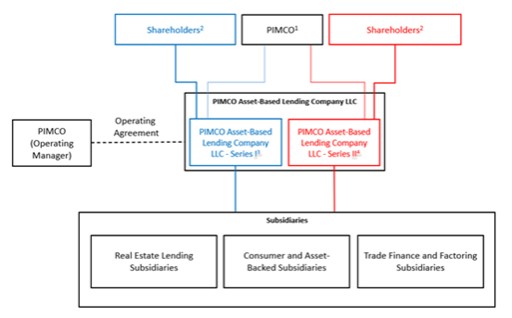
 

LOGO


1

As of the date hereof, PIMCO GP LXXXII, LLC holds all of 80 V Shares, which are non-economic shares that have certain rights and privileges, including the exclusive right to appoint and remove directors of the Board. V Shares are held only by PIMCO GP LXXXII, LLC and/or its affiliates, and are not being offered to other investors.

2

Certain third-party investors in the private offering hold certain Class of Shares offered for anchor investors.

3

Series I has elected to be treated as a corporation for U.S. tax purposes.

4

Series II has elected to be treated as a partnership for U.S. tax purposes.


13


Table of Contents

The Board of Directors, Executive Officers and Acquisition Committee

Overall responsibility for the Company’s oversight rests with the Board. To the extent permitted by applicable law, the Board may delegate any of its rights, powers and authority to, among others, any committee of the Board, the officers of the Company or the Operating Manager. As of the date of this Annual Report, the Board consists of six members, three of whom are independent directors, as such term is defined in Section 303A.02 of the New York Stock Exchange Listed Company Manual. See “Item 5. Directors, Executive Officers and Corporate Governance.”

The Company’s executive officers or the Acquisition Committee (in each case, through a delegation of authority from the Board) or, in certain cases, a committee of the Board, as applicable, are responsible for making capital allocation decisions proposed by the Operating Manager and overseeing the management of the Company.

Operating Agreement

The description below of the Operating Agreement is only a summary and is not necessarily complete. The description set forth below is qualified in its entirety by reference to the Operating Agreement which is filed as an exhibit to this Annual Report.

We have entered into the Operating Agreement pursuant to which the Operating Manager manages the Company on a day-to-day basis (subject to the directions of the Acquisition Committee and to the supervision of the Board). The Operating Manager provides certain management, administrative and advisory services to the Company related to funding, financing and/or structuring the Portfolio Assets (including the Asset-Backed Instruments); provided, however, that the Acquisition Committee (pursuant to a delegation of authority from the Board and, in certain instances, a committee of the Board, as applicable) is responsible for making capital allocation and acquisition decisions proposed by the Operating Manager.

Additionally, under the terms of the Operating Agreement, the Operating Manager is responsible for performing (or causing to be performed) such services and activities relating to the assets and operations of the Company, the Series and the Company’s subsidiaries (referred to in this section titled “Operating Agreement” as the “Subsidiaries”) as may be appropriate, including, without limitation;


originating and recommending opportunities to acquire Portfolio Assets, consistent with the business objectives and strategy of the Company, the Series and the Subsidiaries;


monitoring and evaluating the Company’s, the Series’ and the Subsidiaries’ Portfolio Assets;


analyzing and investigating potential dispositions of Portfolio Assets, including realization of the Company’s assets during a wind down and/or liquidation of the Company’s affairs, identification of potential acquirers and evaluations of offers made by such potential acquirers, but excluding dispositions in connection with securitizations;


structuring of acquisitions of Portfolio Assets;


establishing, acquiring or acting through special purpose vehicles or subsidiaries (including subsidiaries controlled by the Company or a Series) that do not involve securitizations;


identifying bank and institutional sources of financing for the Company, each Series and its Portfolio Assets, arrangement of appropriate introductions and marketing of financial proposals;


preparing, reviewing, executing and entering into, in each case on behalf of the Company or a Series, all agreements and other documents required in connection with the acquisition, disposition or financing of each Portfolio Asset, except those transactions relating to securitizations;


administering the day to day operations and performing and supervising the performance of such other administrative functions necessary to the management of the Company and the Subsidiaries as may be agreed upon by the Operating Manager and the Board, including, without limitation, the collection of revenues and the payment of the debts and obligations of the Company, the Series and the Subsidiaries and maintenance of appropriate computer services to perform such administrative functions, in each case, for which the Company shall reimburse the Operating Manager;


14


Table of Contents
   

monitoring the performance of Portfolio Assets and, where appropriate, providing advice regarding the management of Portfolio Assets, other than relating to securitizations;


arranging and coordinating the services (including research services) of other professionals and consultants, including PIMCO personnel;


making recommendations to the Company with respect to the Company’s repurchase offers;


originating, recommending opportunities to form, acquiring, structuring, coordinating and assisting with managing operations of any joint venture or Portfolio Assets held by the Company, the Series or the Subsidiaries and conducting all matters with the joint venture or other partners consistent with the business objectives and strategies of the Company (including, for the avoidance of doubt, the power to structure joint ventures that provide that any controlling interest of the Company will be forfeited upon termination of the Operating Agreement);


advising the Company, the Series and the Subsidiaries on, preparing, negotiating and entering into, on behalf of the Company, the Series or the Subsidiaries, applications and agreements relating to programs established by the U.S. government;


coordinating with the Dealer Manager to arrange marketing materials, advertising, industry group activities (such as conference participations and industry organization memberships) and other promotional efforts designed to promote the Company’s, the Series’ and the Subsidiaries’ business;


communicating on behalf of the Company and the Subsidiaries with, and servicing, the holders of any of their equity or debt securities, including as required to satisfy the reporting and other requirements of any governmental bodies or agencies or trading markets and to maintain effective relations with such holders;


counseling the Company in connection with policy decisions to be made by the Board;


evaluating and recommending to the Board hedging strategies and engaging in hedging activities on behalf of the Company, the Series and the Subsidiaries, consistent with such strategies as so modified from time to time;


counseling the Company and the Subsidiaries regarding the maintenance of their exclusion from the definition of an investment company under the Investment Company Act, monitoring compliance with the requirements for maintaining such exclusion and using commercially reasonable efforts to cause them to maintain such exclusion from such status;


furnishing reports and statistical and economic research to the Company and the Subsidiaries regarding their activities and services performed for the Company, the Series and the Subsidiaries by the Operating Manager;


using information obtained by the Operating Manager in its capacity as operating manager of the Company to provide information to, or for the benefit of, the Shareholders, including without limitation reports on valuation, portfolio positions and portfolio risk profiles;


providing periodic reports with respect thereto to the Board, including comparative information with respect to such operating performance and budgeted or projected operating results;


investing and reinvesting any moneys and securities of the Company, the Series and the Subsidiaries (including investing in short term investments pending the acquisition of Asset-Backed Instruments, payment of fees, costs and expenses, or payments of dividends or distributions to Shareholders and members of the Company and the Subsidiaries), subject to the directions and supervision of the Board, and advising the Company and the Subsidiaries as to their capital structure and capital raising;


assisting the Company and the Subsidiaries in retaining qualified accountants and legal counsel, as applicable, to assist in developing appropriate accounting systems and procedures, internal controls and other compliance procedures and testing systems with respect to financial reporting obligations and to conduct quarterly compliance reviews with respect thereto;


assisting the Company and the Subsidiaries to qualify to do business in all applicable jurisdictions and to obtain and maintain all appropriate licenses;


15


Table of Contents
   

assisting the Company, the Series and the Subsidiaries in complying with all regulatory requirements applicable to them in respect of their business activities, including preparing or causing to be prepared all financial statements required under applicable regulations and contractual undertakings and all reports and documents, if any, required under the Exchange Act or the Securities Act;


assisting the Company, the Series and the Subsidiaries in taking all necessary action to enable them to make required tax filings and reports;


placing, or facilitating the placement of, all orders pursuant to the Operating Manager’s acquisition determinations for the Company, the Series and the Subsidiaries either directly with the issuer or with a broker or dealer (including any affiliated broker or dealer);


handling and resolving all claims, disputes or controversies (including all litigation, arbitration, settlement or other proceedings or negotiations) on the Company’s, the Series’ and/or the Subsidiaries’ behalf in which the Company, the Series and/or the Subsidiaries or their respective Portfolio Assets, may be involved or to which they may be subject arising out of their day to day operations (other than with the Operating Manager or its affiliates), subject to such limitations or parameters as may be imposed from time to time by the Board;


using commercially reasonable efforts to cause expenses incurred by the Company, the Series and the Subsidiaries or on their behalf to be commercially reasonable or commercially customary and within any budgeted parameters or expense guidelines set by the Board from time to time;


advising the Company, the Series and the Subsidiaries with respect to and structuring long term financing vehicles for the Portfolio Assets that do not involve securitizations;


serving as the Company’s, the Series’ and the Subsidiaries’ consultant with respect to decisions regarding any of their financings, hedging activities or borrowings undertaken by the Company, the Series and the Subsidiaries other than those involving securitizations;


pursuant to delegation from the Board, determining, maintaining, monitoring and evaluating valuations with respect to the Portfolio Assets of the Company and the Series in accordance with the Pricing Policies adopted by the Company (as such is amended, updated and modified from time to time);


maintaining, monitoring and evaluating the Information Security Program Policy, Privacy Policy and Policy for Handling Client Information, each adopted by the Company;


providing the Company, the Series and the Subsidiaries with such other services as the Board may, from time to time, appoint the Operating Manager to be responsible for and perform, consistent with the terms of the Operating Agreement;


using commercially reasonable efforts to cause the Company, the Series and the Subsidiaries to comply with all applicable laws; and


determining any requirement for Shareholders to provide information in accordance with the LLC Agreement or the principles thereof.

The Operating Manager’s services under the Operating Agreement are not exclusive, and the Operating Manager, or any affiliate thereof, is free to furnish similar services to other entities, and it intends to do so, so long as its services to the Company are not impaired. For the avoidance of doubt, the management, policies and operations of the Company and the Series shall be the ultimate responsibility of the Board acting pursuant to and in accordance with the LLC Agreement.

The term of the Operating Agreement will continue indefinitely unless terminated as described below. The Operating Agreement may be terminated upon the affirmative vote of all of our independent directors, based upon unsatisfactory performance by the Operating Manager that is materially detrimental to the Company generally, the Series and the Subsidiaries, taken as a whole. The Company will need to provide the Operating Manager 180 days’ written notice of any termination. The Company may also terminate the Operating Agreement “for cause,” as described in the Operating Agreement, subject to the terms thereof.

The Operating Manager may terminate the Operating Agreement if the Company becomes required to register as an investment company under the Investment Company Act, with such termination deemed to occur immediately prior to such event. The Operating Manager may also terminate the Operating Agreement by providing the Company with 180 days’ written notice. In addition, if the Company defaults in the performance or observance of any material term, condition or covenant contained in the Operating Agreement and the default continues for a period of 30 days after written notice to the Company requesting that the default be remedied within that period, the Operating Manager may terminate the Operating Agreement upon 60 days’ written notice.


16


Table of Contents

In addition, if the Operating Agreement is terminated, the Operating Agreement will obligate the Company to forfeit its voting securities or other controlling interest in any Asset-Backed Instrument, which would likely require the Company to register as an investment company under the Investment Company Act and adversely affect an investment in the Shares. The Operating Agreement requires the Company to redeem any E Shares and/or V Shares if the Operating Agreement is terminated, which could require the Company to liquidate Asset-Backed Instruments at unfavorable times or prices, which may adversely affect an investment in the Shares.

The Operating Agreement may not be terminated for any other reason, including if the Operating Manager experiences a change of control or due solely to the poor performance or under-performance of the Company’s operations or Asset-Backed Instruments, and the Operating Agreement continues in perpetuity, until terminated in accordance with its terms. Because the Operating Manager has a significant influence on the affairs of the Company, the Company may be unwilling to terminate the Operating Agreement, even in the case of a default. Even if the Operating Manager’s performance does not meet the expectations of Shareholders, and the Company is unable or unwilling to terminate the Operating Agreement, the Company is not entitled to terminate the Operating Agreement and the Company’s NAV per Share, which is computed separately for each Class of the Shares of each Series, could decline.

Compensation of the Operating Manager

The compensation of the Operating Manager is described below. While the components used to calculate the Management Fee and the Performance Fee apply with respect to each Series and are the same for each Series unless otherwise indicated, the Management Fee rate and/or Performance Fee rate may differ among Classes of Shares within the Series, as indicated below.


Management  

Fee  


Performance  

Fee  


Minimum  

Initial  
Purchase  
Amount  


Dealer  

Manager  

Fee  


Distribution  

and  
Servicing  
Fee  

Anchor I Shares

   0.50%     5.0%    

$10,000  

   3.5% of  
transaction  

price  

   N/A  

Anchor I-B Shares(a)

   0.50%     5.0%      0.85%  

Anchor II Shares

   0.75%     7.5%      N/A  

Anchor II-B Shares

   0.85%(c)  

Anchor III Shares

   0.50%(b)     5.0%      N/A  

Standard A Shares

   1.25%     12.5%      N/A  

Standard B Shares

   1.25%     12.5%      0.85%(c)  
 
(a) 

On February 26, 2026, the Board unanimously approved the creation and issuance of Anchor I-B Shares.

(b)

For the Anchor III Shares, the Operating Manager has agreed to waive 100% of the Management Fee for twelve (12)-months beginning July 14, 2025.

(c)

The Dealer Manager has waived the distribution and servicing fee effective from October 1, 2025 until such date as determined in its sole discretion. In addition, notwithstanding the ongoing waiver, on March 4, 2026, the Company and the Dealer Manager agreed to an increase in the distribution and servicing fees for Anchor II-B Shares and Standard B Shares from 0.75% to 0.85% per annum of the outstanding Anchor II-B Shares and Standard B Shares.


17


Table of Contents

Management Fee

So long as the Operating Agreement has not been terminated, we will continue to pay the Operating Manager a management fee (the “Management Fee”) monthly in arrears in an amount equal to (i) 1.25% per annum of the month-end NAV attributable to the Standard A Shares and Standard B Shares, (ii) 0.75% per annum of the month-end NAV attributable to Anchor II Shares and Anchor II-B Shares and (iii) 0.50% per annum of the month-end NAV attributable to the Anchor I Shares, Anchor I-B Shares and Anchor III Shares; provided that the Management Fee is reduced by any applicable Special Fees (as defined below); provided, however, that the Management Fee is not reduced for any Other Fees (as defined below). In calculating the Management Fee, the Company uses its NAV before giving effect to accruals for the Management Fee, the Performance Fee, combined annual distribution fees and shareholder servicing fees or distributions payable on its Shares. The Operating Manager or an affiliate may rebate, waive or reduce the Management Fee charged to certain Shareholders at the sole discretion of the Operating Manager or such affiliate. Any such rebate, waiver or reduction may be affected either by way of purchase of additional Shares by the Operating Manager or such affiliate for the Shareholder or by way of rebate to the relevant Shareholder’s account. The Management Fee may alternatively, in the discretion of the Operating Manager, be paid in whole or in part by the Company’s subsidiaries, in which case it shall result in a change in the cash or retained earnings of such subsidiaries.

“Special Fees” mean net consulting or monitoring fees, Portfolio Asset directors’ fees, closing fees and advisory services fees and similar fees, whether in cash or in kind, including options, warrants and other non-cash consideration paid to the Operating Manager or any of its affiliates or any employees of the foregoing in connection with actual or contemplated acquisitions of or investments in Portfolio Assets (in each case allocable to the Company).

The Operating Manager may, in its discretion and without further notice to or consent of any Shareholder, afford particular Shareholders more favorable terms with respect to the Management Fee, and such more favorable terms may be set forth in a side letter or other similar written agreement with such Shareholder.

Performance Fee

So long as the Operating Agreement has not been terminated, the Operating Manager will continue to be entitled to receive a performance fee (the “Performance Fee”), promptly following the end of each Reference Period (as defined below), equal to (i) 12.5% of the Total Return (as defined below) with respect to Standard A Shares and Standard B Shares, (ii) 7.5% of the Total Return with respect to Anchor II Shares and Anchor II-B Shares and (iii) 5.0% of the Total Return with respect to Anchor I Shares, Anchor I-B Shares and Anchor III Shares, in each case subject to a 5.0% annual Hurdle Amount and a High Water Mark with a 100% Catch-Up (each as defined below).

Specifically, the Operating Manager is entitled to receive, promptly following the end of each Reference Period, Performance Fees equal to:


First, if the Total Return with respect to Anchor I Shares, Anchor I-B Shares, Anchor II Shares, Anchor II-B Shares, Anchor III Shares, Standard A Shares and Standard B Shares for the applicable period exceeds the sum, with respect to such relevant type of Shares, of (i) the Hurdle Amount for that period and (ii) the Loss Carryforward Amount (as defined below) (any such excess, “Excess Profits”), 100% of such Excess Profits until the total amount allocated to the Operating Manager equals 12.5% (with respect to Standard A Shares or Standard B Shares), 7.5% (with respect to Anchor II Shares or Anchor II-B Shares) and 5.0% (with respect to Anchor I Shares, Anchor I-B Shares or Anchor III Shares) of the sum of (x) the Hurdle Amount with respect to such type of Shares for that period and (y) any amount allocated to the Operating Manager with respect to such type of Shares pursuant to this clause (any such amount, the “Catch-Up”); and


Second, to the extent there are remaining Excess Profits, (i) with respect to Standard A Shares or Standard B Shares, 12.5% of such remaining Excess Profits, (ii) with respect to Anchor II Shares or Anchor II-B Shares, 7.5% of such remaining Excess Profits and (iii) with respect to Anchor I Shares, Anchor I-B Shares or Anchor III Shares, 5.0% of such remaining Excess Profits.


18


Table of Contents

“Total Return” with respect to any Shares for any period since the end of the prior Reference Period shall equal the sum of:


all distributions accrued or paid (without duplication) on such Shares outstanding at the end of such period since the beginning of the then-current Reference Period; plus


the change in aggregate NAV of such Shares since the beginning of the Reference Period before giving effect to (x) changes resulting solely from the proceeds of issuances of additional Shares, (y) any fee/accrual to the Performance Fee and (z) applicable expenses for the servicing fee (including any payments made to the Company for payment of such expenses).

For the avoidance of doubt, the calculation of Total Return (i) includes any appreciation or depreciation in the NAV of any relevant Shares issued during the then-current Reference Period, (ii) excludes the proceeds from the initial issuance of such Shares, (iii) treats any withholding tax on distributions paid by or received by the Company generally or any Series as part of the distributions accrued or paid on Shares and (iv) excludes any taxes (whether paid, payable, accrued or otherwise) of any intermediate entities, and may be calculated without taking into account certain deferred tax liabilities of such intermediate entities, as determined in the good faith judgment of the Operating Manager.

“Hurdle Amount” for any period during a Reference Period means that amount that results in a 5.0% of annualized rate of return for such period on the NAV of the Investor Shares outstanding at the beginning of the then-current Reference Period and all Investor Shares (as defined below) issued since the beginning of the then-current Reference Period, calculated in accordance with recognized industry practices and taking into account the timing and amount of all distributions accrued or paid (without duplication) on all such Shares but excluding applicable expenses for the servicing fee. The ending NAV of Investor Shares used in calculating the annualized rate of return is calculated before giving effect to any allocation/accrual to the Performance Fees and applicable expenses for the servicing fee. For the avoidance of doubt, the calculation of the Hurdle Amount for any period excludes any Investor Shares repurchased during such period, which are subject to the Performance Fees upon repurchase. Except as described in the definition of “Loss Carryforward Amount” below, any amount by which the Total Return falls below the Hurdle Amount does not carry forward to subsequent periods. The Operating Manager or its affiliate, as applicable, is not obligated to return any portion of the Performance Fees paid due to the subsequent performance of the Company.

“Loss Carryforward Amount” was equal to zero as of December 31, 2025, and shall cumulatively increase by the absolute value(s) of any negative annual Total Returns and decrease by any positive annual Total Returns; provided, that the Loss Carryforward Amount shall at no time be less than zero; provided, further, that the calculation of the Loss Carryforward Amount excludes the Total Return related to any Shares repurchased during the applicable Reference Period, which Shares are subject to the Performance Fees upon repurchase as described above. For the avoidance of doubt, with respect to Shares repurchased during the applicable Reference Period, the Loss Carryforward Amount shall not include amounts that would have been attributable to such repurchased Shares had such Shares not been repurchased during the applicable Reference Period. The effect of the Loss Carryforward Amount is that the recoupment of past annual Total Return losses offsets the positive annual Total Return gain of the applicable Reference Period for purposes of the calculation of the Performance Fees. This is referred to as a “High Water Mark.”

“Reference Period” means each fiscal year commencing on January 1 and ending on December 31; provided, that the initial Reference Period shall be the period ending on December 31, 2025.

E Shares shall not be subject to the Performance Fee.

The Operating Manager may, in its discretion and without further notice to or consent of any Shareholder, afford particular Shareholders more favorable terms with respect to the Performance Fee, and such more favorable terms may be set forth in a side letter or other similar written agreement with such Shareholder.


19


Table of Contents

Other Fees

From time to time, the Operating Manager, certain vehicles or companies of the Operating Manager or PIMCO Clients or their affiliates (including Service Providers (as defined below) affiliated with PIMCO (including the Services Company (as defined below)) (collectively, “Affiliated Service Providers”)) will provide services to certain persons or entities, including the Company, the Series, and potential and existing Portfolio Assets (including with respect to the Company’s acquisition thereof). For example, an insurance company owned by a PIMCO Client and/or alternative investment vehicles could provide insurance products and services to the Company. Related fees payable by the Company, a Series or the Portfolio Assets, as applicable, are retained by, and for the benefit of, the Operating Manager and/or such affiliates and Affiliated Service Providers, and are not applied to reduce the Management Fee.

For the avoidance of doubt, a Portfolio Asset may, on such terms as such Portfolio Assets determines to be in its best interest, provide services to another Portfolio Assets or PIMCO Client (or receive services from another Portfolio Assets or PIMCO Client), and may pay or receive related compensation, without the approval of the Board or any investor of the Company. In certain cases, Affiliated Service Providers or personnel thereof will not be employees of the Operating Manager or its affiliates notwithstanding the fact that they will have attributes of “employees” of the Operating Manager or its affiliates (e.g., they may have dedicated offices at the Operating Manager or an affiliate thereof, use email addresses, telephone numbers and other contact information that are similar to those used by personnel of the Operating Manager or its affiliates, participate in general meetings and events for personnel of the Operating Manager or its affiliates, work on matters for the Operating Manager or its affiliates as their primary or sole business activity and/or be compensated on a weekly or monthly basis rather than on a project basis), and in other cases, such Affiliated Service Providers will be an employee of the Operating Manager or its affiliates with respect to certain activities, even though they are not considered Operating Manager employees, affiliates or personnel for purposes of certain provisions of this Registration Statement, the LLC Agreement and the Operating Agreement, including the portions thereof relating to expenses and fees (“Dual Service Providers”).

Dual Service Providers may have a variety of roles and titles with respect to their employment with the Operating Manager or its affiliates, and may include legal, paralegal, finance, tax, accounting, technology, compliance, valuation, operational and asset management professionals and employees, among others. Portfolio managers, analysts and other professionals of the Operating Manager or its affiliates may also serve as Dual Service Providers. The Operating Manager has formed PIMCO Aurora LLC, a subsidiary of the Operating Manager (the “Services Company”), to serve as a Service Provider in exchange for certain fees payable by the Company or the Portfolio Assets. Certain personnel of the Services Company are also employees of the Operating Manager or an indirect subsidiary thereof and these individuals will be providing services on behalf of both the entity that employs them and the Services Company. In the future, some individuals may be employed by and provide services exclusively on behalf of the Services Company, while others will continue to be dual personnel of the Services Company and the Operating Manager or an affiliate thereof. The Company may in the future use other Affiliated Service Providers.

“Other Fees” payable by the Company means:

(i) fees, costs and expenses that comprise or constitute Organizational and Offering Expenses or Operating Expenses (each as defined below);

(ii) salary, fees, expenses or other compensation of any nature paid by a Portfolio Asset to any individual (or to the Operating Manager or any of its affiliates with respect to such individual) who acts as an officer of, or in an active management role at, such Portfolio Asset (including industry executives, advisors, consultants (including operating consultants and sourcing consultants)), operating executives, subject matter experts or other persons acting in a similar capacity engaged or employed by PIMCO;

(iii) without limiting the foregoing items (i) and (ii), fees, costs or expenses paid to or in respect of PIMCO or any industry executives, advisors, consultants (including operating consultants and sourcing consultants), operating executives, subject matter experts or other persons acting in a similar capacity who provide services to the Company or its Portfolio Assets (including allocable overhead or other amounts or compensation of PIMCO, including all costs and expenses on account of compensation and benefits of its employees);


20


Table of Contents

(iv) payments, fees, costs, expenses and other liabilities, allocable overhead or other amounts or compensation (such as arranger, brokerage, placement, syndication, solicitation, underwriting, agency, origination, sourcing, group purchasing, structuring, collateral management, special purpose vehicle (including any special purpose vehicle of a Portfolio Asset), capital markets syndication and advisory fees (including underwriting and debt advisory fees) or subsidiary management or administration, operation, asset service, advisory, commitment, facility, float, insurance, reinsurance or other fees, discounts, retainers, spreads, commissions and concessions or other fees associated with the effectuation of any securities or financing transactions, but not merger and acquisition transaction advisory services fees related to the negotiation of the acquisition of a Portfolio Asset (including, for the avoidance of doubt, CLOs, CDOs, RMBSs (each as defined below), and other structures acquired by the Company) earned by or paid to (whether in cash or in kind) an Affiliated Service Provider, or another person with respect to services rendered by such Affiliated Service Provider or other person); provided that if such Affiliated Service Provider is engaged in the relevant activity or service on a for-profit basis, as determined by the Operating Manager in good faith, then, unless approved by the Board, the applicable fees paid to it for such services will be on terms as determined by the Operating Manager which the Operating Manager determines are not materially less favorable to the Company or the applicable Portfolio Asset than the fees that could be paid to a third party with commensurate skill, expertise or experience (to the extent applicable), in each case, as determined by the Operating Manager in good faith;

(v) amounts earned by or for the account of any PIMCO Client (directly or indirectly through an expense offset mechanism);

(vi) fees, costs and expenses for any and all services whatsoever (including merger and acquisition transaction advisory services fees related to the negotiation of the acquisition of an instrument) paid or otherwise borne by any Portfolio Asset or issuer of any securities or other financial instruments that constitute debt opportunities or opportunities with respect to which the Operating Manager does not exercise control with respect to the decision to engage the services giving rise to such fees, costs and expenses;

(vii) fees, costs and expenses or other amounts or compensation earned by any person or otherwise borne with respect to Portfolio Assets or transactions that are otherwise consented to or approved by a committee of the Board’s independent directors; it being understood that in connection with obtaining such consent or approval, the Operating Manager will furnish or make available to the Board all material information, then actually known and available to the Operating Manager, that the Operating Manager determines in good faith is reasonably necessary for the Board to provide such consent or approval on a reasonably informed basis;

(viii) any fees, costs or expenses paid to any Affiliated Service Provider, including where such fees, costs or expenses are structured as a performance fee;

(ix) fees, costs and expenses or other amounts or compensation (including management fees, operating expenses and performance fees) earned by any person or otherwise borne with respect to Portfolio Assets managed by the Operating Manager or any of its affiliates that are acquired by the Company in the secondary market; and

(x) any fees, costs or expenses determined by the Operating Manager in good faith to be similar in nature to any of the foregoing.

Fees paid to a Service Provider are determined in the Company’s commercially reasonable discretion in compliance with the LLC Agreement, taking into account the relevant facts and circumstances and consistent with the responsibilities of the Company and the Operating Manager. Any fees, costs, expenses and liabilities incurred through


21


Table of Contents

the use or engagement of Service Providers are, and will continue to be, borne (directly or indirectly) by the Company (regardless of whether the services rendered by the Service Providers benefit all or only some of the Shareholders) and will not offset fees payable to the Operating Manager, even though such amounts may be substantial. Compensation arrangements with Service Providers may be structured in various ways, including project-based fees, time-based (e.g., hourly, weekly or monthly) fees, asset-based fees, flat fees, fees calculated on a basis-point or percentage basis, origination fees, servicing fees, management promote, incentive fees and/or a profits or equity interest in a Portfolio Asset. Service Providers will not be required to provide services “at cost” and therefore are expected to earn a profit from providing services to the Company.

Any profit earned by Affiliated Service Providers (and, if applicable, indirectly, the Operating Manager, Allianz SE, their affiliates and/or their respective employees, consultants and other personnel) for services provided in respect of the Company is not expected to be shared with the Company or the Shareholders and will not offset fees payable to the Operating Manager.

“Service Providers” include consultants, advisors, transaction finders or sourcers, operating partners, loan and other servicers, loan and other originators, collateral managers, program managers, property and other asset managers, leasing agents, asset monitors and administrators (including copyright administrators), developers, development managers, project managers, investment bankers, brokers, accountants, valuation agents, waterfall agents, calculation agents, paying agents, transfer agents and intermediaries, billing and collection agents, trustees, master servicers, software providers, tax preparers and consultants, analytic service providers, data management and reporting providers, technology professionals, technology providers, investor subscription platform providers, transfer service providers, pricing/modeling service providers, insurance providers, legal counsel, appraisers, industry or sector experts, joint venture partners and development partners, regulatory and compliance service providers, contract employees, outside legal counsel and/or temporary employees (as well as secondees of any of the foregoing), other persons providing similar types of services, whether working onsite at PIMCO offices or offsite as well as Affiliated Service Providers. In addition, Service Providers may provide various technology platform services in connection with the Company’s ongoing operations, including in connection with the processing and completion of investor subscription materials, the administration and tracking of the Company’s obligations (such as investment limitations and/or side letter undertakings) and associated compliance efforts (including with respect to ongoing monitoring and/or notice obligations), and compliance matters relating to obligations of the Operating Manager and/or its affiliates under applicable law. Service Providers will provide services in respect of the Company, the Related Acquisition Vehicles, their parallel vehicles and/or Portfolio Assets.

Organizational and Offering Expenses

The Company has incurred organizational and offering expenses (the “Organizational and Offering Expenses”) in connection with the Company and Related Acquisition Vehicles, including legal, accounting, printing, distribution, mailing and filing fees and expenses, taxes, due diligence expenses of participating broker-dealers supported by detailed and itemized invoices, costs in connection with preparing sales materials, design, website and electronic database expenses, fees and expenses payable to State Street Bank and Trust Company (which serves as the Company’s custodian and transfer agent), or the then acting transfer agent, fees to attend retail seminars sponsored by participating broker-dealers and reimbursements for customary travel, lodging and meals and other similar fees, costs and expenses of the Company and Related Acquisition Vehicles (excluding upfront selling commissions, Dealer Manager Fees, the combined annual distribution fees and shareholder servicing fees).

Operating Expenses

Each Class of Shares pays or otherwise bears its proportionate portion of the payments, fees, costs, expenses and other liabilities (for the avoidance of doubt, including any applicable value-added tax) or obligations resulting from, related to, associated with, arising from or incurred in connection with the applicable Series and Class of Shares and, more generally, the Company’s and the Related Acquisition Vehicles’ operations (collectively, “Operating Expenses”), as such items are more fully described in the Operating Agreement.


22


Table of Contents

Reimbursement of Company Expenses Paid by the Operating Manager

Each Class of Shares pays or otherwise bears its proportionate portion of the payments, fees, costs, expenses and other liabilities incurred in connection with the applicable Series and Class of Shares and, more generally, the Company’s operations (including, without limitation, organizational, offering, distribution and operating expenses of the Company and Related Acquisition Vehicles (to the extent not paid by the applicable Related Acquisition Vehicles)).

The Operating Manager and its affiliates are entitled to reimbursement from the Company (or, if applicable, from a Series) for any Operating Expenses for Organizational and Offering Expenses paid or incurred by them on behalf of the Company.

The Company’s expenses incurred in connection with the offering of Shares to investors, whether borne by the Operating Manager or the Company, are capitalized and amortized over a 12-month period. The Company’s expenses in connection with the formation and organization of the Company are expensed as incurred.

Borrowings and Leverage

The Company may obtain one or more credit facilities in order to (i) make or leverage portfolio acquisitions, (ii) cover the Organizational and Offering Expenses and Operating Expenses (including Management Fees), (iii) to enable the Company, any special purchase vehicle, blocker entity, any alternative investment structure or any of their respective subsidiaries to issue or cause the issuance of letters of credit, or (iv) otherwise carry out the activities of the Company. There is no guarantee the Company will obtain any such credit facilities on favorable terms or at all. See “Item 1A. Risk FactorsRisks Related to Owning and Managing a Platform of Underlying Asset-Backed Instruments The Company may need to incur financial leverage to be able to achieve its business objectives. The Company cannot guarantee the availability of such financing. In addition, the Company may enter into an unsecured line of credit with PIMCO or one of its affiliates for such purposes. PIMCO or one of its affiliates may face conflicts of interest in connection with any borrowings or disputes under this unsecured line of credit.

The Company may borrow money from other PIMCO Clients or any affiliates or portfolio companies of PIMCO or any PIMCO Clients on an arm’s-length basis or on terms not materially less favorable than what could be obtained from an unaffiliated third party. See “Item 13. Certain Relationships and Related Transactions, and Director Independence—Potential Conflicts of Interest.

It is currently expected that the Company will not directly borrow funds (on a recourse basis to the Company) from any person to the extent that such borrowing would cause the aggregate amount of direct borrowings by the Company, on a recourse basis, to exceed two times the Company’s NAV, as measured at or around the time such indebtedness is incurred; provided that any such calculation will exclude any Excluded Obligations (as defined below) as well as any financing provided or guaranteed by or eligible to be guaranteed by the Federal Deposit Insurance Corporation (the “FDIC”), the Federal Reserve Bank, any other government agency, Freddie Mac or Fannie Mae, and, for the avoidance of doubt, will also exclude any debt instruments issued by (or financing provided to the Company (including warehouse financing) with intent to securitize the underlying assets) a securitization vehicle in which the Company holds some or all of the other interests (whether residual, equity or otherwise). “Excluded Obligations” means (a) any financings provided to Platform Acquisitions and/or Structured Instruments and (b) guarantees of obligations of any subsidiary. The Company may incur additional leverage from time to time, including, without limitation, for investment purposes or during periods when the Company is experiencing unusual market volatility or other unexpected conditions.


23


Table of Contents

Hedging

The Company, the Related Acquisition Vehicles and/or subsidiaries thereof employ hedging in support of financing techniques or that is designed to reduce the risks of adverse movements in interest rates, securities prices, commodities prices and currency exchange rates, as well as other risks. While such transactions may reduce certain risks, such transactions themselves may entail certain other risks, including counterparty default, convergence and other related risks. Thus, while the Company and/or its subsidiaries may benefit from the use of these hedging mechanisms, unanticipated changes in interest rates, securities prices, commodities prices or currency exchange rates or other events related to hedging activities could result in a poorer overall performance for the Company and/or its subsidiaries than had they not entered into such hedging transactions.

Certain non-United States domiciled Feeder Entities entered, or intend to enter, into currency hedging arrangements in order to mitigate currency fluctuations from negatively affecting the value of such Feeder Entities’ investment in the Company. In connection with such currency hedging arrangements, the Company is expected to provide guarantees, issue letters of credit and/or provide other credit support in support of such Feeder Entities’ obligations under any such currency hedging arrangements of such Feeder Entities to the extent necessary. While gains and losses on the currency hedging transactions undertaken in connection with, and the expenses of, a Feeder Entity’s currency hedging arrangements are expected to be allocated to the applicable Feeder Entity only, the Company as a whole may be liable for obligations in connection with currency hedging transactions undertaken by a specific Feeder Entity.

Distributions

Beginning February 2026, we started paying distributions to our Shareholders. We intend to pay regular monthly distributions to Shareholders of record. We intend to declare, accrue and pay distributions monthly. However, there can be no guarantee that we will pay monthly distributions consistently and at a specific rate, or at all. While we expect to declare and pay regular monthly distributions, and accordingly, we are subject to Delaware distribution rules with respect to limited liability companies, we do not intend to adopt a written distribution policy. The ultimate decision to declare distributions will be a case-by-case determination by the Board. If the Company decides to adopt a distribution policy, it will provide appropriate disclosure in advance. Due to tax considerations and other factors, the amount of the distributions ultimately received by each Shareholder may differ. The record date for distributions will be the last calendar day of the month immediately preceding the distribution. See “Item 1A. Risk Factors—Risks Related to the Company and an Investment in the Shares—The amount of any distributions the Company may pay is uncertain. The Company may not be able to sustain the payment of distributions.

Cash distributions to Shareholders will be automatically reinvested under the Company’s distribution reinvestment plan (the “DRIP”) in additional whole and fractional Shares attributable to the type of Shares that a Shareholder owns unless and until an election is made on behalf of such participating Shareholder to withdraw from the DRIP and receive distributions in cash. The number of Shares to be received when distributions are reinvested will be determined by dividing the amount of the distribution, net of any applicable withholding taxes, by the applicable NAV per share as of the end of the prior month. Shares will be distributed in proportion to the type of Shares held by the Shareholder under the DRIP. There will be no upfront commissions charged on Shares issued to a Shareholder under the DRIP.

Share Repurchases

We expect that the Company will conduct a quarterly Share Repurchase (each, a “Share Repurchase”) for up to 5.0% of the aggregate NAV (measured collectively across both Series) of our outstanding Shares at a price based on the NAV per Share as of the last calendar day of the calendar quarter prior to the commencement of the applicable Share Repurchase (the “Repurchase Plan”); provided that the Company may further limit the number of Shares subject to the quarterly repurchases of the Shares in accordance with the LLC Agreement and applicable securities law. The Company commenced its Share Repurchases beginning February 2026. In the event that the Company determines to repurchase some but not all of the Shares submitted for repurchase during any quarter, Shares submitted for repurchase during such quarter will be repurchased on a pro rata basis after the Company has repurchased all Shares for which repurchase has been requested due to death, disability, divorce, dissolution, bankruptcy, insolvency or adjudicated incompetence of the Shareholder and any minimum account repurchases made by the Company. All unsatisfied repurchase requests must be resubmitted in a later quarter.


24


Table of Contents

Under the Repurchase Plan, the Company may choose to, or choose not to, conduct repurchases for any particular quarter. To the extent the Company chooses to repurchase Shares in any particular quarter, the Company will only repurchase Shares during the repurchase window, which the Company expects (but does not guarantee and may change in its sole discretion) will open at least ten (10) business days before the publishing of the prior-quarter NAV during each quarter, and remain open until the later of (a) twenty (20) business days in total have elapsed since the opening of the repurchase window or (b) ten (10) business days have elapsed following the date on which NAV per Share as to each type of Share is made publicly available. To have Shares repurchased, a Shareholder’s repurchase request and required documentation must be received by the Company’s transfer agent in good order by 4:00 p.m. (Eastern time) no later than the last business day of the repurchase window (such last business day, the “Repurchase Date”). Repurchase requests received in good order by the Repurchase Date and processed by the Company’s transfer agent will be effected at a repurchase price equal to the transaction price on the applicable Repurchase Date (which will generally be equal to the applicable NAV per Share as of the last calendar day of the prior quarter), except that Anchor I Shares, Anchor I-B Shares, Anchor II Shares, Anchor II-B Shares and/or Anchor III Shares that have not been outstanding for at least 24 months after the date Investor Shares are first issued (the “Launch Date”) will be subject to the early repurchase fee (the “Early Repurchase Fee”) described below.

The Company expects settlements of Share repurchases to be made within three (3) to five (5) business days of the Repurchase Date. A Shareholder may withdraw its, his or her repurchase request by notifying the transfer agent directly or through the Shareholder’s financial intermediary. Repurchase requests must be cancelled (by notice to the Company) before 4:00 p.m. (Eastern time) on the applicable Repurchase Date. Certain broker-dealers require that their clients process repurchases through their broker-dealer, which may impact the time necessary to process such repurchase request, impose more restrictive deadlines than described under the Repurchase Plan, impact the timing of a Shareholder receiving repurchase proceeds and require different paperwork or process than described in the Repurchase Plan. Shareholders should contact their broker-dealer first if they want to request the repurchase of their Shares.

Due to differential fees (including accrued, but unpaid Performance Fees) and other factors, the NAV of each type of Shares will differ, but all NAV calculations are expected to be based on the joint underlying economic interests of the Company in the assets underlying its Portfolio Assets.

Since the commencement of operations, the Company received subscriptions of $26,835,125 from an affiliate of the Operating Manager (such investor, the “Seed Investor”) and, in return, issued Anchor II Shares of Series II, to assist the Company with initial operational and acquisition activities. In connection with the Seed Investor’s investment, the Company and the Seed Investor entered into a letter agreement pursuant to which in the event the Seed Investor’s aggregate economic interests in the Company equal or exceed seventeen percent (17%) of the total outstanding economic interest of the Company (the “Ownership Limitation”) on the last business day of the second month of any calendar quarter, the Company agreed that it shall, effective prior to the last business day of the applicable calendar quarter, repurchase Shares from the Seed Investor or its affiliates, without penalty, to the extent necessary such that their aggregate economic interests in the Company shall no longer equal or exceed the Ownership Limitation after giving effect to such Share repurchases. Such repurchases will not be subject to or counted towards the quarterly repurchase cap of 5.0% of the aggregate NAV (measured collectively across both Series) of the outstanding Shares.

Early Repurchase Fee

Until the 2nd anniversary of the Launch Date, the Anchor I Shares, the Anchor I-B Shares, the Anchor II Shares, the Anchor II-B Shares and the Anchor III Shares requested to be repurchased shall be subject to an Early Repurchase Fee of 5.0% of the NAV of such Anchor I Shares, Anchor I-B Shares, Anchor II Shares, Anchor II-B Shares and Anchor III Shares repurchased.

Mandatory Repurchases

Subject to the LLC Agreement, the Board may cause the Company or a Series to repurchase from time to time all or some of the Shares of a Shareholder without the consent or action by such Shareholder or any other person, on 5 days’ prior written notice, if the Board determines that:


any Shareholder does not meet any investor eligibility requirements established by the Company or the applicable Series from time to time;


ownership of Shares by a Shareholder or other person is likely to cause the Company or a Series to be in violation of, or require registration of the Shares under, or subject the Company or a Series to additional registration or regulation under, the securities, commodities, or other laws of the United States or any other jurisdiction in the world, including without limitation the Investment Company Act of 1940, as amended (the “Investment Company Act”);


25


Table of Contents
   

continued ownership of the Shares by a Shareholder may be harmful or injurious to the business or reputation of the Company, a Series, the Operating Manager, or any of their affiliates, or may subject the Company, a Series or any Shareholder to an undue risk of adverse tax or other fiscal or regulatory consequences;


any Shareholder fails to maintain a minimum balance of $500 of its Shares; or


any other reasons provided in the LLC Agreement.

Employees

We have been carrying out, and expect to continue to carry out, our business plans pursuant to efforts of our officers and other personnel, which may be supplied by the Operating Manager, or may be directly hired by the Company or one or more of its subsidiaries, in addition to the services of the Operating Manager. To the extent that an officer or other personnel spend time on the Company or its subsidiaries, we expect such PIMCO personnel to devote sufficient time to managing the Company or its subsidiaries and/or overseeing, managing and supporting our Portfolio Assets, so that the Company can carry out its proposed activities. We currently have no employees and are managed by the Operating Manager pursuant to the Operating Agreement. Each of our officers is an employee of the Operating Manager or its affiliates. The Operating Manager’s team includes senior PIMCO professionals who have significant experience in underwriting and structuring Portfolio Assets as well as managing other investments and private funds. Through the Company’s relationship with the Operating Manager, the Company has access to PIMCO’s platform for sourcing and evaluating Portfolio Assets.

Emerging Growth Company

We are and will remain an “emerging growth company” as defined in the JOBS Act until the earlier of (a) the last day of the fiscal year (i) following the fifth anniversary of the date of first sale of common equity securities pursuant to an effective registration statement under the Securities Act, (ii) in which we have total annual gross revenue of at least $1.235 billion or (iii) in which we are deemed to be a large accelerated filer, which means the market value of our Shares that is held by non-affiliates exceeds $700 million as of the date of our most recently completed second fiscal quarter, and (b) the date on which we have issued more than $1.0 billion in non-convertible debt during the prior three-year period. For so long as we remain an “emerging growth company” we may take advantage of certain exemptions from various reporting requirements that are applicable to other public companies that are not “emerging growth companies” including, but not limited to, not being required to comply with the auditor attestation requirements of Section 404 of the Sarbanes-Oxley Act of 2002 (the “Sarbanes-Oxley Act”). We cannot predict if investors will find our Shares less attractive because we may rely on some or all of these exemptions.

In addition, Section 107 of the JOBS Act also provides that an “emerging growth company” can take advantage of the extended transition period provided in Section 7(a)(2)(B) of the Securities Act for complying with new or revised accounting standards. In other words, an “emerging growth company” can delay the adoption of certain accounting standards until those standards would otherwise apply to private companies. We will take advantage of the extended transition period for complying with new or revised accounting standards, which may make it more difficult for Shareholders and securities analysts to evaluate us since our financial statements may not be comparable to companies that comply with public company effective dates and may result in less investor confidence.

Private Offering of Shares

We intend to continue conducting a continuous private offering of our Shares to (i) “accredited investors” (as defined in Regulation D under the Securities Act) and (ii) in the case of Shares sold outside the United States, to persons that are not “U.S. persons” (as defined in Regulation S under the Securities Act) in reliance on exemptions from the registration requirements of the Securities Act (the “Private Offering”).


26


Table of Contents

Shares are offered on a monthly basis at NAV per Share (generally measured as of the end of the month immediately preceding the date of the allocation of Shares to subscribing Shareholders), plus any applicable upfront commissions and Dealer Manager Fees. The NAV per Share as of the date on which an investor makes a subscription request may be significantly different than the offering price such investor pays at the NAV per Share on the date of the allocation of Shares to such investor.

Shares are subject to different selling commissions, Dealer Manager Fees, servicing fees or distribution fees, as applicable, which will result in the dilution of Shares in proportion to the fees charged to different classes of Shares.

We may offer additional classes of Shares in the future.

In addition, we do not expect to make any public offering of any of our common equity, pursuant to the Securities Act or otherwise.

We expect investors to obtain Shares by subscription and obtain liquidity from the Company by having their Shares repurchased or redeemed by participating in the Repurchase Plan. In connection with each subscription or repurchase of Shares, a Shareholder will typically receive a number of Shares or cash, respectively, at a price that reflects the Company’s most recently calculated NAV (which generally will be the Company’s NAV as determined as of the last calendar day of the immediately preceding (i) calendar month for subscriptions and (ii) calendar quarter for repurchases).

The Company issues separate types of Shares for each of its two series: Series I and Series II. Each Series is a separate series under Delaware law and not a separate legal entity. Series I has elected to be treated as a corporation for U.S. tax purposes and Series II has elected to be treated as a partnership for U.S. tax purposes.

Feeder Entities

We have created, and may continue to create in the future, certain U.S. and non-U.S. partnerships or other entities that will serve as “feeder” entities (the “Feeder Entities”) or parallel entities, as well as other entities or structures through which investors will indirectly invest in or obtain exposure to the Company or some portion or all of its assets (collectively with Feeder Entities, “Related Acquisition Vehicles”).

Reporting Obligations

We make available on our websites our annual reports on Form 10-K, quarterly reports on Form 10-Q and current reports on Form 8-K and amendments to those reports filed or furnished pursuant to Section 13(a) or 15(d) of the Exchange Act as soon as reasonably practicable after electronically filing such material, or furnishing it, to the SEC. The SEC also maintains a website (https://www.sec.gov) that contains such reports, proxy and information statements and other information. The Company’s websites at https://pimco.com/palcoseriesi for Series I and https://pimco.com/palcoseriesii for Series II, contain additional information about our business, but the contents of the websites are not incorporated by reference in or otherwise a part of this Annual Report. From time to time, we may use our websites as a distribution channel for material company information. Financial and other important information regarding us is accessible through and posted on the Company’s websites at https://pimco.com/palcoseriesi or https://pimco.com/palcoseriesii, as applicable.

Certain United States Federal Income Tax Considerations

The following is a general discussion of certain U.S. federal income tax considerations that may be relevant to Shareholders based upon the U.S. Internal Revenue Code of 1986, as amended (the “Code”), U.S. Treasury regulations promulgated thereunder and the court decisions and administrative rulings and guidance related thereto, any of which could be changed at any time, possibly with retroactive effect. This discussion is necessarily general and is not intended to be applicable to all categories of Shareholders, some of which, including, without limitation, dealers in securities or currencies, financial institutions or financial services entities, mutual funds, life insurance companies, persons that hold Shares as part of a straddle, hedge, constructive sale or conversion transaction with other investments, U.S. Shareholders whose functional currency is not the U.S. dollar, persons who have


27


Table of Contents

elected mark-to-market accounting, persons who hold Shares through a partnership or other entity treated as a pass-through entity for U.S. federal income tax purposes, persons who are liable for the alternative minimum tax, and certain U.S. expatriates or former long-term residents of the United States and other Shareholders that do not hold their Shares as capital assets, may be subject to special rules. Tax-exempt organizations (including tax-exempt accounts) and non-U.S. investors are addressed separately below.

The Company formed separate Series pursuant to the LLC Act, each of which is intended to be treated as a separate entity for U.S. federal income tax purposes. Series I has elected to be treated as a corporation for U.S. federal income tax purposes and Series II has elected to be treated as a partnership for U.S. federal income tax purposes.

If a partnership is a Shareholder, the tax treatment of a partner in such partnership will generally depend upon the status of the partner and the activities of the partnership.

For purposes of this discussion, a “U.S. Person” is (i) an individual who is a citizen or resident of the United States, (ii) a corporation, partnership or other entity created or organized in the United States or under the laws of the United States, any state thereof or the District of Columbia, (iii) an estate the income of which is subject to U.S. federal income taxation regardless of its source or (iv) a trust that (a) is subject to the supervision of a court within the United States and the control of a U.S. person as described in Section 7701(a)(30) of the Code or (b) has a valid election in effect under applicable U.S. Treasury regulations to be treated as a U.S. Person. A “U.S. Series I Shareholder” is a Series I Shareholder that is a U.S. Person, and a “U.S. Series II Shareholder” is a Series II Shareholder that is a U.S. Person. A “Non-U.S. Series I Shareholder” is a Series I Shareholder that is not a U.S. Person and a “Non-U.S. Series II Shareholder” is a Series II Shareholder that is not a U.S. Person.

Unless otherwise expressly provided herein, this discussion does not address possible state, local or non-U.S. tax consequences of the purchase, ownership or disposition of Shares, some or all of which may be material to particular Shareholders. This discussion also does not address the potential application of the U.S. federal alternative minimum tax to the Shareholders.

Treatment of the Series as Separate Entities

We formed two separate Series pursuant to the LLC Act, and although the IRS has only issued proposed regulations relating to series entities, each Series is intended to be treated as a separate entity and have a different tax classification for U.S. federal income tax purposes. Under Delaware law, to the extent the records maintained for a Series account for the assets associated with such Series separately from the other assets of the Company or any other Series, the debts, liabilities, obligations and expenses incurred, contracted for or otherwise existing with respect to such Series are segregated and enforceable only against the assets of such Series and not against the assets of the Company generally or any other Series. Series I and Series II are expected to acquire, directly or indirectly, the same portfolio of Portfolio Assets on a pro rata basis. Series I has elected to be treated as a corporation for U.S. federal income tax purposes and Series II has elected to be treated as a partnership for U.S. federal income tax purposes. The state tax treatment of a series limited liability company depends on the laws of each state, and it is possible that a particular state may treat Series I and Series II as a single entity for state tax purposes or may treat Series I or Series II as separate entities but classified differently than the IRS does for U.S. federal income tax purposes. The Series conduct the business of the Company jointly and although they have the ability and intention to contract in their own names, they do so jointly and in coordination with one another. Neither Series has directors, officers or employees, but each is overseen by the Board and managed by the Operating Manager.

We intend to conduct our operations so that we are not required to register as an investment company under the Investment Company Act. See “Item 1A. Risk Factors—Risks Related to our Company and an Investment in our Shares—While we believe neither Series is or will be an investment company under the Investment Company Act, we cannot guarantee we will always be able to maintain our intended status under the Investment Company Act. We intend to conduct our operations so that neither Series I nor Series II would be defined as an investment company as that term is defined and used under the Investment Company Act.


28


Table of Contents

Series I:

Corporate Status of Series I

Series I has elected to be classified as a corporation for U.S. federal income tax purposes. As such, tax attributes are not expected to flow between Series I and the Series I Shareholders. Instead, all income of the corporation is expected to be subject to corporate income tax, which may result in the Series I Shareholders bearing a greater tax burden than Series II Shareholders. U.S. Series I Shareholders that are tax-exempt are not expected to be treated as incurring unrelated business taxable income (“UBTI”) unless such U.S. Series I Shareholder’s investment is financed with leverage, and Non-U.S. Series I Shareholders are not expected to be treated as incurring income effectively connected with a U.S. trade or business unless ownership of the Series I Shares is associated with such Non-U.S. Series I Shareholder’s trade or business within the United States or unless Series I is a “United States real property holding corporation” as discussed below.

Distributions to Series I Shareholders

In the event that we make a distribution of cash or other property (other than certain pro rata distributions of our Shares) in respect of our Series I Shares, the distribution generally will be treated as a dividend for United States federal income tax purposes to the extent it is paid from our current or accumulated earnings and profits, as determined under United States federal income tax principles. Any portion of a distribution that exceeds our current and accumulated earnings and profits generally will be treated first as a tax-free return of capital, causing a reduction in the adjusted tax basis of a Series I Shareholder, and to the extent the amount of the distribution exceeds a Series I Shareholder’s adjusted tax basis in our Shares, the excess will be treated as gain from the disposition of Series I Shares (the tax treatment of which is discussed below under “Series I—Gain on Disposition of Series I Shares”). Series I Shareholders that reinvest any distributions pursuant to the DRIP may have tax liabilities that exceed cash distributions made to such Series I Shareholders, in which case such excess tax liability arising from the ownership of Series I Shares would need to be satisfied from a Series I Shareholder’s own funds.

Dividends paid to a Non-U.S. Series I Shareholder generally will be subject to withholding of United States federal income tax at a 30% rate or such lower rate as may be specified by an applicable income tax treaty. However, dividends that are effectively connected with the conduct of a trade or business by the Non-U.S. Series I Shareholder within the United States (and, if required by an applicable income tax treaty, are attributable to a United States permanent establishment) are not subject to the withholding tax, provided certain certification and disclosure requirements are satisfied. Instead, such dividends are subject to United States federal income tax on a net income basis generally in the same manner as if the Non-U.S. Series I Shareholder were a United States person as defined under the Code. Any such effectively connected dividends received by a foreign corporation may be subject to an additional “branch profits tax” at a 30% rate or such lower rate as may be specified by an applicable income tax treaty.

A Non-U.S. Series I Shareholder who wishes to claim the benefit of an applicable treaty rate and avoid backup withholding, as discussed below, for dividends is required (a) to provide the applicable withholding agent with a properly executed IRS Form W-8BEN or IRS Form W-8BEN-E (or other applicable form) certifying under penalty of perjury that such Series I Shareholder is not a United States person as defined under the Code and is eligible for treaty benefits or (b) if Series I Shares are held through certain foreign intermediaries, to satisfy the relevant certification requirements of applicable United States Treasury regulations. Special certification and other requirements apply to certain Non-U.S. Series I Shareholders that are pass-through entities rather than corporations or individuals.

A Non-U.S. Series I Shareholder eligible for a reduced rate of United States federal withholding tax pursuant to an income tax treaty may obtain a refund of any excess amounts withheld by timely filing an appropriate claim for refund with the IRS.


29


Table of Contents

Gain on Disposition of Series I Shares

U.S. Series I Shareholders generally are subject to gain upon the sale or taxable disposition of Series I Shares in an amount equal to the excess of the amount realized over the Series I Shareholder’s adjusted basis in the Series I Shares, which gain would generally be characterized as capital gain. If the Series I Shares sold were held by the selling Series I Shareholder for more than one year, the gain on the sale would be long-term capital gain. Subject to the discussion of backup withholding below, any gain realized by a Non-U.S. Series I Shareholder on the sale or other disposition of Series I Shares generally will not be subject to United States federal income tax unless:


the gain is effectively connected with a trade or business of the Non-U.S. Series I Shareholder in the United States (and, if required by an applicable income tax treaty, is attributable to a United States permanent establishment of the Non-U.S. Series I Shareholder);


the Non-U.S. Series I Shareholder is an individual who is present in the United States for 183 days or more in the taxable year of that disposition, and certain other conditions are met; or


Series I is or has been a “United States real property holding corporation” for U.S. federal income tax purposes at any time during the previous five years while owned by the Non-U.S. Series I Shareholder and certain other conditions are met.

A Non-U.S. Series I Shareholder described in the first or third bullet points immediately above will be subject to tax on the gain derived from the sale or other disposition in the same manner as if the Non-U.S. Series I Shareholder were a United States person as defined under the Code. In addition, if any Non-U.S. Series I Shareholder described in the first bullet point immediately above is a foreign corporation, the gain realized by such Non-U.S. Series I Shareholder may be subject to an additional “branch profits tax” at a 30% rate or such lower rate as may be specified by an applicable income tax treaty. An individual Non-U.S. Series I Shareholder described in the second bullet point immediately above will be subject to a 30% (or such lower rate as may be specified by an applicable income tax treaty) tax on the gain derived from the sale or other disposition, which gain may be offset by United States source capital losses even though the individual is not considered a resident of the United States.

Generally, a corporation is a “United States real property holding corporation” if the fair market value of its United States real property interests equals or exceeds 50% of the sum of the fair market value of its worldwide real property interests and its other assets used or held for use in a trade or business (all as determined for United States federal income tax purposes). We have not determined whether Series I is a “United States real property holding corporation” for United States federal income tax purposes. We do not presently expect Series I to be treated as a United States real property holding corporation, but depending on the composition and character of its assets it is possible that it is or may become a United States real property holding corporation.

Information Reporting and Backup Withholding

Distributions paid to Series I Shareholders will generally be reported to the IRS. Distributions paid to a Non-U.S. Series I Shareholder and the amount of any tax withheld with respect to such distributions generally will be reported to the IRS. Copies of the information returns reporting such distributions and any withholding may also be made available to the tax authorities in the country in which the Non-U.S. Series I Shareholder resides under the provisions of an applicable income tax treaty.

A Non-U.S. Series I Shareholder will not be subject to backup withholding on distributions received if such Series I Shareholder certifies under penalty of perjury that it is a Non-U.S. Series I Shareholder (and the payor does not have actual knowledge or reason to know that such Series I Shareholder is a United States person as defined under the Code), or such Series I Shareholder otherwise establishes an exemption.

Information reporting and, depending on the circumstances, backup withholding will apply to the proceeds of a sale or other disposition of Series I Shares within the United States or conducted through certain United States-related financial intermediaries unless the beneficial owner certifies under penalty of perjury that it is a Non-U.S. Series I Shareholder (and the payor does not have actual knowledge or reason to know that the beneficial owner is a United States person as defined under the Code), or such owner otherwise establishes an exemption.


30


Table of Contents

Backup withholding is not an additional tax and any amounts withheld under the backup withholding rules will be allowed as a refund or a credit against a Non-U.S. Series I Shareholder’s United States federal income tax liability provided the required information is timely furnished to the IRS.

Foreign Account Tax Compliance

Under Sections 1471 through 1474 of the Code (such Sections commonly referred to as “FATCA”), a 30% United States federal withholding tax is imposed on any dividends paid on our Series I Shares to (i) a “foreign financial institution” (as specifically defined in the Code and whether such foreign financial institution is the beneficial owner or an intermediary) which does not provide sufficient documentation, typically on IRS Form W-8BEN-E, evidencing either (x) an exemption from FATCA, or (y) its compliance (or deemed compliance) with FATCA (which may alternatively be in the form of compliance with an intergovernmental agreement with the United States) in a manner which avoids withholding, or (ii) a “non-financial foreign entity” (as specifically defined in the Code and whether such non-financial foreign entity is the beneficial owner or an intermediary) which does not provide sufficient documentation, typically on IRS Form W-8BEN-E, evidencing either (x) an exemption from FATCA, or (y) adequate information regarding certain substantial United States beneficial owners of such entity (if any). If a dividend payment is both subject to withholding under FATCA and subject to the withholding tax discussed above under “Series I—Distributions to Series I Shareholders,” an applicable withholding agent may credit the withholding under FATCA against, and therefore reduce, such other withholding tax. While withholding under FATCA would also have applied to payments of gross proceeds from the sale or other taxable disposition of our Series I Shares, proposed United States Treasury regulations (upon which taxpayers may rely until final regulations are issued) eliminate FATCA withholding on payments of gross proceeds entirely. Series I Shareholders should consult their own tax advisors regarding these requirements and whether they may be relevant to the Shareholders’ ownership and disposition of Series I Shares.

Series II:

Partnership Status of Series II

Series II has elected and is expected to be treated as a partnership for U.S. federal income tax purposes. An entity that is treated as a partnership for U.S. federal income tax purposes, subject to the discussion below in “—Information Returns and Audit Procedures,” generally incurs no U.S. federal income tax liability. Instead, each partner is generally required to take into account its allocable share of items of income, gain, loss, deduction or credit of the partnership in computing its U.S. federal income tax liability, regardless of whether cash distributions are made. Distributions of cash by a partnership to a partner generally are not taxable unless the amount of cash distributed to a partner is in excess of the partner’s adjusted basis in its partnership interest.

An entity that would otherwise be classified as a partnership, such as Series II, for U.S. federal income tax purposes may nonetheless be taxable as a corporation if it is a “publicly traded partnership,” unless an exception applies. An exception, referred to as the “Qualifying Income Exception,” exists with respect to a publicly traded partnership if (i) at least 90% of such partnership’s gross income for every taxable year consists of “qualifying income” and (ii) the partnership would not be required to register under the Investment Company Act if it were a U.S. corporation. Qualifying income includes certain interest income, dividends, real property rents, gains from the sale or other disposition of real property and any gain from the sale or disposition of a capital asset or other property held for the production of income that otherwise constitutes qualifying income.

We intend to manage the affairs of Series II so that Series II will meet the Qualifying Income Exception in each taxable year. However, the portion of Series II’s income that is qualifying income may change from time to time, and there can be no assurance that at least 90% of its gross income in any year will constitute qualifying income. In the event that Series II does not meet the Qualifying Income Exception, there are other exceptions to the “publicly traded partnership” rules, including an exemption applicable to periodic redemptions, that may apply. Upon request, the Company counsel will provide an opinion, based on representations provided by Series II, that for U.S. federal income tax purposes (i) Series II will be treated as a partnership and not as an association taxable as a corporation and (ii) Series II will not be treated as a “publicly traded partnership” taxable as a corporation within the meaning of Section 7704 of the Code.


31


Table of Contents

No ruling has been or will be sought from the IRS, and the IRS has made no determination as to Series II’s status for U.S. federal income tax purposes or whether Series II’s operations meet the Qualifying Income Exception.

If Series II were to be recharacterized as a corporation for U.S. federal income tax purposes or were required to register under the Investment Company Act, it would be treated as if it had transferred all of its assets, subject to liabilities, to a newly formed corporation in return for stock in such corporation, and then distributed the stock to Series II Shareholders in liquidation. This deemed contribution and liquidation could result in the recognition of gain (but not loss) to U.S. Series II Shareholders. If, at the time of such deemed contribution, Series II were to have liabilities in excess of the tax basis of its assets, U.S. Series II Shareholders generally would recognize gain in respect of such excess liabilities upon the deemed transfer. Thereafter, Series II would be treated as a corporation for U.S. federal income tax purposes.

In addition, if Series II were treated as a corporation in any taxable year, its items of income, gain, loss, deduction or credit would be reflected only on Series II’s tax return, rather than being passed through to Series II Shareholders, and Series II would be subject to U.S. corporate income tax in a similar manner to Series I.

Based on the foregoing consequences, the treatment of Series II as a corporation could materially reduce a Series II Shareholder’s after-tax return and therefore could result in a substantial reduction of the value of our Series II Shares. The remainder of this summary assumes that Series II will be treated as a partnership for U.S. federal income tax purposes.

Investment Structure

Series II structures certain acquisitions through entities classified as corporations for U.S. federal income tax purposes. Such acquisitions will be structured as determined in the sole discretion of the Operating Manager generally to ensure that Series II is classified as a partnership and not a publicly traded partnership taxable as a corporation (as discussed above under “—Partnership Status of Series II”) and to provide simplified tax reporting for Series II Shareholders. Because Series II Shareholders are located in numerous taxing jurisdictions and subject to different tax rules, no assurance can be given that any such investment structure will benefit all Series II Shareholders to the same extent, including any structures or investments utilizing leverage. Any such investment structure may result in additional indirect tax liabilities for certain Series II Shareholders. As discussed below under “—Passive Foreign Investment Companies” and “—Controlled Foreign Corporations,” if any such entity were a non-U.S. corporation, it might be considered a PFIC or CFC (each as defined below). If any such entity were a U.S. corporation, it would be subject to U.S. federal net income tax on its income, including any gain recognized on the disposition of its investments. In addition, if an investment held through an entity classified as a corporation for U.S. federal income tax purposes were to involve U.S. real property, gain recognized on the disposition of the investment by a corporation generally would be subject to corporate-level tax, whether the corporation were a U.S. or a non-U.S. corporation.

Consequences to U.S. Series II Shareholders

Ownership of Series II Shares

Income and Loss. U.S. Series II Shareholders are required to take into account, as described below, their allocable share of Series II’s items of income, gain, loss, deduction and credit for each of Series II’s taxable years ending with or within such Series II Shareholder’s taxable year. Each item generally has the same character and source as though a Series II Shareholder had realized the item directly. Series II Shareholders must report such items without regard to whether any distribution has been or will be received from Series II. Series II intends to make cash distributions to all Series II Shareholders on a monthly basis. However, based upon each Series II Shareholder’s particular tax situation and depending upon whether they reinvest such distributions pursuant to the DRIP, their tax liability might exceed cash distributions made to Series II Shareholders, in which case such excess tax liabilities arising from the ownership of Series II Shares would need to be satisfied from a Series II Shareholder’s own funds.


32


Table of Contents

With respect to U.S. Series II Shareholders who are individuals, certain dividends paid by a corporation (including any “blocker” vehicle taxable as a corporation for U.S. federal income tax purposes and certain qualified foreign corporations) to Series II and that are allocable to such U.S. Series II Shareholders may qualify for reduced rates of taxation. A qualified foreign corporation includes a foreign corporation that is eligible for the benefits of specified income tax treaties with the United States with respect to its shares that are readily tradable on an established securities market in the United States. Among other exceptions, U.S. Series II Shareholders who are individuals will not be eligible for reduced rates of taxation on any dividends if the payer is a “passive foreign investment company” (a “PFIC”) for the taxable year in which such dividends are paid or for the preceding taxable year. Dividends received by non-corporate U.S. Series II Shareholders may be subject to an additional Medicare tax on unearned income of 3.8% (see “—Medicare Tax” below). U.S. Series II Shareholders that are corporations may be entitled to a “dividends received deduction” in respect of dividends paid by U.S. corporations in which Series II owns stock. Prospective Series II Shareholders should consult their own tax adviser regarding the application of the foregoing rules in light of their particular circumstances.

For U.S. federal income tax purposes, a Series II Shareholder’s allocable share of Series II’s items of income, gain, loss, deduction or credit is governed by the LLC Agreement if such allocations have “substantial economic effect” or are determined to be in accordance with such Series II Shareholder’s interest in Series II. Series II believes that, for U.S. federal income tax purposes, such allocations should be given effect, and Series II intends to prepare and file tax returns based on such allocations. If the IRS were to successfully challenge the allocations made pursuant to the LLC Agreement, then the resulting allocations for U.S. federal income tax purposes might be less favorable than the allocations set forth therein.

Basis. In general, Series II Shareholders will have an initial tax basis in their Series II Shares equal to the sum of (i) the amount of cash paid for Shares and (ii) their share of Series II’s liabilities, if any. That basis will be increased by such Series II Shareholder’s share of Series II’s income and by increases in their share of Series II’s liabilities, if any. That basis will be decreased, but not below zero, by distributions received from Series II, by their share of Series II’s losses and by any decrease in their share of Series II’s liabilities. Under applicable U.S. federal income tax rules, a partner in a partnership has a single, or “unitary,” tax basis in their partnership interest. As a result, any amount paid to acquire additional Series II Shares (including through the DRIP) will be averaged with the adjusted tax basis of Series II Shares owned by such Series II Shareholder prior to the acquisition of such additional Series II Shares.

Limits on Deductions for Losses and Expenses. A Series II Shareholder’s deduction of their allocable share of Series II’s losses will be limited to their tax basis in Series II Shares and, if such Series II Shareholder is an individual or a corporate holder that is subject to the “at risk” rules, to the amount for which such Series II Shareholder is considered to be “at risk” with respect to Series II’s activities, if that is less than their tax basis. In general, a Series II Shareholder will be at risk to the extent of their tax basis in our Series II Shares, reduced by (i) the portion of that basis attributable to their share of Series II’s liabilities for which they will not be personally liable (excluding certain qualified non-recourse financing) and (ii) any amount of money borrowed to acquire or hold Series II Shares, if the lender of those borrowed funds owns an interest in Series II, is related to the Series II Shareholder, or can look only to such Series II Shareholder’s Series II Shares for repayment. A Series II Shareholder’s at-risk amount generally will increase by their allocable share of Series II’s income and gain and decrease by cash distributions received from Series II and their allocable share of losses and deductions. Series II Shareholders must recapture losses deducted in previous years to the extent that distributions cause their at-risk amount to be less than zero at the end of any taxable year. Losses disallowed or recaptured as a result of these limitations will carry forward and will be allowable to the extent that their tax basis or at risk amount, whichever is the limiting factor, subsequently increases. Upon the taxable disposition of Series II Shares, any gain recognized can be offset by losses that were previously suspended by the at-risk limitation, but may not be offset by losses suspended by the basis limitation. Any excess loss above the gain previously suspended by the at-risk or basis limitations may no longer be used. An additional limitation may apply to the deduction of certain “excess business losses” by non-corporate U.S. Series II Shareholders. Shareholders should consult their own tax adviser regarding the limitations on the deductibility of losses under the Code.

Individuals and certain estates and trusts are not permitted to claim miscellaneous itemized deductions. Such miscellaneous itemized deductions may include the operating expenses of Series II, including Series II’s allocable share of the Management Fee.

Limitations on Deductibility of Organizational and Offering Expenses and Syndication Fees. In general, neither Series II nor any U.S. Series II Shareholder may deduct organizational or syndication expenses. Syndication fees (which would include any sales or placement fees or commissions) must be capitalized and cannot be amortized or otherwise deducted.


33


Table of Contents

Limitations on Interest Deductions. While it is not presently expected, if Series II were to incur debt, it is possible that such indebtedness could give rise to UBTI to the extent such indebtedness is used or deemed to be used to acquire investments. In addition, a Series II Shareholder’s pro rata share of Series II’s interest expense, if any, is likely to be treated as “investment interest” expense. For a non-corporate U.S. Series II Shareholder, the deductibility of “investment interest” expense generally is limited to the amount of such Series II Shareholder’s “net investment income.” Net investment income includes gross income from property held for investment and amounts treated as portfolio income under the passive loss rules, less deductible expenses, other than interest, directly connected with the production of investment income, but generally does not include gains attributable to the disposition of property held for investment. A Series II Shareholder’s share of Series II’s dividends and interest income will be treated as investment income, although “qualified dividend income” subject to reduced rates of tax in the hands of an individual will only be treated as investment income if such individual elects to treat such dividends as ordinary income not subject to reduced rates of tax. In addition, state and local tax laws may disallow deductions for their share of Series II’s interest expense. Under Section 163(j) of the Code, additional limitations may apply to a corporate U.S. Series II Shareholder’s share of Series II’s interest expense, if any.

Treatment of Distributions to Series II Shareholders

Distributions of cash by Series II generally will not be taxable to Series II Shareholders to the extent of their adjusted tax basis (described above) in their Series II Shares. Any cash distributions in excess of a Series II Shareholder’s adjusted tax basis generally will be considered to be gain from the sale or exchange of Series II Shares (described below). Such gain generally will be treated as capital gain and will be long-term capital gain if the holding period for such Series II Shares exceeds one year. A reduction in a Series II Shareholder’s allocable share of liabilities, and certain distributions of marketable securities by Series II, if any, will be treated similar to cash distributions for U.S. federal income tax purposes. Series II Shareholders that elect to participate in the DRIP may have tax liabilities that exceed cash distributions made to Series II Shareholders, in which case any tax liabilities arising from the ownership of Series II Shares would need to be satisfied from a Series II Shareholder’s own funds.

Sale or Exchange/Redemption of Series II Shares

Series II Shareholders will recognize gain or loss on the redemption, sale or taxable exchange of Series II Shares equal to the difference, if any, between the amount realized and their tax basis in the Series II Shares sold or exchanged. The amount realized will be measured by the sum of the cash or the fair market value of other property received plus the Series II Shareholder’s share of Series II’s liabilities, if any.

Gain or loss recognized upon the sale or exchange of Series II Shares generally will be taxable as capital gain or loss and will be long-term capital gain or loss if the Series II Shares were held for more than one year as of the date of such sale or exchange. Assuming Series II or, following the finalization of proposed U.S. Treasury regulations discussed below in “—Passive Foreign Investment Companies,” a Series II Shareholder has not elected to treat its share of Series II’s purchase of any PFIC as a “qualified electing fund,” gain attributable to such purchase of a PFIC would be taxable in the manner described below in “—Passive Foreign Investment Companies.” In addition, certain gain attributable to our purchase of a “controlled foreign corporation” (“CFC”) may be characterized as ordinary income, and certain gain attributable to “unrealized receivables” or “inventory items” could be characterized as ordinary income rather than capital gain. For example, if Series II were to hold debt acquired at a market discount, accrued market discount on such debt would be treated as “unrealized receivables.” The deductibility of capital losses is subject to limitations.

Each U.S. Series II Shareholder who acquires Series II Shares at different times (including through the DRIP) and intends to sell all or a portion of the Series II Shares within a year of the most recent purchase should consult its own tax adviser regarding the application of certain “split holding period” rules to such sale and the treatment of any gain or loss as long-term or short-term capital gain or loss.


34


Table of Contents

Medicare Tax

U.S. Series II Shareholders that are individuals, estates or trusts may be required to pay a 3.8% Medicare tax on the lesser of (i) the excess of such U.S. Series II Shareholders’ “modified adjusted gross income” (or “adjusted gross income” in the case of estates and trusts) over certain thresholds and (ii) such U.S. Series II Shareholders’ “net investment income” (or “undistributed net investment income” in the case of estates and trusts). Net investment income generally includes a Shareholder’s allocable share of Series II’s income, as well as gain realized from a sale of Series II Shares. Special rules relating to the 3.8% Medicare tax may apply to dividends and gain, if any, derived by such U.S. Series II Shareholders with respect to Series II’s interest in a PFIC or CFC. See “—Passive Foreign Investment Companies” and “—Controlled Foreign Corporations” below. Prospective Series II Shareholders should consult their own tax adviser regarding the implications of the 3.8% Medicare tax for their ownership and disposition of Series II Shares.

Foreign Tax Credit Limitations

A U.S. Series II Shareholder may be entitled to a foreign tax credit with respect to their allocable share of creditable foreign taxes paid on Series II’s income and gains. Complex rules may, depending on such Series II Shareholder’s particular circumstances, limit the availability or use of foreign tax credits. In particular, a U.S. Series II Shareholder generally is not entitled to an indirect foreign tax credit with respect to non-U.S. taxes paid by an entity in which Series II invests that is treated as a foreign corporation for U.S. federal income tax purposes. Gain from the sale of Series II’s investments may be treated as U.S.-source gain. Consequently, Series II Shareholders may not be able to use the foreign tax credit arising from any foreign taxes imposed on such gain unless the credit can be applied (subject to applicable limitations) against U.S. tax due on other income treated as derived from foreign sources. Certain losses that Series II incurs may be treated as foreign-source losses, which could reduce the amount of foreign tax credits otherwise available.

Deduction for Qualified Business Income

U.S. taxpayers who have domestic “qualified business income” from a partnership generally are entitled to deduct the lesser of such qualified business income or 20% of taxable income. A U.S. Series II Shareholder’s allocable share of Series II’s income is not expected to be treated as qualified business income or as qualified publicly traded partnership income. While no assurances can be provided, a portion of U.S. Series II Shareholder’s allocable share of Series II’s income may include “qualified REIT dividends.”

Foreign Currency Gain or Loss

Because investments may be made and realized in currencies other than U.S. dollars or debt securities denominated in currencies other than U.S. dollars, U.S. Series II Shareholders may recognize a foreign currency gain or loss (ordinary, not capital) when payment is received with respect to such debt securities or when such Shareholder or Series II disposes of foreign currency or such debt securities.

Passive Foreign Investment Companies

U.S. Series II Shareholders may be subject to special rules applicable to indirect investments in foreign corporations, including an investment through Series II in a PFIC. A PFIC is defined as any foreign corporation with respect to which (after applying certain look-through rules) either (i) 75% or more of its gross income for a taxable year is “passive income” or (ii) 50% or more of its assets in any taxable year produce or are held for the production of “passive income.” There are no minimum stock ownership requirements for PFICs. Based on our organizational structure, we believe that Series II is likely to own an interest in a PFIC. If Series II Shareholders in Series II indirectly hold an interest in a foreign corporation for any taxable year during which the corporation is classified as a PFIC with respect to such Series II Shareholder, then the corporation will continue to be classified as a PFIC with respect to such Series II Shareholder for any subsequent taxable year during which such Series II Shareholder continue to hold an interest in the corporation, even if the corporation’s income or assets would not cause it to be a PFIC in such subsequent taxable year, unless an exception applies.


35


Table of Contents

Subject to certain elections described below, any gain on the disposition of stock of a PFIC owned by a Shareholder indirectly through Series II, as well as income realized on certain “excess distributions” by such PFIC, would be treated as though realized ratably over the shorter of a Series II Shareholder’s holding period of Series II Shares or Series II’s holding period for the PFIC. Such gain or income generally would be taxable as ordinary income, and dividends paid by the PFIC would not be eligible for the preferential tax rates for dividends paid to non-corporate U.S. Series II Shareholders. In addition, an interest charge would apply, based on the tax deemed deferred from prior years. To the extent reasonably practicable and administratively feasible, we may structure investments in foreign corporations to avoid holding a PFIC. However, no assurances can be given that we will be able to structure investments to avoid holding any investment through an entity treated as a PFIC.

If Series II or Series II Shareholders were to elect to treat their share of Series II’s interest in a PFIC as a “qualified electing fund” (“QEF Election”) for the first year they were treated as holding such interest, then in lieu of the tax consequences described in the paragraph immediately above, Series II Shareholders would be required to include in income each year a portion of the ordinary earnings and net capital gains of the PFIC, even if not distributed to Series II or to such Series II Shareholder. Series II expects that certain acquisitions will be PFICs and generally intends that Series II will make a QEF Election with respect to such acquisitions, to the extent applicable. Recently proposed U.S. Treasury regulations would require that U.S. Series II Shareholders, rather than Series II, make the QEF Election. These proposed regulations would generally apply prospectively to taxable years beginning on or after the date the proposed regulations are finalized, and any pre-existing QEF Election made by Series II prior to that date would continue for any U.S. Series II Shareholder that owns an interest in a PFIC through Series II on the date the proposed regulations are finalized. A QEF Election must be made by Series II Shareholders on an entity-by-entity basis. To make a QEF Election, Series II Shareholders must, among other things, (i) obtain a PFIC annual information statement and (ii) prepare and submit IRS Form 8621 with the Shareholders’ annual income tax return. To the extent reasonably practicable, we intend to timely provide Shareholders with information related to the PFIC status of each entity we are able to identify as a PFIC, including information necessary to make a QEF Election with respect to such entity. Any such election should be made for the first year Series II holds an interest in such entity or for the first year in which the Shareholder holds Series II Shares, if later.

Once Series II Shareholders have made a QEF Election for an entity, such election applies to any additional shares of interest in such entity acquired directly or indirectly, including through additional Series II Shares acquired after the QEF Election is made (such as Series II Shares acquired under the DRIP). If Series II Shareholders were to make a QEF Election after the first year that Shareholders were treated as holding an interest in a PFIC, the adverse tax consequences relating to PFIC stock would continue to apply with respect to the pre-QEF Election period, unless such Series II Shareholders were to make a “purging election.” The purging election would create a deemed sale of such previously held share of Series II’s interests in a PFIC. The gain recognized by the purging election would be subject to the special tax and interest charge rules, which treat the gain as an excess distribution, as described above. As a result of the purging election, Series II Shareholders would have a new basis and holding period in their share of Series II’s interests in the PFIC. U.S. Series II Shareholders should consult their own tax advisers as to the manner in which such direct inclusions could affect their allocable share of Series II’s income and their tax basis in the Series II Shares and the advisability of making a QEF Election or a purging election.

Treasury regulations under Section 1411 of the Code contain special rules for applying the 3.8% Medicare tax (as described above under “—Medicare Tax”) to U.S. persons owning an interest in a PFIC. Under the special rules, a non-corporate U.S. Series II Shareholder that is subject to a QEF Election with respect to Series II’s interest in a PFIC is permitted to make a special election to treat their share of the ordinary earnings and net capital gains of the PFIC as net investment income for purposes of the 3.8% Medicare tax (the “NIIT Election”). Series II generally intends to make a QEF Election on behalf of all Series II Shareholders, to the extent applicable.

In the case of a PFIC that is a publicly traded foreign company, and in lieu of making a QEF Election, an election may be made to “mark to market” the stock of such publicly traded foreign company on an annual basis. Pursuant to such an election, Series II Shareholders would include in each year as ordinary income the excess, if any, of the fair market value of such stock over its adjusted basis at the end of the taxable year. We do not expect that any


36


Table of Contents

of our existing or future investments will qualify as PFICs that are publicly traded, and therefore we do not expect that a mark-to-market election will be available for any such entity. Prospective Series II Shareholders should consult their own tax adviser regarding the availability of the mark-to-market election with respect to any PFIC in which they are treated as owning an interest through Series II.

Subject to certain exceptions, a U.S. person who directly or indirectly owns an interest in a PFIC generally is required to file an annual report with the IRS, and the failure to file such report could result in the imposition of penalties on such U.S. person and in the extension of the statute of limitations with respect to federal income tax returns filed by such U.S. person. The application of the PFIC rules to U.S. Series II Shareholders is uncertain in certain respects. Prospective Series II Shareholders should consult their own tax adviser regarding the application of the PFIC rules, including the foregoing filing requirements and the impact of a QEF Election, a NIIT Election under the Treasury Regulations under Section 1411 of the Code, or a mark-to-market election, as applicable, with respect to any PFIC in which they are treated as owning an interest through Series II.

Controlled Foreign Corporations

A non-U.S. entity will be treated as a CFC if it is treated as a corporation for U.S. federal income tax purposes and more than 50% of (i) the total combined voting power of all classes of stock of the non-U.S. entity entitled to vote or (ii) the total value of the stock of the non-U.S. entity is owned by U.S. Shareholders on any day during the taxable year of such non-U.S. entity. For this purpose, a “U.S. CFC Shareholder” with respect to a non-U.S. entity means a U.S. person (including a U.S. partnership) that owns (directly, indirectly or constructively) 10% or more of the total combined voting power of all classes of stock of the non-U.S. entity entitled to vote or 10% or more of the total value of shares of all classes of stock of the non-U.S. entity.

Because Series II is a U.S. partnership for U.S. federal income tax purposes and is expected to own an interest in a CFC, then a U.S. Series II Shareholder who meets the ownership tests described above may be required to include in income its allocable share of the CFC’s “Subpart F” income. Subpart F income generally includes dividends, interest, net gain from the sale or disposition of securities, non-actively managed rents and certain other generally passive types of income. The aggregate Subpart F income inclusions in any taxable year relating to a particular CFC are limited to such CFC’s current earnings and profits. Such inclusions will be treated as ordinary income (whether or not attributable to net capital gains). Thus, a U.S. Series II Shareholder may be required to report as ordinary income its allocable share of the CFC’s Subpart F income without corresponding receipts of cash and may not benefit from capital gain treatment with respect to the portion of any earnings attributable to net capital gains of the CFC. Under Treasury regulations, only U.S. Series II Shareholders that are U.S. CFC Shareholders would be required to include in income their allocable shares of a CFC’s Subpart F income. In addition, such U.S. Series II Shareholders that are U.S. CFC Shareholders would be subject to current U.S. federal income tax on the “net CFC tested income” of the CFC, regardless of cash distributions from the CFC.

A Series II Shareholder’s tax basis in their Series II Shares will be increased to reflect any required Subpart F income or net CFC tested income. Such income will be treated as income from sources within the United States, for certain foreign tax credit purposes, to the extent derived by the CFC from U.S. sources. Subpart F income will not be eligible for the reduced rate of tax applicable to certain dividends paid by qualified foreign corporations to individual U.S. persons. See above under “Series II—Consequences to U.S. Series II Shareholders—Ownership of Series II Shares—Income and Loss.” Amounts included as Subpart F income or net CFC tested income with respect to direct and indirect investments generally will not be taxable again when actually distributed by the CFC.

Whether or not any CFC has Subpart F income, any gain allocated to Series II Shareholders from our disposition of an equity interest in a CFC will be treated as dividend income (regardless of U.S. CFC Shareholder status) to the extent of their allocable share of the current and/or accumulated earnings and profits of the CFC. In this regard, earnings would not include any amounts previously taxed pursuant to the CFC rules. However, net losses (if any) of a CFC will not pass through to U.S. Series II Shareholders.

As described above under “—Passive Foreign Investment Companies,” Treasury regulations under Section 1411 of the Code contain special rules for applying the 3.8% Medicare tax to U.S. persons owning an interest in a PFIC. Similar rules apply to U.S. CFC Shareholders of a CFC. Prospective Series II Shareholders should consult their own tax adviser regarding the implications of these special rules.


37


Table of Contents

If a non-U.S. entity held by Series II is classified as both a CFC and a PFIC, then Series II Shareholders will be required to include amounts in income with respect to such non-U.S. entity either under the CFC rules described under this subheading, or under the PFIC rules described under “—Passive Foreign Investment Companies,” but not both. The interaction of these rules is complex, and prospective Series II Shareholders should consult their own tax adviser in this regard.

Based on our organizational structure, we believe that one or more of Series II’s investments in the future are likely to be classified as CFCs. We may in the future acquire certain assets or operating entities through one or more holding entities treated as corporations for U.S. federal income tax purposes, and such future holding entities or other companies may be treated as CFCs. A U.S. Series II Shareholder that is a U.S. CFC Shareholder based on the ownership tests described above may be required to include in income its allocable share of any CFC’s “Subpart F” income. The application of the CFC rules to U.S. Series II Shareholders is uncertain in certain respects. Prospective Series II Shareholders should consult their own tax adviser regarding the implications of the CFC rules for their ownership and disposition of Series II Shares.

REIT Subsidiaries

The following discussion summarizes certain U.S. federal income tax rules applicable REITs and certain U.S. federal income tax consequences to Shareholders with respect to investments held through one or more REIT Subsidiaries. Because of the complexity of the rules that apply to REITs, the discussion does not attempt to summarize all of the REIT rules that could potentially apply to REIT Subsidiaries, the Company, the Series and the Shareholders. Except as otherwise noted, the following discussion assumes that each REIT Subsidiary qualifies as a REIT for U.S. federal income tax purposes.

The REIT provisions of the Code apply to a domestic corporation, trust, or association (i) that is managed by one or more trustees or directors, (ii) the beneficial ownership of which is evidenced by transferable shares or by transferable certificates of beneficial interest, (iii) that properly elects to be taxed as a REIT, (iv) that is neither a financial institution nor an insurance company, (v) that uses a calendar year for U.S. federal income tax purposes, and (vi) that meets the additional requirements discussed below. Commencing with a REIT Subsidiary’s second taxable year, (i) the beneficial ownership of its stock must be held by 100 or more persons during at least 335 days of a 12-month taxable year (or during a proportionate part of a taxable year of less than 12 months) and (ii) at any time during the last half of each taxable year, no more than 50% in value of its stock may be owned, directly or indirectly, by or for five or fewer individuals, private foundations, trusts providing for the payment of supplemental unemployment compensation benefits, and/or portions of trusts permanently set aside or to be used exclusively for charitable purposes (the “5/50 Test”). A “qualified trust” described in Section 401(a) of the Code and exempt from tax under Section 501(a) of the Code generally is not treated as an individual but, rather, shares held by it are treated as owned proportionately by its beneficiaries. For purposes of the 5/50 Test, stock ownership is determined by applying certain constructive ownership rules that treat the Shareholders as owning their proportionate shares of the applicable Series investment in any REIT. It generally is expected that the overall ownership will be sufficiently diverse (and each REIT Subsidiary will be organized in a manner that is expected) to satisfy the 5/50 Test, and that the LLC Agreement of the Company and organizational documents of each REIT Subsidiary will include restrictions on transfers intended to preserve compliance with the 5/50 Test; however, no assurances can be provided. The Company may cause each REIT Subsidiary to issue a relatively small amount of equity directly to at least 100 persons to satisfy the 100 shareholder requirement for each REIT Subsidiary.

In order to maintain qualification as a REIT, a REIT must annually satisfy two gross income requirements. First, at least 75% of a REIT’s gross income for each taxable year generally must be derived, directly or indirectly, from investments of a passive investment character relating to real property or mortgages on real property or from certain types of temporary investments. Qualifying income, excluding gross income from certain dealer sales referred to as “prohibited transactions” (discussed below) and certain hedging and foreign currency transactions, for purposes of this 75% gross income test generally includes: (i) rents from real property, (ii) interest on debt secured by mortgages on real property or on interests in real property, (iii) dividends or other distributions on, and gain from the sale of, shares in other REITs, (iv) gain from the sale of real estate assets, (v) income and gain derived from foreclosure property, and (vi) income from certain types of temporary investments. Second, at least 95% of a REIT’s gross income for each taxable year generally must be derived from the real property investments described above, from other types of dividends and interest, and from gain from the sale or disposition of stock or securities that are not dealer property.


38


Table of Contents

While rents from real property qualify for purposes of the foregoing gross income tests, rents from real property do not include “related party rents.” Related party rents are rents received from any tenant if the REIT owns, directly or indirectly, in the case of a corporate tenant, 10% or more of such tenant’s stock (by vote or value) or, in the case of a non-corporate tenant, an interest of 10% or more in the assets or net profits of such tenant. Certain constructive attribution rules apply for purposes of measuring such ownership, including attribution rules which could potentially treat the Company and/or a REIT Subsidiary as owning an interest in a tenant actually owned by a Shareholder (and not actually owned by the Company or such REIT Subsidiary). The LLC Agreement of the Company and the organizational documents of each REIT Subsidiary require Shareholders to provide certain information relating to their actual and constructive ownership of certain tenants to the Operating Manager upon request and include restrictions on transfers, in each case intended to avoid the recognition of related party rents. While the Operating Manager intends to use reasonable efforts to monitor the composition of the Company and each REIT Subsidiary’s tenants in order to avoid the recognition of related party rents and exclusion of any otherwise qualifying rents from real property, no assurances can be provided that a REIT Subsidiary will not recognize related party rents.

At the close of each quarter of its taxable year, a REIT also must satisfy five tests relating to the nature of its assets. First, real estate assets, cash and cash items, and government securities must represent at least 75% of the value of a REIT’s total assets. Second, securities (other than investments included in the 75% asset class) cannot represent more than 25% of the value of a REIT’s total assets. Third, of the investments that are not included in the 75% asset class and that are not securities of such REIT’s taxable REIT subsidiaries, (i) the value of any one issuer’s securities owned by a REIT may not exceed 5% of the value of its total assets and (ii) such REIT may not own more than 10% by vote or (with certain exceptions) by value of any one issuer’s outstanding securities. Fourth, securities of taxable REIT subsidiaries cannot represent more than 25% of the value of a REIT’s total assets. Fifth, nonqualified publicly offered REIT debt instruments cannot represent more than 25% of the value of a REIT’s total assets.

Use of a REIT generally eliminates (or substantially minimizes) corporate-level U.S. federal income tax by permitting the REIT to deduct dividends paid to shareholders in calculating its taxable income. Moreover, in order to qualify as a REIT, a REIT generally must distribute dividends (other than capital gain dividends) to its shareholders in an annual amount at least equal to 90% of its “REIT taxable income” (determined without regard to the dividends paid deduction and by excluding any net capital gain). For these purposes, dividend distributions include actual distributions and cashless “consent dividends.” The Company intends to cause any REIT Subsidiary within its control to make actual distributions or consent dividends as necessary to eliminate (or substantially minimize) material U.S. federal income tax and to comply with the REIT requirements. In order for a distribution by a REIT Subsidiary to be deductible against taxable income and to be counted toward satisfaction of the REIT minimum distribution requirements, the distribution generally may not constitute a “preferential dividend.” A dividend is not preferential if it is pro rata among all outstanding shares of stock within a class and is in accordance with the preferences among different classes of stock as set forth in the organizational documents of the REIT. In certain situations, the IRS has taken the view that charging different management fee rates to different investors results in preferential dividends. Existing IRS precedents do not consider the application of this preferential dividend rule to a REIT that is a subsidiary of a partnership that charges different management fees and/or incentive distributions to investors in the partnership. A REIT Subsidiary that is deemed to have paid preferential dividends could have additional undistributed taxable income that is subject to corporate level tax, and it might be subject to certain penalties and excise taxes or, depending on the circumstances, such REIT Subsidiary could fail to qualify as a REIT. Under certain circumstances, a REIT Subsidiary may be able to rectify a failure to meet the distribution requirement for a year by paying “deficiency dividends” to shareholders in a later year, subject to an interest charge.

Net losses incurred by a REIT Subsidiary in any taxable year may not reduce the amounts of distributions in subsequent years that are treated as dividends (including capital gain dividends). As a result, Series II Shareholders may be taxable in respect of distributions from a REIT that exceed such Series II Shareholders economic gain. In such event, upon liquidation of the applicable REIT Subsidiary, Series II Shareholders may realize a capital loss, the use of which is subject to limitations.

A REIT Subsidiary’s qualification as a REIT for U.S. federal income tax purposes depends on whether it continues to meet the various requirements summarized above. Because of the complexity of such tests and the potential difficulties of complying with such tests, no assurance can be given that the actual results of a REIT Subsidiary’s operations would satisfy such requirements. In addition, because the relevant laws may change, compliance with one or more of the REIT requirements may become impossible or impracticable for the Company or


39


Table of Contents

any REIT Subsidiary. If a REIT Subsidiary fails to qualify for taxation as a REIT in any taxable year, it may be able to preserve its REIT status under certain savings provisions through the payment of certain penalty taxes (which may be substantial). If no relief provisions apply, a REIT Subsidiary generally would be subject to tax on its taxable income at regular corporate rates, would otherwise be treated as a regular taxable corporation and may be ineligible to elect REIT status again prior to the fifth taxable year following the first year in which it failed to qualify as a under the Code.

To the extent that a REIT Subsidiary does not distribute all of its net capital gain and REIT taxable income, it generally will be subject to tax on the undistributed amount at corporate tax rates and an additional 4% excise tax on certain undistributed amounts. Notwithstanding the foregoing, even if a REIT Subsidiary qualified for taxation as a REIT, it nonetheless could be subject to U.S. federal income tax in certain circumstances, including (without limitation) the following: (i) a REIT Subsidiary could be subject to tax at the highest corporate rate on certain income from “foreclosure property” acquired by reason of default on a lease or indebtedness held by such REIT Subsidiary; (ii) a REIT Subsidiary would be subject to a 100% U.S. federal income tax rate on net income from “prohibited transactions” (generally, certain sales or other dispositions of property (other than foreclosure property) held primarily for sale to customers in the ordinary course of business); and (iii) a REIT Subsidiary would be subject to a 100% tax on certain redetermined rents, redetermined deductions, redetermined service income and excess interest payments involving or attributable to a taxable REIT subsidiary of such REIT Subsidiary (generally arising if such REIT Subsidiary and a taxable REIT subsidiary enter into transactions with each other that are not arm’s length). As noted above, gains derived by a REIT from sales of property (other than foreclosure property) held primarily for sale to customers in the ordinary course of business are subject to the 100% tax on net income from such prohibited transactions. Under existing law, whether property is held as inventory or primarily for sale to customers in the ordinary course of a trade or business is a question of fact that depends on all the facts and circumstances surrounding the particular transaction. The Code provides a safe harbor pursuant to which sales of properties held for at least two years and meeting certain additional requirements will not be treated as prohibited transactions, but compliance with the safe harbor may not be practical. Given the absence of bright-line tests for determining when property is treated as held for sale and the potential difficulties in qualifying for the statutory safe harbor, the IRS may successfully contend that some or all of the sales made by any REIT Subsidiary are prohibited transactions and that gains from such sales are subject to the 100% tax.

Taxation of REIT Shareholders

Series II Shareholders will be allocated a portion of the income with respect to its indirect ownership of any REIT Subsidiary and will generally be taxed with respect to this allocated income in the same manner as if such Series II Shareholder held the REIT shares directly. For purposes of this discussion, Series I will generally be treated in the same manner as a Series II Shareholder with respect to a REIT Subsidiary.

Distributions made by a REIT to its taxable shareholders out of current or accumulated earnings and profits (and not designated as capital gain dividends) are generally taken into account by them as ordinary income and will not be eligible for the dividends-received deduction for corporations or the reduced capital gains rates that generally apply to distributions by non-REIT C corporations to certain non-corporate Series II Shareholders. Individual taxpayers may be allowed a 20% deduction for “qualified REIT dividends” (i.e., REIT ordinary dividends other than capital gain dividends and portions of REIT dividends designated as qualified dividend income eligible for capital gain tax rates). The overall deduction is limited to 20% of the sum of the taxpayer’s taxable income (less net capital gain) and certain cooperative dividends, subject to further limitations based on taxable income. Distributions that a REIT designates as capital gain dividends will be taxed as long-term capital gains (to the extent they do not exceed the REIT’s actual net capital gain for the taxable year) without regard to the period for which the shareholder has held its shares. However, corporate Series II Shareholders may be required to treat up to 20% of certain capital gain dividends as ordinary income. Distributions in excess of current and accumulated earnings and profits are generally not taxable to a shareholder to the extent that they do not exceed the shareholder’s adjusted basis in its shares, but rather will reduce such adjusted basis. To the extent that such distributions exceed the adjusted basis of a shareholder’s shares they will be included in income as long-term capital gain (or short-term capital gain if the shares have been held for one year or less), assuming the shares are a capital asset in the hands of the shareholder.


40


Table of Contents

A REIT is treated as making a distribution that can count toward meeting its annual distribution requirement if it declares a “consent dividend.” A consent dividend is a hypothetical distribution (as distinguished from an actual distribution) that is treated for U.S. federal income tax purposes as if it were distributed in money by the REIT to its shareholders on the last day of the REIT’s taxable year, received by its shareholders on that day, and immediately contributed by the shareholders as paid-in capital to the REIT on that day. Each Series II Shareholder’s distributive share of the amount of any consent dividend will be treated as a dividend to such person in accordance with the rules governing dividends discussed above. The Company currently intends for each REIT Subsidiary to make actual distributions, rather than consent dividends, to meet its REIT distribution requirements, but shareholders of the REIT may be required to accept consent dividends. Shareholders may not include in their income tax returns any net operating losses or capital losses of a REIT.

Assuming the shares were a capital asset in the hands of the shareholder, a shareholder’s gain on the sale of its shares in a REIT will be taxed at long-term or short-term capital gain rates, depending on how long the shares were held. However, in general, any loss upon a sale or exchange of shares by a shareholder that has held such shares for six months or less (after applying certain holding period rules), will be treated as a long-term capital loss to the extent of previous distributions from a REIT to the shareholder that were required to be treated by such shareholder as long-term capital gain. Subject to certain requirements, distributions by a REIT to U.S. taxable investors in liquidation of such REIT will be treated as gain (or loss) from the sale or exchange of shares in the REIT.

U.S. Withholding Taxes

Although each U.S. Series II Shareholder is required to provide an IRS Form W-9, we nevertheless may be unable to accurately or timely determine the tax status of Series II Shareholders for purposes of determining whether U.S. withholding applies to payments made by Series II to some or all Series II Shareholders. In such a case, payments made by Series II to U.S. Series II Shareholders might be subject to U.S. “backup” withholding at the applicable rate or other U.S. withholding taxes. Series II Shareholders would be able to treat as a credit their allocable share of any U.S. withholding taxes paid in the taxable year in which such withholding taxes were paid and, as a result, might be entitled to a refund of such taxes from the IRS. In the event Series II Shareholders redeem, transfer or otherwise dispose of some or all of their Series II Shares, special rules might apply for purposes of determining whether such Series II Shareholders or the transferees of such Series II Shares were subject to U.S. withholding taxes in respect of income allocable to, or distributions made on account of, such Series II Shares or entitled to refunds of any such taxes withheld.

Consequences to Tax-Exempt U.S. Series II Shareholders

It is not presently expected that the activities of the Company will give rise to UBTI allocable to U.S. tax-exempt organizations (including tax-exempt accounts). Notwithstanding the foregoing, income recognized by a U.S. tax-exempt organization (including a tax-exempt account) is exempt from U.S. federal income tax except to the extent of the organization’s UBTI. UBTI is defined generally as any gross income derived by a tax-exempt organization (including a tax-exempt account) from an unrelated trade or business that it regularly carries on, less the deductions directly connected with that trade or business. In addition, income arising from a partnership (or other entity treated as a partnership for U.S. federal income tax purposes) that holds operating assets or is otherwise engaged in a trade or business generally will constitute UBTI. Notwithstanding the foregoing, UBTI generally does not include any dividend income, interest income, certain other categories of passive income or capital gains realized by a tax-exempt organization (including a tax-exempt account), so long as such income is not “debt financed,” as discussed below. Series II believes that it should not be regarded as engaged in a trade or business, and anticipates that any operating assets held by Series II will be held through entities that are treated as corporations for U.S. federal income tax purposes.

The exclusion from UBTI does not apply to income from “debt-financed property,” which is treated as UBTI to the extent of the percentage of such income that the average acquisition indebtedness with respect to the property bears to the average tax basis of the property for the taxable year. If an entity treated as a flow-through for U.S. federal income tax purposes, such as Series II, incurs acquisition indebtedness, a tax-exempt partner in such flow-through entity (including one holding through a flow-through structure) will be deemed to have acquisition indebtedness equal to its allocable portion of such acquisition indebtedness. If any such indebtedness were used by Series II (or deemed to be used) to acquire property, such property generally would constitute debt-financed property, and any income from or gain from the disposition of such debt-financed property allocated to a tax-exempt organization (including a tax-exempt account) generally would constitute UBTI to such tax-exempt organization, subject to certain exceptions in


41


Table of Contents

cases where debt is paid off. In addition, even if such indebtedness were not used (or deemed to be used) by Series II to acquire property but were instead used to fund distributions to Series II Shareholders, if a tax-exempt organization (including a tax-exempt account) subject to taxation in the United States were to use such proceeds to make an investment outside Series II, the IRS might assert that such acquisition constitutes debt-financed property to such Series II Shareholder with the consequences noted above. It is not presently expected that Series II will incur indebtedness in a manner that generates UBTI attributable to debt-financed property.

Series II may (but is not required to) hold a portion of its investments through one or more REIT Subsidiaries. Dividends from a REIT Subsidiary will generally not be treated as UBTI to tax-exempt U.S. Series II Shareholders, even if the property held by the REIT Subsidiary is debt-financed, except to the extent of “acquisition indebtedness” with respect to the investment in the REIT Subsidiary. However, an investment in a “pension-held REIT” within the meaning of section 856(h)(3)(D) of the Code may give rise to UBTI.

Tax-exempt U.S. Series II Shareholders should consult their own tax advisers regarding the tax consequences of a purchase of Series II Shares.

Consequences to Non-U.S. Series II Shareholders

Series II may acquire the Portfolio Assets (other than the Portfolio Assets that are treated as corporations for U.S. federal income tax purposes) indirectly through entities that are treated as corporations for U.S. federal income tax purposes or REIT Subsidiaries (as discussed above under “—REIT Subsidiaries”), and as a result does not expect that any such acquisition will generate income treated as effectively connected with a U.S. trade or business (other than effectively connected income attributable to the sale of a United States real property interest). However, no assurance can be given that Series II Shareholders will not incur income treated as effectively connected with a U.S. trade or business. If, as anticipated, Series II is not treated as engaged in a U.S. trade or business or as deriving income which is treated as effectively connected with a U.S. trade or business, and provided that a Non-U.S. Series II Shareholder is not itself engaged in a U.S. trade or business, then such Non-U.S. Series II Shareholder generally will not be subject to U.S. tax return filing requirements solely as a result of owning Series II Shares and generally will not be subject to U.S. federal income tax on its allocable share of Series II’s interest and dividends from non-U.S. sources or gain from the sale or other disposition of securities or real property located outside of the United States.

However, there can be no assurance that the law will not change or that the IRS will not deem Series II to be engaged in a U.S. trade or business. If, contrary to our expectations, Series II is treated as engaged in a U.S. trade or business, then a Non-U.S. Series II Shareholder generally would be required to file a U.S. federal income tax return, even if no effectively connected income were allocable to it. If Series II were to have income treated as effectively connected with a U.S. trade or business, then a Non-U.S. Series II Shareholder would be required to report that income and would be subject to U.S. federal income tax at the regular graduated rates. In addition, Series II might be required to withhold U.S. federal income tax on such Non-U.S. Series II Shareholder’s distributive share of such income at the highest rate of income tax applicable to such Non-U.S. Series II Shareholder based on the status of such Non-U.S. Series II Shareholder. A corporate Non-U.S. Series II Shareholder might also be subject to branch profits tax at a rate of 30%, or at a lower treaty rate, if applicable. If, contrary to expectation, Series II were engaged in a U.S. trade or business, then gain or loss from the sale of Series II Shares by a Non-U.S. Series II Shareholder would be treated as effectively connected with such trade or business to the extent that such Non-U.S. Series II Shareholder would have had effectively connected gain or loss had Series II sold all of its assets at their fair market value as of the date of such sale. In such case, any such effectively connected gain generally would be taxable at the regular graduated U.S. federal income tax rates, and the amount realized from such sale generally would be subject to a 10% U.S. federal withholding tax.

Further, it is possible that Series II will recognize gain from the sale of a United States real property interest. Regardless of whether Series II’s activities constitute a trade or business giving rise to U.S. “effectively connected” income, under provisions added to the Code by the Foreign Investment in Real Property Tax Act of 1980 (“FIRPTA”), Non-U.S. Series II Shareholders (other than certain qualified foreign pension funds) are taxed on the gain derived from the dispositions of United States real property interests (including gain allocated to a Non-U.S. Series II Shareholder upon a sale of such property interests by Series II). A United States real property interest includes an interest in a United States real property holding corporation. Under FIRPTA, Non-U.S. Series II Shareholders treat gain or loss from dispositions of U.S. real property interests as if the gain or loss were “effectively connected” with a


42


Table of Contents

U.S. trade or business and, therefore, are required to pay U.S. taxes at regular U.S. rates on such gain or loss. As a result, Non-U.S. Series II Shareholders that receive income allocations from the sale of a United States real property interest (including distributions from a REIT Subsidiary to the extent attributable to the disposition by the REIT Subsidiary of a United States real property interest) may be required to file a United States federal income tax return and may be subject to United States federal income tax at regular U.S. rates on a sale, exchange or other disposition of such United States real property interest. Generally, with respect to gain attributable to Series II’s sale of a United States real property interest that is allocated to a Non-U.S. Series II Shareholder, Series II will be required to withhold at the highest rate of income tax applicable to each Non-U.S. Series II Shareholder based on the status of such Non-U.S. Series II Shareholder. Also, such gain may be subject to a 30% branch profits tax (as discussed above).

Upon a sale of a Non-U.S. Series II Shareholder’s Shares, if (i) 50% or more of Series II’s gross assets consist of U.S. real property interests and (ii) 90% or more of Series II’s gross assets consist of U.S. real property interests and cash or cash equivalents, a purchaser will be required to withhold tax pursuant to Section 1445 of the Code on the full amount of the purchase price. Regardless of whether Series II satisfies these requirements, gain attributable to its U.S. real property interests may be subject to U.S. federal income tax.

In general, even if Series II is not engaged in a U.S. trade or business, and assuming Series II Shareholders are not otherwise engaged in a U.S. trade or business, Non-U.S. Series II Shareholders will nonetheless be subject to a withholding tax of 30% on the gross amount of certain U.S.-source income which is not effectively connected with a U.S. trade or business. Income subjected to such a flat tax rate is income of a fixed or determinable annual or periodic nature, including dividends and certain interest income. Such withholding tax may be reduced or eliminated with respect to certain types of income under an applicable income tax treaty between the United States and a Series II Shareholder’s country of residence or under the “portfolio interest” rules or other provisions of the Code, provided that such Series II Shareholder provides proper certification as to their eligibility for such treatment. Notwithstanding the foregoing, and although each Non-U.S. Series II Shareholder is required to provide us with an IRS Form W-8, we nevertheless may be unable to accurately or timely determine the tax status of Series II Shareholders for purposes of establishing whether reduced rates of withholding apply to some or all Series II Shareholders. In such a case, a Series II Shareholder’s allocable share of distributions of U.S.-source dividend and interest income will be subject to U.S. withholding tax at a rate of 30%. Further, if such Series II Shareholder would not be subject to U.S. tax based on their tax status or otherwise were eligible for a reduced rate of U.S. withholding, such Series II Shareholder might need to take additional steps to receive a credit or refund of any excess withholding tax paid on their account, which could include the filing of a non-resident U.S. income tax return with the IRS. Among other limitations applicable to claiming treaty benefits, if a Series II Shareholder resides in a treaty jurisdiction which does not treat Series II as a pass-through entity, such Series II Shareholder might not be eligible to receive a refund or credit of excess U.S. withholding taxes paid on their account. In the event a Series II Shareholder elects to redeem, sell or exchange some or all of their Series II Shares, special rules may apply for purposes of determining whether such Series II Shareholder or the transferee of such Series II Shares are subject to U.S. withholding taxes in respect of income allocable to, or distributions made on account of, such Series II Shares or entitled to refunds of any such taxes withheld. See “Series II—Consequences to U.S. Series II Shareholders—Sale or Exchange/Redemption of Series II Shares.” Prospective Series II Shareholders should consult their own tax adviser regarding the treatment of U.S. withholding taxes.

Special rules may apply to any Non-U.S. Series II Shareholder (i) that has an office or fixed place of business in the United States; (ii) that is an individual present in the United States for 183 days or more in a taxable year, calculated taking into account a portion of the days such individual was present in the United States in the preceding two years; or (iii) that is (a) a former citizen or long-term resident of the United States, (b) a foreign insurance company that is treated as holding a partnership interest in Series II in connection with its U.S. business, (c) a PFIC, (d) a CFC or (e) a corporation that accumulates earnings to avoid U.S. federal income tax. Prospective Series II Shareholders should consult their own tax adviser regarding the application of these special rules.

Taxes in Other Jurisdictions

In addition to U.S. federal income tax consequences, a purchase of Series II Shares could subject Series II Shareholders to U.S. state and local taxes in the U.S. state or locality in which they are a resident for tax purposes. Series II Shareholders could also be subject to tax return filing obligations and income, franchise or other taxes, including withholding taxes, in non-U.S. jurisdictions in which Series II acquires investments. We will attempt, to the extent reasonably practicable, to structure our operations and acquisitions so as to avoid income tax filing


43


Table of Contents

obligations by U.S. Series II Shareholders in non-U.S. jurisdictions. However, there may be circumstances in which we are unable to do so. Income or gain from assets held by Series II may be subject to withholding or other taxes in jurisdictions outside the United States, except to the extent an income tax treaty applies. If Series II Shareholders wish to claim the benefit of an applicable income tax treaty, they might be required to submit information to tax authorities in such jurisdictions. Prospective Series II Shareholders should consult their own tax adviser regarding the U.S. state, local and non-U.S. tax consequences of a purchase of Series II Shares in Series II.

Information Returns and Audit Procedures

We have agreed to use commercially reasonable efforts to furnish Series II Shareholders U.S. tax information (including estimates of the taxable income or loss computed for U.S. tax purposes allocated to them within 90 calendar days of the end of the fiscal year). However, while delays are not expected, providing this U.S. tax information to Series II Shareholders could be subject to delay in the event of, among other reasons, evolving reporting and compliance requirements or other events. It is therefore expected that, in any taxable year, Series II Shareholders will need to apply for an extension of time to file the Shareholders’ tax returns. In preparing this U.S. tax information, we will use various accounting and reporting conventions, some of which have been mentioned in the previous discussion, to determine a Series II Shareholder’s share of income, gain, loss and deduction. The IRS may successfully contend that certain of these reporting conventions are impermissible, which could result in an adjustment to the Shareholders’ income or loss.

Series II may be audited by the IRS. Adjustments resulting from an IRS audit could require Series II Shareholders to adjust a prior year’s tax liability and result in an audit of their own tax return. Any audit of a Series II Shareholder’s tax return could result in adjustments not related to Series II’s tax returns, as well as those related to Series II’s tax returns. If the IRS makes an audit adjustment to our income tax returns, it may assess and collect any taxes (including penalties and interest) resulting from such audit adjustment directly from Series II instead of Series II Shareholders. We may be permitted to elect to have the Operating Manager and Series II Shareholders take such audit adjustment into account in accordance with their interests during the taxable year under audit. However, there can be no assurance that we will choose to make such election or that it will be available in all circumstances. If we do not make the election, and we pay taxes, penalties or interest as a result of an audit adjustment, then cash available for distribution to Series II Shareholders might be substantially reduced. As a result, current Series II Shareholders might bear some or all of the cost of the tax liability resulting from such audit adjustment, even if current Series II Shareholders did not own Series II Shares during the taxable year under audit.

Pursuant to the partnership audit rules, a “partnership representative” designated by Series II will have the sole authority to act on behalf of Series II in connection with any administrative or judicial review of Series II’s items of income, gain, loss, deduction or credit. In particular, the partnership representative will have the sole authority to bind both former and current Series II Shareholders and to make certain elections on behalf of Series II pursuant to the partnership audit rules. Prospective Series II Shareholders should consult their own tax adviser regarding the implications of the partnership audit rules for a purchase of Series II Shares.

Foreign Account Tax Compliance

Under Sections 1471 through 1474 of the Code (such Sections commonly referred to as “FATCA”), a 30% withholding tax is imposed on “withholdable payments” made to a “foreign financial institution” or a “non-financial foreign entity,” unless such financial institution or entity satisfies certain information reporting or other requirements. Withholdable payments include certain U.S.-source income, such as interest, dividends and other passive income. Proposed Treasury regulations eliminate the requirement to withhold tax under FATCA on gross proceeds from the sale or disposition of property that can produce U.S.-source interest or dividends. The IRS has announced that taxpayers are permitted to rely on the proposed regulations until final Treasury regulations are issued. We intend to comply with FATCA, so as to ensure that the 30% withholding tax does not apply to any withholdable payments received by the Company, or our assets. Nonetheless, the 30% withholding tax may also apply to such Series II Shareholder’s allocable share of distributions attributable to withholdable payments, unless they properly certify their FATCA status on IRS Form W-8 or IRS Form W-9 (as applicable) and satisfy any additional requirements under FATCA.


44


Table of Contents

In compliance with FATCA, information regarding certain Series II Shareholders’ ownership of Shares may be reported to the IRS or to a non-U.S. governmental authority. FATCA remains subject to modification by an applicable intergovernmental agreement between the United States and another country for cooperation to facilitate the implementation of FATCA, or by future Treasury regulations or guidance. Prospective Series II Shareholders should consult their own tax adviser regarding the consequences under FATCA of a purchase of Series II Shares.

Tax Shelter Regulations and Related Reporting Requirements

If Series II were to engage in a “reportable transaction,” we (and possibly Series II Shareholders) would be required to make a detailed disclosure of the transaction to the IRS in accordance with regulations governing tax shelters and other potentially tax-motivated transactions. A transaction may be a reportable transaction based upon any of several factors, including the fact that it is a type of tax avoidance transaction publicly identified by the IRS as a “listed transaction” or “transaction of interest,” or that it produces certain kinds of losses exceeding certain thresholds. Any purchase of Series II Shares may be considered a “reportable transaction” if, for example, Series II were to recognize certain significant losses in the future. In certain circumstances, a Series II Shareholder who disposes of an interest in a transaction resulting in the recognition by such holder of significant losses in excess of certain threshold amounts may be obligated to disclose its participation in such transaction. Certain of these rules are unclear, and the scope of reportable transactions can change retroactively. Therefore, it is possible that the rules may apply to transactions other than significant loss transactions.

Moreover, if Series II were to participate in a reportable transaction with a significant purpose to avoid or evade tax, or in any listed transaction, Series II Shareholders might be subject to significant accuracy-related penalties with a broad scope, for those persons otherwise entitled to deduct interest on federal tax deficiencies, non-deductibility of interest on any resulting tax liability, and in the case of a listed transaction, an extended statute of limitations. Series II does not intend to participate in any reportable transaction with a significant purpose to avoid or evade tax, nor does it intend to participate in any listed transactions. However, no assurance can be provided that the IRS will not assert that it has participated in such a transaction. Prospective Series II Shareholders should consult their own tax adviser concerning any possible disclosure obligation under the regulations governing tax shelters with respect to the disposition of Series II Shares.

Withholding and Backup Withholding

For each calendar year, Series II will report to the Shareholders and to the IRS the amount of distributions that we pay, and the amount of tax (if any) that we withhold on these distributions. The proper application to Series II of the rules for withholding under Sections 1441 through 1446 of the Code (applicable to certain dividends, interest and amounts treated as effectively connected with a U.S. trade or business, among other items) is unclear.

Under the backup withholding rules, Series II Shareholders may be subject to backup withholding tax with respect to distributions paid unless: (i) they are an exempt recipient and demonstrate this fact when required; or (ii) provide a taxpayer identification number, certify as to no loss of exemption from backup withholding tax, and otherwise comply with the applicable requirements of the backup withholding tax rules. A U.S. Series II Shareholder that is exempt should certify such status on a properly completed IRS Form W-9. A Non-U.S. Series II Shareholder may qualify as an exempt recipient by submitting a properly completed IRS Form W-8. Backup withholding is not an additional tax. The amount of any backup withholding from a payment to a Series II Shareholder will be allowed as a credit against their U.S. federal income tax liability and may entitle such Series II Shareholder to a refund from the IRS, provided they supply the required information to the IRS in a timely manner.

If Series II Shareholders do not timely provide Series II, or the applicable nominee, broker, clearing agent or other intermediary, with IRS Form W-9 or IRS Form W-8, as applicable, or such form is not properly completed, then Series II may become subject to U.S. backup withholding taxes in excess of what would have been imposed had Series II or the applicable intermediary received properly completed forms from all Series II Shareholders. For administrative reasons, and in order to maintain the fungibility of Shares, such excess U.S. backup withholding taxes, and if necessary similar items, may be treated by Series II as an expense that will be borne indirectly by all Shareholders on a pro rata basis (e.g., since it may be impractical for us to allocate any such excess withholding tax cost to the Series II Shareholders that failed to timely provide the proper U.S. tax forms).


45


Table of Contents

Information Reporting with Respect to Foreign Financial Assets

Under Treasury regulations, certain U.S. persons that own “specified foreign financial assets” with an aggregate fair market value exceeding either $50,000 on the last day of the taxable year or $75,000 at any time during the taxable year generally are required to file an information report with respect to such assets with their tax returns. Significant penalties may apply to persons who fail to comply with these rules. Specified foreign financial assets include not only financial accounts maintained in foreign financial institutions, but also, unless held in accounts maintained by a financial institution, any stock or security issued by a non-U.S. person, any financial instrument or contract held for investment that has an issuer or counterparty other than a U.S. person, and any interest in a foreign entity. The failure to report information required under the current regulations could result in substantial penalties and in the extension of the statute of limitations with respect to federal income tax returns filed by such Series II Shareholder. Prospective Series II Shareholders should consult their own tax adviser regarding the possible implications of these Treasury regulations for a purchase of Series II Shares.

Other Tax Matters

Taxable Year

The Company uses the calendar year as its taxable year for U.S. federal income tax purposes. Under certain circumstances which we currently believe are unlikely to apply, a taxable year other than the calendar year may be required for Series II.

New Legislation or Administrative Judicial Action

The U.S. federal income tax treatment of Shareholders depends, in some instances, on determinations of fact and interpretations of complex provisions of U.S. federal income tax law for which no clear precedent or authority may be available. Shareholders should be aware that the U.S. federal income tax rules are constantly under review (including currently) by the Congressional tax writing committees and other persons involved in the legislative process, the IRS, the U.S. Treasury Department and the courts, frequently resulting in revised interpretations of established concepts, statutory changes, revisions to regulations and other modifications and interpretations, any of which could adversely affect the value of Shares and be effective on a retroactive basis. For example, changes to the U.S. federal income tax laws and interpretations thereof could make it more difficult or impossible for Series II to be treated as a partnership that is not taxable as a corporation for U.S. federal income tax purposes, change the character or treatment of portions of the Company’s income, reduce the net amount of distributions available to Shareholders, or otherwise affect the tax considerations of owning Shares. Such changes could also affect or cause the Company to change the way it conducts its activities and adversely affect the value of Shares.

The foregoing discussion is not intended as a substitute for careful tax planning. The tax matters relating to the Company and Shareholders are complex and are subject to varying interpretations. Moreover, the effect of existing income tax laws, the meaning and impact of which is uncertain, and of proposed changes in income tax laws will vary with the particular circumstances of each Shareholder, and in reviewing this Annual Report these matters should be considered. Each Shareholder should consult its own tax adviser with respect to the U.S. federal, state, local and other tax consequences of any purchase of Shares.

Certain ERISA Considerations

The following is a summary of certain considerations associated with an investment in the Company by (i) “employee benefit plans” within the meaning of Section 3(3) of the U.S. Employee Retirement Income Security Act of 1974, as amended (“ERISA”) that are subject to Part 4 of Subtitle B of Title I of ERISA, (ii) plans, individual retirement accounts (“IRAs”) and other arrangements that are subject to Section 4975 of the Code or provisions under any other U.S. federal, state or local or non-U.S. or other laws or regulations that are similar to such provisions of ERISA or the Code (collectively, “Similar Laws”) and (iii) entities whose underlying assets are considered to include the assets of any of the foregoing described in clauses (i) and (ii) (each of the foregoing described in clauses (i), (ii) and (iii) referred to herein as a “Plan”).


46


Table of Contents

Fiduciary Duty of Investing Plans

ERISA and the Code impose certain duties on persons who are fiduciaries of a Plan which is a Benefit Plan Investor (as defined below) subject to Title I of ERISA or Section 4975 of the Code and prohibit certain transactions involving the assets of a Benefit Plan Investor and its fiduciaries or other interested parties. Under ERISA and the Code, any person who exercises any discretionary authority or control over the administration of a Benefit Plan Investor or the management or disposition of the assets of a Benefit Plan Investor, or who renders investment advice for a fee or other compensation to a Benefit Plan Investor, is generally considered to be a fiduciary of the Benefit Plan Investor.

In considering an investment in the Company of a portion of the assets of any Plan, a fiduciary should determine, particularly in light of the risks and lack of liquidity inherent in an investment in the Company, whether the investment is in accordance with the documents and instruments governing the Plan and the applicable provisions of ERISA, the Code or any Similar Law relating to a fiduciary’s duties to the Plan including the prudence, diversification, delegation of control and prohibited transaction provisions of ERISA, the Code and any other applicable Similar Laws.

Prohibited Transaction Issues

Section 406 of ERISA and Section 4975 of the Code prohibit Benefit Plan Investors from engaging in specified transactions involving plan assets with persons or entities who are “parties in interest,” within the meaning of ERISA, or “disqualified persons,” within the meaning of Section 4975 of the Code, unless an exemption is available. A party in interest or disqualified person who engaged in a non-exempt prohibited transaction may be subject to excise taxes and other penalties and liabilities under ERISA and the Code. In addition, the fiduciary of the Benefit Plan Investor that engaged in such a non-exempt prohibited transaction may be subject to penalties and liabilities under ERISA and the Code. The fiduciary of a Benefit Plan Investor that proposes to purchase or hold any Shares should consider, among other things, whether such purchase and holding may involve the sale or exchange of any property between a Benefit Plan Investor and a party in interest or disqualified person, or the transfer to, or use by or for the benefit of, a party in interest or disqualified person, of any “plan assets.” Depending on the satisfaction of certain conditions which may include the identity of the fiduciary of the Benefit Plan Investor making the decision to acquire or hold Shares on behalf of a Benefit Plan Investor, Prohibited Transaction Class Exemption (“PTCE”) 91-38 (relating to investments by bank collective investment funds), PTCE 84-14 (relating to transactions effected by a “qualified professional asset manager”), PTCE 95-60 (relating to investments by an insurance company general account), PTCE 96-23 (relating to transactions directed by an in-house asset manager) or PTCE 90-1 (relating to investments by insurance company pooled separate accounts) could provide an exemption from the prohibited transaction provisions of ERISA and Section 4975 of the Code. Each of the above-noted exemptions contains conditions and limitations on its application. It should be further noted that even if the conditions specific to one or more of these exemptions are satisfied, the scope of relief provided by these exemptions may not necessarily cover all acts involving the Shares that might be construed as prohibited transactions. Fiduciaries of Benefit Plan Investors considering acquiring and/or holding Shares in reliance on these or any other exemption should carefully review the exemption in consultation with its own legal advisors to assure it is applicable. There can be no assurance that all of the conditions of any such exemptions will be satisfied with respect to any particular transaction involving the Shares.

Plan Assets

Under ERISA and the regulations promulgated thereunder as modified by Section 3(42) of ERISA (the “Plan Asset Regulations”), when Benefit Plan Investor acquires an equity interest in an entity that is neither a “publicly-offered security” (within the meaning of the Plan Asset Regulations, as described below) nor a security issued by an investment company registered under the Investment Company Act, the Benefit Plan Investor’s assets include both the equity interest and an undivided interest in each of the underlying assets of the entity unless it is established either that less than 25% of the total value of each class of equity interest in the entity is held by Benefit Plan Investors (the “25% Test”) or that the entity is an “operating company” (each as defined in the Plan Asset Regulations). For purposes of the 25% Test, the assets of an entity will not be treated as “plan assets” if, immediately after the most recent acquisition of any equity interest in the entity, less than 25% of the total value of each class of equity interest in the entity is held by Benefit Plan Investors, excluding equity interests held by persons (other than Benefit Plan Investors) with discretionary authority or control over the assets of the entity or who provide investment advice for a fee


47


Table of Contents

(direct or indirect) with respect to such assets, and any affiliates thereof. The term “benefit plan investors” (“Benefit Plan Investors”) is generally defined to include “employee benefit plans” (within the meaning of Section 3(3) of ERISA) that are subject to Title I of ERISA, “plans” within the meaning of Section 4975 of the Code to which Section 4975 of the Code is applicable (including, without limitation, “Keogh” plans and IRAs), as well as any entity whose underlying assets include plan assets by reason of the investment in such entity by such an employee benefit plan or plan (e.g., an entity of which 25% or more of the total value of any class of equity interests is held by Benefit Plan Investors and which does not satisfy another exception under ERISA). The Company is not an investment company under the Investment Company Act. Thus, absent satisfaction of another exception under the Plan Asset Regulations, if 25% or more of the total value of any class of equity interests of the Company were held by Benefit Plan Investors, an undivided interest in each of the underlying assets of the Company would be deemed to be “plan assets” of any Benefit Plan Investor that invested in the Company.

Under the Plan Asset Regulations, a “publicly-offered security” is a security that is (a) “freely transferable,” (b) part of a class of securities that is “widely held” and (c) (i) sold to the Benefit Plan Investor as part of an offering of securities to the public pursuant to an effective registration under the Securities Act, and the class of securities to which such security is a part is registered under the Exchange Act within 120 days after the end of the fiscal year of the issuer during which the offering of such securities to the public has occurred, or (ii) is part of a class of securities that is registered under Section 12 of the Exchange Act.

To the extent any class of our Shares is not “publicly-offered” within the meaning of the Plan Asset Regulations, the Company intends to use reasonable efforts to satisfy another exception to the Plan Asset Regulations, including prohibiting investment from, Benefit Plan Investors in one or more classes of our Shares. However, there can be no assurance that, notwithstanding such efforts of the Operating Manager, the Company will satisfy the Plan Asset Regulations, or the underlying assets of the Company will not otherwise be deemed to include “plan assets” within the meaning of the ERISA.

Plan Asset Consequences

If the assets of the Company were deemed to be “plan assets” under ERISA, this would result, among other things, in (i) the application of the prudence and other fiduciary responsibility standards of ERISA to acquisitions made by the Company and (ii) the possibility that certain transactions in which the Company might seek to engage in could constitute “prohibited transactions” under ERISA and the Code. Fiduciaries of Benefit Plan Investors who decide to invest in the Company could, under certain circumstances, be liable for prohibited transactions or other violations as a result of their investment in the Company or as co-fiduciaries for actions taken by or on behalf of the Company. With respect to an IRA that invests in the Company, the occurrence of a prohibited transaction involving the individual who established the IRA, or his or her beneficiaries, would cause the IRA to lose its tax-exempt status.

The foregoing statements regarding the consequences under ERISA and the Code of an investment in the Company are based on the provisions of ERISA and the Code as currently in effect and the existing administrative and judicial interpretations thereunder. No assurance can be given that administrative, judicial or legislative changes that would make the foregoing statements incorrect or incomplete will not occur.

Reporting Obligations

Under ERISA’s general reporting and disclosure rules, certain Benefit Plan Investors subject to Title I of ERISA are required to file annual reports (Form 5500) with the DOL regarding their assets, liabilities and expenses. To facilitate compliance with these requirements it is noted that the descriptions contained in this Annual Report of fees and compensation, including the Management Fee and the Performance Fee payable to the Operating Manager, are intended to satisfy the disclosure requirements for “eligible indirect compensation” for which the alternative reporting option on Schedule C of Form 5500 may be available.

While Plans that are governmental plans, certain church plans and non-U.S. plans may not be subject to the fiduciary responsibility or prohibited transaction provisions of Title I of ERISA or Section 4975 of the Code, such Plans may nevertheless be subject to Similar Laws. Fiduciaries of any such Plans, in consultation with their advisors and legal counsel, should consider the impact of their respective laws and regulations on an investment in the Company and the considerations discussed above, if applicable.


48


Table of Contents

Important Notice for Plans

Each Plan proposing to invest in the Company will be deemed to make certain representations, including, but not limited to, that it is, and any fiduciaries responsible for the Plan’s investment are, professionally advised, aware of and understand the Company’s business objectives, policies and strategies and that the decision to invest plan assets in the Company was made with appropriate consideration of relevant investment factors with regard to the Plan and is consistent with the duties and responsibilities imposed upon fiduciaries with regard to their investment decisions under applicable law, including ERISA and applicable Similar Law. This Annual Report does not constitute an undertaking to provide impartial investment advice and it is not our intention to act in a fiduciary capacity with respect to any Plan. PIMCO, the Operating Manager and their respective affiliates (the “Relevant Entities”) have a financial interest in investors’ investment in the Shares on account of the fees and other compensation they expect to receive (as the case may be) from the Company and their other relationships with the Company as contemplated hereunder. Any such fees and compensation do not constitute fees or compensation rendered for the provision of investment advice to any Plan. Each Plan which acquires or holds any Shares will be deemed to represent and warrant that it is advised by a fiduciary that is (a) independent of the Relevant Entities; (b) capable of evaluating investment risks independently, both in general and with respect to particular transactions and investment strategies contemplated in this Annual Report; and (c) a fiduciary (under ERISA, Section 4975 of the Code or applicable Similar Law) with respect to the Plan’s investment in the Shares, who is responsible for exercising independent judgment in evaluating the Plan’s investment in the Shares and any related transactions.

The sale of Shares to a Plan is in no respect a representation by us or any other person associated with the offering of our Shares that such an investment meets all relevant legal requirements with respect to investments by Plans generally or any particular Plan, or that such an investment is appropriate for Plans generally or any particular Plan.

Each Benefit Plan Investor is advised to contact its own legal, financial advisor or other fiduciary unrelated to the relevant entities about whether an investment in our Shares, or any decision to continue to hold, transfer, vote or provide any consent with respect to any such Shares, may be appropriate for the Plan’s circumstances.

Item 1A. Risk Factors

An investment in the Company involves significant risks and other considerations and, therefore, should be undertaken only by prospective investors capable of evaluating and bearing such risks and other considerations. A Shareholder must have the ability to understand, the financial capacity and the willingness to accept, the extent of its exposure to the risks and lack of liquidity inherent in an investment in the Shares. Shareholders with any doubts as to the suitability of an investment in the Company should consult their professional advisors to assist them in conducting their own legal, tax, accounting and financial evaluation of the merits and risks of an investment in the Company in light of their own circumstances and financial condition. The Company cannot predict the performance of its Portfolio Assets and, accordingly, the Company is not suitable as the sole investment vehicle for a Shareholder. In addition, there will be occasions when the Operating Manager and its affiliates will encounter potential conflicts of interest in connection with the Company, as described below under “Item 13. Certain Relationships and Related Transactions, and Director Independence.” The following discussion enumerates certain risk factors that should be carefully evaluated before making a purchase of the Shares. This summary does not purport to be a complete discussion of all of the risks and other factors and considerations which relate to or might arise from investing in the Company or from the Company’s Portfolio Assets. As used herein, the term “Company” refers to PALCO and each Series thereof, as applicable. For the avoidance of doubt, the Company is a holding company operating through its subsidiaries, and risk factors that describe the Company’s assets mean assets held indirectly by the Company through such subsidiaries. For purposes of this “Item 1A. Risk Factors,” the term “Portfolio Asset” shall be deemed to include, at any time, then-current and potential Portfolio Assets, unless the context otherwise requires.


49


Table of Contents

Risks Related to the Company and an Investment in the Shares

The Company faces heightened risks because it is a recently formed entity with a limited operating history and record.

The Company is a recently formed entity. Accordingly, the Company has a limited performance history for a prospective shareholder to consider. The Company commenced its operations in July 2025 and, therefore, has limited operating history upon which prospective Shareholders can evaluate their performance. Prospective Shareholders should not construe, and should draw no conclusions from, the prior experience of the Operating Manager or the performance of any other investment entities associated with PIMCO, as providing any assurances regarding the performance of the Company.

The Company’s Portfolio Assets (including the Asset-Backed Instruments) may not achieve the Company’s business objectives or generate returns for Shareholders.

Shareholders rely on the ability of the Operating Manager to choose, acquire and dispose the Portfolio Assets, and there is no assurance that the Operating Manager will find attractive opportunities to meet the Company’s objectives or that the Company will be able to acquire and dispose the Portfolio Assets (including Asset-Backed Instrument) or other assets. The realizable value of a highly illiquid asset, at any given time, could be less than its intrinsic value. In addition, it is possible that certain Portfolio Assets held by the Company’s subsidiaries will require a substantial amount of time to liquidate. There can be no assurance that the Company will be able to generate returns for its Shareholders or that the returns will be commensurate with the risks of acquiring the type of companies and transactions described herein. There can be no assurance that any Shareholder will receive any distribution from the Company. The Company bears fees, costs and expenses incurred in developing, investigating, negotiating or structuring any acquisition of Portfolio Assets (including the Asset-Backed Instruments) in which the Company does not actually consummate (including any such fees, costs and expenses not borne by Co-Investors (as defined below)) and fees, costs and expenses associated with joint ventures or similar arrangements (“Joint Venture”) and portfolios of Asset-Backed Instruments which are part of the same acquisition strategy (“Programmatic Acquisition”).

In certain instances, the Company, through its subsidiaries, may acquire a Portfolio Asset (including an Asset-Backed Instrument) with the intent to subsequently sell or syndicate a portion of such Portfolio Asset to Co-Investors or other persons (including PIMCO or PIMCO Clients) prior to the closing of the acquisition of such Portfolio Asset. In such event, the Company will bear the risk that any or all of the excess portion of such Portfolio Asset will not be sold or will only be sold on unattractive terms and that, as a consequence, the Company will bear the entire portion of any fees, costs and expenses related to such Portfolio Asset, hold a larger than expected Portfolio Assets in the applicable asset class or could realize lower than expected returns from such Portfolio Assets (see also “—Additional Risks Related to the Operation of the Company GenerallyThe Company’s business may be affected by offering Co-Investments or opportunities to provide debt financing to any person” below). Any such sell down or syndication will not be deemed to be a cross trade or principal trade and, as such, will not require the approval of the Board, the Shareholders or any other person. Further, any “back-to-back” commitment or assignment of a commitment in connection with an acquisition similarly will not be deemed a cross trade or a principal trade. Accordingly, an investment in the Company should only be considered by prospective investors who do not require current income and can afford a loss of their entire investment.

The Company’s ability to achieve its business objectives depends on the Operating Manager because the Operating Manager has significant discretion as to the implementation of the Company’s objectives and policies.

The Company depends on the diligence, skill and business relationships of the employees of the Operating Manager. The Company is reliant on the Operating Manager. In particular, the Company’s performance will depend on the success of the Operating Manager’s acquisition and disposition of the Portfolio Assets. The Company depends on the Operating Manager’s assessment of appropriate economic terms when entering transactions to acquire or dispose the Portfolio Assets. Economic terms determined by the Operating Manager in respect of each acquisition will be based on the Operating Manager’s assessment of a variety of factors. Each of these factors involves subjective judgments and forward-looking determinations by the Operating Manager. In conducting such assessment, the Operating Manager expects to use publicly available information as well as private information, including from consultants and investment bankers. If the Operating Manager misprices an acquisition (for whatever reason) or due to unanticipated illiquidity, the actual returns on the acquisition could be less than anticipated at the time of acquisition or disposition and could result in a disposition at a price less than the acquisition price.


50


Table of Contents

In addition, the acquisition processes described herein are subject to change at any time without notice. There can be no assurance that (i) the acquisition processes identified herein will continue to be employed by the Company or the Operating Manager or (ii) members of the PALCO acquisition team identified herein will continue to be associated with or employed by PIMCO or any of its affiliates. Past performance of any PIMCO Client or acquisition utilizing any of the acquisition processes identified above is in no way indicative of future results.

The Company’s Shares are not registered under the Securities Act, so they are subject to heightened restrictions on transferability and resale.

The Shares are not registered under the Securities Act or the securities laws of any state or other jurisdiction and are being offered and sold in reliance on exemptions from the registration requirements of the Securities Act and such laws. It is not contemplated that the Shares will ever be registered under the Securities Act. The Shares are subject to restrictions on transferability and resale and may not be transferred or resold except as permitted under the Securities Act and other applicable securities laws. Shareholders’ Subscription Agreements and the LLC Agreement contain representations and impose restrictions on transferability designed to assure that the conditions of the exemptions from such registration requirements are met. Shareholders also may not be permitted to transfer all or any part of their Shares to a person which gives rise to CFIUS (as defined below) or national security considerations with respect to the Company, an existing or potential Portfolio Assets or any of their actual or potential underlying assets. See “—The Company could be subject to review and approval by CFIUS or other regulatory agencies resulting in limitations or restrictions on its acquisitions and Joint Ventures” below. Shareholders also may not be permitted to transfer all or any part of their Shares to a person that would require PALCO to register under the Investment Company Act.

There is no market for the Shares, and Shareholders bear the risks of owning Shares for an extended period of time due to limited repurchases.

The Shares have not been registered under the Securities Act, the securities laws of any state or the securities laws of any other jurisdiction and cannot be resold unless they are subsequently registered under the Securities Act and other applicable securities laws or an exemption from registration is available. There is no public market for the Shares and none is expected to develop. Accordingly, there are no quoted prices for the Shares. In addition, there are substantial restrictions upon the repurchase of Shares under the LLC Agreement and applicable securities laws, including that the Company may limit the number of Shares subject to Share Repurchases or may decide to not conduct Share Repurchases for certain periods. Consequently, Shareholders must be prepared to bear the risks of owning Shares for an extended period of time. See “Item 1. Business—Share Repurchases.”

Shareholders have limited liquidity and may be limited in their opportunity to have their Shares repurchased and may not receive a full return of their invested capital if they elect to have their Shares repurchased by the Company.

A purchase of the Company’s Shares requires a long-term commitment, with no certainty of return and should be viewed as an illiquid investment. Certain Portfolio Assets may be held for the long term. Since there is no established market for the Shares, and none is expected to develop, a Shareholder of the Company will be unable to sell or otherwise dispose its Portfolio Assets readily and may encounter difficulty ascertaining the market value of its Shares. Shares in the Company are subject to restrictions on resales under applicable securities laws. Repurchases of Shares by the Company will likely be the only way for a Shareholder to dispose of Shares. It is uncertain as to when profits, if any, will be realized by a Shareholder and if such Shareholder will realize profits from the Company prior to the Company repurchasing its Shares. Losses on dispositions of unsuccessful Portfolio Assets may be realized before gains on dispositions of successful Portfolio Assets are realized. Furthermore, the expenses of operating the Company (including any fees payable to the Operating Manager (or an affiliate thereof)) may exceed its income, thereby requiring that the difference be paid from the Company’s assets. The Company is not obligated to liquidate any instruments in order to meet repurchase requests under the Repurchase Plan and the Company may not have sufficient cash flow to meet repurchase requests at any given time. If the Operating Manager determines there is insufficient liquidity to meet repurchase requests, such requests will be delayed until the Operating Manager determines there is sufficient liquidity; such delay may be significant. The Company, through its subsidiaries, intends to primarily own Portfolio Assets for the long term. The number of potential purchasers and sellers is expected to be


51


Table of Contents

limited. This factor could have the effect of limiting the availability of Portfolio Assets for purchase by the Company and will also limit the ability of the Company to sell Portfolio Assets at their fair market value in response to changes in the economy or financial markets. Illiquidity could also result from legal or contractual restrictions on their resale.

The realizable value of a highly illiquid Portfolio Asset at any given time could be less than its intrinsic value. In addition, certain types of Portfolio Assets owned by the Company’s subsidiaries are likely to require a substantial length of time to liquidate. There can be no assurance that the Company will be able to dispose of its instruments at the price and at the time it wishes to do so. Such illiquidity may continue even if the underlying entities obtain listings on securities exchanges.

A purchase of the Company’s Shares is suitable only for sophisticated investors and an investor must have the financial ability to understand and the willingness to accept the extent of its exposure to the risks and lack of liquidity inherent in a purchase of the Company’s Shares. Shareholders should consult their professional advisors to assist them in making their own legal, tax, regulatory, accounting and financial evaluation of the merits and risks of a purchase of the Company’s Shares in light of their own circumstances and financial condition.

Certain acquisitions by the Company may be of securities that are or become publicly traded and are therefore subject to the risks inherent in holding public securities. Such holdings will involve economic, political, interest rate and other risks, any of which could result in an adverse change in the market price. In addition, in some cases the Company will be prohibited by contract or other limitations from selling such securities for a period of time so that the Company is unable to take advantage of favorable market prices. Such factors will be used in calculating monthly NAV, and the Company’s monthly NAV is not audited by its independent registered public accounting firm. The Company calculates and publishes the NAV of its Shares monthly solely for purposes of establishing the price at which the Company sells and repurchase its Shares, and for publishing the value of each Shareholder’s investment in the Company on such Shareholder’s customer account statement, and the Company’s monthly NAV should not be viewed as a measure of the Company’s historical or future financial condition or performance. The components and methodology used in calculating the Company’s monthly NAV may differ from those used by other companies now or in the future. Errors may occur in calculating the Company’s monthly NAV, which could impact the price at which the Company sells and repurchases its Shares.

There is no public trading market for the Shares; therefore, a Shareholder’s ability to dispose of its Shares will likely be limited to repurchase by the Company. If a Shareholder sells its Shares to the Company, the Shareholder may receive less than the price it paid.

There is no current public trading market for the Shares, and the Company does not expect that such a market will ever develop. Therefore, repurchase of Shares by the Company will likely be the only way for a Shareholder to dispose of its Shares. While the Company intends to continue to conduct quarterly Share Repurchases, there is no guarantee that the Company will elect to conduct a Share Repurchase. Moreover, even if the Company conducts a Share Repurchase, there is no guarantee that Shareholders will be able to sell all of the Shares that they desire to sell in any particular Share Repurchase. In the event that the Company repurchases Shares in any Share Repurchase, the Company expects to repurchase Shares at an applicable price equal to either the NAV per Share, or a discount to the NAV per Share, of the type of Shares being repurchased as of the last calendar day of the calendar quarter prior to the commencement of the Share Repurchase and not based on the price at which a Shareholder initially purchased its Shares. As a result, a Shareholder may receive less than the price it paid for its Shares when the Shareholder sells them to the Company pursuant to any Share Repurchase.

Economic events that may cause the Company’s Shareholders to request that the Company repurchase their Shares in connection with a Share Repurchase may materially and adversely affect the Company’s cash flows, its results of operations and its financial condition.

Economic events could cause the Company’s Shareholders to seek to sell their Shares to the Company pursuant to any Share Repurchase for up to 5.0% of the aggregate NAV (measured collectively across both Series) of the Company’s outstanding Shares at an applicable price based on the NAV per Share at a time when such events are adversely affecting the performance of the Company. Even if the Company decides to satisfy all resulting repurchase requests, its cash flow could be materially adversely affected. In addition, if the Company determines to sell Portfolio Assets to fund a Share Repurchase, the Company may not be able to meet future repurchase requests, take advantage of new acquisition opportunities or realize the return on such Portfolio Assets that the Company may have been able to achieve had it sold at a more favorable time, and the Company’s results of operations and financial condition could be materially adversely affected.


52


Table of Contents

The Company may require a Shareholder to have their Shares repurchased at any time in the Company’s sole discretion.

The Company may require a Shareholder to surrender and have all or any portion of its Shares repurchased at any time if the Company determines that it would be in its interest, in consultation with the Operating Manager, for the Company to repurchase the Shares or for certain other reasons enumerated in the LLC Agreement. To the extent that the Company requires the mandatory repurchase of any Shares of any Shareholder, such repurchase will not be subject to the repurchase limits on quarterly Share Repurchases, unless otherwise determined by the Company in its sole discretion.

The amount of any distributions the Company may pay is uncertain. The Company may not be able to sustain the payment of distributions.

Distributions to Shareholders will be made only if, as and when declared by the Board. Shareholders may or may not receive distributions. In addition, some of the Company’s distributions may include a return of capital. The Company cannot make assurances as to when or whether cash distributions will be made to Shareholders, the amount of any such distribution or the availability of cash for any such distribution, since the ability to make distributions will be dependent upon the cash flow, financial condition and other factors relating to the Portfolio Assets. Such factors include the ability to generate sufficient cash from operations to pay expenses, service debt and to satisfy other liabilities as they come due. Furthermore, the Operating Manager, in its sole discretion, may use or set aside cash for working capital purposes, or for the funding of present or future reserves for contingent liabilities, taxes, acquisition activities, or actual or anticipated Management Fees. If the Operating Manager determines that all or any portion of net capital event proceeds are not necessary for ongoing expenses (including debt payments and fees), anticipated acquisitions, capital expenditures and reserves, such amounts may be used to satisfy repurchase requests at the Board’s discretion in consultation with the Operating Manager. Accordingly, the payment of cash distributions is subject to the discretion of the Board, based on information provided by the Operating Manager.

The Operating Manager has the right to reinvest certain proceeds realized from Portfolio Assets by the Company. For all such purposes, proceeds realized by the Company will include amounts deemed distributed, but not actually distributed, to a Shareholder in respect of taxes (whether withheld from distributions to the Company or otherwise attributable to a Shareholder). Subject to oversight by the Board, the Operating Manager may elect to reinvest all such proceeds otherwise available for distribution to Shareholders.

There could be circumstances under which the Operating Manager elects to withhold distributions to, among other reasons, pay obligations such as indebtedness of the Company, or of any subsidiary or assets thereof, which could result in such amounts, and the retention and reuse thereof, not being subject to the terms and limitations of the LLC Agreement.

Neither the Operating Manager nor any of its affiliates is obligated to support or guarantee any level of distributions. In addition, because the Operating Manager does not charge a Management Fee on, and the Operating Manager does not receive a Performance Fee for, the E Shares, the per Share amount of distributions on the E Shares could be higher compared to the Shares.

The Company is subject to substantial fees and expenses, which could impact Shareholder returns.

The Company pays the Management Fee, Organizational and Offering Expenses and Operating Expenses whether or not it makes any profits, as set forth in the Operating Agreement and the LLC Agreement. If PIMCO pays such expenses on behalf of the Company or related to any Portfolio Assets, PIMCO will seek and obtain reimbursement from the Company or through such Portfolio Assets and, to the extent PIMCO incurred a cost of capital for the time period between payment of the expense and reimbursement by the Company or through such Portfolio Asset, PIMCO has the authority to include such amount in the amount reimbursed from the Company or through such


53


Table of Contents

Portfolio Assets (with PIMCO determining in its discretion whether to include (i) the calculation of the aggregate amount of the cost of capital and (ii) such amount as part of the reimbursement). This includes amounts payable to or in respect of any PIMCO personnel or engagement of consultants, operating partners, operating executives or similar persons. No such amounts will constitute Special Fees and, therefore, such amounts will not reduce Management Fees paid by the Company. It is difficult to predict the future expenses of the Company. Such expenses will be substantial, and neither the Company’s expenses nor its fees (other than the amount of Organizational and Offering Expenses that may be ultimately borne by the Company) is subject to any cap.

Payment by the Company of the Management Fee or Performance Fee in Shares will dilute a Shareholder’s interest in the Company.

At the Operating Manager’s election, the Company may pay the Operating Manager all or a portion of its Management Fees in the E Shares in lieu of paying the Operating Manager an equivalent amount of such Management Fee in cash, which will dilute the interests of Shares issued by the Company. In addition, the Company may pay PIMCO all or a portion of its Performance Fee in the E Shares in lieu of paying PIMCO an equivalent amount of such Performance Fee in cash, which will similarly dilute the interests of Shares issued by the Company.

The Company is responsible for the costs of its personnel and employees and for the costs of certain of the Operating Manager’s employees when used for the Company’s benefit.

PIMCO has in-house accounting, legal, compliance, tax, administrative, management, operational, finance, risk, reporting, technology, investor servicing and other types of personnel or employees that provide support to PIMCO Clients (including the Company and its Portfolio Assets) and their respective subsidiaries and potential and existing platforms on an ongoing basis. These employees assist with, among other things, the legal, compliance, tax, administrative, operational, finance, risk, reporting, technology, investor servicing and other functions of the Operating Manager, their affiliates and PIMCO Clients (including the formation of, and capital raising for, PIMCO Clients) and their respective acquisition, due diligence, holding, maintenance, financing, restructuring and disposition of investments, including, without limitation, mergers and acquisitions, financing and accounting, legal, tax and operational support and risk, litigation and regulatory management and compliance. The performance of such functions by PIMCO employees could be in addition to or as an alternative to the outsourcing of any such services to third party Service Providers at market rates, including entities and persons regularly used by PIMCO and its affiliates, PIMCO Clients and their respective potential and existing platforms.

All fees, costs and expenses incurred by PIMCO (including allocable compensation (such as salary, bonus and payroll taxes) and benefits (such as health insurance and compensation for vacation time and sick time) of such personnel or employees and other related overhead otherwise payable by PIMCO in connection with their employment, such as rent, property taxes and utilities allocable to workspaces) in connection with services performed by personnel or employees of the Operating Manager or their affiliates that constitute services for or in respect of the Company, its subsidiaries and its existing and potential Portfolio Assets, are allocable to and borne by the Company. Without prejudice to the above, in relation to the Operating Manager, the overhead allocation could also specifically include fees, costs and/or expenses relating to services connected to the valuation function, the risk management function and the finance function (as well as the supervision and oversight of the central administration function). Such allocations to the Company will be based on any of the following methodologies (or any combination thereof), among others: (i) requiring personnel to periodically allocate their historical time spent with respect to the Company, other PIMCO Clients or the Operating Manager, approximating the proportion of certain personnel’s time spent with respect to the Company (which is anticipated to be tracked on a regular, but not necessarily weekly or biweekly or similar basis), and, in each case, either allocating their compensation and allocable overhead based on such approximations of time spent, or charging such approximations of time spent at market rates, (ii) the assessment of an overall dollar amount (based on a fixed fee or percentage of AUM) that the Operating Manager determines in good faith represents a fair recoupment of expenses and a market rate for such services or (iii) any other methodology determined by the Operating Manager in good faith to be appropriate and practicable under the circumstances. Such methodologies take into account an employee’s aggregate compensation without any deduction for compensation allocable to vacation time, sick time, weekend time, break time, overnight hours, time spent in training or other administrative tasks or any other hours during a year when an employee is not working on PIMCO or PIMCO Client matters. This means, for example, that allocable compensation and benefits attributable to an employee that is on vacation for one week out of a month will still be based on the full amount of compensation paid to the employee for such month, without any deduction for the vacation week.


54


Table of Contents

The methodology described above utilized for one personnel group could be different from the methodology utilized by another personnel group, and different methodologies may be utilized, including within a single personnel group, at different times or in determining different types of allocations (such as allocations among PIMCO Clients, on the one hand, and allocations as between PIMCO Clients and PIMCO affiliates, on the other hand). Determining such charges based on approximate allocations, rather than time recorded on an hourly or similar basis (which will not be undertaken), could result in the Company being charged a different amount (including relative to another PIMCO Client), which could be higher or lower, than would be the case under a different methodology. Any methodology (including the choice thereof), as well as the application of any approximations it entails, involves inherent conflicts between the interests of the Company, on the one hand, and any other PIMCO Client or PIMCO affiliate to which all or a portion of the relevant personnel’s time would otherwise be charged, on the other hand, and could result in incurrence of greater expenses by the Company and its subsidiaries and potential and existing Portfolio Assets than would be the case if such services were provided by third parties at market rates. Further, there could be PIMCO Clients whose governing documents restrict or preclude the allocation of any of the foregoing amounts to such PIMCO Clients, in which case such PIMCO Clients could bear a lesser amount of such expenses relative to the Company or any other PIMCO Client or not bear any such expenses at all.

Valuations of the Company’s assets are estimates of fair value and may not necessarily correspond to realizable value.

Within the parameters of the Company’s valuation policies and procedures, the valuation methodologies used to value the Company’s instruments involve subjective judgments and projections and that ultimately may not materialize. Ultimate realization of the value of an instrument depends to a great extent on economic, market and other conditions beyond the Company’s control and the control of the Operating Manager. Rapidly changing market conditions or material events may not be immediately reflected in the Company’s NAV.

Among the Company’s important features are the provisions relating to the purchase and repurchase of Shares. The valuation of Shares upon purchase (including any reinvestment of cash distributions in additional Shares), the amount payable to investors upon repurchase and certain other valuations are generally based upon the Company’s NAV per Share as of the last calendar day of the immediately preceding calendar quarter. The Company relies on the Operating Manager and its affiliates for valuation of the Company’s assets and liabilities.

The values of the Company’s assets are established in accordance with the Company’s valuation policies and procedures approved by the Board. The valuation policies and procedures can be modified by the Board. The Company primarily holds and will continue to primarily hold Portfolio Assets and other assets that do not have readily assessable market values. The Operating Manager determines the estimated values of the Company’s Portfolio Assets and the Company uses the estimated values provided as well as inputs from other sources in computing the Company’s monthly NAV per Share.

The monthly valuations performed by the Operating Manager may vary from similar valuations performed by any independent third parties for similar types of assets. The valuation of illiquid assets is inherently subjective and subject to increased risk that the information utilized to value such assets or to create the pricing models may be inaccurate or subject to other error. In addition, valuations rely on a variety of assumptions, including assumptions about projected cash flows for the remaining holding periods for the assets, market conditions at the time of such valuations and/or any anticipated disposition of the assets, legal and contractual restrictions on transfers that may limit liquidity, and any transaction costs related to, and the timing and manner of, any anticipated disposition of the assets, all of which may materially differ from the assumptions and circumstances on which the valuations are based. The value of the Company’s assets may also be affected by any changes in tax rates, accounting standards, policies or practices as well as general economic, political, regulatory and market conditions, global equity market conditions, changes in credit markets and interest rates, foreign exchange rates, commodity prices, natural or man-made disasters or catastrophes and the actual operations of the Portfolio Assets, which are not predictable and can have a material impact on the reliability and accuracy of such valuations. Shareholders that redeem will not benefit from any such changes after their redemption, and conversely, Shareholders that do not redeem may be burdened by the impact of any such changes, including with respect to the impact of any such changes on the portion of any asset attributable to


55


Table of Contents

redeemed Shareholders. As such, the carrying value of an asset may not reflect the price at which the asset could be sold in the market, since market prices of assets can only be determined by negotiation between a willing buyer and seller, and the difference between carrying value and the ultimate sales price could be material. Further, any volatility smoothing biases in the Company’s valuation process, generally, may lower the volatility of the Company’s NAV and cause the Company’s NAV to not accurately reflect the actual value of Portfolio Assets. Accordingly, such values may not accurately reflect the actual market values of the assets, and, thus, Shareholders will likely make decisions as to whether to purchase Shares or submit Shares for repurchase without complete and accurate valuation information.

Determining the impact of these factors on the valuation of Portfolio Assets involves a significant degree of judgment. Because valuations, and in particular valuations of assets for which market quotations are not readily available, are inherently uncertain, may fluctuate over short periods of time and may be based on estimates, the Operating Manager’s fair value determinations may differ materially from the values that would have resulted if a ready market had existed.

During periods of market uncertainty and volatility, accurate valuations may be even more difficult to obtain. This is particularly true during periods of low transaction volume because there are fewer market transactions that can be considered in the context of a valuation. Changes in credit markets can also impact valuations and may have offsetting results when using discounted cash flow analysis for Portfolio Assets that do not have readily observable market prices. For example, if applicable interest rates rise, then the assumed cost of capital would be expected to increase under the discounted cash flow analysis, and this effect would negatively impact their valuations if not offset by other factors. Rising U.S. interest rates may also negatively impact certain foreign currencies that depend on foreign capital flows.

In addition, Shareholders would be adversely affected by higher Management Fees and by higher Performance Fees if the Company’s NAV is overstated. Due to a wide variety of market factors and the nature of certain instruments to be held by the Company, there is no guarantee that the value determined by the Company will represent the value that will be realized by the Company on a realization of the instruments or that would, in fact, be realized upon an immediate disposition of the instruments.

The Operating Manager may benefit by the Company retaining ownership of the Company’s instruments at times when the Shareholders may be better served by the sale or disposition of the Company’s instruments in order to avoid a reduction in the Company’s NAV. If the Company’s NAV is calculated in a way that is not reflective of its actual NAV, then the purchase price of the Shares or the price paid for the repurchase of the Shares on a given date may not accurately reflect the value of the Company’s holdings, and Shares may be worth less than the purchase price or more than the repurchase price.

Further, in connection with each subscription or repurchase of Shares, a Shareholder will receive a number of Shares or cash, respectively, at a price that reflects the Company’s most recently calculated NAV (which generally will be the Company’s NAV as determined as of the last calendar day of the immediately preceding (i) calendar month for subscriptions and (ii) calendar quarter for repurchases). There is no requirement, and it is not anticipated, that a new valuation will be made in connection with any such purchase and related issuance of Shares and, as a result, the price paid for Shares may not accurately reflect the current NAV at the time of issuance.

Any discrepancy between the NAV of the Company used in connection with the repurchase or issuance and the actual NAV of the Company as of the date of such repurchase or issuance may have an adverse effect on the Shareholder from whom Shares are repurchased, the Shareholder to whom Shares are issued or the Company as a whole, as applicable. Any such discrepancy may also lead the Company to dispose of more instruments than necessary, and potentially at less advantageous prices. By way of example, in the event the Company were to liquidate instruments in order to satisfy repurchase requests based on a determination of NAV of the Company used in connection with the repurchase that in retrospect turns out to be higher than the actual NAV of the Company as of the repurchase date, a Shareholder requesting the repurchase of a certain percentage of its Shares may receive a greater amount of repurchase proceeds than the repurchase proceeds it should have received in respect of such repurchase, thereby adversely affecting remaining Shareholders and the ability of the Company to employ the excess amounts paid out for the instruments of the Company or other cash needs. If the Company were to borrow amounts to satisfy such repurchase request, the amounts borrowed might be higher than the amounts the Company would have borrowed had the correct or lower NAV been used to calculate repurchase proceeds, and such higher borrowing may have an adverse effect on the remaining Shareholders. In addition, if a new purchase of Shares by a new Shareholder is made based on such erroneously high or temporarily elevated NAV, the number of Shares issued to such new Shareholder will be lower than the number of Shares it should have received.


56


Table of Contents

Monthly NAV calculations are not governed by governmental or independent securities, financial or accounting rules or standards.

The methods the Company uses to calculate its monthly NAV, which is the basis for the offering price for the Shares, the investment value published in customer account statements for the Shareholders, and amounts paid to Shareholders under the Repurchase Plan, are not prescribed by the rules of the SEC or any other regulatory agency. Further, there are no accounting rules or standards that prescribe which components should be used in calculating monthly NAV, and, while the Company may consult with its auditors or other independent valuation agents when valuing certain of its Portfolio Assets or other, the Company’s monthly NAV is not audited by its independent registered public accounting firm. The components and methodology used in calculating the Company’s monthly NAV may differ from those used by other companies now or in the future. The Company’s monthly NAV should not be viewed as a measure of the Company’s historical or future financial condition or performance. Errors may occur in calculating the Company’s monthly NAV, which could impact the price at which the Company sells and repurchases its Shares. The Company and the Operating Manager cannot provide assurance that it will be able to choose, make or realize returns in any particular Portfolio Assets. There can be no assurance that the Company will be able to generate returns for the Shareholders or that the returns will be commensurate with the risks of owning the type of Portfolio Assets described herein. There can be no assurance that any Shareholder will receive any distribution from the Company or liquid assets with respect to the repurchase of its Shares. Accordingly, a purchase of the Company’s Shares should only be considered by persons who can afford a loss of their entire investment.

Shareholders do not have control or influence over Company policies, operations or acquisitions or the decision to conduct Share repurchases or the selection of Service Providers. Further, under certain circumstances, the Company may amend the LLC Agreement without Shareholder approval and Shareholders are not entitled to vote for the election of directors.

Shareholders are not able to make decisions about acquisitions or any other decisions concerning the management of the Company. The management, financing and disposition policies of the Company are determined by the Board and implemented with the assistance of the Operating Manager and the Board. These policies may be changed from time to time at the discretion of the Board without a vote of the Shareholders, although the Board has no present intention to make any such changes. Any such changes could be detrimental to the value of the Company. Shareholders have no right to participate in the day-to-day operation of the Company, including, acquisition and disposition decisions and decisions regarding the selection of Service Providers (including Affiliated Service Providers) and the operation and financing of its acquisitions. The Shareholders also have no opportunity to evaluate any economic, financial or other information that is utilized by the Operating Manager in the performance of its obligations under the Operating Agreement, nor will Shareholders receive all financial information with respect to any acquisition that is available to the Company or the Operating Manager. Shareholders do not have an opportunity to evaluate for themselves or to approve any Portfolio Assets. Shareholders therefore rely on the ability of the Operating Manager to select Portfolio Assets to be acquired by the Company. Finally, as further discussed in “—Potential Conflicts of Interest; Other Activities of the Operating Manager,” the Board, with the assistance of the Operating Manager, will select the Service Providers (which include Affiliated Service Providers) and determine the compensation of such providers without the review by or consent or approval of the Shareholders or any other independent party, except as may otherwise be provided in the LLC Agreement. The Shareholders must therefore rely on the ability of the Board and the Company’s officers, with the assistance of the Operating Manager, to select and compensate Service Providers in a manner beneficial to the Company and to make and manage acquisitions and dispose of such acquisitions. The success of the Company depends on the ability of the Company’s management, with the assistance of the Operating Manager, to identify suitable acquisitions, to negotiate and arrange the closing of appropriate transactions and to arrange the timely disposition of acquisitions. The Operating Manager may be unable to find a sufficient number of suitable attractive opportunities to meet the Company’s businesses strategy. No person should purchase a Share unless such person is willing to entrust all aspects of the management of the Company to the Board and the Operating Manager.


57


Table of Contents

The Board may cause the Company to repurchase Shares from time to time or assign this right to PIMCO or its affiliates. The Board may use its own discretion, free of fiduciary duty restrictions, in determining whether to cause the Company to exercise this right. As a result, Shareholders may have their Shares repurchased at an undesirable time or price. For additional information, see the LLC Agreement which has been filed with the SEC.

Further, the LLC Agreement can be amended from time to time generally by the Board with the consent of the Members holding a majority of the V Shares, which are currently and are expected going forward to be held solely by PIMCO GP LXXXII, LLC and/or its affiliates, and without the consent of the Shareholders as set forth in the LLC Agreement. The LLC Agreement sets forth certain other procedures for its amendment, including provisions allowing the amendment of the LLC Agreement without the consent of the Shareholders in certain circumstances. In addition, lenders to the Company will, under the terms of financing arrangements put in place with them, require the Company to seek lender approval of certain amendments to the LLC Agreement prior to the Board adopting any such amendment. The Company will file a Form 8-K with the SEC disclosing any amendments made to its LLC Agreement.

The Shares do not have voting power, which is instead vested exclusively in the Members. PIMCO GP LXXXII, LLC and/or its affiliates own and are expected to continue to own all of the Company’s outstanding V Shares and have the sole ability to elect directors of the Company. Shareholders have no opportunity to control either larger strategic goals or the day-to-day operations, including acquisition and disposition decisions, of the Company. Shareholders must rely entirely on the Board, the Operating Manager, PIMCO and their affiliates to conduct and manage the affairs of the Company and its Portfolio Assets (including the Asset-Backed Instruments).

Prospective Shareholders will not know the NAV per Share of their investment until after the investment has been accepted.

Prospective Shareholders will not know the NAV per Share of their investment until after their subscription has been accepted. Prospective Shareholders will be required to subscribe for a dollar amount, and the number of Shares that such Shareholder receives will subsequently be determined based on our NAV per Share as of the end of the month immediately before such prospective Shareholder’s subscription is accepted by the Company (e.g., a subscription for Shares accepted by the Company on September 1 of a calendar year will be based upon the Company’s NAV as of August 31 of that year, which NAV will generally not be available until after September 1 of that year). Prospective Shareholders will learn of such NAV and the corresponding number of Shares represented by their subscription after the Company publishes the NAV per Share.

If the Company’s series limited liability company structure is not respected, then Shareholders may have to share any liabilities of the Company and the other Series with all Shareholders and not just those who hold Shares of the same Series as them.

The Company is structured as a Delaware limited liability company that issues separate types of Shares for each Series. Each Series is a separate series under Delaware law and not a separate legal entity. Under the LLC Act, if certain conditions (as set forth in Sections 18-215(b) or 18-218(c) of the LLC Act, depending on whether such series is established as a “protected series” under Section 18-215(b) of the LLC Act or a “registered Series” under Section 18-218 of the LLC Act) are met, the debts, liabilities, obligations and expenses of one Series are segregated from the debts, liabilities, obligations and expenses of the other Series and the assets of one Series are not available to satisfy the debts, liabilities, obligations or expenses of the other Series. Although this limitation of liability is recognized by Delaware, there is no guarantee that if challenged in the courts of another U.S. state or a foreign jurisdiction or in a U.S. federal court, such courts will uphold this statutory segregation of liabilities. If the Company’s series limited liability company structure is not respected, then the assets of a Series may be subject to the liabilities of another Series, of the Company, generally, and not just of that particular Series. Furthermore, while the Company intends to maintain separate and distinct records for each Series and account for them separately and otherwise meet the requirements of the LLC Act, it is possible a court could conclude that the methods used did not satisfy Section 18-215(b) or Section 18-218(c) of the LLC Act, as applicable, and thus potentially expose the assets of a Series to the liabilities of another Series or of the Company generally. The consequence of this is that Shareholders may have to bear higher than anticipated expenses which would adversely affect the value of their Shares of the applicable Series or the likelihood of any distributions being made by a particular Series to its Shareholders, and the Series could be treated as a single entity for U.S. federal tax purposes with different consequences to Shareholders. The state tax treatment of a series limited liability company depends on the laws of each state, and it is possible that a particular


58


Table of Contents

state may treat Series I and Series II as a single entity for state tax purposes or may treat Series I or Series II as separate entities but classified differently than the IRS does for U.S. federal income tax purposes. In addition, the Company is not aware of any court case that has tested the limitations on inter-series liability provided by Section 18-215(b) or Section 18-218 of the LLC Act in federal bankruptcy courts and it is possible that a bankruptcy court could determine that the assets of one Series should be applied to meet the liabilities of the other Series or the liabilities of the Company generally where the assets of such other Series or of the Company generally are insufficient to meet its liabilities.

While the Company believes neither Series nor the Company is or will be an investment company under the Investment Company Act, the Company cannot guarantee it will always be able to maintain its intended status under the Investment Company Act.

The Company seeks to conduct its operations directly and through wholly or majority-owned subsidiaries in a manner such that the Company and each of its Series do not fall within, or are excluded from, the definition of an “investment company” under the Investment Company Act.

The Investment Company Act contains two relevant definitions for the term “investment company.” Under Section 3(a)(1)(A) of the Investment Company Act, a company is deemed to be an “investment company” if it is, or holds itself out as being, engaged primarily, or proposes to engage primarily, in the business of investing, reinvesting, or trading in securities. The Company refers to this as the “Subjective Test.” Under Section 3(a)(1)(C) of the Investment Company Act, a company is deemed to be an “investment company” if it is engaged, or proposes to engage, in the business of investing, reinvesting, owning, holding or trading in securities, and owns or proposes to acquire “investment securities” having a value exceeding 40% of the value of its total assets (exclusive of U.S. Government securities and cash items) on an unconsolidated basis. The Company refers to this as the “Objective Test.” Excluded from the term “investment securities,” as that term is used under the Objective Test, are U.S. Government securities and securities issued by majority-owned subsidiaries that are not themselves investment companies and are not relying on the exception from the definition of “investment company” set forth in Section 3(c)(1) or Section 3(c)(7) of the Investment Company Act.

The Company does not believe either Series or the Company is or will become an “investment company” under either definition. The Company does not engage primarily or hold itself out as proposing to become engaged primarily in the business of investing, reinvesting, or trading in securities. Each Series is a holding company that will primarily engage in the business of their jointly held subsidiaries that are primarily engaged in non-investment company businesses.

The Company believes neither Series nor the Company is an investment company under the Objective Test because more than 60% of the value of each Series’ assets, exclusive of cash and government securities, will be assets that are not “investment securities,” as that term is defined and used under the Investment Company Act. The Company expects most of its wholly owned and majority-owned subsidiaries to primarily be outside the definitions of “investment company” found under the Subjective Test and the Objective Test, or as further explained below, to rely on an exception from the definition of “investment company” other than the exceptions under Section 3(c)(1) and Section 3(c)(7) of the Investment Company Act. Consequently, the Series’ interests in these subsidiaries (which are expected to constitute most of the Company’s assets collectively) generally will not constitute “investment securities.” Accordingly, the Company believes it is not and will continue to not be considered an investment company under the Objective Test.

Some of the Company’s majority-owned subsidiaries rely on the exceptions from the definition of investment company under Section 3(c)(5)(A) or (B) of the Investment Company Act, which except from the definition of investment company, respectively, (i) any person who is primarily engaged in the business of purchasing or otherwise acquiring notes, drafts, acceptances, open accounts receivable and other obligations representing part or all of the sales price of merchandise, insurance and services; or (ii) any person that is primarily engaged in the business of making loans to manufacturers, wholesalers and retailers of, and to prospective purchasers of, specified merchandise, insurance and services. The SEC staff has issued no-action letters interpreting Section 3(c)(5)(A) and (B) pursuant to which it has taken the position that these exceptions are available to a company with at least 55% of its assets consisting of eligible loans and receivables of the type specified in Section 3(c)(5)(A) and (B). The SEC staff has indicated that the single most important factor in determining whether an issuer may rely on Section 3(c)(5)(A) and/or Section 3(c)(5)(B) is the strength of the connection between the obligations held by the issuer and the specific merchandise,


59


Table of Contents

insurance, services purchased and sold. In that connection, the SEC staff has taken the position that loans and receivables for the sale of a broad array of merchandise, insurance and services are within the scope of Section 3(c)(5)(A) and/or (B), including (i) loans and notes evidencing loans to project companies or managing members of project companies for generating, transmitting, and distributing energy and related services, (ii) loans to finance the purchase of electric generating transmission, and distribution facilities, equipment, and machinery, (iii) loans to finance public works projects, and (iv) student loans to finance the purchase of education services. Notably, the SEC staff has refused to grant no-action relief when a company’s loans have not related to the sale of specific merchandise, insurance or services. For example, the staff has refused to grant no-action relief to entities holding general commercial loans. In recognition of the fact that eligible loans or notes evidencing loans under Section 3(c)(5)(A) and/or (B) must be used for purchasing specific merchandise or services, the Company’s subsidiaries that intend to rely on Section 3(c)(5)(A) and/or (B) will (i) not issue redeemable securities and (ii) will be primarily engaged in a business of the type specified in the Section. Accordingly, the Company expects that at least 55% of the assets of such Company subsidiaries will consist of loans and notes evidencing loans in which the use of proceeds is specifically tied to the financing of, among other things, consumer products and hard assets. However, no assurance can be given that the SEC or the SEC staff will concur with this position. In addition, the SEC or the SEC staff may, in the future, issue further guidance that may require the Company to reclassify its assets for purposes of qualifying with this exclusion. A change in the value of the Company’s assets could cause it or one or more of the Company’s wholly or majority-owned subsidiaries, including those relying on Section 3(c)(5)(A) or (B), to fall within the definition of “investment company,” and negatively affect the Company’s ability to not fall within the definition of “investment company” under the Investment Company Act.

Certain of the Company’s subsidiaries rely on the exception from the definition of investment company under Section 3(c)(5)(C) of the Investment Company Act, which excepts from the definition of investment company any entity primarily engaged in the business of purchasing or otherwise acquiring mortgages and other liens on and interests in real estate. The SEC staff has taken the position that this exception, in addition to prohibiting the issuance of certain types of securities, generally requires that at least 55% of an entity’s assets must be comprised of mortgages and other liens on and interests in real estate, also known as “qualifying assets,” and at least another 25% of the entity’s assets must be comprised of additional qualifying assets or a broader category of assets that the Company refers to as “real estate-related assets” under the Investment Company Act (and no more than 20% of the entity’s assets may be comprised of miscellaneous assets). “Qualifying assets” for this purpose include senior loans, certain B-Notes and certain mezzanine loans that satisfy various conditions as set forth in SEC staff no-action letters and other guidance, and other assets that the SEC staff in various no-action letters and other guidance has determined are the functional equivalent of senior loans for the purposes of the Investment Company Act. The Company treats as real estate-related assets B-Notes and mezzanine loans that do not satisfy the conditions set forth in the relevant SEC staff no-action letters and other guidance, and debt and equity securities of companies primarily engaged in real estate businesses. Unless a relevant SEC staff no-action letter or other guidance applies, the Company expects to treat preferred equity interests as real estate-related assets. These no-action positions are based on specific factual situations that may be substantially different from the factual situations the Company and its subsidiaries may face, and a number of these no-action positions were issued more than twenty years ago. There may be no guidance from the SEC staff that applies directly to the Company’s factual situations and as a result the Company may have to apply SEC staff guidance that relates to other factual situations by analogy. No assurance can be given that the SEC or its staff will concur with the Company’s classification of its assets. In addition, the SEC or its staff may, in the future, issue further guidance that may require the Company to re-classify its assets for purposes of the Investment Company Act, including for purposes of the Company’s subsidiaries’ compliance with the exclusion provided in Section 3(c)(5)(C) of the Investment Company Act.

Certain of the Company’s subsidiaries may rely on the exception from the definition of investment company under Section 3(c)(3) of the Investment Company Act, which excepts from the definition of investment company any domestic entity regulated as an insurance company. Certain other of the Company’s subsidiaries may rely on the exception under Rule 3a-6 under the Investment Company Act for any company organized and regulated as a foreign insurance company which is engaged primarily and predominantly in the reinsurance of risks on insurance agreements. With respect to foreign insurance companies, the law in this area is subjective and there is a lack of guidance as to the meaning of “primarily and predominantly” under the relevant exception to the Investment Company Act. For example, there is no standard for the amount of premiums that need to be written relative to the level of a company’s capital in order to qualify for the exception. There is no guarantee that the Company will be able to ensure that any foreign insurance or reinsurance subsidiaries maintain an exclusion from registration under the Investment Company Act and any adjustment in the Company’s strategy or assets could have a material adverse effect on the Company.


60


Table of Contents

Although the Company expects to operate in a manner such that it does not meet the definition of an investment company under Section 3(a)(1), the Company may also seek to rely on Section 3(c)(6) of the Investment Company Act, which excepts from the definition of investment company any holding company primarily engaged, directly or through majority-owned subsidiaries, in one or more businesses described in Sections 3(c)(3), 3(c)(4), and 3(c)(5) (from which not less than 25% of the holding company’s gross income during its last fiscal year was derived) together with an additional business or businesses other than investing, reinvesting, owning, holding, or trading in securities. The SEC has indicated that Section 3(c)(6) requires a company to hold at least 55% of its assets in, and derive 55% of its income from, subsidiaries engaged in businesses described in Sections 3(c)(3), 3(c)(4), and 3(c)(5). The staff of the SEC has issued little additional interpretive guidance with respect to Section 3(c)(6). To the extent that the Company sought to rely on Section 3(c)(6) as opposed to Section 3(a)(1), the Company would monitor the assets and income of its subsidiaries that rely on Sections 3(c)(5)(A), 3(c)(5)(B), or 3(c)(5)(C) to determine compliance with the Section 3(c)(6) exclusion. In order to rely on Section 3(c)(6), the Company would need to ensure that it was primarily engaged in businesses described in Sections 3(c)(3), 3(c)(4), and 3(c)(5), which would potentially limit the ability of the Company to pursue other business opportunities that fall outside of Sections 3(c)(3), 3(c)(4), and 3(c)(5) of the Investment Company Act.

Notwithstanding the Company’s intentions and expected efforts, there can be no assurance that each Series and the Company will avoid being deemed an investment company under the Investment Company Act.

The Company may take actions or forgo potential opportunities to ensure that it is not deemed an investment company and there is no guarantee that the Company will be able to adjust its assets in the manner required to maintain an exclusion from registration under the Investment Company Act and any adjustment in the Company’s strategy or assets could have a material adverse effect on the Company.

As stated above, the Company seeks to continue to conduct its operations so that neither Series nor the Company would fall within the definition of an investment company under the Investment Company Act. When determining whether to acquire any additional assets, the Company analyzes both (i) the status of the potential asset under the Investment Company Act and (ii) the potential effect of such asset on the status of the Company, Series I and Series II. Additionally, the Company analyzes the Investment Company Act status of its wholly owned and majority-owned subsidiaries on an ongoing basis to make sure that the Company satisfies the Objective Test.

To ensure that neither Series nor the Company is deemed to be an investment company, the Company may be required to materially restrict or limit the scope of its operations or plans. A change in the value of the Company’s assets could cause either Series to fall within the definition of “investment company” inadvertently, and negatively affect the Company’s ability to avoid being defined as an investment company under the Investment Company Act. As described above, in such a situation the Company would seek to rely on the exception from the definition of investment company set out in Section 3(c)(6) of the Investment Company Act.

To avoid being deemed an investment company under the Investment Company Act, the Company may be unable to sell assets it would otherwise want to sell, or the Company may need to sell assets it would otherwise wish to retain. In addition, the Company may have to forgo opportunities to acquire interests in companies that it would otherwise want to acquire and that would otherwise be additive to the Company’s business strategy (particularly if the Company were to rely on Section 3(c)(6) of the Investment Company Act).

If either Series or the Company became defined as an investment company that is required to register but failed to do so, such Series would be prohibited from engaging in any business, and criminal and civil actions could be brought against that Series or the Company.


61


Table of Contents

The Company may have control positions in certain portfolio companies, which may expose the Company to additional liabilities and other legal risks and burdens.

The Company may have controlling interests in certain companies (including any Platform Companies) (because of its equity ownership, representation on the board of directors and/or contractual rights), either on its own or, in certain cases, with another financial partner or vehicle. The exercise of control over a company may impose additional risks of liability for environmental damage, product defects, failure to supervise management, pension and other fringe benefits, violation of governmental regulations (including securities laws, anticorruption laws, anti-money laundering, and economic sanctions) or other types of related liability in which the limited liability characteristics of the Company may be ignored, particularly when the such company operates in a regulated industry. If these liabilities were to arise, the Company might suffer a significant loss. In addition, it is possible that employees of the Operating Manager will serve as directors of certain of such companies, including public companies, and as such, will have duties to persons other than the Company.

To the extent that the Company owns a controlling stake in or is deemed to be an affiliate of a particular company, it may also be subject to certain additional bankruptcy or securities law risks and restrictions that could affect the liquidity of the Company’s interest, the Company’s potential liability and the Company’s ability to liquidate its interest without materially and adversely impacting the price thereof, including control person liability under applicable securities laws, insider trading restrictions, the affiliate sale restrictions of Rule 144 of the Securities Act and the disclosure requirements of Sections 13 and 16 of the Exchange Act. Further, to the extent that affiliates of the Company or the Operating Manager are subject to such restrictions, the Company, by virtue of its affiliation with such entities, may be similarly restricted, regardless of whether the Company stands to benefit from such affiliate’s ownership.

If the Company, alone, in some cases together with other PIMCO Clients or as part of a group acting together for certain purposes, becomes the beneficial owner of more than 10% of a registered class of equity securities of a U.S. public company, or an employee of PIMCO or its affiliates serves on the board of directors of such a company or otherwise seeks to or has the effect of controlling the company, the Company likely would be subject to certain additional reporting requirements under Sections 13 and 16 of the Exchange Act and to liability for short-swing profits under Section 16 of the Exchange Act, which may have the effect of limiting liquidity of the Company’s interest and/or preventing the Company from acquiring additional securities. Furthermore, the Company may also be subject to similar reporting requirements and other limitations in non-U.S. jurisdictions where it holds significant positions in companies in such jurisdictions.

The exercise of control over a company, depending upon the amount and type of securities owned by the Company, contractual arrangements between the company and the Company, employees of the Company and or the Operating Manager or its affiliates serving as directors or officers of a company, and other relevant factual circumstances, could result in bankruptcy law risks, including an extension to one year of the general 90-day bankruptcy preference period with respect to payments made to the Company. See “—The Company’s instruments are subject to fraudulent conveyance and preference considerations and thus involve heightened risk of loss” below. The exercise of control over a company and other relevant factual circumstances may also provide grounds for challenges to the priority and enforceability of Portfolio Assets or other claims the Company may have against the company, including under doctrines of debt recharacterization and equitable subordination, if the company is subject to a bankruptcy case or other insolvency proceeding. See “—The Company may be subject to claims under lender liability, equitable subordination and debt recharacterization theories” below.

Risks Related to Owning and Managing a Platform of Underlying Asset-Backed Instruments

The Company faces heightened risks relating to owning and managing Asset-Backed Instruments.

All acquisitions involve risks, including the risk that the entire amount deployed may be lost. No guarantee or representation is made that the Company’s objectives will be achieved. The Company is subject to the risks involved with indirectly owning and managing asset-based finance instruments-related assets. See “—Risks Related to Owning and Managing a Platform of Underlying Asset-Backed Instruments.” In addition, the Company may utilize various techniques, such as leverage and derivatives (including swaps), which can in certain circumstances increase the adverse impact to which the Company’s assets may be subject. See “—The availability of capital is generally a


62


Table of Contents

function of capital market conditions that are beyond the control of the Company or any Asset-Backed Instrument and this may increase the exposure of such Asset-Backed Instrument to adverse economic factors or unfavorable financing terms, which may subject the Company to risks or adversely affect its business” below. In the event of the insolvency of the issuer of securities directly or indirectly owned by the Company, or a related event such as a bail-in under which creditors of the issuer (including bondholders) are required to accept a write-off of amounts owed, some or all of the amount deployed is likely to be lost.

The Company’s lending platform manages a significant amount of asset-based securities in a range of asset classes that subject them to further risks, including, among others, credit risk, liquidity risk, interest rate and other market risk, operational risk, structural risk, sponsor risk, monoline wrapper risk and other legal risk.

The characteristics of ABS differ from traditional debt securities. Among the major differences are that interest and principal payments are made more frequently, usually monthly, and that the principal may be prepaid at any time because the underlying loans or other assets generally may be prepaid at any time. ABS are not secured by an interest in the related collateral. Credit card receivables, for example, are generally unsecured and the debtors are entitled to the protection of a number of state and federal consumer loan laws, many of which give such debtors the right to set off certain amounts owed on the credit cards, thereby reducing the balance due. Most issuers of ABS backed by automobile receivables permit the servicers to retain possession of the underlying obligations. If the servicer were to sell these obligations to another party, there is a risk that the purchaser would acquire an interest superior to that of the holders of the related ABS. In addition, because of the large number of vehicles involved in a typical issuance and technical requirements under state laws, the trustee for the holders of the ABS may not have a proper security interest in all of the obligations backing such ABS. Therefore, there is a possibility that recoveries on repossessed collateral may not, in some cases, be available to support payments on these securities. The risk of acquiring ABS is ultimately dependent upon payment of underling loans by the debtor.

The collateral supporting ABS is of shorter maturity than certain other types of loans and is less likely to experience substantial prepayments. ABS are often backed by pools of any variety of assets, including, for example, real property leases, mobile home loans and aircraft leases, which represent the obligations of a number of different parties and use credit enhancement techniques such as letters of credit, guarantees or preference rights. The value of an ABS is affected by changes in the market’s perception of the asset backing the security and the creditworthiness of the servicing agent for the loan pool, the originator of the loans or the financial institution providing any credit enhancement, as well as by the expiration or removal of any credit enhancement.

In addition, exposure to subordinated ABS involve greater credit risk of default than the senior classes of the issue or series. Default risks may be further pronounced in the case of ABS secured by, or evidencing an interest in, a relatively small or less diverse pool of underlying loans. Certain subordinated securities absorb all losses from default before any other class of securities is at risk, particularly if such securities have been issued with little or no credit enhancement equity. Such securities, therefore, possess some of the attributes typically associated with equity holdings.

There may also be no established, liquid secondary market for many of the ABS the Company may purchase. The lack of such an established, liquid secondary market could have an adverse effect on the market value of such ABS and the Company’s ability to sell them. Further, ABS may be subject to certain transfer restrictions that may further restrict liquidity. Finally, the Company may engage in enforcement actions, litigation and settlement discussions that may expose the Company to additional expenses, legal proceedings and restrict its trading activities. There is no assurance that any of these enforcement actions or other activist efforts by the Company will prove successful.

The Company faces heightened risk because its strategy concentrates its assets in Asset-Backed Instruments. Because a significant amount of the Company’s aggregate capital could be invested in a single Asset-Backed Instrument, a loss with respect to such Asset-Backed Instrument could have a significant adverse impact on the Company’s capital.

While diversification is an objective of the Company’s business strategy, there is no assurance as to the degree of diversification that will actually be achieved in the Company’s Portfolio Assets. Because a significant amount of the Company’s aggregate capital may be invested in a single Asset-Backed Instrument


63


Table of Contents

(and also a significant amount in connection with a financing transaction (including loan guarantees) intended to be repaid within 12 months or less entered into between the Company and an Asset-Backed Instrument on an interim basis pending the expected refinancing, satisfaction or sale of such financing to another person or entity in connection with, or in order to facilitate, the consummation of the Company’s acquisition of such Asset-Backed Instrument or with cost overruns) a loss with respect to such Asset-Backed Instrument could have a significant adverse impact on the Company’s capital. To the extent that the Company acquires more than one Asset-Backed Instrument partnering with a single operational management team or other acquisition of an Asset-Backed Instrument consisting of multiple assets or operating businesses, a series of related transactions, Joint Ventures or similar arrangements in one or more Asset-Backed Instruments which is both (i) designated as a Programmatic Acquisition for purposes of the LLC Agreement by the Operating Manager, either at the time of the applicable acquisition or thereafter in connection with a subsequent acquisition that will comprise part of such Programmatic Acquisition; and (ii) made in connection with a programmatic Joint Venture, platform Joint Venture, series Joint Venture, asset acquisition/build up strategy and/or other operating platform, arrangement, company or business established in connection with developing, sourcing or operating opportunities. For the avoidance of doubt, Programmatic Acquisitions may include: (a) multiple ventures or platforms investing in the same asset-backed finance industry segment, (b) portfolios of Asset-Backed Instruments that are related or in the same asset-backed finance industry segment, (c) multiple ventures or platforms with the same operating or developer partner investing in different asset-backed finance industry segments and (d) portfolios of Asset-Backed Instruments which are part of the same investment strategy, such concentration will be more pronounced.

Because the Operating Manager has developed expertise in certain core industries, the Company’s assets could be concentrated in one or more of such industries. Moreover, the Company’s assets and the acquisitions are and will continue to be concentrated within the asset-backed finance sector. Concentration of acquisitions in an industry, sector, security or geographic region make the Company’s holdings more susceptible to fluctuations in value resulting from adverse economic and business conditions in those industries, sectors, securities or geographic regions. The risk of loss on the Company’s assets is likely to be increased as a result of such concentration. If the Company co-invests with private equity, credit or real asset funds, including other PIMCO Clients, a Shareholder invested in such other vehicle could have exposure to an Asset-Backed Instrument through more than one vehicle. Further, the Operating Manager may determine that there are exceptions to the aforementioned limitations (i) for payments made under, or required by, any non-recourse carve out guarantees, completion guarantees, equity commitment letters, environmental indemnities, hedging guarantees or guarantees made in order to facilitate or finance acquisitions, including in respect of customary key principal, “bad acts” or other performance-related matters, or (ii) in the event the Company has procured the binding commitment of one or more persons, including other PIMCO Clients and/or Co-Investors, to acquire a portion of the Company’s interest.

To the extent there is a downturn affecting a country, region or asset type in which the Company’s holdings are concentrated, this could increase the risk of defaults, reduce the amount of payments the Company receives on its assets and, consequently, could have an adverse impact on the Company’s financial condition and results and its ability to make distributions. It is not reasonable to expect all of the Company’s assets to perform well or even return capital; accordingly, for the Company to achieve above-average returns, at least one or a few of its assets must significantly exceed performance expectations. There are no assurances that such performance returns will be achieved.

The Company will be able to make acquisitions in the most junior levels of an Asset-Backed Instrument’s capital structure and, therefore, relative to other investors in the Asset-Backed Instrument, may be subject to the greatest risk of loss, including, in certain circumstances, as a result of events not related directly to the Asset-Backed Instrument itself. Further, in circumstances where the Operating Manager intends to refinance all or a portion of the capital in a future acquisition, there will be a risk that such refinancing may not be completed, which could lead to increased risk as a result of the Company having an unintended long-term interest as to a portion of the amount invested and/or reduced diversification.

The Company’s holdings could include Asset-Backed Instruments based in, or companies that conduct all or a large portion of their operations in, countries outside North America and Europe, and such countries could have a short history as market economies. Loans to companies or acquisitions of assets or companies in such countries could entail a higher risk than loans to companies or acquisitions of assets or companies with operations or assets wholly or substantially within North America or Europe. Particular risks associated with assets based in, or companies that conduct all or a large portion of their operations in countries outside, North America and Europe include changes in


64


Table of Contents

exchange control regulations, political and social instability, government expropriation, imposition of unanticipated taxes, illiquid markets and limited information, high transaction costs, limited government supervision of exchanges, brokers and companies, complex or undeveloped insolvency laws, difficulty in enforcing contractual obligations, lack of uniform accounting and auditing standards and greater price volatility.

The Company’s Portfolio Assets may also be impacted by interest rate fluctuations which may be beyond the control of the Company.

General fluctuations in the market prices of securities and interest rates may affect the value of the assets held by the Company. Volatility and instability in the securities markets may also increase the risks inherent in the Company’s assets. The ability of companies, businesses, Asset-Backed Instruments or other assets in which the Company may acquire to refinance debt securities and/or other financial instruments may depend on their ability to sell new securities and/or debt instruments in the high-yield debt or bank financing markets, which may be difficult to access at favorable rates. Interest rate changes may affect the value of a debt instrument indirectly (especially in the case of fixed-rate securities) and directly (especially in the case of instruments whose rates are adjustable). In general, rising interest rates will negatively impact the price of a fixed rate debt instrument and falling interest rates will have a positive effect on price. Adjustable rate instruments also react to interest rate changes in a similar manner although generally to a lesser degree (depending, however, on the characteristics of the reset terms, including the index chosen, frequency of reset and reset caps or floors, among other factors). Interest rate sensitivity is generally more pronounced and less predictable in instruments with uncertain payment or prepayment schedules. The Company may experience increased interest rate risk to the extent it acquires, if at all, lower-rated instruments, debt instruments with longer maturities, debt instruments paying no interest (such as zero coupon debt instruments) or debt instruments paying non-cash interest in the form of other debt instruments.

The Company faces risks by originating loans if then unable to sell, assign or close a transaction for such loan.

The Company’s strategy may include the origination of loans, including secured and unsecured notes, senior and second lien loans, mezzanine loans and other similar instruments. From time to time, the Company may offer participations in and/or assignments or sales of loans (or interests therein) to other PIMCO Clients or sales of loans (or interests therein) to third parties, in either case that the Company has originated or purchased; provided that there is no assurance that the Company will complete the sale of such an instrument. See also “—Risks Related to the Company and an Investment in the SharesThe Company’s Portfolio Assets (including the Asset-Backed Instruments) may not achieve the Company’s business objectives or generate returns for Shareholders” and “—The Company’s business may be affected by offering Co-Investments or opportunities to provide debt financing to any person” herein. In the event of such an offer to other PIMCO Clients, the price of the participation, assignment or sale will not be set by the Operating Manager or the Company, but rather will be established based on third-party valuations. Further, the decision by any PIMCO Client to accept or reject the offer may be made by a party independent of the Operating Manager, such as an independent third-party valuation firm or the independent directors of such PIMCO Client, if any, or an advisory or credit committee composed of individuals who are not affiliated with PIMCO. In determining the target amount to allocate to a particular loan origination, the Company may take into consideration the fact that it may sell, assign or offer participations in such acquisition to third parties as described above. If the Company is unable to sell, assign or successfully close transactions for the loans that it originates, the Company will be forced to hold its interest in such loans until such time as it can be disposed. This could result in the Company’s assets being over-concentrated in certain borrowers. Loan origination presents special tax considerations for the Company and its Shareholders, including potentially generating ECI for non-U.S. Series II Shareholders that are ECI-sensitive. Series II Shareholders are expected to hold originated loans through a “blocker” vehicle taxable as a corporation for U.S. federal income tax purposes. See “—The Company’s business may be affected by offering Co-Investments or opportunities to provide debt financing to any person” andCertain United States Federal Income Tax Considerations.

Being a control person in a company may give rise to increased risk of liability for the Company and the Operating Manager, which could adversely affect a portion of the Company’s assets.

The Company has and will continue to have controlling interests in a number of its Portfolio Assets. The fact that the Company or the Operating Manager exercises control or exerts influence (or merely has the ability to exercise control or exert influence) over an issues may give rise to risks of liability (including under various theories of parental


65


Table of Contents

liability and piercing the corporate veil doctrines) for, among other things, personal injury and/or property or environmental damage claims arising from an accident or other unforeseen event, product defects, employee benefits (including pension and other fringe benefits), failure to supervise management, violation of laws and governmental regulations (including securities laws, anti-trust laws, employment laws, insurance laws, anti-bribery (and other anti-corruption laws)) and other types of liability for which the limited liability characteristic of business ownership and the Company itself (and the limited liability structures that may be utilized by the Company in connection with its ownership of Portfolio Assets or otherwise) may be ignored or pierced, as if such limited liability characteristics or structures did not exist for purposes of the application of such laws, rules, regulations and court decisions. These risks of liability may arise pursuant to U.S. and non-U.S. laws, rules, regulations, court decisions or otherwise (including the laws, rules, regulations and court decisions that apply in jurisdictions in which an issuer or its subsidiaries are organized, headquartered or conduct business). Such liabilities may also arise to the extent that any such laws, rules, regulations or court decisions are interpreted or applied in a manner that imposes liability on all persons that stand to economically benefit (directly or indirectly) from ownership of Portfolio Assets, even if such persons do not exercise control or otherwise exert influence over such issuers (e.g., Shareholders). Lawmakers, regulators and plaintiffs have recently made (and may continue to make) claims along the lines of the foregoing, some of which have been successful. If these liabilities were to arise with respect to the Company or its Portfolio Assets, the Company might suffer significant losses and incur significant liabilities and obligations. The having or exercise of control or influence over an issuer could expose the assets of the Company, its Shareholders, the Operating Manager and their respective affiliates to claims by such issuer, its security holders and creditors and regulatory authorities or other bodies. While the Operating Manager seeks to manage the Company to minimize exposure to these risks, the possibility of successful claims cannot be precluded, nor can there be any assurance as to whether such laws, rules, regulations or court decisions will be expanded or otherwise applied in a manner that is adverse to the Portfolio Assets, the Company, and its Shareholders. Moreover, it is possible that, when evaluating a potential asset, the Operating Manager may choose not to pursue or consummate the acquisition of such asset, if any of the foregoing risks may create liabilities or other obligations for any of the Company, the Operating Manager or any of their respective affiliates, the Portfolio Assets, partners or employees.

There is no restriction on credit quality for Company acquisitions of debt instruments and the amount and timing of payments with respect to loans are not guaranteed, which may cause losses.

The Company may, in certain circumstances, acquire Asset-Backed Instruments, other debt instruments or convertible debt securities in connection with acquisitions in equity or equity-related securities (including as additional acquisitions) or may make debt acquisitions, which could take into account leverage incurred in connection with such acquisitions, comparable to equity or equity-related securities. Such debt may be unsecured and structurally or contractually subordinated to substantial amounts of senior indebtedness, all or a significant portion of which may be secured. Moreover, such debt acquisitions may not be protected by financial covenants or limitations upon additional indebtedness and there is no minimum credit rating for such debt acquisitions. Other factors may materially and adversely affect the market price and yield of such debt acquisitions, including investor demand, changes in the financial condition of the applicable issuer, government fiscal policy and domestic or worldwide economic conditions. Certain debt instruments which the Company may acquire may have speculative characteristics. A secured debt acquisition is subject to the same risks as the underlying asset securing the debt.

There are no restrictions on the credit quality of the acquisitions of the Company. Rating agencies rate debt securities based upon their assessment of the likelihood of the receipt of principal and interest payments. Rating agencies do not consider the risks of fluctuations in market value or other factors that may influence the value of debt securities. Therefore, the credit rating assigned to a particular instrument may not fully reflect the true risks of an acquisition in such instrument. Credit rating agencies may change their methods of evaluating credit risk and determining ratings. These changes may occur quickly and often. While the Company may give some consideration to ratings, ratings may not be indicative of the actual credit risk of the Company’s assets in rated instruments.

Generally, acquisitions in speculative securities offer a higher return potential than higher-rated securities, but involve greater volatility of price and greater risk of loss of income and principal. The issuers of such instruments (including sovereign issuers) may face significant ongoing uncertainties and exposure to adverse conditions that may undermine the issuer’s ability to make timely payment of interest and principal. Such instruments are regarded as predominantly speculative with respect to the issuer’s capacity to pay interest and repay principal in accordance with the terms of the obligations and involve major risk exposure to adverse conditions. In addition, an economic recession could severely disrupt the market for most of these instruments and may have an adverse impact on the value of such instruments. It also is likely that any such economic downturn could adversely affect the ability of the issuers of such instruments to repay principal and pay interest thereon and increase the incidence of default for such instruments.


66


Table of Contents

The Company’s portfolio, held indirectly through its subsidiaries, includes and will continue to include loans, which may be non-performing and possibly in default. Furthermore, the obligor and/or relevant guarantor may also be in bankruptcy or liquidation. There can be no assurance as to the amount and timing of payments with respect to such loans. Although the Operating Manager seeks to manage these risks, there can be no assurance that these acquisitions will increase in value or that the Company will not incur significant losses. The Operating Manager anticipates that several of the Company’s assets will incur losses.

Acquiring Asset-Backed Instruments puts the Company at risk of any adverse changes of those assets.

The Asset-Backed Instruments which the Company acquires could deteriorate as a result of, among other factors, an adverse development in their business, a change in their competitive environment, or an economic downturn. As a result, Asset-Backed Instruments that the Company may have expected to be stable may operate at a loss or have significant variations in operating results, may require substantial additional capital to support their operations or to maintain their competitive positions or may otherwise have a weak financial condition or be experiencing financial distress. In some cases, the success of the Company’s strategy and approach depends, in part, on the ability of the Company to effect improvements in the operations of the Asset-Backed Instruments and/or recapitalize their balance sheets. The activity of identifying and implementing operating improvements and/or recapitalization programs at the Asset-Backed Instruments entails a high degree of uncertainty. There can be no assurance that the Company will be able to successfully identify and implement such operating improvements and/or recapitalization programs. In addition, the Company may cause its Asset-Backed Instruments to bear certain fees, costs and expenses that the Company would otherwise bear, including the fees, costs and expenses incurred in developing, investigating, negotiating, structuring or consummating the Company’s or any other acquisitions of such Asset-Backed Instruments. For example, the Operating Manager may cause such Asset-Backed Instruments to bear the fees, costs and expenses that are incurred in connection and concurrently with the acquisition of such Asset-Backed Instruments and such other fees, costs and expenses that may otherwise be treated as Operating Expenses.

The payment of such fees, costs and expenses by such Asset-Backed Instruments may reduce the amount of cash that the Asset-Backed Instruments have on hand.

The Company faces risks associated with opportunities in loans secured by real estate.

The Company acquires (indirectly through its subsidiaries) loans secured by real estate, and may, as a result of default, foreclosure or otherwise, hold real estate assets it was not otherwise expecting to hold. Real estate historically has experienced significant fluctuations and cycles in performance that may result in reductions in the value of the Company’s opportunities. The Company may be subject to the varying degrees of risk generally incident to ownership and operations of the properties to which the Company will be exposed and which collateralize or support its assets. Of particular concern may be those environmental risks provided by mortgaged properties that are, or have been, the site of manufacturing, industrial or disposal activity. Such environmental risks may give rise to a diminution in the value of property (including real property securing any platform) or liability for cleanup costs or other remedial actions, which liability could exceed the value of such property or the principal balance of the related Portfolio Assets of the Company. In certain circumstances, a lender may choose not to foreclose on contaminated property rather than risk incurring liability for remedial actions.

The ultimate performance and value of the Company’s real estate-related instruments depend upon, in large part, the Company’s ability to operate each such instrument so that it provides sufficient cash flows necessary to pay the Company’s equity acquisition and a return on such acquisition, or to pay interest and principal due to the Company or a lender. Revenues and cash flows may be adversely affected by:


changes in local real estate market conditions due to changes in national or local economic conditions or changes in local property market characteristics;


67


Table of Contents
   

government regulation including taking or condemnation losses and limitations on rent, such as rent control and rent stabilization;


competition from other properties and changes in the supply and demand for competing properties in an area;


fluctuations in building occupancy and the financial resources of tenants;


changes in interest rates and in the state of the debt and equity capital markets, particularly the availability of debt financing which may render the sale or refinancing of properties difficult or impracticable;


the ongoing need for capital improvements, particularly in older buildings;


changes in real estate tax rates and other operating expenses;


adverse changes in governmental rules and fiscal policies, civil unrest, acts of God, including earthquakes, hurricanes, floods, fires and other natural disasters, acts of war or terrorism, which may decrease the availability of or increase the cost of insurance or result in uninsured losses;


adverse changes in zoning laws;


the impact of present or future environmental legislation and compliance with environmental laws;


the impact of lawsuits which could cause the Company to incur significant legal expenses and divert management’s time and attention from day-to-day operations of the Company; and


other adverse factors that are beyond the Company’s control.

In the event that any of the Company’s Portfolio Assets experience any of the foregoing events or occurrences, the value of, and return on, such acquisition would be negatively impacted.

The Company faces risks associated with acquiring residential mortgage-backed securities.

The Company, through its subsidiaries, may acquire certain of its assets in residential mortgage-backed securities (“RMBS”) and become holders of RMBS. Holders of RMBS bear various risks, including credit, market, interest rate, structural and legal risks. RMBS represent interests in pools of residential mortgage loans secured by residential mortgage loans. Such loans may be prepaid at any time. Residential mortgage loans are obligations of the borrowers thereunder only and are not typically insured or guaranteed by any other person or entity, although such loans may be securitized and the securities issued in such securitization may be guaranteed or credit enhanced. The rate of defaults and losses on residential mortgage loans will be affected by a number of factors, including general economic conditions and those in the area where the related mortgaged property is located, the borrower’s equity in the mortgaged property and the financial circumstances of the borrower. If a residential mortgage loan is in default, foreclosure of such residential mortgage loan may be a lengthy and difficult process, and may involve significant expenses. Furthermore, the market for defaulted residential mortgage loans or foreclosed properties may be very limited.

At any one time, a portfolio of RMBS may be backed by residential mortgage loans with disproportionately large aggregate principal amounts secured by properties in only a few states or regions. As a result, the residential mortgage loans may be more susceptible to geographic risks relating to such areas, such as adverse economic conditions, adverse events affecting industries located in such areas and natural hazards affecting such areas, than would be the case for a pool of mortgage loans having more diverse property locations. In addition, the residential mortgage loans may include so-called “Jumbo” mortgage loans, having original principal balances that are higher than is generally the case for residential mortgage loans. As a result, such a portfolio of RMBS could experience increased losses.


68


Table of Contents

Each underlying residential mortgage loan in an issue of RMBS may have a balloon payment due on its maturity date. Balloon residential mortgage loans involve a greater risk to a lender than self-amortizing loans, because the ability of a borrower to pay such amount will normally depend on its ability to obtain refinancing of the related mortgage loan or sell the related mortgaged property at a price sufficient to permit the borrower to make the balloon payment, which will depend on a number of factors prevailing at the time such refinancing or sale is required, including the strength of the residential real estate markets, tax laws, the financial situation and operating history of the underlying property, interest rates and general economic conditions. If the borrower is unable to make such balloon payment, the related issue of RMBS may experience losses.

Prepayments on the underlying residential mortgage loans in an issue of RMBS will be influenced by the prepayment provisions of the related mortgage notes and may also be affected by a variety of economic, geographic and other factors, including the difference between the interest rates on the underlying residential mortgage loans (giving consideration to the cost of refinancing) and prevailing mortgage rates and the availability of refinancing. In general, if prevailing interest rates fall significantly below the interest rates on the related residential mortgage loans, the rate of prepayment on the underlying residential mortgage loans would be expected to increase. Conversely, if prevailing interest rates rise to a level significantly above the interest rates on the related mortgages, the rate of prepayment would be expected to decrease. Prepayments could reduce the yield received on the related issue of RMBS.

Residential mortgage loans in an issue of RMBS may be subject to various federal and state laws, public policies and principles of equity that protect consumers, which among other things may regulate interest rates and other charges, require certain disclosures, require licensing of originators, prohibit discriminatory lending practices, regulate the use of consumer credit information and regulate debt collection practices. Violation of certain provisions of these laws, public policies and principles may limit the servicer’s ability to collect all or part of the principal of or interest on a residential mortgage loan, entitle the borrower to a refund of amounts previously paid by it, or subject the servicer to damages and sanctions. Any such violation could result also in cash flow delays and losses on the related issue of RMBS.

RMBS may have structural characteristics that distinguish them from other asset-based securities. The rate of interest payable on RMBS may be set or effectively capped at the weighted average net coupon of the underlying mortgage loans themselves. As a result of this cap, the return to investors is dependent on the relative timing and rate of delinquencies and prepayments of mortgage loans bearing a higher rate of interest. In general, early prepayments will have a greater impact on the yield to investors. Federal and state law may also affect the return to investors by capping the interest rates payable by certain mortgagors. The Servicemembers Civil Relief Act of 2003 provides relief for soldiers and members of the reserve called to active duty by capping the interest rates on their mortgage loans at 6% per annum. Certain RMBS may provide for the payment of only interest for a stated period of time.

In addition, structural and legal risks of RMBS include the possibility that, in a bankruptcy or similar proceeding involving the originator or the servicer (often the same entity or affiliates), the assets of the issuer could be treated as never having been truly sold by the originator to the issuer and could be substantively consolidated with those of the originator, or the transfer of such assets to the issuer could be voided as a fraudulent transfer. Challenges based on such doctrines could result also in cash flow delays and losses on the related issue of RMBS.

Bankruptcy-related reorganizations can be contentious and adversarial. It is by no means unusual for participants to use the threat of, as well as actual, litigation as a negotiating technique. The Operating Manager anticipates that during the term of the Company, the Operating Manager and the Company may be named as defendants in civil proceedings. The expense of defending against claims by third parties and paying any amounts pursuant to settlements or judgments would generally be borne by the Company or the relevant assets and would reduce net assets.

It is not expected that RMBS will be guaranteed or insured by any governmental agency or instrumentality or by any other person, although the Company will be permitted to acquire direct obligations of, or that are fully guaranteed as to principal and interest by, the United States or certain instrumentalities thereof. Distributions on RMBS will depend solely upon the amount and timing of payments and other collections on the related underlying mortgage loans.


69


Table of Contents

The Company may face risks associated with purchasing participation interests in debt instruments.

The Company may purchase participation interests in debt instruments which do not entitle the holder thereof to direct rights against the obligor. Participations held by the Company’s subsidiaries in a seller’s portion of a debt instrument typically result in a contractual relationship only with such seller, not with the obligor. The Company has the right to receive payments of principal, interest and any fees to which it is entitled only from the seller and only upon receipt by such seller of such payments from the obligor. In connection with purchasing participations, the Company generally has no right to enforce compliance by the obligor with the terms of the related loan agreement, nor any rights of set-off against the obligor and the Company may not directly benefit from the collateral supporting the debt instrument in which it has purchased the participation. As a result, the Company assumes the credit risk of both the obligor and the seller selling the participation. In the event of the insolvency of such seller, the Company may be treated as a general creditor of such seller and may not benefit from any set-off between such seller and the obligor. When the Company holds a participation in a debt instrument, it may not have the right to vote to waive enforcement of any restrictive covenant breached by an obligor or, if the Company does not vote as requested by the seller, it may be subject to repurchase of the participation at par. Sellers voting in connection with a potential waiver of a restrictive covenant may have interests different from those of the Company, and such selling institutions may not consider the interests of the Company in connection with their votes.

The Company’s business may be affected by prepayment risk.

The frequency at which prepayments (including voluntary prepayments by obligors and accelerations due to defaults) occur on bonds and loans will be affected by a variety of factors, including the prevailing level of interest rates and spreads, as well as economic, demographic, tax, social, legal and other factors. Generally, obligors tend to prepay their fixed-rate obligations when prevailing interest rates fall below the coupon rates on their obligations. Similarly, floating rate issuers and borrowers tend to prepay their obligations when spreads narrow.

In general, “premium” securities (securities whose market values exceed their principal or par amounts) are adversely affected by faster than anticipated prepayments. Since many fixed-rate obligations will be premium instruments when interest rates and/or spreads are low, such debt instruments and Asset-Backed Instruments may be adversely affected by changes in prepayments in any interest rate environment.

The adverse effects of prepayments may impact the Company’s holdings in two ways. First, particular instruments may experience outright losses, as in the case of an interest-only instrument in an environment of faster actual or anticipated prepayments. Second, particular instruments may underperform relative to hedges that the Operating Manager may have constructed for these assets, resulting in a loss to the Company’s overall portfolio. In particular, prepayments (at par) may limit the potential upside of many instruments to their principal or par amounts, whereas their corresponding hedges often have the potential for unlimited loss.

If a REIT Subsidiary does not qualify as a REIT, it will be subject to tax as a regular corporation and could face a substantial tax liability.

The Company may (but is not required to) hold a portion of its Portfolio Assets through one or more affiliated entities electing to be treated as REIT. However, qualification as a REIT involves the application of highly technical and complex Code provisions for which only a limited number of judicial or administrative interpretations exist. Notwithstanding the availability of cure provisions in the Code, various compliance requirements could be failed and could jeopardize the REIT status of any REIT Subsidiary. Furthermore, new tax legislation, administrative guidance or court decisions, in each instance potentially with retroactive effect, could make it more difficult or impossible for a REIT Subsidiary to qualify as a REIT. If a REIT Subsidiary fails to qualify as a REIT in any tax year, then:


it would be taxed as a regular domestic corporation, which under current laws, among other things, means being unable to deduct distributions to stockholders in computing taxable income and being subject to federal income tax on its taxable income at regular corporate income tax rates; any resulting tax liability could be substantial and could have an adverse effect on the value of the Shares;


70


Table of Contents
   

unless it is entitled to relief under applicable statutory provisions, it would be required to pay taxes, and thus, its cash available for distribution to stockholders would be reduced for each of the years during which it did not qualify as a REIT and for which it had taxable income; and


it generally would not be eligible to requalify as a REIT for the subsequent four full taxable years.

The Company may face risks associated with REITs.

In the event that the Company chooses to acquire or form a REIT Subsidiary in the future, such event could subject the Company to numerous risks. If a REIT Subsidiary does not qualify as a REIT or certain REIT Subsidiary assets are held through taxable REIT Subsidiaries, it will be subject to tax as a regular corporation and could face a substantial tax liability or other restrictions in its acquisition activities. In addition, for a REIT Subsidiary to maintain its REIT status, it may have to borrow funds on a short-term basis during unfavorable market conditions, which would adversely affect the Company’s (and in turn the Shares’) performance.

Due to different accounting and other standards, the Company may be presented with information that is less reliable and less sophisticated than GAAP principles would allow for, which would adversely affect the Company’s business.

Accounting, financial, auditing and other reporting standards, practices and disclosure requirements that are not equivalent to GAAP, may differ in fundamental ways. Accordingly, information available to the Company that is not consistent with GAAP, including both general economic and commercial information and information concerning specific Portfolio Assets, may be less reliable and less detailed than information available in more financially sophisticated countries, which could adversely impact, among other things, the Company’s due diligence and reporting activities. Assets and profits appearing on the financial statements of a Portfolio Asset may not reflect its financial position or results of operations in the way they would be reflected had such financial statements been prepared in accordance with GAAP. Even for financial statements prepared in accordance with GAAP, the accounting entries and adjustments may not reflect economic reality and actual value.

Furthermore, for a Portfolio Asset that keeps accounting records in a currency other than U.S. dollars, inflation accounting rules in certain markets require, for both tax and accounting purposes, that certain assets and liabilities be restated on the Portfolio Asset’s balance sheet in order to express items in terms of a currency of constant purchasing power. As a result, financial data of acquisition targets may be materially affected by restatements for inflation and may not accurately reflect actual value. Accordingly, the Company’s ability to conduct due diligence in connection with an acquisition and to monitor acquired assets may be adversely affected by these factors.

Some Asset-Backed Instrument acquisitions occur on an expedited basis which may result in limited financial information being available, and limited time to conduct analysis.

Investment analyses and recommendations by the Operating Manager and investment decisions by the Acquisition Committee will often be undertaken on an expedited basis in order for the Company to take advantage of acquisition opportunities. In such cases, the information available to the Operating Manager and/or the Acquisition Committee at the time of an acquisition-related recommendation and/or decision, respectively, may be limited, and one or both of them may not have access to the detailed information necessary for a full evaluation of the opportunity. In addition, the financial information available to the Operating Manager and/or the Acquisition Committee may not be accurate or provided based upon accepted accounting methods. The Acquisition Committee will rely upon consultants or advisors in connection with the evaluation of proposed acquisitions. There can be no assurance that these consultants or advisors will accurately evaluate such acquisitions.

The Company may need to incur financial leverage to be able to achieve its business objectives. The Company cannot guarantee the availability of such financing.

Borrowing money to partially or wholly purchase Portfolio Assets could provide the Company with the opportunity for greater capital appreciation but, at the same time, will increase the Company’s exposure to capital and interest rate risk and higher expenses. The terms and cost of such borrowing will be dependent on market conditions


71


Table of Contents

and could involve one or more types of financing, including without limitation, asset-based financing, repurchase agreements, securities lending, and/or prime brokerage financing, including margin lending. See “—The availability of capital is generally a function of capital market conditions that are beyond the control of the Company or any Portfolio Asset and this may increase the exposure of such Portfolio Asset to adverse economic factors or unfavorable financing terms, which may subject the Company to risks or adversely affect its business” below. If the assets of the Company are not sufficient to pay the principal of, and interest on, the debt when due, or if the Company breaches any covenant or any other obligation with respect to such borrowing, then the Company could sustain a total loss of its Portfolio Assets.

The success of the Company depends on its ability to navigate the acquisitions and competition of the market. It is possible that competition for appropriate acquisition opportunities may increase, thus reducing the number of opportunities available to the Company and adversely affecting the terms, including pricing, upon which Asset-Backed Instruments can be acquired.

There is currently, and will continue to be, competition for acquisition opportunities by vehicles, with objectives and strategies similar to the Company’s objectives and strategies, as well as by private equity funds, business development companies, strategic investors, hedge funds and others. See “—Due to conflicts between PIMCO or its affiliates and the Company regarding allocation of acquisition opportunities, there is no guarantee that the Company will participate in specific PIMCO opportunities, which may harm the Company’s performance.” Some of these competitors may have more relevant experience, greater financial, technical, marketing and other resources, more personnel, higher risk tolerances, different risk assessments, lower return thresholds, lower cost of capital, access to funding sources unavailable to the Company and a greater ability to achieve synergistic cost savings in respect of an investment other than the Company, the Operating Manager, PIMCO and each of their respective affiliates. It is possible that competition for appropriate acquisition opportunities may increase, thus reducing the number of opportunities available to the Company and adversely affecting the terms, including pricing, upon which acquisition of Asset-Backed Instruments can be made. Such competition is particularly acute with respect to participation by the Company in auction proceedings. To the extent that the Company encounters competition for acquisitions, returns to Shareholders may decrease, including as a result of significant fees and expenses identifying, investigating and attempting to acquire potential assets that the Company does not ultimately acquire, including fees and expenses relating to due diligence, travel and related expenses.

Based on the foregoing, there can be no assurance that the Company will be able to identify or consummate acquisitions that satisfy the Company’s rate of return objectives or realize upon their values, or that the Company will be able to deploy fully its committed capital. The success of the Company depends on the Operating Manager’s ability to identify suitable acquisitions, to negotiate and arrange the closing of appropriate transactions and to arrange the timely disposition of Asset-Backed Instruments.

Credit facilities may impose limitations on the Company’s business, such as caps on borrowings, or result in the Company being liable for borrowings of another party to a transaction.

As described in “Item 1. Business—Borrowings and Leverage,” the Company and/or the Series are expected to obtain one or more credit facilities in order to (i) facilitate acquisitions, financings or dispositions by the Company and Portfolio Assets, (ii) fund Organizational and Offering Expenses, Operating Expenses, Management Fees, placement fees or other obligations of the Company (including to facilitate the making of distributions, including Performance Fee distributions) or Portfolio Assets, (iii) to conduct Share Repurchases under the Repurchase Plan or (iv) otherwise carry out the activities of the Company. There is no guarantee the Company will obtain any such credit facilities on favorable terms or at all. If the Company obtains a credit facility, it is generally expected that the Company’s interim capital needs would be satisfied through borrowings by the Company under the credit facility, including those used to pay interest on credit facilities. Credit facilities are utilized by operating companies for various purposes, including to bridge the time between the closing of an acquisition and the receipt of proceeds from periodic subscriptions, to make distributions and for broader cash management purposes. From the Shareholders’ perspective, such facilities can smooth cash flows. In addition, such facilities permit the Company to have ready access to cash in the event short-term funding obligations (e.g., margin requirements) arise, which allows for efficient cash management (as opposed to holding larger cash reserves).


72


Table of Contents

Borrowings by the Company or its operating entities or other subsidiaries also may, in whole or in part, be directly or indirectly secured by the Company’s assets.

For the avoidance of doubt, neither the foregoing restrictions pertaining to borrowings and guarantees nor the Company’s acquisition limitations, if any, will apply to, or prevent the Company from entering into (a) any non-recourse asset-based financing or (b) agreements to indemnify or provide funds in the event of breaches of contractual provisions by the Company, its subsidiaries or its acquisitions (whether such agreement to provide funds is described as a guarantee, performance undertaking or otherwise). Any funded guarantees of indebtedness or other obligations of Portfolio Assets or such other entities will only be included with the interests of the Company in the relevant acquisition for purposes of measuring the Company’s limitations, if any, to the extent determined by the Operating Manager.

There are no limitations under the LLC Agreement on the time any borrowings or guarantees by the Company under a credit facility may remain outstanding, and the interest expense and other fees, costs and expenses of or related to any borrowings or guarantees by the Company will be Operating Expenses and, accordingly, will decrease net returns of the Company.

As the Operating Manager determines, in its discretion, lenders or other providers of financing to the Company or its existing or potential assets, operating entities or other subsidiaries can include PIMCO, PIMCO Clients or any of their respective affiliates or existing or potential Portfolio Assets, and could take the form of stapled or seller financing to Portfolio Assets that are the subject of a disposition. Any such transactions will give rise to conflicts of interest between PIMCO or the relevant financing provider, on the one hand, and the Company, on the other hand; however, subject to the Operating Manager’s policies and procedures then in effect and the terms of the LLC Agreement, such transactions generally will not require the approval of the Board or consent of the Shareholders and as described in “—Potential Conflicts of Interest—Other Activities of the Operating Manager” below.

It is possible that a counterparty, lender or other unaffiliated participant in credit facilities (or otherwise in connection with the acquisition of Portfolio Assets) requires or desires to face only one entity or group of entities, which may result in (i) the Company and/or a Portfolio Asset being solely liable with respect to such third party for such other entities’ share of the applicable obligation or (ii) the Company or such Portfolio Asset being jointly and severally liable for the full amount of such applicable obligation. Such arrangements may result in the Company and such third party or third parties (which could include PIMCO, its affiliates or other PIMCO Clients) entering into, participating in or applying a back-to-back or other similar reimbursement arrangement (and in most circumstances, especially where there are back-to-back or other similar reimbursement obligations, the Company and/or such third parties, as applicable, would not be compensated (or provide compensation to the other) for being primarily liable to, contributing amounts in excess of its pro rata share to or otherwise directly contracting with such counterparty, lender or other unaffiliated participant) which also could include provisions intended to mitigate certain impacts that may arise with respect to the primary obligor, which could be the Company or PIMCO, its affiliates or another PIMCO Client (e.g., any reduction in the borrowing base of the Company, as the primary obligor attributable to credit support attributable to PIMCO, its affiliates or one or more other PIMCO Clients that are indirect obligors) relating to a reduction in its borrowing base under a credit facility. If the Company enters into any such arrangements with PIMCO, its affiliates or one or more other PIMCO Clients, it will be subject to the counterparty risk of PIMCO, its affiliates or the other PIMCO Clients involved, including, without limitation, the risk of a default or delay in the performance of PIMCO, its affiliates or such other PIMCO Client’s obligations. The foregoing arrangements will arise in connection with Co-Investments, in particular where a counterparty transacts with a single entity resulting in the Company having to enter into back-to-back arrangements with Co-Investors or a co-investment vehicle. Although the Operating Manager will, in good faith, allocate the related repayment obligations and other related liabilities arising out of such credit facilities among the foregoing (to the extent applicable), the alternative investment vehicles of the Company will, in such circumstance, be subject to each other’s credit risk, as well as the credit risk of such Portfolio Assets. In such situations it is not expected that the Company and/or such Portfolio Asset would be compensated (or provide compensation to the other) for being primarily liable vis-à-vis such third-party counterparty, and even where the Company incurs primary liability and PIMCO, its affiliates or other PIMCO Clients participate in such obligation by virtue of sharing arrangements, a portion of any guarantee or other similar fees paid to the Company likely would be shared with PIMCO, its affiliates or the applicable other PIMCO Client(s), despite the incremental risk taken on by the Company.


73


Table of Contents

The Operating Manager may be subject to conflicts of interest in allocating such repayment obligations and other related liabilities. As stated above, the Company is authorized to make permanent borrowings utilizing a credit facility or other forms of leverage, whereby the Company borrows money with no intention at the time of the borrowing to repay it using capital contributions for any purpose, including the making of equity, debt or other assets, even if the asset is initially being permanently levered using a credit facility but ultimately replaced in whole or in part with other forms of permanent financing. Such forms of permanent leverage could be used in addition to or in lieu of asset-level financing in connection with the acquisition, financing or realization (in whole or in part) of an asset. This could result in the capital structures of Portfolio Asset being structured or managed in a way that utilizes permanent forms of financing (such as permanent borrowings under a credit facility) where such forms of financing are not necessarily required in connection with the acquisition or other activity with respect to the Portfolio Asset. The Operating Manager will, in its discretion, determine whether and to what extent a borrowing is “recourse” to the applicable Series (and could determine to count such borrowing or indebtedness for purposes of such cap only to the extent that it is so secured), and will be subject to conflicts of interest in making such determination given that, among other things, if a borrowing is not deemed to be recourse to such Series, then it will not count towards the aforementioned cap on borrowings at such Series level or be subject to certain of the limitations applicable to certain assets across the capital structure (including in different levels thereof) of Portfolio Assets. Furthermore, it is possible that an Affiliated Service Provider could earn Other Fees in connection with the structuring, placement or syndication of any such credit facility or other fund-level financing.

At any time, the Operating Manager has the ability to cause the Company and/or related entities, including subsidiaries and intermediate entities or SPVs that have been or will be formed for the purpose of holding one or more Portfolio Assets, including newly formed entities, to enter into “NAV” facilities or similar financing arrangements the effect of which, among other things, could accelerate the receipt of distributions, including Performance Fee, to PIMCO. The provider of any such financing can be any person that is permitted to provide financing to the Company. In connection with such transactions, the Operating Manager has the ability to pledge the Company’s assets, including on a cross-collateralized basis. Such financing arrangements will not be considered borrowings by the Company for purposes of the limitations on borrowings (or any limits on issuing additional interests) by the Company and will be excluded from the calculation of applicable acquisition limitations of the Company, if any.

Industry and Sector Specific Risks

Risks Related to Strategic Investments in Securities and Other Asset-Backed Instruments

The Company’s acquisition of Asset-Backed Instruments may involve risks that differ from or are greater than risks associated with other types of instruments. Such risks include, among others, credit risk, liquidity risk, interest rate and other market risk, operational risk, structural risk, sponsor risk and other legal risk.

An ABS is a fixed income security that predominantly derives its creditworthiness from cash flows relating to a pool of assets. These securities include securities backed by many types of assets, including pools of automobile loans, residential mortgages, educational loans, home equity loans, credit card receivables and secured or unsecured bonds issued by corporate or sovereign obligors, unsecured loans made to a variety of industrial loan customers of one or more lending banks or a combination of those bonds and loans (i.e., CLOs or CDOs).

Payment of interest and repayment of principal on ABSs largely depends on the cash flows generated by the underlying assets backing the securities and, in certain cases, may be supported by letters of credit, surety bonds or other credit enhancements. The amount of market risk associated with ABSs depends on many factors, including the deal structure, such as determinations as to the required amount of underlying assets or other support needed to produce the cash flows necessary to service interest and principal payments, the quality of the underlying assets, the level of credit support, if any, provided for the securities, and the credit quality of the credit-support provider, if any. ABSs involve risk of loss of principal if obligors of the underlying obligations default and the defaulted amounts exceed the securities’ credit support. Principal repayment could be materially slowed depending on the cash flows generated by the underlying assets and/or principal losses may materially reduce payments received by a holder. Payments may be affected by changes in prepayment and delinquency rates, loss severity, ability of bond insurers to honor obligations, future levels of interest rates, the structure of legal contracts and assumptions made by the Operating Manager.


74


Table of Contents

The obligations underlying ABSs, in particular mortgage-backed securities (“MBSs”), also are subject to unscheduled prepayment and the Company may be unable to redeploy prepayments at as high a yield as the ABS. Further, early payment may cause these securities to experience significantly greater price and yield volatility than traditional fixed income securities. If the life of an ABS is inaccurately predicted, the Company may not be able to realize the rate of return it expected.

MBSs are subject to varying degrees of credit risk, depending on whether they are issued by agencies or instrumentalities of the U.S. government, including those whose securities are neither guaranteed nor insured by the U.S. government, or by U.S. governments or non-governmental issuers. In addition, MBSs are subject to the risk of loss of principal if the obligors of the underlying obligations default in their payment obligations, and to certain other risks. A mortgage pool may issue securities subject to various levels of subordination; the risk of non-payment affects securities at each level, although the risk is greater in the case of more highly subordinated securities. For example, if the Company purchases MBSs that are “subordinated” to other interests in the same mortgage pool, the Company as a holder of those securities may only receive payments after the pool’s obligations to other holders have been satisfied. An unexpectedly high rate of defaults on the mortgages held by a mortgage pool may limit substantially the pool’s ability to make payments of principal or interest to the Company as a holder of such subordinated securities, reducing the market values of those securities or in some cases rendering them worthless; the risk of such defaults is generally higher in the case of mortgage pools that include so-called “sub-prime” mortgages. An unexpectedly high or low rate of prepayments on a pool’s underlying mortgages may have a similar effect on subordinated securities.

Government actions and proposals affecting the terms of underlying home and consumer loans, changes in demand for products, such as automobiles, financed by those loans and the inability of borrowers to refinance existing loans, such as subprime mortgages, have had, and may continue to have, adverse valuation and liquidity effects on ABSs. In addition, the SEC has proposed certain disclosure requirements for issuers of ABSs and the effect of these proposals on the market for ABSs is currently unknown and may be significant and adverse.

In addition, many agency MBSs are purchased in forward-settling transactions conducted in the TBA market. The parties to such transactions bear counterparty risk, particularly if the transactions are uncleared and the parties did not agree to post-collateral or margin. The Federal Reserve Bank of New York’s Treasury Market Practices Group has recommended introducing margin requirements for all forward-settling agency MBSs, which historically have not been collateralized. Further, in early 2014, FINRA proposed amendments to the FINRA rules that would establish mandatory margin requirements for the TBA market, including TBA transactions, certain MBS and ABS pool transactions and certain transactions in collateralized mortgage obligations (“CMOs”), in each case for which the difference between the trade date and the contractual settlement date is greater than three (3) business days, with limited exceptions. The collateralization of TBA trades is intended to mitigate counterparty credit risk between trade and settlement, but imposes added operational complexity.

The value of ABSs also may be affected by other factors, such as the availability of information concerning the pool and its structure, the creditworthiness of the servicing agent for the pool and its ability to service the underlying collateral, the originator of the underlying assets or the entities providing the credit enhancement. In addition, the value of ABSs is subject to risks associated with the servicers’ performance. In some circumstances, a servicer’s or originator’s mishandling of documentation related to the underlying collateral, such as failure to properly document a security interest in the underlying collateral, may affect the rights of the security holders in and to the underlying collateral. A single financial institution may serve as a trustee for multiple ABSs. As a result, a disruption in that institution’s business may have a material impact on multiple ABSs. In addition, the insolvency of entities that generate receivables or that utilize the underlying assets may result in a decline in the value of the underlying assets as well as costs and delays.

Certain types of ABSs may not have the benefit of a security interest in the related assets. In addition, the Company may acquire securities backed by pools of corporate or sovereign bonds, bank loans made to corporations or a combination of those bonds and loans, many of which may be unsecured. In other instances, the holders of the receivables underlying an ABS may not have a proper security interest or even when security interests are present, the ability of an issuer of certain types of ABSs to enforce those interests may be more limited than that of an issuer of MBSs. In addition, certain types of ABSs may experience losses on the underlying assets as a result of certain rights provided to consumer debtors under federal and state law.


75


Table of Contents

As with MBSs, ABSs are subject to the risks associated with the loans or other underlying assets.

Positions in smaller and middle-market companies can involve heightened risks due to, among other factors, lack of resources, wider price fluctuations and reduced liquidity from lower frequency and volume of trading in the company’s securities.

While smaller and middle-market companies generally have potential for rapid growth, they often involve higher risks, including because they may lack the management experience, financial resources, product diversification, competitive strength or access to capital of larger companies. In addition, in many instances, the frequency and volume of the trading of securities for such companies may be substantially less than is typical of larger companies. As a result, the securities of smaller and middle-market companies may be subject to wider price fluctuations. When liquidating positions in smaller and middle-market companies, the Company may have to sell portfolio holdings at discounts from quoted prices or may have to make a series of small transactions over an extended period of time. In addition, positions in such companies may also be particularly difficult to analyze due to, among other factors, limited attention from analysts and large institutional investors and, in certain cases, limited publicly available financial information. With respect to the Company’s position in small- and medium-size enterprise loans and similar loans, the Company may receive less borrower information, receive less collateral and be subject to heightened default risk as compared to loans made to other types of entities. These factors related to positions in smaller and middle-market companies may materially and adversely affect the Company’s business, results of operations, financial condition and net worth.

Positions in stressed and distressed assets are speculative in nature and may incur significant or total losses for the Company.

The Company is expected to take positions, on an active or opportunistic basis, in bonds, loans, notes and other obligations and securities, including derivatives relating to any of the foregoing, of issuers experiencing, or expected to experience, financial stress or distress, which may include supporting and/or participating in the provision of debtor-in-possession or rescue loans. Such Portfolio Assets may trade significantly below par, are considered speculative and entail substantial inherent risks, which are generally significantly higher than the risks involved in investing in other companies. In particular, defaulted obligations might be repaid, if at all, only after lengthy workout or bankruptcy proceedings, during which the issuer might not receive, or even accrue, any interest or other payments; the amount of any recovery may be affected by the relative security of the Company’s position in the issuer’s capital structure, and the recovery could be in the form of instruments or interests different from the instrument or interest providing the basis for the claim and on terms that may differ from prevailing market terms for similar instruments or interests. In addition, such Portfolio Assets are more likely to be challenged as fraudulent conveyances, and amounts paid on the Portfolio Assets may be subject to avoidance as a preference under certain circumstances. See “—The Company’s instruments are subject to fraudulent conveyance and preference considerations and thus involve heightened risk of loss.” and “—Bankruptcy and insolvency cases involve many significant risks and may lead to material or total losses on the Company’s positions” below.

Bankruptcy and insolvency cases involve many significant risks and may lead to material or total losses on the Company’s positions.

If any issuers of debt or equity held by the Company or any counterparties to the derivatives transactions and other transactions entered into by the Company, or any custodians of the Company’s assets or any obligors in connection with Portfolio Assets, are involved in bankruptcy proceedings, the Company will be subject to certain risks inherent in bankruptcy proceedings, including the duration, administrative costs and impact of a bankruptcy case on the value of assets administered in bankruptcy or on a company’s or asset’s value, including that a bankruptcy case may damage or diminish a company’s relationship with its employees, customers and/or suppliers. Many of the events within a bankruptcy or insolvency case are adversarial and often beyond the control of the debtor’s management, creditors, equityholders and other interested parties. In a bankruptcy case, while creditors and other interested parties generally are afforded an opportunity to object to significant actions, or to demand that certain actions take place, there can be no assurance that a court would not approve actions or inaction which may be contrary to the interests of the Company.


76


Table of Contents

Generally, the duration of a bankruptcy or insolvency case can only be roughly estimated. The reorganization of a company can involve substantial legal, professional and administrative costs to the company and to the Company; it is subject to unpredictable and lengthy delays, and during the process the company’s competitive position may erode, key management and employees may depart and the company may not have access to capital to make expenditures necessary to preserve the value of its business. In some cases, the company may not be able to reorganize and may be required to liquidate assets on an expedited basis. The debt of companies in bankruptcy proceedings may, in some cases, not pay current interest and other charges, may not accrue interest and other charges during pendency of the bankruptcy case, may not be entitled to payment of pre-payment premiums and may be adversely affected by an erosion of the issuer’s fundamental value. In addition, the priority and enforceability of debt against a company in bankruptcy may be subject to challenge in a bankruptcy proceeding, including with respect to fees that may have been paid prior to the commencement of the bankruptcy proceeding and any original issue discount on the price of the debt at the time of issuance. The status and priority of debt may be challenged in bankruptcy under the doctrines of debt recharacterization and equitable subordination. Further, a debtor seeking to reorganize under U.S. federal bankruptcy law will frequently obtain relief from the bankruptcy court limiting trading in claims against, and shares of, the debtor in order to maximize the debtor’s ability to utilize tax attributes, such as net operating losses, following a reorganization. This relief may limit the Company’s ability to buy or sell debt and equity positions.

During the pendency of a bankruptcy case, an automatic stay put in place by the applicable bankruptcy court will, unless lifted by the court, generally prevent creditors from taking action against the debtor to foreclose on collateral or otherwise to collect on amounts owed to such creditors. Unless a creditor’s claim in such case is secured by assets having a value in excess of such claim, or the bankruptcy estate is determined to be solvent, no interest on debt claims will accrue during the pendency of the bankruptcy case. Moreover, even under circumstances where interest may accrue during the pendency of the bankruptcy case, a court may limit the amount of such interest, including preventing the collection of default interest or penalties that the debtor might otherwise be liable for. Therefore, even in a successful bankruptcy reorganization, a creditor’s return can be adversely affected by the passage of time during which a plan of reorganization or liquidation of the debtor is being developed and negotiated, approved by the applicable creditors and holders of interests and confirmed by the bankruptcy court.

The priority of valid and perfected liens held by secured creditors as of the commencement of the bankruptcy case is typically recognized in a bankruptcy case, unless avoided as a preference or fraudulent transfer. However, under certain circumstances, a court may allow a debtor-in-possession to obtain post-petition financing by granting liens that are pari passu or senior to preexisting, valid liens. Under certain circumstances, such post-petition financing can also include pre-existing debt that is rolled into such pari passu or senior post-petition financing. In addition, under certain circumstances, a court may allow a debtor-in-possession to sell assets subject to a valid and perfected lien, with such lien attaching to the proceeds of such sale. Although a secured creditor with valid and perfected liens on such assets usually has the ability to “credit bid” on such assets up to the full value of the debt secured by such assets, under certain circumstances a court can prevent or restrict this ability to credit bid.

The administrative costs in connection with a bankruptcy case, including any post-petition financing, are frequently high and will generally be satisfied from assets of the debtor’s estate prior to any distributions to creditors, other than out of assets or proceeds thereof which are subject to valid and enforceable liens and other security interests, and equityholders. In addition, certain types of unsecured claims have legal priority to bankruptcy estate distributions over the claims of other general unsecured creditors, for example, claims arising post-petition and certain claims for wages and taxes.

U.S. bankruptcy law generally does not permit the separate classification of “substantially similar” claims in determining the classification of claims in a reorganization for the purpose of voting on a plan of reorganization. However, because the standard for classification is vague, there exists a significant risk that the Company’s bankruptcy plan voting rights with respect to a class of debt or equity can be diminished by the inflation of the number and the amount of claims in, or other gerrymandering of, bankruptcy plan voting classes.

Although a claimant is not typically compelled to release direct claims it may have against non-debtor third parties, in certain circumstances a court may compel such release in the context of a plan of reorganization or liquidation.


77


Table of Contents

Claims in bankruptcy cases often recover less than the full allowed amount of such claims, and, depending on the debtor’s assets and liabilities, there may be no recovery at all for some classes of creditors. The claims of even over-secured creditors are sometimes paid out over time and may receive, as bankruptcy plan consideration, debt instruments that will trade below par. At the outset of a bankruptcy case, only the debtor may file a proposed plan of reorganization or liquidation. While the U.S. Bankruptcy Code permits other parties-in-interest to file proposed plans of reorganization or liquidation after the debtors’ “exclusive period” to do so ends, bankruptcy courts typically extend the debtor’s exclusive period, which effectively permits only the debtor to file a proposed reorganization or liquidation plan. While impaired creditors and equityholders can vote on the plan of reorganization or liquidation, the unanimous consent of all creditor and equityholder classes is often not required for the bankruptcy court to confirm a proposed plan. Therefore, subject to certain provisions of the U.S. Bankruptcy Code, a proposed plan may be “crammed down” on dissenting classes of creditors and equityholders upon the acceptance of that plan by at least one impaired accepting creditor class. Moreover, minority members of a class may be deemed to be members of an accepting class if the requisite majority of that class votes to accept the proposed plan.

Even if a class of claims is entitled to a recovery in a reorganization or liquidation proceeding, such recovery could be in the form of instruments or interests different from the form of instrument or interest which formed the basis for the original claims, including debt securities, equity securities, convertible securities, warrants, options, cash, interests in litigation claims or trusts formed to pursue such litigation claims, interests in liquidation trusts or other property or interests, any of which could be illiquid and/or difficult to value. Furthermore, the terms of instruments or interests distributed in a bankruptcy or insolvency proceeding may differ from prevailing market terms for similar instruments or interests, and may have a market value of less than par.

The Company may be presented with the opportunity to take new positions in connection with the reorganization or liquidation of an issuer of Portfolio Assets, including through a post-petition financing, equity or equity rights offering, litigation financing, bridge financing or other exit financing. The Company may take such positions as part of an in-court or out-of-court restructuring of an issuer of Portfolio Assets, and any such position will be subject to the same risks as other Portfolio Assets of the Company and others associated with past bankruptcy entities.

Contractual subordination provisions are generally enforceable when a company is in bankruptcy, as are most inter-creditor agreement terms. However, there are instances where creditors and equityholders may lose their ranking and priority when they take over management and functional operating control of a debtor. In those cases where the Company, by virtue of such action, is found to exercise “domination and control” of a debtor, the Company may lose its priority if the debtor or other creditors can demonstrate that the debtor’s business was adversely impacted or other creditors and/or equityholders were harmed by improper or unfair actions of the Company, whether or not the Company is found to be a controlling party of the debtor. In addition, debt extended to a financially distressed company by an entity that owns an equity interest in the borrower may be recharacterized as having been an equity capital contribution, rather than a debt obligation.

Notwithstanding the corporate structure of various debtor entities, such as special purpose entities created to hold assets and to structure for bankruptcy remoteness, such entities may, in certain cases, be consolidated in bankruptcy proceedings, which can affect the outcome of such proceedings and the amounts ultimately received by creditors. In addition, if a claim can be asserted against only a corporate holding entity, such claim may be structurally subordinated to direct claims against an affiliated entity that owns assets directly.

Any one or more of the above factors could materially and adversely affect the value of, and return on, the Company’s assets.

Changes in bankruptcy and insolvency laws may increase the risk of losses on the Company’s positions.

The U.S. Bankruptcy Code and other laws and regulations affecting debtors’ and creditors’ rights are subject to change, including by way of legislative action or judicial interpretation. By way of example, in 2021, legislation was proposed (S. 3022, the Stop Wall Street Looting Act of 2021) that could impose additional risks of liability for the Company or its positions. As proposed, this legislation could make the Company jointly and severally liable for all liabilities of an asset, including debt, legal judgments, WARN Act violations and pension-related obligations and impose a statutory presumption that fraudulent transfers have occurred with respect to certain “change in control


78


Table of Contents

transactions” undertaken in the eight years before a bankruptcy filing. In addition, governmental actors have shown a willingness to intervene in bankruptcy-related matters, for example, the U.S. government’s bailouts of General Motors and Chrysler, which may increase uncertainty regarding the enforcement of creditors’ rights and the bankruptcy process generally. Any such actions could alter the expected outcome or timeline, or introduce greater uncertainty regarding the expected outcome of an asset of the Company, which may adversely affect such asset or the Company’s program.

Non-U.S. bankruptcy and insolvency laws may increase the risk of losses on the Company’s positions.

Portfolio Assets may include securities or obligations collateralized by assets located outside of the United States, or of issuers or guarantors organized under the laws of jurisdictions other than the United States. Similarly, issuers or guarantors of securities constituting Portfolio Assets may have a principal place of business, establishment or substantial assets or personnel located outside of the United States. As a result, such securities or obligations may be subject to bankruptcy or insolvency laws of non-U.S. jurisdictions. These laws may be substantially less favorable to creditors than the U.S. Bankruptcy Code, which may materially and adversely affect the Company’s business, results of operations, financial condition and net worth.

The Company faces risks arising from providing debtor-in-possession and rescue financing and could incur partial or total losses if the debtor fails to successfully restructure or reorganize or due to insufficient collateral or otherwise.

The Company may support and/or participate in the provision of debtor-in-possession (“DIP”) or rescue loans in implementing its strategy. A DIP or rescue loan may be needed to enable a financially distressed company to operate during a bankruptcy case or pending approval or completion of an acquisition or restructuring. A DIP loan is made to a debtor in bankruptcy and requires the approval of the bankruptcy court in which the case is pending. In the context of a DIP or rescue loan, the Company generally will obtain a secured and/or a priority claim against the debtor’s assets that would permit the Company to foreclose on its collateral if the debtor fails to restructure or reorganize. In addition, if the Company wished to participate in the restructured or reorganized entity, it could agree to convert its loan into debt or equity interests issued in connection with the restructuring or reorganization. If the debtor fails to successfully restructure or reorganize, or if the assets pledged or charged as collateral for the Company’s DIP or rescue loan are insufficient, the Company may not be able to recover the full amount lent to the debtor and may lose money.

The Company may be subject to claims under lender liability, equitable subordination and debt recharacterization theories.

Some judicial decisions in the United States have upheld the right of borrowers or their creditors to sue lending institutions on the basis of various evolving legal theories (collectively termed “lender liability”). Generally, lender liability is founded upon the premise that a lender has violated a duty, whether implied or contractual, owed to the borrower or has assumed a degree of control over the borrower resulting in creation of a fiduciary duty owed to the borrower or its other creditors or shareholders. In addition, courts have in some cases applied the doctrine of equitable subordination to subordinate a creditor’s claim against a borrower to claims of other creditors of the borrower when the creditor is found to have engaged in unfair, inequitable or fraudulent conduct. There can be no assurance as to whether any fund, lending institution or other party from which the Company may directly or indirectly acquire such claims engaged in any such conduct and, if it did, as to whether the Company would be subject to claims that the Portfolio Assets should be equitably subordinated based on such conduct. Because of the nature of certain of the Portfolio Assets, the Company could be subject to allegations of lender liability or to claims that the Portfolio Assets should be equitably subordinated.

In addition, claims of creditors can be recharacterized as equity if a court determines that the terms of the debt or the creditor’s actions in failing to enforce the debt evidence an intention to treat the debt as equity. Debt recharacterization is often based on multi-factor tests derived from tax court cases that afford a bankruptcy court considerable discretion to recharacterize and alter the status and enforceability of debt. Debt recharacterization is a greater risk in situations where a creditor, such as the Company, owns both equity and debt of an entity. Recharacterization could materially and adversely affect the value of the Company’s assets.


79


Table of Contents

The Company’s instruments are subject to fraudulent conveyance and preference considerations and thus involve heightened risk of loss.

Various federal and state laws enacted for the protection of creditors may apply to the purchase of the Portfolio Assets, transfers, payments or liens related thereto, by virtue of the Company’s role as a creditor with respect to the borrowers under such Portfolio Assets. If a court, in a lawsuit brought by an unpaid creditor, a debtor-in-possession, a trustee in bankruptcy or their respective representatives, were to find that the debtor either (i) took any action to intentionally delay or frustrate exercise of creditor rights or (ii) (a) did not receive fair consideration or reasonably equivalent value for incurring indebtedness or the grant of any security interest or other lien securing such indebtedness and, (b) after giving effect to such indebtedness and/or grant of any security interest or other lien, the debtor (1) was insolvent, (2) was engaged in a business for which the remaining assets of such issuer constituted unreasonably small capital or (3) intended to incur, or believed that it would incur, debts beyond its ability to pay such debts as they mature, such court could, under certain circumstances, invalidate, in whole or in part, such indebtedness and such security interest or other lien as fraudulent conveyances, could subordinate such indebtedness to existing or future creditors of the debtor and could allow the debtor to recover amounts previously paid by the debtor to the creditor, including to the Company, in satisfaction of such indebtedness or proceeds of such security interest or other lien previously applied in satisfaction of such indebtedness.

The measure of insolvency for purposes of the foregoing will vary. Generally, an issuer or obligor would be considered insolvent at a particular time if the sum of its debts were then greater than all of its property at a fair valuation, or if the present fair saleable value of its assets were less than the amount that would be required to pay its probable liabilities on its existing debts as they became absolute and matured. There can be no assurance as to what standard a court would apply in order to determine whether the issuer or obligor was “insolvent” after giving effect to the incurrence of the indebtedness and/or the granting of any security interest or other lien or that, regardless of the method of valuation, a court would not determine that the issuer was “insolvent” upon giving effect to such incurrence of indebtedness and/or grant of security interests or other lien.

The Company may acquire bank debt or other indebtedness issued by a debtor which is guaranteed by other entities within the debtor’s corporate family. In such circumstances, the debtor entity may own few or no assets other than the equity of its subsidiaries and, as a result, any recovery may be available only, if at all, from the entities that guaranteed the indebtedness. There is a risk, however, that the obligations of such guarantors and any security interests or other liens issued by the guarantors to secure such obligations may be avoided as fraudulent conveyances in the event that a court were to determine that such guarantors were financially impaired or insolvent and did not receive reasonably equivalent value in exchange for the issuance of the guarantees and for the security interests or other liens granted by the guarantors. A court could determine that the guarantors did not receive reasonably equivalent value or fair consideration in incurring the obligations or granting the security interests or other liens despite the existence of “indirect” benefits to the guarantors, such as the strengthening of the corporate enterprise in the transaction. In addition, provisions in guarantees and other similar documents governing similar obligations by which fraudulent conveyance exposure is sought to be reduced or eliminated, such as so-called “savings clauses,” may not be enforceable. As a result, the Portfolio Asset in corporate bank debt or other indebtedness guaranteed by subsidiaries of a borrower could be subject to avoidance as a fraudulent conveyance.

If a transaction is found to have been a fraudulent conveyance, the transferee may be compelled to return the value of the assets transferred as of the time of the transfer, even if the then current value of the assets is substantially less. In addition, unless the transferee is deemed to be a “good faith” transferee, the return of the asset value may not even provide for reductions based on value provided by the transferee to the transferor.

In addition, in the event of the insolvency, as determined by a court based on the law of the jurisdiction which is being applied, of an issuer of a Portfolio Asset, payments made on the Portfolio Asset, management or similar fees paid to the Company or new liens granted, could be subject to avoidance as a “preference” if made within a certain period of time, which may be as long as one year, before a bankruptcy filing depending on a number of factors.

In general, if payments on a Portfolio Asset are avoidable, whether as a fraudulent conveyance or preference, such payments can be recaptured either from the initial recipient, such as the Company, or from subsequent transferees of such payments, potentially including Shareholders. In addition, if the grant of a security interest or other lien is avoidable, whether as a fraudulent conveyance or preference, the value of the security interest or other lien can be recovered from the initial transferee or the entity for whose benefit such transfer was made, such as the Company, and such recovery could include the diminution in value of the property which was subject to the security interest or other lien from the date of transfer.


80


Table of Contents

There can be no assurance that a successful cause of action for fraudulent conveyance or preference will not occur, or as to whether any fund, lending institution or other party from which the Company may directly or indirectly acquire a Portfolio Asset engaged in any conduct to give rise to such causes of action, and if it did, as to whether such causes of action could be asserted against the Company.

The Company faces portfolio company risk, especially with respect to those assets which are stressed, distressed, in special situations or otherwise experiencing financial difficulties.

The Company’s Portfolio Assets, some of which are expected to be in stressed and distressed companies or represent “special situations”, may involve a high degree of business and financial risk. See “—Positions in stressed and distressed assets are speculative in nature and may incur significant or total losses for the Company.” and “—The Company may acquire or take positions in “special situations”, which typically involve elevated risk due to, among other things, incomplete information and asymmetric risks.” Portfolio companies, including any Platform Company, may be in early stages of development, may have operating losses or significant variations in operating results and may be engaged in rapidly changing businesses with products subject to a substantial risk of obsolescence. Portfolio companies, including any Platform Companies, will also include companies that are experiencing or are expected to experience financial difficulties, which may never be overcome. In addition, many of them will have weak financial conditions and may require substantial additional capital to support their operations, to finance expansion or to maintain their competitive positions. Portfolio companies, including any Platform Companies, may face intense competition, including competition from companies with greater financial resources, more extensive development, manufacturing, marketing and other capabilities and a larger number of qualified managerial and technical personnel. In addition, portfolio companies, including any Platform Companies, in which the Company expects to acquire may be required to comply with numerous U.S. and non-U.S. statutory and regulatory standards. A portfolio company, including any Platform Company, in which the Company acquires could be materially and adversely affected as a result of statutory or regulatory changes or changes in judicial or administrative interpretations of existing laws and regulations that impose more comprehensive or stringent requirements on such company, the markets in which such company operates or such company’s industry generally.

There can be no assurance that a portfolio company’s management team, including a Platform Company’s management team, will be able to operate such company successfully. In addition, instances of fraud or other illegal practices committed by the management team of a portfolio company may undermine the Company’s position in such portfolio company, or Platform Company, as applicable, and the Company may suffer losses. In addition, portfolio companies, including any Platform Companies, need to attract, retain and develop executives and members of their management teams. There can be no assurance that a portfolio company, including any Platform Company, will be able to attract, retain and develop suitable members of its management team, which may adversely and materially affect the Company.

The Company may incur contingent liabilities in connection with its acquisitions, which would involve a higher risk of loss.

The Company is expected to from time to time incur contingent liabilities in connection with an asset. For example, the Company may participate in one or more positions that are structured as “future funding” or “delayed-draws.” If the borrower subsequently draws down on the delayed-draw facility, the Company would be obligated to fund the amounts due. However, there can be no assurance that an issuer will ultimately draw down on any such obligation, in which case the Company may never fund the position (in full or in part), which may result in the Company not fully deploying their committed capital. In addition, it is possible that a delayed-draw would be bifurcated by PIMCO into separate positions, with certain holders, which may or may not include the Company, participating in the initial drawdowns and other holders, which may or may not include the Company, participating in the later drawdowns. In this situation, it is possible that only those holders that participate in such position at the initial closing will benefit from any upfront fees or other original issue discount from such position. The Company is expected to also incur numerous other types of contingent liabilities. There can be no assurance that the Company will adequately reserve for its contingent liabilities and that such liabilities will not materially and adversely affect the Company’s business, results of operations, financial condition and net worth.


81


Table of Contents

The Company faces certain risks related to Portfolio Asset monitoring and involvement as well as the related potential conflicts of interest.

The Company’s strategy may from time to time enable it to place representatives on the creditors’ or steering committees and/or the boards of directors of certain companies in which it has acquired. While such involvement may enable the Operating Manager to enhance the value of the Company’s Portfolio Assets, it may also prevent the Company from freely disposing of such Portfolio Assets, while also exposing it to legal claims and adverse publicity, including claims of breach of duty of loyalty, securities claims and other management-related claims. In addition, if the Operating Manager’s representatives are serving as directors of companies that are insolvent, such persons may have a fiduciary obligation to consider the interests of the creditors of such entity as well as the interests of the shareholders of such entity. The interests of such parties may be adverse to the interests of the Company. These fiduciary obligations may conflict with the Operating Manager’s obligation to the Company, and the Operating Manager may cause its representatives to resign from such positions in order to reduce such conflicts. Any involvement by representatives of the Operating Manager, including through serving on a board of directors, or permanent or ad hoc creditors’ or steering committees, may also entail a substantial time commitment, which may limit such representatives’ ability to participate in other Company matters and its acquisitions.

The Company may acquire trade claims, which are speculative, illiquid and may be subject to transfer restrictions and carry a high degree of risk.

The Company may acquire in trade claims. Trade claims are purchased from creditors of companies in financial difficulty and often involved in bankruptcy proceedings, or from various third parties, including suppliers of goods or services, landlords and judgment creditors. For purchasers such as the Company, trade claims offer the potential for profits since they are often purchased at a significant discount from face value and, consequently, may generate capital appreciation in the event that the market value of the claim increases as the debtor’s financial position improves or the claim is paid.

A position in trade claims is very speculative and carries a high degree of risk. Trade claims are illiquid instruments which generally do not pay interest and there can be no guarantee that the debtor will ever be able to satisfy the obligation on the trade claim. In addition, there can be restrictions on the purchase, sale and/or transferability of trade claims during all or part of a bankruptcy proceeding. The markets in trade claims are not regulated by federal securities laws or the SEC. The purchase and sale of trade claims are generally consummated by written contract between the parties and often contain customary language regarding the return of a portion of the purchase price in the event that all or a portion of the claim is disallowed or rejected. Because trade claims are typically unsecured, holders of trade claims may have a lower priority in terms of payment than certain other creditors in a bankruptcy proceeding. Further, the validity of trade claims may be challenged by a debtor or by other creditors and, if such challenge is successful, rejected in whole or in part, which may require the sellers to return a portion of the purchase price consideration, which may or may not have been paid by the seller.

The Company may acquire or take positions in “special situations”, which typically involve elevated risk due to, among other things, incomplete information and asymmetric risks.

The Company is expected to take positions in “special situations,” on a control or non-control basis, including recapitalizations, spinoffs, corporate and financial restructurings, acquiring or otherwise taking control of a pooled investment vehicle, such as a business development company, or its assets, litigation or other catalyst-orientated situations. Such positions are often difficult to analyze and subject to incomplete information and asymmetric risks. In any such opportunity, there exists the risk that the relevant transaction either will be unsuccessful, will take considerable time or will result in a distribution of cash or a new security the value of which will be less than the purchase price to the Company of the security or other financial instrument in respect of which such distribution is received, if any distribution is received. Similarly, if an anticipated catalyst produces an unanticipated result or does not in fact occur, the Company may choose to sell the Portfolio Asset at a loss or hold the Portfolio Asset and ultimately recover less than the amount of its initial cost of acquisition, if any amount is recovered at all. Any risk management strategies employed cannot fully insulate the Company from the risks inherent in its planned activities. Moreover, in certain situations, the Company may be unable to, or may choose not to, implement risk management strategies because of the costs involved or other relevant circumstances.


82


Table of Contents

The Company’s acquisitions of equity securities may be subject to limited marketability and price volatility.

As with other Portfolio Assets, the value of equity securities held by the Company may be adversely affected by actual or perceived negative events relating to the issuer of such securities, the industry or geographic areas in which such issuer operates or the financial markets generally. However, equity securities may be even more susceptible to such events given their subordinate position in the issuer’s capital structure. As such, equity securities generally have greater price volatility than fixed income securities, and the market price of equity securities owned by the Company is more susceptible to moving up or down in a rapid or unpredictable manner. In addition, equity securities often lose a significant amount of their value and may become worthless as a result of a bankruptcy proceeding, liquidation or reorganization.

The Company may acquire corporate debt, which may be sensitive to interest rates and expose the Company to other types of volatility.

The Company is expected to acquire a variety of bonds and related debt obligations of varying maturities issued by U.S. and non-U.S. companies, banks, savings and loan holding companies, insured depository institutions and other corporate entities. Corporate debt securities include bills, notes, debentures, money market instruments and similar instruments and securities, and are generally used by corporations and other issuers to borrow money from investors for such purposes as working capital or capital expenditures. The issuer pays the investor a variable or fixed rate of interest and normally must repay the amount borrowed on or before maturity. Certain bonds are “perpetual” in that they have no maturity date.

The return of corporate debt securities reflects interest earnings, changes in the market value of the security and the expected principal recovery amount. The market value of a corporate debt obligation may be expected to rise and fall inversely with interest rates generally. Debt securities with longer maturities tend to be more sensitive to interest rate movements than those with shorter maturities. In addition to interest rate risk, corporate debt securities also involve the risk that the issuers of the securities may not be able to meet their obligations on interest or principal payments at the time called for by an instrument. The rate of return or return of principal on some debt securities may be linked or indexed to the level of exchange rates between the U.S. dollar and a foreign currency or currencies. Corporate debt securities are subject to the risk of the issuer’s inability to meet principal and interest payments on the obligation and may also be subject to price volatility due to such factors as interest rate sensitivity, market perception of the creditworthiness of the issuer and general market liquidity.

The Company may acquire high yield debt and unrated securities, which have greater credit and liquidity risk than more highly rated assets.

High yield securities are typically junior to the obligations of companies to senior creditors, trade creditors and employees, in particular with respect to the value of any assets pledged as collateral for such obligation. High yield securities and unrated securities, which are not rated by a rating agency, may be more susceptible to real or perceived adverse economic and competitive industry conditions than investment-grade securities. A projection of an economic downturn or of a period of rising interest rates, for example, could cause a decline in the prices of high yield securities and unrated securities, because the advent of a recession could lessen the ability of an issuer to make principal and interest payments on its debt obligations. In addition, such securities have historically experienced greater default rates than investment grade securities. The ability of holders of high yield debt to influence a company’s affairs is often substantially less than that of senior creditors, especially during periods of financial distress or following insolvency.

As with other Portfolio Assets, there may not be a liquid market, if there is any market, for certain high yield debt which is held by the Company, which could result in the Company being unable to sell such securities for an extended period of time, if at all. In addition, as with other types of Portfolio Assets, the market for high yield debt has historically been subject to material disruptions that have caused substantial volatility in the prices of such securities. Consolidation in the financial services industry has resulted in there being fewer market makers for high yield debt, which may result in further risk of illiquidity and volatility with respect to high yield debt held by the


83


Table of Contents

Company, and this trend may continue in the future. Furthermore, high yield debt which is held by the Company is unlikely to be registered under the Securities Act, and, unless so registered, the Company will not be able to sell such high yield debt except pursuant to an exemption from registration under the Securities Act. Unrated securities may be less liquid than comparable rated securities and may also involve the risk that the Operating Manager may not accurately evaluate the security’s comparative credit rating.

Analysis of creditworthiness of issuers of high yield and unrated securities may be more complex than for issuers of higher-quality fixed income securities. Since it is expected that most of the Company’s assets will not be rated by any rating agency or will be rated below investment grade, the Company will be more dependent on the Operating Manager’s creditworthiness analysis than if the Company acquired exclusively in higher-quality and rated securities. See “—There is no restriction on credit quality for Company acquisitions of debt instruments and the amount and timing of payments with respect to loans are not guaranteed, which may cause losses.” above.

Bank loans and corporate loans may not be readily marketable and may be subject to resale restrictions and other risks.

Bank loans and corporate loans, which the Company or its affiliates is expected to acquire or otherwise gain exposure to, may not be readily marketable and may be subject to restrictions on resale. In some cases, negotiations involved in disposing of indebtedness may require weeks or months to complete. Consequently, some indebtedness may be difficult or impossible to dispose of readily at what the Operating Manager believes to be a fair price. In addition, bank loans and corporate loans are often less liquid than other types of debt securities, particularly in times of significant market dislocation. Loans to SMEs and similar loans may involve certain heightened risks.

Holders of bank loans, corporate loans and other forms of direct indebtedness depend primarily upon the creditworthiness of the corporate or other borrower for payment of principal and interest. If the Company does not receive scheduled interest or principal payments on such indebtedness, the value of the Company’s positions could be adversely affected. The Company is expected to acquire secured and unsecured bank loans and corporate loans. Bank loans and corporate loans that are secured may offer the Company more protection than an unsecured loan in the event of non-payment of scheduled interest or principal. However, there is no assurance that the liquidation of any collateral from a secured bank loan or corporate loan would satisfy the borrower’s obligation, or that such collateral could be liquidated. In the event of the bankruptcy of a borrower, the Company could experience delays or limitations in its ability to realize the benefits of any collateral securing a loan and could be compelled to accept new instruments or interests in respect of its claims under the bank loan in a plan of reorganization. These new instruments or interests may be on terms different from prevailing market terms for similar instruments and interests.

Bank loans usually require, in addition to scheduled payments of interest and principal, the prepayment of the bank loan from free cash flow. The degree to which borrowers prepay bank loans, whether as a contractual requirement or at their election, may be affected by general business conditions, the financial condition of the borrower and competitive conditions among lenders, among others. As such, prepayments cannot be predicted with accuracy. Upon a prepayment, either in part or in full, the actual outstanding debt on which the Company derives interest income will be reduced. The effect of prepayments on the Company’s performance may or may not be mitigated by the receipt of prepayment fees and/or the Company’s allocation of prepayments in other bank loans that have similar or identical yields.

The Company may purchase “assignments” of bank loans from lenders. The purchaser of an assignment typically succeeds to all the rights and obligations under the loan agreement with the same rights and obligations as the assigning lender. Assignments may, however, be arranged through private negotiations between potential assignees and potential assignors, and the rights and obligations acquired by the purchaser of an assignment may differ from, and be more limited than, those held by the assigning lender. See “—Risks Related to Regulatory Matters.”

The Company may also acquire “participations” in bank loans. Participations by the Company in a lender’s portion of a bank loan typically will result in the Company having a contractual relationship only with such lender, not with the borrower. As a result, the Company may have the right to receive payments of principal, interest and any fees to which it is entitled only from the lender selling the participation and only upon receipt by such lender of such payments from the borrower. In connection with purchasing participations, the Company generally will have no right to enforce compliance by the borrower with the terms of the loan agreement, nor any rights with respect to any funds acquired by other lenders through set-off against the borrower, and the Company may not directly benefit from any collateral supporting the bank loan in which it has purchased the participation. As a result, the Company assumes the credit risk of both the borrower and the lender selling the participation.


84


Table of Contents

In many cases bank loans and loan participations would not be deemed to be securities for purposes of U.S. federal and/or state securities laws. As a result, a position in bank loans would not be afforded the same protections as a position in securities, such as the extensive disclosure requirements under U.S. federal and/or state securities laws, which may adversely impact the Company’s ability to seek recourse in respect of such positions.

The Company faces risks related to holding mortgages or other consumer loans, including, among others, risk of prepayment, delinquency, default and foreclosure.

The Company may hold or be exposed to, such as through a Structured Instrument (as defined below), mortgage loans and consumer loans, such as credit card receivables, automobile loans, student loans, peer-to-peer loans, unsecured consumer credit loans or other loans. These loans are subject to risks of prepayment, delinquency, default, foreclosure and other risks similar to those present in mortgage loans. The ability of a borrower to repay any such loan is dependent on a number of factors, including the income and assets of the borrower. The Company may acquire loans that have been made to borrowers of varying creditworthiness, and it may acquire loans that have been extended pursuant to varying underwriting guidelines, to no underwriting guidelines at all, or to fraudulent origination practices. Such loans are also subject to extensive and unpredictable regulation as well as debtor relief laws, which may impede collection efforts relating to, or otherwise impact the value of, the Company’s positions therein. Consumer loans may be backed by collateral, as in automobile loans, or they may be unsecured, exposing the Company to default risk as an unsecured creditor of an individual borrower.

Congress, regulators such as the U.S. Consumer Financial Protection Bureau (CFPB) and the individual states may further regulate the consumer credit industry in ways that make it more difficult for servicers of such loans to collect payments on such loans, resulting in reduced collections. Such laws and regulations may, among other things, regulate interest rates and other charges, require certain disclosures, regulate the use of consumer credit information and regulate debt collection practices. Violation of certain provisions of these laws and regulations may limit a servicer’s ability to collect all or part of the principal of, or interest on, such loans, entitle the borrower to a refund of amounts previously paid by it, or subject the servicer to damages and sanctions. Changes to federal or state bankruptcy or debtor relief laws may also impede collection efforts or alter timing and amount of collections. If an obligor sought protection under federal or state bankruptcy or debtor relief laws, a court could reduce or discharge completely the obligor’s obligations to repay amounts due on its loan.

Risks specific to different categories of consumer loans may affect the Company’s return on such positions. In the case of credit card loans, for example, various and unpredictable social, economic and geographic factors may affect the payment patterns and rates of default by borrowers, including consumer confidence and attitudes toward debt, rates of inflation and unemployment and prevailing interest rates. Rates of prepayment and default on student loans will similarly vary based on a number of factors, but will also be affected by contractual terms present in such loans, including the extension of grace periods, deferment periods and, under some circumstances, forbearance periods. The Operating Manager cannot predict how these and other factors may affect the Company’s positions in consumer loans.

The Company faces risks associated with acquiring residential mortgage loans, including, among others, the risk of default, delinquency or foreclosure.

The Company expects to hold or, either directly or through assets such as CDOs and RMBSs, be exposed to residential mortgage loans. Residential mortgage loans are secured by residential property and are subject to risks of delinquency and foreclosure and risks of loss. The ability of a borrower to repay a loan secured by a residential property is dependent upon various factors, including the income or assets of the borrower. If a residential mortgage loan is in default, foreclosure of such residential mortgage loan may be a lengthy and difficult process and may involve significant expenses. The ultimate disposition of a foreclosed property may yield a price insufficient to cover the cost of the foreclosure process and the balance attached to the defaulted mortgage loan. The Company is expected to hold or acquire RMBS backed by non-prime or sub-prime residential mortgage loans, which are subject to higher delinquency, foreclosure and loss rates than prime residential mortgage loans, which could result in higher losses to


85


Table of Contents

the Company. Non-prime and sub-prime residential mortgage loans are made to borrowers who have poor or limited credit histories and, as a result, do not qualify for traditional mortgage products. In addition, these loans may have been extended pursuant to varying underwriting guidelines, to no underwriting guidelines at all or to fraudulent origination practices. Because of the poor, or lack of, credit history, non-prime and sub-prime borrowers have materially higher rates of delinquency, foreclosure and loss, all else being equal, compared to prime credit quality borrowers. There is limited history with respect to the performance of RMBS backed by residential mortgage loans over various economic cycles. Positions in non-prime and sub-prime RMBS backed by non-prime or sub-prime residential mortgage loans and derivatives transactions that reference non-prime or sub-prime RMBS, all else being equal, have higher risk than acquiring RMBS backed by prime residential mortgage loans.

Due to the long holding period and other unique characteristics often associated with land banking positions, the Company faces heightened entitlement and other regulatory risks.

The Company is expected to participate in transactions involving the acquisition of undeveloped land for residential or commercial land banking purposes. In addition to risks associated with real estate development, due to the long-term holding period often associated with land banking positions, entitlement and other regulatory risks may be heightened. Further, until the disposition or development of such undeveloped land, the Company would not realize any income from such land banking positions. Undeveloped land is also a highly illiquid asset, and the Company may not be able to dispose of undeveloped land when desired due to various changes in market conditions.

The Company’s origination and syndication of certain assets are subject to market competition and supply of qualifying loans, which could reduce the Company’s returns.

The Company or its affiliates intend to originate certain assets and may syndicate a portion of one or more assets to other affiliated funds or third parties, subject to the completion of each such purchaser’s own review process. In originating and purchasing loans, the Company competes with a broad spectrum of lenders, some of which may have greater financial resources than the Company. Increased competition for, or a diminishment in the available supply of, qualifying loans could result in lower yields on such loans, which could reduce returns to the Company. Prior to any syndication of such loans, or if such syndication is not successful, the Company’s exposure to the originated asset may exceed the exposure that the Company intends to have over the long-term or would have had if it had purchased such asset in the secondary market rather than originating it. Specifically, if the Company is unable to sell, assign or successfully close transactions for the loans that it originates, the Company will be forced to hold its interest in such loans for an indeterminate period of time. This could result in the Company being over-concentrated in certain borrowers. In such circumstances, the Company may elect to sell all or a portion of an originated asset at a loss in order to rebalance the Company’s portfolio.

The level of analytical sophistication, both financial and legal, necessary for successful financing to companies, particularly companies experiencing significant business and financial difficulties is unusually high. There is no assurance that the Operating Manager will correctly evaluate the value of the assets collateralizing the Company’s loans or the prospects for successful repayment or a successful reorganization or similar action.

The Company faces risks based on its ability to acquire loans on advantageous terms and competition and supply.

The Company’s success depends, in part, on the ability of the Company or its affiliates to purchase loans on advantageous terms. In purchasing loans, the Company or its affiliates will compete with a broad spectrum of lenders. Increased competition for, or a diminishment in the available supply of, qualifying loans could result in lower yields on such loans, which could reduce returns (if any) to investors.

The Company faces risks associated with owning convertible securities, which may be subject to redemption at the option of the issuer at a price established in the convertible security’s governing instrument.

Convertible securities generally offer lower interest or dividend yields than non-convertible debt securities of similar quality. The market values of convertible securities tend to decline as interest rates increase and, conversely, to increase as interest rates decline. However, a convertible security’s market value tends to reflect the market price of the common stock of the issuing company when that stock price approaches or is greater than the convertible


86


Table of Contents

security’s “conversion price.” The conversion price is defined as the predetermined price at which the convertible security could be exchanged profitably for the associated stock. As the market price of the underlying common stock declines, the price of the convertible security tends to be influenced more by the yield of the convertible security. Thus, it may not decline in price to the same extent as the underlying common stock. Generally, in the event of a liquidation of the issuing company, holders of convertible securities would be paid before the company’s common stockholders but after holders of any debt obligations of the company. Consequently, the issuer’s convertible securities generally entail less risk than its common stock but more risk than its debt obligations. There is also a risk that, under certain circumstances, a bankruptcy court may order that convertible securities are treated as equity.

The Company may acquire synthetic convertible securities, which are created through a combination of separate securities that possess the two principal characteristics of a traditional convertible security, such as an income-producing security (“income-producing component”) and the right to acquire an equity security (“convertible component”). The income-producing component is achieved by purchasing a non-convertible, income-producing securities, such as bonds, preferred stocks and money market instruments. The convertible component is achieved by purchasing warrants or options to buy common stock at a certain exercise price, or options on a stock index. The values of synthetic convertible securities will respond differently to market fluctuations than a traditional convertible security because a synthetic convertible is composed of two or more separate instruments, each with its own market value. Synthetic convertible securities are also subject to the risks associated with derivatives. In addition, if the value of the underlying common stock or the level of the index involved in the convertible element falls below the strike price of the warrant or option, the warrant or option may lose all value.

The Company may be subject to macroeconomic risk factors affecting financial entities, including economic and political conditions, market trends, capital requirements and regulation.

Banking Portfolio Assets and other financial institutions (collectively, “Financial Entities”) generally have asset and liability structures that are essentially monetary in nature and are directly affected by many factors, including, among others, domestic and international economic and political conditions, broad trends in business and finance, legislation and regulation affecting the local, national and international business and financial communities, including the Dodd-Frank Act as discussed below, monetary and fiscal policies, interest rates, inflation, currency values, market conditions, the availability and cost of short-term or long-term funding and capital, the credit capacity or perceived creditworthiness of customers and counterparties and the level and volatility of trading markets. Such factors can affect customers and counterparties of banking entities and may affect the value of financial instruments held by banking entities. Fluctuations in interest rates, which affect the value of assets and the cost of funding liabilities, are not predictable or controllable and may affect economic activity in various regions or could materially and adversely affect the Company’s business, results of operations, financial condition and net worth.

The Company faces competitive conditions in the financial services industry.

The financial services industry is extremely competitive, and it is expected that competitive conditions in the industry will continue to intensify. Merger activity in the financial services industry has resulted in larger institutions with greater financial and other resources that are capable of offering a wider array of financial products and services. The financial services industry has become considerably more concentrated as numerous financial institutions have been acquired by or merged into other institutions. In addition, technological advances and the growth of e-commerce have made it possible for non-financial institutions to offer competing products and services that have been traditionally offered by financial services institutions. It is expected that cross-industry competition will continue to grow. As a result, the competitive position of the Financial Entities in which the Company holds positions could be weakened, which could adversely affect the Company.

The Company also faces operational risks associated with the financial services industry.

The financial services industry is highly dependent on communications and information systems and is exposed to many types of operational risk, including the risk of fraud by employees or other parties, recordkeeping error, errors resulting from faulty computer or telecommunication systems, computer failures and damage to computer and telecommunication systems caused by internal or external events. The occurrence of any of these failures, errors or breaches could result in a loss of information, business or regulatory scrutiny, or other events, any of which could materially and adversely affect the Company’s business, results of operations, financial condition and net worth.


87


Table of Contents

A concentration of loans in a primary market area may increase risk. The Company’s success may depend on the general economic conditions in the area in which any future target bank in which the Company holds positions may have a concentration of branches. The local economic conditions in such areas may have a significant impact on the ability of borrowers to repay loans. As such, a decline in real estate valuations in this market would lower the value of the collateral securing those loans. In addition, a significant weakening in general economic conditions, such as inflation, recession, unemployment, vacancy rates or other factors beyond the Company’s control, could negatively affect the Company.

The Company faces risks associated with banking, which is a highly leveraged business.

While banking entities are subject to minimum capital standards, nonetheless, banking remains a highly leveraged business. The liabilities of banks, consisting primarily of deposit liabilities, are typically many multiples of the Shareholders’ equity. In addition, many of the assets of banks are not highly liquid. Accordingly, declines in asset values, increases in the cost of liabilities, the inability to maintain adequate liquidity or a multitude of other factors can adversely affect the Company.

The Company’s acquisitions may be subject to state banking regulations.

State-chartered banks and thrifts are subject to state as well as federal supervision and regulation. In general, most state bank and thrift supervision and regulation is similar to its federal counterparts. However, in some instances, state regulation and supervision may be more onerous and restrictive, and cost more to comply with, than the corresponding federal regulation and supervision.

The Company’s acquisitions may be subject to other bank and thrift-related laws and regulations.

In addition to laws and regulations that affect businesses in general, banks and thrifts are subject to a number of federal and state laws and regulations that may have a material impact on their business. These include, among others, state usury laws, state laws relating to fiduciaries, the Truth-in-Lending Act, the Truth-in-Savings Act, the Equal Credit Opportunity Act, the Fair Credit Reporting Act, the Expedited Funds Availability Act, the Home-Mortgage Disclosure Act, the Real Estate Settlement Procedures Act, the Uniting and Strengthening America By Providing Appropriate Tools Required to Intercept and Obstruct Terrorism Act of 2001 and the Bank Secrecy Act and the Financial Recordkeeping and Reporting of Currency and Foreign Transactions Regulation issued thereunder by the U.S. Department of the Treasury (“Treasury”), electronic funds transfer laws, redlining laws, antitrust laws, environmental laws and privacy laws. Violation of any of these laws could result, in addition to serious reputational and other negative consequences, in significant fines and penalties to banks and their directors and officers and could materially and adversely affect the Company’s business, results of operations, financial condition and net worth.

The Company’s acquisitions may be subject to foreign bank or financial company-related laws and regulations.

The Company is expected to acquire banks or financial companies located outside the United States (“Foreign Financial Entities”). Foreign Financial Entities are subject to the laws and regulations of their jurisdictions of incorporation as well as the laws and regulations of other jurisdictions in which they conduct business or own assets. Such laws and regulations may, among other things, result in the Company being subject to lock-up periods, heightened regulatory oversight or increased reporting requirements or compliance costs. Changes in foreign laws or regulations may reduce the profitability of the Company’s assets in Foreign Financial Entities or require the Company to reduce its stake in or divest itself entirely from Foreign Financial Entities. Failure to comply with existing or future foreign laws or regulations could result in significant fines and penalties to Foreign Financial Entities and their directors and officers and could materially and adversely affect the Company’s business, results of operations, financial condition and net worth.


88


Table of Contents

The Company faces risks associated with ownership of restricted securities, including reduced liquidity, infrequent and reduced trades, less available information, difficulty in valuation and trading restrictions.

It is expected that a significant portion of the Company’s Portfolio Assets are securities (“restricted securities”) that have not been registered for sale to the public under the Securities Act pursuant to an exemption from registration, including, for example, Section 4(a)(2) of, or Rule 144A under, the Securities Act. Restricted securities are generally only sold to institutional investors in private sales from the issuer or from an affiliate of the issuer. These securities may be less liquid than securities registered for sale to the general public. The liquidity of a restricted security may be affected by a number of factors, including: (i) the credit quality of the issuer; (ii) the frequency of trades and quotes for the security; (iii) the number of dealers willing to purchase or sell the security and the number of other potential purchasers; (iv) dealer undertakings to make a market in the security; and (v) the nature of the security and the nature of marketplace trades. Also, restricted securities may be difficult to value because market quotations may not be readily available.

In addition, a debtor in a bankruptcy or reorganization case may be granted a trading restriction order by a bankruptcy court in order to protect such debtor’s tax attributes, such as net operating losses (a “NOL Order”). Such an order may prohibit or severely restrict the ability of some creditors and equityholders to sell their claims and interests in the debtor. The Company’s ability to transfer its interests in such a debtor may be impaired, delayed or prohibited as a consequence of a NOL Order. The Company may also incur added expenses if it attempts to challenge or limit the scope of a NOL Order, and such an attempt may not be successful. Similarly, issuers with net operating losses sometimes adopt shareholder rights plans or similar arrangements in order to preserve the ability to utilize such net operating losses in the future; any such actions could also limit or otherwise adversely impact the Company’s ability to transfer or dispose of its interests in any such issuer.

Because of the Company’s interest in zero-coupon bonds, deferred interest rate bonds and payment-interest securities, the Company may face outsized impacts from interest rate fluctuations and other credit risks which may be beyond the control of the Company.

Zero-coupon bonds pay interest only at maturity rather than at intervals during the life of the security. Deferred interest rate bonds generally provide for a period of delay before the regular payment of interest begins. Payment-in-kind securities (“PIKs”) are debt obligations that pay “interest” in the form of other debt obligations, instead of in cash. Each of these instruments is normally issued and traded at a deep discount from face value. Zero-coupon bonds, deferred interest rate bonds and PIKs allow an issuer to avoid or delay the need to generate cash to meet current interest payments and, as a result, may involve greater credit risk than bonds that pay interest currently or in cash. The market value of such securities is often more volatile than that of non-zero coupon fixed income securities of comparable quality and maturity. This volatility stems from the fact that such securities are particularly sensitive to downward pricing pressures from rising interest rates or widening credit spreads and may require the Company to recognize income without receiving cash payments.

The Company faces interest-rate risks associated with ownership of inflation-indexed bonds.

Inflation-indexed bonds, other than municipal inflation-indexed bonds and certain corporate inflation-indexed bonds, as described below, are fixed income securities whose principal value is periodically adjusted according to the rate of inflation. If the index measuring inflation falls, the principal value of inflation-indexed bonds, other than municipal inflation-indexed bonds and certain corporate inflation-indexed bonds, will be adjusted downward, and consequently the interest payable on these securities, calculated with respect to a smaller principal amount, will be reduced. Repayment of the original bond principal upon maturity as adjusted for inflation is guaranteed in the case of U.S. Treasury inflation-indexed bonds. For bonds that do not provide a similar guarantee, the adjusted principal value of the bond repaid at maturity may be less than the original principal. With regard to municipal inflation-indexed bonds and certain corporate inflation-indexed bonds, the inflation adjustment is reflected in the semi-annual coupon payment. As a result, the principal value of municipal inflation-indexed bonds and such corporate inflation-indexed bonds does not adjust according to the rate of inflation.

The value of inflation-indexed bonds is expected to change in response to changes in real interest rates. Real interest rates are tied to the relationship between nominal interest rates and the rate of inflation. If nominal interest rates increase at a faster rate than inflation, real interest rates may rise, leading to a decrease in the value of inflation-indexed bonds.


89


Table of Contents

The Company faces volatility and other unanticipated risks, including, among others, counterparty and credit risk, associated with ownership of event-linked instruments.

The Company is expected to obtain event-linked exposure by acquiring “event-linked bonds” or “event-linked swaps” or by implementing “event-linked strategies.” Event-linked exposure results in gains or losses that typically are contingent or formulaically related to defined trigger events. Examples of trigger events include hurricanes, earthquakes, weather-related phenomena or statistics relating to such events. Some event-linked bonds are commonly referred to as “catastrophe bonds.” If a trigger event occurs, the Company may lose a portion of its entire principal used to acquire the bond or notional amount on a swap. Event-linked exposure often provides for an extension of maturity to process and audit loss claims where a trigger event has, or possibly has, occurred. An extension of maturity may increase volatility. Event-linked exposure may also expose the Company to certain unanticipated risks including credit risk, counterparty risk and adverse regulatory or jurisdictional interpretations. Event-linked exposures may also be subject to liquidity risk.

The Company’s potential acquisitions of term loans, delayed draw loans, revolvers and bridge loans may require the Company to increase its position even if repayment is unlikely, and such acquisitions may be difficult to transfer or resell.

The Company is expected to acquire a variety of different types of debt, including but not limited to term loans, delayed draw term loans, bridge loans and revolving loans. A term loan is a loan that has a specified repayment schedule. A delayed draw loan is a loan that typically permits the borrower to withdraw predetermined portions of the total amount borrowed at certain times. A revolving credit facility differs from a delayed draw loan in that as the borrower repays the loan, an amount equal to the repayment may be borrowed again during the term of the revolving credit facility. Delayed draw loans and revolving credit facilities usually provide for floating or variable rates of interest. If the Company enters into or acquires a commitment with a borrower regarding a delayed draw loan or a revolver, the Company will be obligated on one or more dates in the future to lend the borrower monies, up to an aggregate stated amount, if called upon to do so by the borrower. These commitments may have the effect of requiring the Company to increase its position in a borrower at a time when it might not otherwise decide to do so, including at a time when the company’s financial condition makes it unlikely that such amounts will be repaid. Delayed draw loans and revolvers may be subject to restrictions on transfer, and only limited opportunities may exist to resell such instruments. As a result, the Company may be unable to sell such instruments at an opportune time or may have to resell them at less than fair market value.

The Company may make bridge loans to borrowers with the expectation of a subsequent refinancing or sell down. For reasons not always in the Company’s control, such refinancing or sell down may not occur, which would result in the bridge loan remaining outstanding longer than anticipated. In such event, the Company may have more risk associated with such instruments or a larger overall position in the borrowers and/or market sector than originally anticipated.

The Company faces risks associated with participation on committees formed by creditors, including restrictions on disposing Portfolio Assets and exposure to legal claims and adverse publicity.

While the Company has no obligation to do so, it may participate on committees formed by creditors to negotiate the management or potential restructuring of financially troubled companies that may or may not be in bankruptcy, or the Company may seek to negotiate directly with the debtors with respect to restructuring issues. See “—The Company may have control positions in certain portfolio companies, which may expose the Company to additional liabilities and other legal risks and burdens” above. If the Company does join a committee formed by creditors, the participants on the committee would be interested in obtaining an outcome that is in their respective individual best interests or the interests of the constituency that the committee represents and there can be no assurance of obtaining results most favorable to the Company in such proceedings. While such involvement may enable the Operating Manager to enhance the value of the Company’s Portfolio Assets, it may also prevent the Company from freely disposing of such Portfolio Assets, while also exposing it to legal claims and adverse publicity, including claims of breach of fiduciary duties, securities claims and other management-related claims. In addition, if the Operating Manager’s representatives are serving as directors of companies which are insolvent, such persons may have fiduciary obligations to consider the interest of creditors of such entity as well as the shareholders of such entity. The interests of such parties may be adverse to the interests of the Company. These fiduciary obligations may conflict with the


90


Table of Contents

Operating Manager’s obligation to the Company, and the Operating Manager may cause its representatives to resign from such positions in order to reduce such conflicts. Any involvement by representatives of the Operating Manager, including through serving on a board of directors, or permanent or ad hoc creditors’ or steering committees, may also entail a substantial time commitment, which may limit such representatives’ ability to participate in other Company matters and assets.

The Company may be provided with material non-public information that may restrict its ability to trade in the company’s securities or be subject to other limitations on trading. Conversely, the Company may trade in the company’s securities while engaged in the company’s restructuring activities, which creates a risk of litigation and liability that may cause the Company to incur significant legal fees and potential losses. As the Company will typically indemnify any person serving on a committee on its behalf, indemnification payments could adversely affect the return on the Company’s position in a portfolio company. In certain cases, the Company may not be permitted to serve on a committee even where it would desire to do so as a result of the Company’s holdings of other securities of an issuer or may decline to serve because of these or other conflicts.

The Company faces risks associated with acquiring secondary instruments, including incomplete information and the reduced ability to negotiate the structure of such instrument.

The Company may acquire assets other than at original issue, including secondary debt (“Secondary Instruments”). In many cases, the economic, financial and other information available to and utilized by the Operating Manager in selecting and structuring Secondary Instruments may be incomplete or unreliable. The Company may also not have the opportunity to negotiate the terms of Secondary Instruments, and such instruments may therefore not include covenants and protections generally sought when the Company makes its primary Portfolio Assets. For example, certain debt instruments (so-called “covenant lite” deals) often imposed less stringent covenants on the borrowers of such debt instruments than the covenants the Company expects to include for loans acquired by the Company or its affiliates. Many “covenant lite” debt instruments issued during that time period may not obligate such Portfolio Assets to observe and maintain financial maintenance covenants, such as covenants requiring issuers to comply with a maximum leverage ratio, a minimum interest or fixed charge coverage ratio or maximum capital expenditures. Ownership of covenant lite instruments may expose the Company to different risks, including with respect to liquidity, price volatility and ability to restructure loans, than is the case with loans that have such requirements and restrictions. As a result of the exposure to covenant lite instruments, the Company’s losses may be increased, which could result in an adverse impact on the Company’s ability to make distributions. Even if such covenants and protections are included in the instruments held by the Company, the terms of the instruments may provide such Portfolio Assets substantial flexibility in determining compliance with such covenants.

Moreover, the purchase price of Secondary Instruments will be subject to negotiation with the sellers of such interests and may, in certain cases, include the Company’s assumption of certain contingent liabilities. The overall performance of the Company may depend in part on the accuracy of the information available to the Operating Manager, the acquisition price paid by the Company for the Secondary Instruments and the structure of such acquisitions and the Company’s ultimate exposure to any assumed liabilities.

The Company may have the opportunity to acquire a portfolio of Secondary Instruments from a seller on an “all or nothing” basis. Certain of the Secondary Instruments in the portfolio may be less attractive than others, and certain of the sponsors of such Secondary Instruments may be more familiar to the Operating Manager than others, or may be more experienced or highly regarded than others. In such cases, it may not be possible for the Company to exclude from such purchases those instruments which the Operating Manager considers, for commercial, tax, legal or other reasons, less attractive.

Residential mortgage servicing state license requirements may materially and adversely affect the Company.

State mortgage finance licensing laws vary considerably. Many of the mortgage licensing laws impose a licensing obligation to service residential mortgage loans. Certain state collection agency licensing laws require entities collecting on delinquent or defaulted loans for others or acquiring such loans to be licensed. Failure to obtain and maintain the appropriate state licenses, or to qualify for the appropriate exemptions, could materially and adversely affect the Company’s positions to the extent the Company seeks to engage in loan servicing activities directly or has a financial interest in a servicer.


91


Table of Contents

The Company faces interest-rate risk, which may cause changes in prepayment rates and lead to reduced returns or losses.

Changes in prepayment rates could reduce the value of mortgage loans directly held by the Company or underlying a security held by the Company. In the case of residential mortgage loans, there are seldom any restrictions on borrowers’ abilities to prepay their loans. Homeowners tend to prepay mortgage loans faster when interest rates fall. Consequently, owners of the loans have to reinvest the money received from the prepayments at the lower prevailing interest rates. Conversely, homeowners tend not to prepay mortgage loans when interest rates rise. Consequently, owners of the loans are unable to reinvest money that would have otherwise been received from prepayments. This volatility in prepayment rates may impair the Company’s ability to maintain targeted amounts of leverage on its portfolio and result in reduced earnings or losses and reduce the availability of cash.

Loans secured by lower quality collateral may have higher default and other risks.

There are no restrictions on the credit quality of the properties and/or other collateral securing the Company’s loans. While the Company may seek to over-collateralize loans secured by properties that it deems to be of lesser quality, loans arranged by the Company may nonetheless have exposures to default in payment of interest and/or principal due to risks relating to such properties, and the market values of such properties also tend to be more sensitive to changes in economic conditions than better quality properties.

The Company’s business may be affected by prepayment, which could reduce the assets which the Company acquires.

The terms of loans which the Company acquires may be subject to early redemption features, refinancing options, prepayment options or similar provisions which, in each case, could result in the issuer repaying the principal on an obligation held by the Company earlier than expected, either with or without a prepayment premium. This may happen when there is a decline in interest rates, when the borrower’s improved credit or operating or financial performance allows the refinancing of certain classes of debt with lower cost debt. Assuming an improvement in the credit market conditions, early repayments of the obligations held by the Company could increase. The yield of the Company’s assets may be affected by the rate of prepayments differing from the Operating Manager’s expectations. In addition, there is no assurance that the Company will be able to re-deploy proceeds received from prepayments in assets that satisfy its objectives, and any delay in re-deploying such proceeds may materially affect the performance of the Company. Conversely, delays in prepayment may postpone distributions to Shareholders. Furthermore, changes in prepayment rates could reduce the value of loans directly held by the Company or underlying a security held by the Company, and volatility with respect to prepayment risks may impair the Company’s ability to maintain targeted amounts of leverage on its portfolio and result in reduced earnings or losses and reduce the availability of cash.

The Company’s exit strategies for its assets are uncertain.

Due to the less liquid nature of most of the assets which the Company is expected to acquire, the Operating Manager is unable to predict with confidence what the exit strategy will ultimately be for any given position, or that one will definitely be available. Exit strategies which appear to be viable when an asset is initiated may be precluded by the time the asset is ready to be realized due to economic, legal, political or other factors.

The Company’s business is subject to the risk that any obligations arising from an asset may be modified contrary to the preferences of the Company.

The terms and conditions of loan agreements and related assignments generally may be amended, modified or waived only by the agreement of the lenders. Generally, any such agreement must include a majority or a super majority, measured by outstanding loans or commitments, or, in certain circumstances, a unanimous vote of the lenders. Consequently, the terms and conditions of the payment obligation arising from Portfolio Assets could be modified, amended or waived in a manner contrary to the preferences of the Company if a sufficient number of the other lenders concurred with such modification, amendment or waiver. There can be no assurance that any obligations arising from a Portfolio Asset will maintain the terms and conditions to which the Company originally agreed.


92


Table of Contents

The Company faces default and foreclosure risks, among others, on the mortgage loans it acquires, which may lead to reduced returns or a total loss of capital.

The Company is expected to acquire loans, or securities backed by loans, that may be at the time of their acquisition, or may become after origination or acquisition, non-performing loans. By their nature, these assets can involve a high degree of financial risk, and there can be no assurance that the Company’s return objectives will be realized or that there will be any return of capital. In the event of any default under a loan directly held by the Company or a loan underlying a security held by the Company, the Company will bear a risk of loss of principal to the extent of any deficiency between the value of the collateral and the principal and accrued interest of the loan, which could materially and adversely affect the Company’s business, results of operations, financial condition and net worth. Other non-performing loans may require workout negotiations and/or restructuring, which may entail, among other things, a substantial reduction in the interest rate, capitalization of interest payments and/or a substantial write-down of the original principal amount of such loans. Further, even if a restructuring were successfully accomplished, unless the restructuring provided for full amortization on or prior to maturity and the borrower strictly complied with that restructuring, a risk exists that upon maturity of such loans, replacement financing will not be available and such loans may not be repaid. In the event of the bankruptcy of a borrower, the loan to that borrower will be deemed to be secured only to the extent of the value of the underlying collateral at the time of bankruptcy, as determined by the bankruptcy court, the lien securing the loan will be subject to the avoidance powers of the bankruptcy trustee or debtor-in-possession to the extent the lien is unenforceable under state law, and realizing any value under such circumstances can be an expensive and lengthy process that could have a substantial negative effect on the anticipated return on the loan and on the security backed by such loan. Other risks attendant to a bankruptcy filing are described above. The foregoing statement does not apply in the context of a borrower insolvency case commenced under chapter 13 of the U.S. Bankruptcy Code where the underlying collateral is used as the principal residence of the borrower, but in such instances, the lender will nonetheless be stayed from the collection of its claim, taking possession of the collateral and enforcing its lien unless and until the lender obtains relief from the automatic stay under the U.S. Bankruptcy Code.

It is possible that the Operating Manager may find it necessary or desirable to foreclose on collateral securing one or more loans purchased by the Company. The foreclosure process varies by jurisdiction and can be expensive and lengthy, which could have a substantial negative effect on the Company’s anticipated return on the foreclosed mortgage loan, and may be adversely affected by the operation of state law governing the foreclosure process as well as other creditor’s rights provided in the governing loan instruments. Inadequate documentation of loans or assignments of loans and erroneous or incomplete recordkeeping with respect to loans that were formerly securitized in loan pools may impair the Company’s ability to foreclose on collateral securing loans. Borrowers often resist foreclosure actions by asserting numerous claims, including lender liability claims, and may also file for bankruptcy at any time during the foreclosure process. The foreclosure process also tends to create a negative public image of the collateral and may result in the disruption of the collateral’s ongoing activities. The Company’s involvement in the foreclosure process may also expose the Company and/or its affiliates to negative publicity, adverse public sentiment, regulatory scrutiny or legal disputes, which may adversely impact the Company and its anticipated assets. In some situations, the Company may be unable or unwilling to foreclose because of holdings of other PIMCO accounts or other conflicts, which could disadvantage the Company.

Also, a number of mortgage loan originators have previously experienced serious financial difficulties or bankruptcy. The foregoing, pullbacks by banks in trading and other refinancing difficulties, has resulted in reduced demand for mortgage loans and mortgage-related securities and increased investor yield requirements and has caused limited liquidity in the secondary market for mortgage-related securities, both of which can adversely affect the market value of mortgage-related securities. As a result, the performance of the Company’s mortgage loans and other assets backed by mortgage loans could be correspondingly adversely affected.

A number of local governments have in the past and may in the future consider using eminent domain to seize loans and forgive principal on the loans. Such seizures, if they are successful, could result in losses and write-downs relating to the Company’s loans and other assets backed by mortgage loans, such as MBSs, and could increase the Company’s credit losses. These actions and others that state and local governments may pursue in the future could materially and adversely affect the Company’s business, results of operations, financial condition and net worth.


93


Table of Contents

The servicers who service loans that the Company has acquired or is exposed to may experience financial difficulty or bankruptcy, negatively affecting the Company’s positions.

In addition to risks associated with attempting to predict default and recovery rates on loans that the Company or its affiliates are expected to acquire or to which it otherwise has exposure, the creditworthiness, servicing practices and viability of the servicers of such loans are also significant risks. For example, CDOs and RMBSs may provide that the servicer is required to make advances in respect of delinquent loans. However, servicers experiencing financial difficulties may not be able to perform these or their other obligations. Servicers who have sought bankruptcy protection may, due to application of the provisions of bankruptcy law, not be required to advance such amounts. Even if a servicer were able to advance amounts in respect of delinquent loans, its obligation to make such advances may be limited to the extent that it does not expect to recover such advances due to the deteriorating credit of the delinquent loans. In addition, a servicer’s obligation to make such advances may be limited to the amount of its servicing fee.

Illiquidity and unpredictability in these markets make it difficult to determine whether such servicers have sufficient capital and adequate staffing levels to fulfill their servicing obligations and the extent to which such servicers are subject to regulatory risks and risk of error. Recently, a number of originators and servicers of loans have experienced serious financial difficulties and, in some cases, have entered bankruptcy proceedings. Such financial difficulties may have a negative effect on the ability of servicers to pursue collection on loans that are experiencing increased delinquencies and defaults and to maximize recoveries on sale of underlying collateral.

The Company will also be exposed to these and other risks to the extent it has a financial interest in a servicer or otherwise engages in servicing activities. While the Company may utilize, or replace existing servicers with, affiliated servicers, there can be no assurance that any such affiliated servicer will be successful or will have a positive impact on the Company’s performance.

The Company faces higher risk of loss on loans secured by non-owner occupied properties.

Certain mortgage loans may be secured by residential properties where the occupant is not the owner. These mortgage loans may present a greater risk of loss because these borrowers may be more likely to default on a mortgage loan secured by non-owner-occupied property than a mortgage loan secured by a primary residence of a borrower.

The Company faces litigation and related risks associated with loan origination and servicing.

Loan origination and servicing companies are routinely involved in legal proceedings concerning matters that arise in the ordinary course of their business. These legal proceedings range from actions involving a single plaintiff to class action lawsuits with potentially tens of thousands of class members or more. In addition, a number of participants in the loan origination and servicing industry, including control persons of industry participants, have been the subject of regulatory actions by state regulators, including state Attorneys General, and by the federal government. Governmental investigations, examinations or regulatory actions or private lawsuits, including purported class action lawsuits, may materially and adversely affect such companies’ financial results. To the extent the Company seeks to engage in origination and/or servicing directly, or has a financial interest in, or is otherwise affiliated with, an origination or servicing company, the Company will be subject to enhanced risks of litigation, regulatory actions and other proceedings. As a result, the Company may be required to pay legal fees, settlement costs, damages, penalties or other charges, any or all of which could materially and adversely affect the Company and its assets.

A number of regulatory authorities have taken action against certain loan originators and servicers for alleged violations of laws. Certain of those actions prohibit those servicers from pursuing foreclosure actions. In the future, additional jurisdictions could seek similar limitations on the ability of loan servicers to take actions, such as pursuing foreclosures, that may be essential to service and preserve the value of the loans on behalf of their holders. Any such limitations that applied to a servicer of the loans could adversely affect the holder’s ability to realize proceeds on such loans.


94


Table of Contents

The Company is subject to the risk that violations of various federal, state and local laws may result in losses on mortgage loans.

Violations of certain federal, state or local laws and regulations relating to the protection of consumers, unfair and deceptive practices and debt collection practices may limit the ability of the Company, servicers and/or their affiliates to collect all or part of the principal of or interest on the residential mortgage loans and, in addition, could subject the Company, servicers and/or their affiliates to damages and administrative enforcement.

The Company is subject to risks associated with purchasing pools of loans.

In connection with the acquisition of whole or other loans, the Company may be required to purchase other types of assets as part of an available pool of assets in order to acquire the desired loans. These other assets may include assets that subject the Company to additional risks. Acquisition of less desirable assets may impair the performance of the Company and reduce returns, if any, to investors.

The Company faces risks associated with assignments and participations in loans, including assumption of credit risk and exit restrictions. In addition, in purchasing a participation, the Company may not have the right to enforce compliance by the obligor and may not directly benefit from the collateral supporting the loan obligation.

The Company is expected to acquire positions by way of assignment or by way of participation. Holders of indirect participation interests are subject to additional risks not applicable to a holder of a direct assignment interest in a loan. In purchasing an assignment of a loan obligation, the Company would typically succeed to all the rights and obligations of the selling institution and become a lender under the loan or credit agreement with respect to the loan obligation. In contrast, participations acquired by the Company in a portion of a loan obligation held by a selling institution would typically result in a contractual relationship only with such selling institution, not with the obligor. The Company would have the right to receive payments of principal, interest and any fees to which they are entitled under the participation only from the selling institution and only upon receipt by the selling institution of such payments from the obligor. In purchasing a participation, the Company generally will have no right to enforce compliance by the obligor with the terms of the loan or credit agreement or other instrument evidencing such loan obligation, nor any rights of set-off against the obligor, and the Company may not directly benefit from the collateral supporting the loan obligation in which they have purchased the participation. As a result, the Company will assume the credit risk of both the obligor and the selling institution, which will remain the legal owner of record of the applicable loan. In the event of the insolvency of the selling institution, the Company may be treated as a general creditor of the selling institution in respect of the participation, may not benefit from any set-off exercised by the selling institution against the obligor and may be subject to any set-off exercised by the obligor against the selling institution. If the Company purchases a participation from a selling institution that does not itself retain any portion of the applicable loan, the Company may have limited ability to monitor the terms of the loan agreement and the continuing creditworthiness of the borrower. In addition, when the Company holds a participation in a loan obligation, the Company may not have the right to vote to waive enforcement of any default by an obligor. A selling institution may have interests different from those of the Company, and the selling institution might not consider the interests of the Company when taking actions with respect to the loan underlying the participation. Selling institutions typically reserve the right to administer the debt obligations sold by them as they see fit and to amend the documentation evidencing such debt obligations in all respects. In addition, some participation agreements that provide voting rights to the participant further provide that if the participant does not vote in favor of amendments, modifications or waivers, the selling institution may repurchase such participation at par. The Company is expected to enter into a participation arrangement with the intent of ultimately acquiring the underlying instrument by way of assignment, but such transaction may take longer than the Company originally anticipated or may never occur. Assignments and participations are typically sold strictly without recourse to the selling institution thereof, and the selling institution will generally make no representations or warranties about the underlying loan, the borrowers, the documentation of the loans or any collateral securing the loans. Certain loans have restrictions on assignments and participations that may negatively impact the Company’s ability to exit from all or part of a loan.


95


Table of Contents

The Company faces risks associated with acquisitions of structured instruments, including prepayment risk, market and regulatory uncertainty, extension risk, interest rate risk, subordination risk, default-related risks and the possibility of material misrepresentation or omission from issuers or guarantors.

The Company is expected to acquire interests in various tranches of structured products, securitizations and other ABSs backed by assets of any type, including non-agency RMBSs and ABSs, CDOs, CMOs, including interest-only and principal-only classes and repackaged securities (collectively, “Structured Instruments”). Structured Instruments are highly complex instruments that are subject to a number of risks. These risks include prepayment risk, market and regulatory uncertainty, extension risk, interest rate risk, subordination risk, default-related risks, as well as the possibility of material misrepresentation or omission from issuers/guarantors. In addition, Structured Instruments are often leveraged, thereby increasing their risk, and due to their complex structure, they may be difficult to value and may have reduced liquidity. Structured Instruments are also subject to the risks associated with the underlying issuers and underlying assets, such as mortgage loans and real estate assets, such as default or bankruptcy at the underlying asset level and claims of fraudulent conveyance, and because the Company will not own such assets directly, it will not benefit from general rights applicable to the holders of such assets, such as the right to indemnity and the rights of setoff, or have voting rights with respect to such assets. In addition, the Company is expected to securitize certain Portfolio Assets, including through repackaged securities, as well as the creation of securitized vehicles to which the Company contributes a pool of assets and sells debt interests in such securitized vehicle to purchasers, including other PIMCO Clients. In some cases, short-term credit facilities, including facilities that are recourse to the Company, may be used to finance the acquisition by securitized vehicles of assets until a sufficient quantity of assets is accumulated, at which time the credit facility is refinanced. As a result, the Company is subject to the risk that it will not be able to obtain, or renew or extend, such short-term facilities or that it will not be able to acquire, during the period that any such short-term facilities are available, a sufficient amount of eligible assets for the purposes of a securitization. In addition, the Company is expected to hold equity interests in securitized vehicles that are not secured by the assets of the securitized vehicles, and the Company may rank behind all creditors of the securitized vehicles. To the extent that any losses are incurred by the securitized vehicle in respect of any collateral, such losses will be borne first by the Company as a holder of common or preferred shares or other junior interests. In addition, conflicts of interest will arise if the Company participates as a sponsor or purchaser of interests of a securitized vehicle in which other PIMCO Clients or affiliates also participate. These conflicts may not be resolved in a way that is beneficial to the Company. The Company may also bear certain additional fees and expenses with respect to any Structured Instruments and such fees and expenses may not be offset against the Management Fee.

The Company faces risks associated with acquiring mortgage-backed securities, including prepayment risk, interest rate risk, risk of default and substantially reduced liquidity.

MBSs are securitized debt obligations, typically issued in senior and subordinated classes and structured with various forms of credit enhancements. The Company is expected to acquire RMBSs. The yield and payment characteristics of MBSs differ from traditional debt securities. Interest and principal prepayments are made more frequently, usually monthly, over the life of the mortgage loans, and principal generally may be prepaid at any time because the underlying mortgage loans generally may be prepaid at any time. MBSs are therefore subject to prepayment risk. In particular, faster or slower prepayments than expected on underlying mortgage loans can increase volatility and dramatically alter the yield to maturity of an MBS, and early repayment of principal on some MBSs may expose the Company to a lower rate of return upon re-deployment of principal.

The value of most MBSs, like traditional debt securities, tends to vary inversely with changes in interest rates. When interest rates rise, the value of MBSs generally will decline; however, when interest rates decline, the value of MBSs with prepayment features may not increase as much as other fixed income securities because prepayment of mortgage loans tends to accelerate during periods of declining interest rates. Alternatively, during periods of rising interest rates, the average life of certain types of MBSs may be extended because of slower than expected principal payments. This could in effect result in locking in a below-market interest rate, increasing the security’s duration and reducing the value of the security. Extension risk may be heightened during periods of adverse economic conditions generally, as payment rates decline due to higher unemployment levels and other factors.

The Company is expected to acquire MBSs that are subordinate in right of payment and rank junior to other securities. Subordinated MBSs involve greater credit risk of default than is applicable to the senior classes. Many of the default-related risks of mortgages will be magnified in subordinated securities. Default risks may be further pronounced in the case of MBSs secured by, or evidencing an interest in, a relatively small or less diverse pool of underlying loans.


96


Table of Contents

Developments in the market for many types of mortgage products, including MBSs, have resulted in substantially reduced liquidity for these assets. Although this reduction in liquidity has been most acute with regard to sub-prime assets, there has been an overall reduction in liquidity across the credit spectrum of mortgage products, which could have an adverse impact on the Company’s MBS assets.

In addition, MBSs are subject to risks relating to mortgage loans and real estate assets, which are described elsewhere in this Annual Report. In particular, the value of MBSs may be substantially dependent on the servicing of the underlying asset pools and are therefore subject to risks associated with the fraud or negligence by, or defalcation of, their servicers. In certain circumstances, the mishandling of related documentation may also affect the rights of securityholders in and to the underlying collateral.

In addition to the typical risks associated with fixed income securities, the Company faces risks specifically associated with taking positions in CDOs, including, but not limited to, the speculative nature of such acquisitions.

The risks of a CDO depend largely on the type of the collateral securities and the class of the CDO which the Company acquires. Normally, collateralized bond obligations (“CBOs”) and other CDOs are privately offered and sold, and thus, are not registered under the securities laws. CDOs are subject to the typical risks associated with fixed income securities. In addition to the other risks associated with fixed income securities, CDOs may entail a variety of unique risks. Among other risks, CDOs may be subject to prepayment risk, credit risk, liquidity risk, market risk, structural risk, legal risk and interest rate risk, which may be exacerbated if the interest rate payable on a structured financing changes based on multiples of changes in interest rates or inversely to changes in interest rates. Additional risks include, without limitation, (i) the possibility that distributions from collateral securities will be insufficient to make interest or other payments, (ii) the possibility that the quality of the collateral may decline in value or default, (iii) the performance of a structure of the issuer thereof, the availability of any credit enhancement, the level and timing of payments and recoveries on and the characteristics of the underlying receivables, loans or other assets that are being securitized, remoteness of those assets from the originator or transferor, the adequacy of and ability to realize upon any related collateral and the capability of the servicer of the securitized assets, (iv) the price of a structured finance instrument, if required to be sold, may also be subject to certain market and liquidity risks for securities of its type at the time of sale, (v) if the particular structured product is a security in which the Company is also interested, this would tend to increase the Company’s overall exposure to the credit of the issuer of such securities, at least on an absolute, if not on a relative basis, (vi) the assets collateralizing any CDO may have more correlated performance than expected at the time of structuring such CDO and therefore may perform worse than projected in a default scenario and (vii) the issuer and the holders may interpret the terms of the instrument differently, giving rise to disputes. A CDO also is subject to the risk that the issuer and the holders may interpret the terms of the instrument differently, giving rise to disputes.

For CBOs, the cash flows from the trust are split into two or more portions, called tranches, varying in risk and yield. The riskiest portion is the residual or “equity” tranche which bears the bulk of defaults from the bonds or loans in the trust and serves to protect the other, more senior tranches from default in all but the most severe circumstances. Because they may be partially protected from defaults, senior tranches of a CBO trust typically have higher ratings and lower yields than their underlying securities, and can be rated investment grade. Despite the potential protection from the equity tranche, senior CBO tranches can experience substantial losses due to actual defaults, increased sensitivity to defaults due to collateral default and disappearance of protecting tranches, market anticipation of defaults, fraud by the trust and the illiquidity of CBO securities. The Company may acquire any tranche of a CBO.

Some structured financing may have prepayment provisions or which are prepaid because underlying loans are prepaid earlier than expected or capital may otherwise be repaid earlier than expected. If the Operating Manager is unable to identify new accretive income producing assets that meet the Company’s objectives and policy, or are unable to do so in a timely manner, this could materially and adversely affect the Company’s objectives and policy.

In many securitizations, such as CDO transactions, there are asset and counterparty performance requirements that must be met to ensure income is paid to all holders, rather than being retained in a lock-up or cash reserve as additional credit or liquidity support for senior holders. If the Company takes subordinated positions in such transactions, it could result in an elimination, deferral or reduction of the income received by the Company.


97


Table of Contents

The underlying collateral in a loan portfolio or securitization is not necessarily individually assessed prior to purchase. The manager of the loan portfolio is responsible for managing the collateral, but may not be able to prevent losses. Losses may occur not only because of default, but an adverse change in interest rates, poor servicing by a portfolio manager, prepayment occurring outside historical averages, adverse credit spread moves, basis risk movements and lower than assumed collateral recover rates, amongst others. Such losses within the collateral may adversely impact the loan portfolio or securitization assets which the Company may hold.

The Company may hold a minority position in structured finance transactions and have little or no capacity to influence the transaction and may result in the Operating Manager being forced to take an action which it believes is not in the best interest of the Company.

Each loan portfolio is administered by a servicer whose role may include underwriting the loan portfolio, arranging its securitization, administering cash flows and arrears, overseeing the realization of security where a loan has gone into default. The Company’s assets and the return to the Company may be materially and adversely impacted where, among other things, the servicer (i) fails to follow best practices in realizing any security values or (ii) fails to adequately administer the loans that fall into arrears or default. In the event that the servicer is unable to meet its administrative obligations, a substitute servicer will need to be appointed. There is a risk that a substitute servicer will not be available when required, that the substitute servicers will not be able to perform its duties with the requisite level of skill and competence or that it will require extra time to assume responsibility for the portfolio.

The Company faces market, prepayment and extension risks associated with taking positions in CMOs.

CMOs are debt obligations collateralized by whole mortgage loans or mortgage pass-through securities. CMOs are subject to market risk, prepayment risk and extension risk similar to MBSs, and certain classes or series may have more or less volatility depending upon the cash flow predictability for such class or series. In particular, for certain CMOs (known as “sequential pay” CMOs), payments of principal received from the pool of underlying mortgages, including pre-payments, are applied to the classes of CMOs in the order of their respective final distribution dates. Thus, no payment of principal will be made to any class of sequential pay CMOs until all other classes having an earlier final distribution date have been paid in full.

In addition, certain classes of CMOs (such as Interest Only (“IO”) and Principal Only (“PO”) classes) are structured in a manner that makes them more sensitive to changes in prepayment rates. IOs are entitled to receive all or a portion of the interest, but none (or only a nominal amount) of the principal payments, from the underlying mortgage assets. If the mortgage assets underlying an IO experience greater than anticipated principal prepayments, then the total amount of interest payments allocable to the IO class, and therefore the total return to investors, generally will be reduced. Conversely, PO classes are entitled to receive all or a portion of the principal payments, but none of the interest, from the underlying mortgage assets. PO classes are purchased at substantial discounts from par, and the total return to investors will be reduced if principal prepayments are slower than expected. Some IOs and POs, as well as other CMO classes, are structured to have special protections against the effect of prepayments. These structural protections, however, normally are effective only within certain ranges of prepayment rates and thus do not protect holders in all circumstances.

Inverse floating rate CMO classes also may be volatile. These classes pay interest at a rate that decreases (increases) when a specified index of rates increases (decreases).

As CMOs have evolved, some classes of CMO bonds have become more common. For example, the Company may acquire parallel-pay and planned amortization class (“PAC”) CMOs and multi-class, pass-through certificates. Parallel-pay CMOs and multi-class, pass-through certificates are structured to provide payments of principal on each payment date to more than one class. These simultaneous payments are taken into account in calculating the stated maturity date or final distribution date of each class, which, as with other CMO and multi-class pass-through structures, must be retired by its stated maturity date or final distribution date but may be retired earlier. PACs generally require payments of a specified amount of principal on each payment date. PACs are parallel-pay CMOs with the required principal amount on such securities having the highest priority after interest has been paid to


98


Table of Contents

all classes. Any CMO or multi-class pass through structure that includes PAC securities must also have support tranches—known as support bonds, companion bonds or non-PAC bonds—which lend or absorb principal cash flows to allow the PAC securities to maintain their stated maturities and final distribution dates within a range of actual prepayment experience. These support tranches are subject to a higher level of maturity risk compared to other mortgage-related securities, and usually provide a higher yield to compensate holders. If principal cash flows are received in amounts outside a pre-determined range such that the support bonds cannot lend or absorb sufficient cash flows to the PAC securities as intended, the PAC securities are subject to heightened maturity risk. Consistent with the Company’s business objectives and policies, the Company may acquire various tranches of CMO bonds, including support bonds.

The Company faces market, prepayment and interest rate risks associated with taking positions in CMO residuals.

CMO residuals are mortgage securities issued by agencies or instrumentalities of the U.S. Government or by private originators of, or holders of, mortgage loans, including savings and loan associations, homebuilders, mortgage banks, commercial banks, investment banks and special purpose entities of the foregoing.

The cash flow generated by the mortgage assets underlying a series of CMOs is applied first to make required payments of principal and interest on the CMOs and second to pay the related administrative expenses and any management fee of the issuer. The residual in a CMO structure generally represents the interest in any excess cash flow remaining after making the foregoing payments. Each payment of such excess cash flow to a holder of the related CMO residual represents income and/or a return of capital. The amount of residual cash flow resulting from a CMO will depend on, among other things, the characteristics of the mortgage assets, the coupon rate of each class of CMO, prevailing interest rates, the amount of administrative expenses and the pre-payment experience on the mortgage assets. In particular, the yield to maturity on CMO residuals is extremely sensitive to pre-payments on the related underlying mortgage assets, in the same manner as an IO class of stripped mortgage-backed securities. In addition, if a series of a CMO includes a class that bears interest at an adjustable rate, the yield to maturity on the related CMO residual will also be extremely sensitive to changes in the level of the index upon which interest rate adjustments are based. As described below with respect to stripped mortgage-backed securities, in certain circumstances the Company may fail to recoup fully, or at all, its initial investment in a CMO residual.

CMO residuals are generally purchased and sold by institutional investors through several investment banking firms acting as brokers or dealers. Transactions in CMO residuals are generally completed only after careful review of the characteristics of the securities in question. However, such transactions inherently involve significant risks up to and including a total loss of the initial purchase amounts. In addition, CMO residuals may, or pursuant to an exemption therefrom, may not have been registered under the Securities Act. CMO residuals, whether or not registered under the Securities Act, may be subject to certain restrictions on transferability.

The Company faces risks associated with taking positions in real estate mortgage conduits.

Real Estate Mortgage Conduits (“REMCs”) are private entities formed for the purpose of holding a fixed pool of mortgages secured by an interest in real property. The general characteristics and risks of REMCs are similar to those of CMOs described above.

The Company faces prepayment, extension, default and subordination risks associated with acquiring repackaged securities.

Repackaged securities are typically structured using a trust that acquires securities of one or more issuers (the “underlying securities”) through the secondary market and/or in private transactions and then sells trust certificates representing interests in the underlying securities. Repackaged securities are subject to many of the same risks applicable to Structured Instruments generally as described herein, including prepayment, extension, default and subordination risks, as well as risks associated with the underlying issuers and their underlying securities.


99


Table of Contents

The Company faces increased risks due to the complex, leveraged and speculative nature of structured instruments, which could lead to reduced returns or a partial or complete loss of the Company’s principal interest in a structured instrument.

Structured Instruments are often leveraged, thereby increasing their risk. Utilization of leverage is a speculative technique and will generally magnify the opportunities for gain and risk of loss borne by a holder in the equity or subordinated debt securities issued by a Structured Instrument. Many Structured Instruments contain covenants designed to protect the providers of debt financing to such Structured Instruments. A failure to satisfy those covenants could result in the untimely liquidation of the Structured Instrument and a complete loss of the Company’s interest therein. In addition, if the particular Structured Instrument is invested in a security in which the Company is also interested, this would tend to increase the Company’s overall exposure to the credit of the issuer of such securities.

Structured Instruments are highly complex instruments. Their complexity gives rise to the risk that investors, parties involved in their creation and issuance, and other parties with an interest in them may not have the same understanding of how these instruments behave, or the rights that the various interested parties have with respect to them. Furthermore, the documents governing these instruments may contain some ambiguities that are subject to differing interpretations. Even in the absence of such ambiguities, if a dispute were to arise concerning these instruments, there is a risk that a court or other tribunal might not fully understand or properly interpret all aspects of these instruments and might rule in a manner contrary to both the terms and the intent of the documents. Therefore, the Company cannot be fully assured that it will be able to enjoy all of the rights that it expects to have when it acquires Structured Instruments. In addition, due to their complex structure, Structured Instruments may be difficult to value and may have reduced liquidity. Structured Instruments are also a relatively recent development in the financial markets. Consequently, there are certain tax and market uncertainties that present risks relating to acquiring Structured Instruments.

As noted above, Structured Instruments are subject to the risks of the underlying assets. These risks include, among other things, the possibility of a default by, or bankruptcy of, the issuers of such assets or a claim that the pledging of collateral to secure any such asset constituted a fraudulent conveyance or preferential transfer that can be subordinated to the rights of other creditors of the issuer of such asset or nullified under applicable law. The Company will not own such assets directly and will therefore not benefit from general rights applicable to the holders of assets, such as the right to indemnity and the rights of setoff, or have voting rights with respect to such assets.

Structured Instruments are also subject to risks relating to the quality of the control and other systems and procedures used by the parties originating and servicing the underlying assets. Deficiencies in these systems may result in higher-than-expected borrower delinquencies or other factors affecting the value of the underlying assets, such as the inability to effectively pursue remedies against borrowers due to defective documentation. The Company may rely upon representations of the securitization vehicles in respect of control and other systems and the securitized assets and conduct little or no diligence in respect of them. Accordingly, there can be no assurance that such systems and underlying assets will not be defective in a manner that could adversely affect the Company.

A number of high-profile cases have alleged that originators and other Structured Instrument parties made misrepresentations with respect to loans or other underlying assets. While such misrepresentations often expose such parties to “putback” liability, there are several potential obstacles to any such action. In particular, transaction documents often provide that only a specified percentage of Structured Instrument securityholders can direct the trustee to take actions, such as obtaining loan files and/or commencing litigation, and only upon the provision of a reasonable indemnity in favor of the trustee. There can be no guarantee that the Company will be able to meet such percentage threshold or successfully negotiate with the trustee, which may not be sufficiently compensated or incentivized to take such actions. To the extent the Company is required or elects to partner with other securityholders, there may be disputes within the group relating to the proper course of action. Documents relating to the underlying assets may be missing or incomplete, and the transaction documents themselves often contain provisions that are complex, ambiguous and/or potentially inconsistent. Any such action may also generate significant publicity and the involvement of governmental, regulatory or other bodies, which introduces an additional element of uncertainty. Similarly, it is often extremely difficult to replace the servicer or manager of a Structured Instrument even when it would be in the securityholders’ best interests to do so. For these and other reasons, any such actions are likely to be complex, lengthy and expensive and may not be ultimately resolved in the Company’s favor. Neither the Company nor Operating Manager on behalf of the Company will be required to threaten or commence any such actions even if it may be beneficial to do so.


100


Table of Contents

Conversely, to the extent the Company sponsors or is otherwise involved in the creation of a Structured Instrument, it will be subject to similar claims from investors therein, any of which could materially and adversely affect the Company’s business, results of operations, financial condition and net worth.

The Company faces certain risks related to fund-sponsored structured instruments.

In connection with the acquisition, financing or disposition of certain Portfolio Assets, the Company is expected to securitize certain Portfolio Assets, including through repackaged securities, while sometimes retaining the exposure to the performance of these instruments. This would sometimes involve creating a special purpose vehicle, contributing a pool of Company assets to it or a related entity (each, a “Securitized Vehicle”) and selling debt interests in such Securitized Vehicle to purchasers (which may include other clients of PIMCO; see “—Potential Conflicts of Interest; Other Activities of the Operating Manager” below). The Company is expected to retain equity of the Securitized Vehicle, together possibly with other tranches as well. In addition, the Company may seek to acquire a Securitized Vehicle rather than creating it.

Accumulation of Assets for Securitized Vehicles; Access to Short-Term Financing; Company Guarantees. In some cases, relatively short-term credit facilities may be used to finance the acquisition by Securitized Vehicles of loans and other assets until a sufficient quantity of assets is accumulated, at which time the credit facility is refinanced through a portfolio level financing, such as a securitization. As a result, the Company is subject to the risk that it will not be able to acquire, during the period that the short-term facilities are available, a sufficient amount of eligible assets for the purposes of a securitization. The Company also bears the risk that it will not be able to obtain such short-term credit facilities or may not be able to renew any short-term credit facilities after they expire should it find it necessary to obtain extensions for such short-term credit facilities to allow more time to obtain a long-term financing or to seek and acquire the necessary eligible instruments for a long-term financing. Inability to renew or extend these short-term credit facilities may require the Company to seek more costly financing for these assets or to lose the ability to utilize them in connection with a securitization. These facilities may be recourse to the Company, and even if they are otherwise “non-recourse”, the Company may bear the “first loss” associated with any decreases in value of the assets. The Company expects to provide guarantees in support of credit facilities used to acquire assets, and there can be no assurance that such guarantees will not have adverse consequences for the Company.

Loss on Non-Conforming Assets. If any of the loans or securities that the Company or its affiliates acquires and subsequently sells or finances do not comply with representations and warranties about certain characteristics of the loans or securities, the underlying borrowers or issuers and the underlying assets, the Company may be required to repurchase such loans or securities or replace them with substitute loans or securities. In addition, in the case of loans or securities that the Company has transferred to a Securitized Vehicle and that the Securitized Vehicle has sold instead of retained, the Securitized Vehicle may be required to indemnify purchasers for losses or expenses incurred as a result of a breach of a representation or warranty. Any significant repurchases or indemnification payments could materially and adversely affect the liquidity, financial condition and operating results of the Securitized Vehicle and/or the Company.

Structural Subordination of Equity or Other Junior Interests. The Company is expected to hold equity interests in Securitized Vehicles that are not secured by the assets of the Securitized Vehicles, and the Company may rank behind all known or unknown creditors, whether secured or unsecured, of the Securitized Vehicles. No person or entity other than the Securitized Vehicle is typically required to make any distributions on the equity interests. Payments from a Securitized Vehicle on its common or preferred shares or other equity interests are subordinate to payments on its debt. To the extent that any losses are incurred by the Securitized Vehicle in respect of any collateral, such losses will be borne first by the Company as a holder of common or preferred shares or other junior interests.

Conflicts of Interest. Conflicts of interest will arise if the Company participates as a sponsor or purchaser of interests of a Securitized Vehicle in which other PIMCO Clients or affiliates also participate. These conflicts may not be resolved in a way that is beneficial to the Company. See “—Potential Conflicts of Interest; Other Activities of the Operating Manager” below.


101


Table of Contents

By using warehouse facilities, the Company faces the risk that it will not be able to acquire a sufficient amount of eligible assets within the necessary time period.

The Company is expected to acquire interests in credit facilities secured by Portfolio Assets. Typically, these warehouse facilities will be used to finance the acquisition of loans and other assets until a sufficient quantity of assets is accumulated, at which time the credit facility is refinanced through a securitization. As a result, the Company is subject to the risk that such warehouse vehicle will not be able to acquire, during the period that the short-term facilities are available, a sufficient amount of eligible assets for the purposes of subsequent securitizations. These facilities may be recourse to the Company, and even if they are otherwise “non-recourse”, the Company may bear the “first loss” associated with any decreases in value of the assets. Except in certain distress scenarios, the ability of the Company to exercise control over these assets may be limited. The Company may provide guarantees in support of credit facilities used to acquire assets, and there can be no assurance that such guarantees will not have material and adverse consequences for the Company. There is no guarantee that the securitization will close or that the securitization market in general would allow a takeout of any warehouse facility and therefore these would constitute credit risks for the Company.

The Company faces risks related to acquisitions of Platform Companies.

The Company has made, and will continue to make, acquisitions indirectly through SPV(s) in the equity interests, and potentially controlling equity interests, in Platform Companies that originate, underwrite and/or service the asset types that fall into the Company’s areas of strategy focus (such acquisitions, “Platform Acquisitions”). Without limitation, the Company may acquire Platform Companies that provide services to, originate and sell assets to or are used for activities by the Company, the Operating Manager, the Operating Manager’s clients and their respective affiliates. The Company, the Operating Manager or its affiliates may form a new Platform Company and recruit an existing or newly formed management team to build a Platform Company through acquisitions and organic growth. As an operating company, each Platform Company bears ordinary operating expenses, which include all normal administrative and operating business expenses, such as salary, rent, the cost of borrowed funds, consultants and advisors, among others, and including expenses relating to its activities. The income, servicing fees and other revenue earned by a Platform Company from its customers are used to pay these expenses. The Company may realize an equity interest in a Platform Company, in whole or in part, through sale of the Platform Company or a disposition of assets held by the Platform Company. The Company may also obtain primary or secondary positions in or otherwise gain exposure to the Platform Acquisitions originated and serviced by Platform Companies.

The structure of each Platform Company will vary, including in respect of whether a management team’s services are exclusive to the Platform Company and whether members of the management team are employed directly by such Platform Company or indirectly through a separate manager to such Platform Company and such structures are subject to change throughout a Platform Acquisition’s hold period, for example, in connection with potential restructurings, refinancings and/or dispositions. Members of the management team for a Platform Acquisition may include current and former PIMCO personnel, advisors, senior advisors, consultants or operating executives.

Platform Companies may provide products and services for fees to the Company, the Operating Manager or its affiliates, including any Service Providers, other PIMCO-managed funds, vehicles or accounts and their portfolio entities, personnel and related parties, as applicable, as well as third parties. Platform Companies could provide products and services for fees to such parties in circumstances where third-party Service Providers are concurrently providing similar services to such parties. Contracting for a product or service from a Platform Company would provide not only current income to the Platform Company and its stakeholders, but could also create significant enterprise value, which could benefit the Operating Manager or its affiliates directly and indirectly. The services provided by the Platform Company’s management team may be similar to, and overlap with, services provided by the Company, the Operating Manager or its affiliates, including any Service Providers, to the Company or to other PIMCO-managed funds, vehicles or accounts. As with the Company’s other Platform Acquisitions, in respect of all Platform Company arrangements, the Company will bear expenses of the management team and/or portfolio company, as the case may be, including, for example, any overhead expenses, management fees or other fees, employee compensation, diligence expenses or other expenses in connection with backing the management team and/or the build out of the Platform Company. Such expenses may be borne directly by the Company as Company expenses, or broken deal expenses, if applicable, or indirectly as the Company bears the start-up and ongoing expenses of the newly formed Platform Company. The compensation of management of a Platform Company may include management fees, or


102


Table of Contents

other fees, including, for example, origination fees regardless of whether the transactions are consummated, interests in the profits of a portfolio company, including profits realized in connection with the disposition of an asset and other performance-based compensation. Although a Platform Company may be controlled by the Company, members of a management team will not be treated as affiliates of the Company, the Operating Manager or their affiliates. Accordingly, none of the expenses described above will be offset against any of the Company’s Management Fees payable to, and Performance Fee distributable to, the Operating Manager. In addition, the Operating Manager is expected to receive fees associated with capital provided by co-investors relating to Platform Acquisitions in which the Company participates.

The Company may realize a Platform Acquisition, in whole or in part, by causing a Platform Acquisition to be realized, or partially realized, in any number of ways, including, without limitation, by: (1) sale, partial sale or other disposition of the Platform Acquisition to a third party, including through the direct or indirect sale of interest in the Platform Acquisition to co-investors or through an initial public offering; (2) distributing any dividends or other current income received by the Platform Acquisition; (3) causing the Company or an affiliate of the Operating Manager or the Company to exchange for cash or cash equivalents, all, certain, or a portion of a Platform Acquisition at the fair market value thereof determined in accordance with the valuation procedures set forth in the Company’s valuation policy (which may include the use of third-party valuation Service Providers); and/or (4) permanently writing down or writing off a Platform Acquisition.

The Company may engage in a variety of over-the-counter and other derivative transactions as part of their hedging or other strategies, which may subject the Company to increased risk or adversely affect the Company’s business. The Company could buy or sell options which involves the risk of losing the value of or incurring liability relating to those options.

The Company is expected to engage in a variety of derivatives transactions. A derivative is a financial contract the value of which depends upon, or is derived from, the value of underlying assets, reference rates or indices. Derivatives may relate to securities, interest rates, currencies or currency exchange rates, inflation rates, commodities and related indices, and include foreign currency contracts, swap contracts, options, forward and futures contracts (including options thereon), repurchase or reverse repurchase agreements or other OTC contracts. The Company is expected to use derivatives for many purposes, including as a substitute for direct exposure, as a way to adjust its exposure to various securities, markets and currencies without actually having to sell existing positions and/or make new acquisitions, and as a means to hedge other positions and to manage liquidity and excess cash. The Company’s use of derivatives may result in losses, reduce the Company’s return and/or increase the volatility of the Company, particularly since many derivatives are inherently leveraged, especially in unusual or extreme market conditions.

All derivatives transactions involve risks different from, and potentially greater than, the risks associated with directly acquiring securities and other more traditional assets, including:

Market Risk. This is the general risk that the value of a particular asset or transaction, including derivatives, will change in a way detrimental to the Company’s interests. General economic and capital and credit market conditions may have a significant impact on the business and assets of the Company. Interest rates, fluctuations in the price of assets and increased competition may adversely and materially affect the value of assets held by the Company and the ability of the Company to make or dispose of assets at attractive prices.

Management Risk. Derivatives contracts are specialized contracts that require techniques and risk analyses with additional levels of complexity associated with the underlying assets. The use of a derivative requires an understanding not only of the underlying instrument, but also of the derivative itself. In particular, the use and complexity of derivatives require the maintenance of adequate controls to monitor the transactions entered into and the ability to assess the risk that a derivative adds to the Company’s portfolio. The Company’s use of derivatives may not be effective or have the desired result, which could negatively impact the Company’s performance. Also, suitable derivatives may not be available in all circumstances and there can be no assurance that the Company will be able to identify or employ a desirable derivatives transaction at any time or from time or time, or that any such transactions will be successful or have the intended result. In addition, the Company may decide not to use derivatives to hedge or otherwise reduce the Company’s risk exposures, potentially resulting in losses for the Company. See “—The Company may engage in a variety of over-the-counter and other derivative transactions as part of their hedging or other strategies, which may subject the Company to increased risk or adversely affect the Company’s business. The Company could buy or sell options which involves the risk of losing the value of or incurring liability relating to those options.”


103


Table of Contents

Counterparty Risk. With respect to derivatives transactions, estimating counterparty risk exposure entails, among other things, reviewing the current market value of open positions, collateral posted in or out against positions, unsettled or failing movements of any cash payments or collateral obligations due from the counterparty and potential replacement cost of positions. When entering into OTC derivatives, there is risk that a loss may be sustained by the Company as a result of the insolvency of the counterparty or its affiliates, or the failure of the counterparty to comply with the terms of the derivative contract. In the event of default by a counterparty, the Company may have contractual remedies pursuant to the agreements related to the transaction, but there is no assurance that the Company will succeed in enforcing contractual remedies. The Company may be delayed in and/or not be able to recover amounts owed to it by an insolvent counterparty. Some derivative transactions, including futures contracts and certain interest rate and index credit default swaps, are required to be or are capable of being centrally cleared. When the Company enters into such derivative transactions, it is subject to the credit risk of the clearing house and the clearing member through which it holds such positions. In general, cleared derivatives transactions can have a lower level of counterparty risk, while OTC derivatives and other uncleared transactions can have a more significant level of counterparty risk. Counterparty credit risk still exists even if a counterparty’s obligations are secured by collateral because the Company’s interest in collateral may not be perfected or additional collateral may not be promptly posted as required. Counterparty credit risk also may be more pronounced if a counterparty’s obligations exceed the amount of collateral held by the Company, if any, the Company is unable to exercise or is delayed in exercising its interest in collateral upon default by the counterparty or its affiliates, or the termination value of the instrument varies significantly from the marked-to-market value of the instrument.

Documentation Risk. Many derivatives transactions also have documentation risk, which is the risk that ambiguities, inconsistencies or errors in the documentation relating to a derivative transaction may lead to a dispute with the counterparty or unintended results. Because the contract for each OTC derivative transaction is often individually negotiated, the counterparty may interpret contractual terms, such as the definition of default, differently than the Company. If that occurs, the cost and unpredictability of the legal proceedings required for the Company to enforce its contractual rights may lead the Company to decide not to pursue its claims against the counterparty. The Company, therefore, assumes the risk that it may be unable to obtain payments the Operating Manager believes are owed to it under derivatives transactions or those payments may be delayed or made only after the Company has incurred the costs of litigation. Also, payment amounts calculated in connection with standard industry conventions for resolving contractual issues, such as ISDA protocols and auction processes, may be different than would be realized if a counterparty were required to comply with the literal terms of the derivatives transactions, such as physical delivery. There is little case law interpreting the terms of most derivatives or characterizing their tax treatment.

Liquidity Risk. Liquidity risk exists when a particular instrument is difficult impractical or impossible to purchase or sell. If a derivative transaction is particularly large or if the relevant market is illiquid, as is the case with many OTC derivatives, it may not be possible to initiate a transaction or liquidate a position at an advantageous price, if at all. Less liquid derivatives may also fall more in price than other derivatives or related securities during market falls. During periods of market disruption, the Company may have a greater need for cash to provide collateral for large swings in the mark-to-market obligations arising under the derivative instruments used by the Company or to provide additional initial margin if required by a clearing house, clearing member or other counterparty and may be forced to sell assets to satisfy margin calls or post collateral to counterparties at times when the Company would otherwise prefer to hold such assets. These risks may be further exacerbated by requirements under rules issued pursuant to financial reform legislation.

Leverage Risk. Since many derivatives have a leverage component, such as a notional value in excess of the assets needed to establish and/or maintain the derivative position, adverse changes in the value or level of the underlying asset, rate or index can result in a loss substantially greater than the amount used to acquire the derivative itself. Certain derivatives have the potential to expose the Company to unlimited loss, regardless of the size of the initial position in the derivative.


104


Table of Contents

Regulatory Risk. The derivatives market is subject to various risks related to existing as well as new and evolving regulation both within and outside the United States. Additional regulation of the derivatives markets may make derivatives more costly, may limit the availability of derivatives, or may otherwise adversely affect the value or performance of derivatives. Any such adverse future developments could impair the effectiveness of the Company’s derivatives transactions and cause the Company to lose value. They may also render certain strategies in which the Company might otherwise engage impossible or so costly that they will no longer be economical to implement. See “—Risks Related to Regulatory Matters.”

Other Risks. Other risks in using derivatives include the risk of mispricing or improper valuation of derivatives. Many derivatives, in particular OTC derivatives, are complex and their valuation often requires modeling and judgment, which increases the risk of mispricing or improper valuation, and there can be no assurance that the pricing models employed by the Company will produce valuations that are consistent with the values realized when OTC derivatives are actually closed out or sold. This valuation risk is more pronounced when the Company enters into OTC derivatives with specialized terms because the value of those derivatives in some cases is determined in part by reference to similar derivatives with more standardized terms. Improper valuations may result in increased cash payment requirements to counterparties, under collateralization and/or errors in calculation of the Company’s NAV. Furthermore, derivatives also involve the risk that changes in their value may not correlate perfectly with their underlying assets, rates or indices. The risk may be more pronounced when outstanding notional amounts in the market exceed the amounts of the referenced assets. Derivatives are also subject to currency and other risks. Suitable derivatives are not available in all circumstances. For example, the economic costs of taking some derivatives positions may be prohibitive. Under the terms of certain contracts governing derivative transactions, the occurrence of certain events with respect to the Company, such as a decline in the Company’s NAV, may cause the Company’s derivatives transactions to be terminated early, including at an inopportune time or at an unfavorable price.

The Company may enter into swap contracts with unlimited notional amounts, which may expose the Company to unlimited risk of loss.

Swap contracts are two-party contracts entered into primarily by institutional holders for periods ranging from a few weeks to a number of years. Under a typical fixed income swap, one party may agree to pay a fixed or variable amount determined by reference to one or more specified instruments, rates or indices, multiplied in each case by a specified amount (“notional amount”), while the other party agrees to pay an amount equal to a different rate multiplied by the same notional amount. Other swaps may be used to provide or hedge exposure to other assets, such as stocks, bonds or currencies. The Company may enter into swaps for speculative or hedging purposes. Notional amounts of swap transactions are not subject to any limitations, and swap contracts may expose the Company to unlimited risk of loss. Swaps may be used as an alternative to futures contracts.

Under current U.S. law, “swaps” (as defined in Section 1a of the U.S. Commodity Exchange Act (the “CEA”) and applicable regulations) are regulated by the CFTC, while “security-based swaps” (as defined in Section 1a of the CEA and applicable regulations) are regulated by the SEC and “mixed swaps” (as defined in Section 1a of the CEA and applicable regulations) are jointly regulated by the CFTC and SEC. “Swaps” include, but are not limited to, certain foreign exchange and currency swaps, forwards and options, interest rate swaps and options, commodity swaps and swaps referencing broad-based securities indices. “Security-based swaps” include, but are not limited to, swaps referencing single securities or narrow-based securities indices. “Mixed swaps” include total return swaps on a single security that also create foreign exchange exposure and basket swaps that include a narrow-based index of securities and an index or basket of commodities.

Swaps are either subject to a bilateral agreement with a counterparty or are cleared through a central clearing organization. Under certain rules and regulations, transactions in some types of swaps, including certain interest rate swaps and credit default swaps on North American and European indices, are required to be centrally cleared. To the extent the Company enters into swaps, forwards, options and other transactions that are not cleared by a central clearing organization, counterparty exposures can develop and the Company takes the risk of nonperformance by the other party on the contract. Swaps, futures, options and other instruments that are cleared by a central clearing organization, which generally are supported by guarantees of the clearing organization’s members, daily marking-to-market and settlement and segregation and minimum capital requirements applicable to intermediaries, are subject to different risks, including the creditworthiness of the central clearing organization and its members.


105


Table of Contents

The U.S., the United Kingdom (“UK”), the European Union (“EU”) and certain other jurisdictions have enacted legislation that provides for increased regulation of the derivatives market, which could restrict the Company’s ability to engage in swap transactions or increase the cost or uncertainty involved in such transactions. See “Risks Related to Regulatory Matters.” For example, the U.S., the UK, the EU and certain other jurisdictions have adopted minimum margin and capital requirements for uncleared derivatives transactions. It is expected that these regulations will have a material impact on the Company’s use of uncleared derivatives. These rules impose minimum margin requirements on derivatives transactions between the Company and its swap counterparties and may increase the amount of margin the Company is required to provide. They impose regulatory requirements on the timing of transferring margin and the types of collateral that parties are permitted to exchange.

Some swaps are required to be executed on an exchange or on a swap execution facility. A swap execution facility is a trading platform where multiple market participants can execute derivatives by accepting bids and offers made by multiple other participants in the platform. While this execution requirement is designed to increase transparency and liquidity in the cleared derivatives market, trading on a swap execution facility can create additional costs and risks for the Company. For example, swap execution facilities typically charge fees, and if the Company executes derivatives on a swap execution facility through a broker intermediary, the intermediary may impose fees as well. In addition, the Company may be required to indemnify a swap execution facility, or a broker intermediary who executes cleared derivatives on a swap execution facility on the Company’s behalf, against any losses or costs that may be incurred as a result of the Company’s transactions on the swap execution facility.

The Company may take positions in credit default swaps, total return swaps and other credit derivatives, and the counterparties of such transactions may default, become insolvent or have other credit risk. In addition, due to limited relevant case law and litigation, judicial interpretation of various provisions in derivatives is unclear.

The Company may have exposure to credit default swaps, total return swaps and other credit derivatives, such as credit default index swaps, in connection with its positions and/or may enter into such derivatives for speculative or hedging purposes. These transactions generally provide for the transfer from one counterparty to another of certain credit risks and return characteristics inherent in the ownership of a financial asset such as a stock, bank loan or a debt security. Such risks include the risk of default and insolvency of the issuer of such asset, and the risk that the credit of the issuer or any underlying collateral will decline or that credit spreads for like assets will change, thus affecting the market value of the financial asset. The transfer of credit risk pursuant to a credit derivative may be complete or partial, and may be for the life of the related asset or for a shorter period. Credit derivatives may be used as a risk management tool for a pool of financial assets, providing the Company with the opportunity to gain exposure to one or more reference loans or other financial assets (each, a “reference asset”) without actually owning such assets in order, for example, to reduce a concentration risk or to diversify the Company.

There are certain legal, tax and market uncertainties that present risks in entering into total return swaps and other credit derivatives. There is currently little or no case law or litigation characterizing total return swaps or other credit derivatives, interpreting their provisions or characterizing their tax treatment. In addition, additional regulations and laws may apply to total return swaps or other credit derivatives that have not heretofore been applied. There can be no assurance that future decisions construing similar provisions to those in any swap agreement or other related documents or additional regulations and laws governing total return swaps or other credit derivatives will not materially and adversely affect the Company’s business, results of operations, financial condition and net worth. Recent turmoil in the securities market generally and among monoline insurers in particular has increased the volatility and other risks associated with these instruments.

The use of leverage will significantly increase the sensitivity of the market value of the total return swaps or other credit derivatives to changes in the market value of the reference assets. The reference assets are subject to the risks related to the credit of the underlying issuers, many of which are described herein. These risks include the possibility of a default or bankruptcy of the issuer or a claim that the pledging of collateral to secure a loan constituted a fraudulent conveyance or preferential transfer that can be subordinated to the rights of other creditors of the issuers or nullified under applicable law.


106


Table of Contents

The Company’s successful use of interest rate swaps depends on the Operating Manager’s ability to correctly predict whether certain assets are likely to produce greater returns than other assets. The Operating Manager’s predictions are in no manner guaranteed to prove correct.

Interest rate swaps typically involve the exchange of the two parties’ respective commitments to pay or receive interest on a notional principal amount, such as an exchange of floating rate payments for fixed rate payments. Whether the Company’s use of interest rate swaps will be successful in furthering its objectives will depend on the Operating Manager’s ability to predict correctly whether certain types of assets are likely to produce greater returns than other assets. The Company will also bear the risk that the Operating Manager will not accurately forecast future market trends, reference rates or the values of assets, indexes or other economic factors in establishing interest rate swap positions for the Company. There is no assurance that interest rate swaps will be available for utilization by the Company, or that they will be successful in any of their intended objectives. Any termination of an interest rate swap transaction could also result in a termination payment by or to the Company.

The Company could enter into repurchase or reverse repurchase agreements or similar transactions which involve the risk of market volatility.

Reverse Repurchase Agreements. Reverse repurchase agreements involve sales by the Company of its securities concurrently with an agreement by the Company to repurchase the same securities at a later date at a fixed price. During the reverse repurchase agreement period, the Company continues to receive principal and interest payments on the securities and has the opportunity to earn a return on the collateral furnished by the counterparty to secure its obligation to redeliver the securities.

Dollar rolls are transactions in which the Company sells securities for delivery in the current month and simultaneously contracts to repurchase substantially similar, with the same type and coupon, securities on a specified future date. During the roll period, the Company forgoes principal and interest paid on the securities. The Company is compensated by the difference between the current sales price and the forward price for the future purchase as well as by the interest earned on the cash proceeds of the initial sale.

If the buyer in a reverse repurchase agreement, dollar roll or similar transaction files for bankruptcy or becomes insolvent, the Company’s use of proceeds from the sale of its securities may be restricted while the other party or its trustee or receiver determines whether to honor the Company’s right to repurchase the securities. Furthermore, in that situation, the Company may be unable to recover the securities it sold in connection with a reverse repurchase agreement and as a result would realize a loss equal to the difference between the value of the securities and the payment it received for them. This loss would be greater to the extent the buyer paid less than the value of the securities the Company sold to it. In addition, reverse repurchase agreements entail many of the same risks as OTC derivatives. These include the risk that the counterparty to the reverse repurchase agreement may not be able to fulfill its obligations, that the parties may disagree as to the meaning or application of contractual terms, or that the instruments may not perform as expected.

Repurchase Agreements. The Company may enter into repurchase agreements with banks and broker-dealers. A repurchase agreement is a contract under which the Company acquires a security, usually an obligation of the government in the jurisdiction where the transaction is initiated or in whose currency the agreement is denominated, for a relatively short period, usually less than a week, for cash and subject to the commitment of the seller to repurchase the security for an agreed-upon price on a specified date. The repurchase price exceeds the acquisition price and reflects an agreed-upon market rate unrelated to the coupon rate on the purchased security. Repurchase agreements afford the Company the opportunity to earn a return on temporarily available cash without market risk, although the Company bears the risk of the seller defaulting in its obligation to pay the repurchase price when it is required to do so. Such a default may subject the Company to expenses, delays and risks of loss including: (i) possible declines in the value of the underlying security while the Company is seeking to enforce its rights thereto, (ii) possible reduced levels of income and lack of access to income during this period and (iii) inability to enforce its rights and the expenses involved in attempted enforcement. In the event of such a default, the Company could realize a loss on the sale of the underlying security to the extent that the proceeds of the sale including accrued interest are less than the resale price provided in the agreement including interest. In addition, if the seller becomes involved in bankruptcy or litigation proceedings, the Company may incur delay and costs in selling the underlying security or may suffer a loss of principal and interest if the Company is treated as an unsecured creditor and is required to return the underlying collateral to the seller’s estate. In addition, repurchase agreements entail many of the same risks as OTC derivatives. These include the risk that the counterparty to the repurchase agreement may not be able to fulfill its obligations, that the parties may disagree as to the meaning or application of contractual terms, or that the instruments may not perform as expected.


107


Table of Contents

The Company faces risks associated with taking positions in structured notes and indexed securities, including volatility, illiquidity and the loss of deployed capital.

Structured notes are derivative debt securities, the interest rate or principal of which is determined by an unrelated indicator. Indexed securities include structured notes as well as securities other than debt securities, the interest rate or principal of which is determined by an unrelated indicator. Indexed securities may include a multiplier that multiplies the indexed element by a specified factor and, therefore, the value of such securities may be very volatile. The terms of the structured and indexed securities may provide that in certain circumstances no principal is due at maturity and therefore may result in a loss of deployed capital. Structured and indexed securities may be positively or negatively indexed, so that appreciation of the reference may produce an increase or a decrease in the interest rate or the value of the structured or indexed security at maturity may be calculated as a specified multiple of the change in the value of the reference; therefore, the value of such security may be very volatile. Structured and indexed securities may entail a greater degree of market risk than other types of debt securities because the investor bears the risk of the reference. Structured or indexed securities may also be more volatile, less liquid and more difficult to accurately price than less complex securities or more traditional debt securities. Structured securities also may involve significant credit risk and risk of default by the counterparty.

The Company may enter into forward contracts that are not regulated or traded on exchanges. Market illiquidity or disruptions due to, for example, trading volume or political intervention could result in significant or total losses to the Company.

The Company may enter into forward contracts and options thereon which are not traded on exchanges and are generally not regulated. There are no limitations on daily price movements of forward contracts, and forward contracts are not necessarily marked to market on a daily basis or otherwise subject to margin requirements. The Company may be required to deposit margin with respect to such trading. The Company’s counterparties are not required to continue to make markets in such contracts and these contracts can experience periods of illiquidity, sometimes of significant duration. There have been periods during which certain counterparties have refused to continue to quote prices for forward contracts or have quoted prices with an unusually wide spread, the difference between the price at which the counterparty is prepared to buy and that at which it is prepared to sell. Arrangements to trade forward contracts may be available with only one or a few counterparties, and liquidity problems therefore might be greater than when numerous counterparties are available to enter into such arrangements. The imposition of credit controls by governmental authorities or the implementation of regulations pursuant to the Dodd-Frank Act might limit such forward trading to less than that which the Operating Manager would otherwise recommend, to the possible detriment of the Company. In addition, disruptions can occur in any market traded by the Company due to unusually high trading volume, political intervention or other factors. Market illiquidity or disruption could result in major losses to the Company.

In addition, the Company may be exposed to credit risks with regard to counterparties with whom it trades as well as risks relating to settlement default. Such risks could result in substantial losses to the Company.

The Company faces various risks associated with engaging in securities lending transactions, including counterparty risk.

The Company may engage in securities lending transactions with broker-dealers and other financial institutions. In such transactions, the Company would typically continue to receive interest or dividends on the securities it loans and would typically place the cash collateral in short-term instruments or funds that acquire short-term instruments. With respect to such transactions, the Company will be subject to risks such as (i) counterparty risk, such as delays in collateral recovery and losses of collateral rights if the borrower of the securities fails to return the securities loaned or becomes insolvent, (ii) the Operating Manager being unable to furnish additional collateral required by counterparties as a result of market movements or otherwise and (iii) risks associated with the instruments in which cash collateral is acquired, including losses experienced by and defaults of such instruments.


108


Table of Contents

If the Company engages in short sales, it may be exposed to a possible unlimited loss.

The Company is not generally expected to engage in short sales, but there could be specific situations in which the Company engages in such transactions to mitigate risk of capital loss. A short sale involves the sale of a security that the Company does not own in the expectation of purchasing the same security, or a security exchangeable therefor, at a later date at a lower price. A short sale involves a theoretically unlimited risk of an increase in the market price of the security sold short, increasing the cost of buying those securities to cover the short position, and thus a possible unlimited loss to the Company. There can be no assurance that the security necessary to cover a short position will be available for purchase or to be borrowed. Purchasing securities to close out the short position can itself cause the price of the securities to rise further, thereby exacerbating the loss. Securities borrowed to be sold short are generally required to be returned to the lender on short notice. Thus, the Company would be required to purchase the security at the market price. If the market price increases, the Company could be required to purchase the securities at a higher price in order to close out the short positions. This may result in losses to the Company.

Securities may be sold short by the Company in a long/short strategy to hedge a long position, or to enable the Company to express a view as to the relative value between the long and short positions. There is no assurance that the objective of this strategy will be achieved, or specifically that the long positions will not decrease in value and the short positions will not increase in value, causing the Company losses on both components of the transaction. In addition, when the Company effects a short sale, it may be obligated to leave the proceeds thereof with the broker and also deposit with the broker an amount of cash or other securities, subject to requirements of applicable law, that is sufficient under any applicable margin or similar regulations to collateralize its obligation to replace the borrowed securities that have been sold, thus exposing the Company to counterparty risk. The Company may gain similar economic exposure and be subject to similar risks through other assets, such as derivatives, that allow it to take short positions.

The Company faces the risk of price and yield fluctuations associated with taking positions in forward commitments and “when-issued” transactions.

The Company may purchase and sell securities or other instruments on a “when-issued” and “delayed delivery” basis. The payment obligation and the interest rate receivable on a forward-commitment, delayed delivery or when-issued security are fixed when the Company enters into the commitment, but the Company does not make payment until it receives delivery from the counterparty. No income accrues to the Company on such securities in purchase transactions prior to the date the Company actually takes delivery of the securities.

When purchasing or otherwise receiving a security on a when-issued, delayed delivery or forward-commitment basis, the Company assumes the rights and risks of ownership of the security, including the risk of price and yield fluctuations. When the Company sells a security on a when-issued, delayed delivery or forward-commitment basis, the Company does not participate in future gains or losses with respect to the security. If the other party to a transaction fails to deliver or pay for the securities, the Company could miss a favorable price or yield opportunity or could suffer a loss.

The Company may take positions using options, the value of which can be adversely affected by, among others, the value of the underlying asset and the market for such option.

The Company may purchase and sell put and call options of any type, including options on securities, both narrow- and broad-based indices, currencies, swaps, futures and forward contracts, U.S. government securities, commodities, realized volatility and realized variance. The Company may also acquire auto-hedged options.

The Company may purchase and sell both put and call options in standardized contracts traded on U.S. or non-U.S. securities exchanges, boards of trade or similar entities, or quoted on Nasdaq or on an OTC market, and agreements, sometimes called cash puts, which may accompany the purchase of a new issue of bonds from a dealer. The Company may write covered straddles consisting of a combination of a call and a put written on the same underlying security.

An option on a security or index is a contract that, in return for a premium, gives the holder of the option the right, but not the obligation, to buy from, in the case of a call, or sell to, in the case of a put, the writer of the option the security underlying the option, or the cash value of the index underlying the option, at a specified price.


109


Table of Contents

Purchasing put and call options, as well as writing such options, are highly specialized activities and entail greater than ordinary risks. For example, the seller (“writer”) of an uncovered put or call option, in other words, where the writer has effectively a long or a short position in the underlying security, index, currency or instrument, assumes the risk. Such risk theoretically may be unlimited in the case of a written option, of a decrease or increase in the market price of the underlying security, index, currency or instrument below or above the sale or purchase price.

There are several risks associated with transactions in options on securities and on indexes. For example, there are significant differences between the securities and options markets that could result in an imperfect correlation between these markets, causing a given transaction not to achieve its objectives. A decision as to whether, when and how to use options involves the exercise of skill and judgment, and even a well-conceived transaction may be unsuccessful because of market behavior or unexpected events.

The value of options written by the Company will be affected by, among other factors, changes in the value of the underlying assets, including those comprising an index, changes in the dividend rates of underlying assets, including those comprising an index, changes in interest rates, changes in the actual or perceived volatility of the market and underlying asset, and the remaining time to an option’s expiration. The value of an option may be materially and adversely affected if the market for the option is reduced or becomes less liquid.

In addition, since an American style option allows the holder to exercise its rights any time prior to expiration of the option, the writer of an American style option has no control over the time when it may be required to fulfill its obligations as a writer of the option.

The hours of trading for options on exchanges may not conform to the hours during which the underlying assets are traded. To the extent that the options markets close before or open later than the markets for the underlying assets, significant price and rate movements can take place in the underlying markets that may not be reflected in the options markets.

An exchange-traded option may be closed out by means of an offsetting transaction only on an exchange, which generally provides a liquid market for an option of the same series. If a liquid market for an exchange-traded option does not exist, the Company might not be able to effect an offsetting closing transaction for a particular option as described above.

National securities exchanges have established limits on the maximum number of options an investor or group of investors acting in concert may write or purchase. The Company, the Operating Manager and other clients of the Operating Manager and its affiliates constitute such a group.

The terms of OTC options, options not traded on exchanges, are generally established through negotiation with the other party to the option contract. While this type of arrangement allows the Company greater flexibility to tailor an option to its needs, OTC options generally involve greater credit risk than exchange-traded options, which are guaranteed by the clearing organization of the exchanges where they are traded.

No guarantee exists that the Company will be able to effect a closing purchase or a closing sale with respect to a specific option at any particular time.

The Company may acquire warrants and rights which are likely to be less liquid and may have terms limiting the Company’s ability to exercise such warrants or rights.

The Company may purchase or otherwise receive warrants or rights. Warrants and rights generally give the holder the right to receive, upon exercise, a security of the issuer at a stated price. Risks associated with the use of warrants and rights are generally similar to risks associated with the use of options. Unlike most options, however, warrants and rights are issued in specific amounts, and warrants generally have longer terms than options. Warrants and rights are not likely to be as liquid as exchange-traded options backed by a recognized clearing agency. In addition, the terms of warrants or rights may limit the Company’s ability to exercise the warrants or rights at such time, or in such quantities, as the Company would otherwise wish.


110


Table of Contents

The Company may enter into futures contracts that may be illiquid or otherwise difficult to exit.

A futures contract involves an agreement to buy and sell a specific quantity of an asset at a predetermined price on a future date. In general, futures contracts give rise to risks similar to those associated with derivatives transactions. Prior to exercise or expiration, a futures position typically can be terminated only by entering into an offsetting transaction, which requires a liquid secondary market on the exchange on which the original position was established. If a liquid secondary market does not exist, the Company may be unable (or delayed in its ability to) liquidate a position. Liquidity may also be impacted by “daily price fluctuation limits” (which limit trading to prices within an established range), trading halts, suspensions, exchange or clearing house equipment failures, government intervention, insolvency of a brokerage firm, clearing house or exchange or other disruptions of normal trading activity. The successful use of futures for speculative purposes is subject to the ability to correctly predict movements in the direction of the relevant market and, to the extent the transaction is entered into for hedging purposes, to ascertain the appropriate correlation between the transaction being hedged and the price movements of the futures contract.

Changes in currency exchange rates may affect the value, dividends, interest and sale of assets of the Company.

Assets of the Company may be denominated in, or linked to, currencies other than the U.S. dollar, and hence the value of such assets will depend in part on the relative strength of the U.S. dollar. The Company may be affected favorably or unfavorably by exchange control regulations or changes in the exchange rate between such currencies and the U.S. dollar. A change in the value of a non-U.S. currency relative to the U.S. dollar will result in a corresponding change in the dollar value of the Company’s assets denominated in that non-U.S. currency as well as the dollar value of non-U.S. currency held by the Company. Changes in currency exchange rates may also affect the value of dividends and interest earned and gains and losses realized on the sale of securities held by the Company.

The Company may enter into forward currency exchange contracts or acquire currency futures contracts and options on currencies and futures as well as swap agreements and options on swaps for various reasons, including to hedge against currency exchange risk, to manage the Company’s exposure to a foreign currency or to shift exposure to foreign currency fluctuations from one currency to another. A forward currency exchange contract which involves an obligation to purchase or sell a specific currency at a future date at a price set at the time of the contract reduces the Company’s exposure to changes in the value of the currency it will deliver and increases its exposure to changes in the value of the currency it will receive for the duration of the contract. The effect on the value of the Company is similar to selling securities denominated in one currency and purchasing securities denominated in another currency. A contract to sell foreign currency would limit any potential gain which might be realized if the value of the hedged currency increases.

The Company is not obligated to engage in any currency hedging operations, and there can be no assurance that the Company will engage in such transactions at any given time or from time to time. In addition, suitable hedging transactions may not be available in all circumstances, or such transactions may not be successful and may eliminate any chance for the Company to benefit from favorable fluctuations in relevant currencies. The Company may use one currency or a basket of currencies to hedge against adverse changes in the value of another currency or a basket of currencies when the Operating Manager believes that exchange rates between the two currencies are correlated. See “—The Company may engage in a variety of over-the-counter and other derivative transactions as part of their hedging or other strategies, which may subject the Company to increased risk or adversely affect the Company’s business. The Company could buy or sell options which involves the risk of losing the value of or incurring liability relating to those options” above.

Money market and other liquid instruments that the Company may acquire are subject to the risk of loss and may lower overall returns of the Company.

The Company may acquire its assets in such liquid securities as the Operating Manager may deem to be advisable, including fixed income securities, money market instruments, money market mutual funds and debt securities issued or guaranteed by the United States, certain U.S. government agencies or instrumentalities. Money market instruments are short-term fixed income obligations, which generally have remaining maturities of one (1) year or less, and may include commercial paper, certificates of deposit and bankers’ acceptances issued by domestic branches of U.S. banks that are members of the FDIC. The Company may be prevented from achieving its objectives during any period in which its assets are not substantially allocated in accordance with its strategy. Notwithstanding their general high-quality nature, money market funds and liquid securities are subject to the risk of loss.


111


Table of Contents

Among other liquid instruments, the Company is expected to hold cash, pending deployment, redeployment or distribution thereof or in connection with the maintenance of reserves, in Cash Management Vehicles.

The Company is dependent on the manager or sponsor of pooled investment vehicles and pass-through entities and may have limited or no ability to influence such manager or sponsor’s actions.

The Company is expected to acquire or take short positions in pooled investment vehicle and pass-through entities, including affiliated or third-party unregistered investment vehicles, investment companies registered under the Investment Company Act (including exchange-traded funds and closed-end companies) and master limited partnerships (“Pooled Investment Vehicles”) on a primary or secondary basis, including in a general partner-led secondary transaction or other recapitalization of an existing Pooled Investment Vehicle. See “—The Company faces risks associated with acquiring secondary instruments, including incomplete information and the reduced ability to negotiate the structure of such instrument.” Positions in Pooled Investment Vehicles may result in the Company bearing the fees and expenses of the Pooled Investment Vehicle, in addition to those of the Company. See “—Potential Conflicts of Interest; Other Activities of the Operating Manager.” To the extent the Company directly holds Pooled Investment Vehicles and other “pass-through” entities, which are treated as partnerships for federal income taxation purposes, the Company must rely on such vehicles to deliver to it certain tax information that is necessary to complete the Company’s own tax returns. If this information is not delivered to the Company in a timely fashion, the Company will be delayed in providing tax information to the Shareholders.

The Company will be dependent on the manager or sponsor of any Pooled Investment Vehicle and may have limited or no ability to influence such manager or sponsor’s actions. Moreover, managers or sponsors of Pooled Investment Vehicles may have inconsistent interests with those of the Company and may take or block actions in a manner materially adverse to the Company’s interests. The Company may have little opportunity to negotiate the terms of an interest in a Pooled Investment Vehicle and may receive incomplete or unreliable information in connection with evaluating any such interest. The Company’s ability to withdraw from or transfer its interest in certain Pooled Investment Vehicles will also typically be limited.

In some cases, the Company may make or dispose of its interest in one or more Pooled Investment Vehicles in secondary transactions. Approval of the sponsors of Pooled Investment Vehicles will often be required to effect any such secondary purchase or sale and there can be no assurances that such approval will be given. In addition, the price paid or received by the Company may represent a substantial mark-up or discount relative to its valuation or the amount of capital contributed. The Company may be required to agree to (a) undertake certain liabilities relating to the Pooled Investment Vehicle incurred before it is purchased or (b) retain certain liabilities relating to the Pooled Investment Vehicle even after it is sold, which in each case may require the Company to incur certain contingent liabilities, including in respect of indemnification obligations. Some Pooled Investment Vehicles have the right to recall distributions to their holders, and the Company may be forced to recall distributions to Shareholders or otherwise reserve amounts to satisfy such obligations, which may prevent the Company from pursuing other opportunities.

When permitted by applicable law and subject to and in accordance with the terms of the LLC Agreement, the Company may acquire or dispose of the Pooled Investment Vehicles in trades between the Company, on one side, and portfolio companies of PIMCO or other PIMCO Clients, on the other side. Conflicts of interest or regulatory issues relating to these transactions could arise which could limit the Company’s decision to engage in these transactions. In connection with a cross trade or a principal transaction, the Operating Manager and/or its affiliates may have a potentially conflicting division of loyalties and responsibilities regarding the Company and the other parties involved in such trade or transaction. The policies and procedures that the Operating Manager has developed to address those types of conflicts may prove inadequate and impact Company performance. However, there can be no assurance that such transactions will be effected, or that such transactions will be effected in the manner that is most favorable to the Company as a party to any such transaction. See “—Potential Conflicts of Interest; Other Activities of the Operating Manager” below.


112


Table of Contents

The Company may engage in transactions with Pooled Investment Vehicles that involve high levels of complexity, such as spin-outs, initial public offerings, acquisitions of cornerstone positions, portfolios of co-investments and direct interests and fund restructurings. These transactions may present additional risks that are not present in primary transactions or more traditional secondary interest transactions. In particular, any such transaction will typically involve higher transaction costs, increased regulatory risk and the consent of or negotiations with the Pooled Investment Vehicle’s sponsor and/or underlying investors and other qualification requirements that may make such purchase or a sale of an asset more difficult or, ultimately, prevent it.

The Company faces risks relating to REITs, including the risks associated with direct ownership of real estate.

Holding interests in real estate (including through an interest in a REIT that holds real estate) will subject the Company to many of the risks associated with direct ownership of real estate, such as losses from casualty, condemnation or mismanagement and changes in local and general economic conditions, supply and demand, interest rates, zoning laws, regulatory limitations on rents, property taxes and operating expenses. In addition, the Company’s holding in a REIT may subject the Company to certain tax risks. REITs are not subject to entity level tax, provided that they comply with certain stringent and complex requirements. If a REIT which the Company holds fails to meet the relevant qualification tests, such REIT may become subject to material taxation or other penalties, which could result in losses for the Company.

The Company faces risks associated with acquiring U.S. government and agency securities, including downgrades and the credit risk that such securities may not be supported by the full faith and credit of the U.S. government.

The Company is expected to acquire debt securities issued or guaranteed by certain U.S. government agencies, instrumentalities and sponsored enterprises. Some U.S. government securities, such as Treasury bills, notes and bonds, are supported by the full faith and credit of the United States; others are supported by the right of the issuer to borrow from the U.S. Treasury; others are supported by the discretionary authority of the U.S. government to purchase the agency’s obligations; and still others are supported only by the credit of the instrumentality. Although U.S. government-sponsored enterprises, such as Fannie Mae and Freddie Mac, may be chartered or sponsored by Congress, they are not funded by Congressional appropriations, and their securities are not issued by the U.S. Treasury or supported by the full faith and credit of the U.S. government and involve increased credit risks. In addition, certain governmental entities have been subject to regulatory scrutiny regarding their accounting policies and practices and other concerns that may result in legislation, changes in regulatory oversight and/or other consequences that could materially adversely affect the credit quality, availability or character of securities issued by these entities.

The Company may dispose of its assets through various methods, each of which is subject to risks, including, among others, legal risk or breaches of representations and warranties.

The Company may dispose of its assets through whatever manner it deems to be advisable, including through asset sales; repackaging transactions; securitizations; selling to a strategic or financial investor; initial public or secondary offerings; separating an enterprise into separate functional entities, disposing of some and retaining the balance; leveraging a company and distributing cash; selling or converting a specific security; out of court exchange offers, where debt is exchanged for cash and/or different securities; recapitalizations; liquidations; strategic transactions and other mergers and acquisitions activity and/or any combination thereof. Therefore, the disposition of Company assets will be subject to the risks associated with the particular exit strategy utilized. In particular, certain disposition techniques and structures may expose the Company to liability for, among other things, securities laws violations, breaches of representations and warranties and repurchase or “putback” obligations with respect to securitizations or similar structures.

The Company faces risks relating to reference rates, including fraud, changes to, or flaws in, the rate-setting process, new regulations or the removal of benchmarks.

Certain financial institutions have in the past been accused by various regulators of manipulating certain reference rates, such as the London Interbank Offered Rate or “LIBOR”, and have been alleged to have altered costs when reporting them to regulators. There can be no assurance that the rate-setting process for reference rates will not be affected by similar conduct in the future, or that the investigations into any rate-setting process and any related litigation will not result in disruptive changes in the process used to determine reference rates or will not affect the use of reference rates going forward. Therefore, the performance, availability or prices of the Company’s assets which are based on reference rates, such as certain interest rate swaps, may be materially and adversely affected by misconduct in the rate-setting process for reference rates and/or as a result of future changes to such process or reference rates becoming no longer available.


113


Table of Contents

In addition, interest rates or other types of rates and indices which are classed as “benchmarks” have been the subject of ongoing national and international regulatory reform, including under the EU regulation on indices used as benchmarks in financial instruments and financial contracts (known as the “Benchmarks Regulation”). The Benchmarks Regulation has been enacted into UK law by virtue of the European Union (Withdrawal) Act 2018 (as amended), subject to amendments made by the Benchmarks (Amendment and Transitional Provision) (EU Exit) Regulations 2019 (SI 2019/657) and other statutory instruments. Following the implementation of these reforms, the manner of administration of benchmarks has changed and may in the future change, with the result that they may perform differently than in the past, the use of benchmarks that are not compliant with the new standards by certain supervised entities is restricted, certain benchmarks are in the process of being eliminated entirely and there could be other negative consequences which cannot be predicted.

LIBOR was the offered rate for short-term Eurodollar deposits between major international banks. In connection with the global transition away from LIBOR led by regulators and market participants, LIBOR was last published on a representative basis at the end of June 2023. Alternative reference rates to LIBOR have been established in most major currencies and the transition to new reference rates continues. Markets in these new rates are developing, but questions around liquidity and how to appropriately mitigate any economic value transfer as a result of the transition remain a concern.

The elimination of the LIBOR benchmark or any other benchmark, or those benchmarks being non-compliant under any regulatory regime, changes in the manner of administration of any benchmark or actions by regulators or law enforcement agencies could result in changes to the levels of the published rates of certain benchmarks, or those benchmarks being discontinued or replaced and could involve, among other things, increased volatility or illiquidity in markets for instruments that rely on such benchmarks. The discontinuation or replacement of a benchmark could require an adjustment to the terms and conditions, including a value payment between the parties, or otherwise result in rates being determined in accordance with fallback provisions contained in the terms and conditions, or have other consequences, in respect of any debt or hedging linked to such benchmark, and there may be mismatches between the rates applicable to different types of financial contracts that are linked to the same benchmark. For example, certain assets may involve individual contracts that have no existing fallback provision or language that contemplates the discontinuation of LIBOR, and those assets could experience increased volatility or illiquidity as a result of the transition process. In addition, interest rate provisions included in such contracts, or in contracts or other arrangements may need to be renegotiated. On March 15, 2022, the Adjustable Interest Rate (LIBOR) Act was signed into law in the U.S. This law provides a statutory fallback mechanism on a nationwide basis for certain contracts that reference USD-LIBOR and contain no, or insufficient, fallback provisions. Generally, the fallback mechanism replaces USD-LIBOR with a benchmark rate that is based on the Secured Overnight Financing Rate (SOFR) that has been selected by the Board of Governors of the Federal Reserve System pursuant to the implementing regulation it adopted in December 2022. The transition of an instrument from LIBOR to a replacement rate as a result of amendment, application of existing fallbacks, statutory requirements or otherwise may result in a reduction in the value of certain instruments held by the Company, or a reduction in the effectiveness of related transactions such as hedges. The discontinuation of LIBOR or changes to or discontinuation of other benchmarks could materially and adversely affect the Company’s business, results of operations, financial condition and net worth.

The Company faces general risks related to holding real estate, including the impact of state and federal regulations, general economic climate and liquidity.

The Company expects to make acquisitions of residential and possibly commercial real estate and real estate-related assets, such as RMBSs, and so will be directly and indirectly exposed to the risks of holding real estate generally. The real estate industry is extensively regulated and subject to frequent regulatory change. The adoption of new government laws and regulations, including laws and regulations with respect to usage, improvements, disclosures, leasing, zoning and taxes, or changes in, or new interpretations of, existing laws can have a significant impact on methods of doing business, costs of doing business and amounts of reimbursement from governmental and other agencies. The real estate industry is and will continue to be subject to varying degrees of regulation and licensing by federal and state regulatory authorities in various states and localities. The Company may be required to incur significant costs to comply with any future changes in such laws or regulations. However, non-compliance with the


114


Table of Contents

existing or future laws and regulations to which each real property is subject could result in substantial capital expenditures to bring the relevant real property into compliance, as well as the imposition of fines or an award of damages to private litigants, which might materially and adversely affect the Company. In addition, real estate assets are subject to a variety of inherent risks, some of which are described in more detail below, that may have an adverse impact on the values of, and returns, if any, from, such assets, including: changes in the general economic climate, local conditions, such as an oversupply of space or a reduction in demand for space, the quality and philosophy of management, competition based on rental rates, attractiveness and location of the properties, physical condition of the properties, the financial condition of tenants, buyers and sellers of properties, the quality of maintenance, insurance and management services, changes in operating costs, interest rate levels, the availability of financing, potential liability under environmental and other laws, including costs of remediation and liabilities associated with environmental conditions, energy prices, the ongoing need for capital improvements, tenant default or distress, construction risks, as well as natural catastrophes (such as earthquakes, hurricanes, floods, pandemics and other natural disasters), acts of war, terrorism, civil unrest, vandalism, uninsurable losses and other factors beyond the Company’s control. The Company is also exposed to the risk of mismanagement of the real estate assets by third parties, including portfolio companies, Joint Venture operating partners and asset managers, agents, servicers and developers, and there can be no assurance that such risk will be alleviated where such third parties are affiliated with the Company or PIMCO. In addition, there is no assurance that there will be a ready market for resale of assets because real estate assets generally are not liquid. Illiquidity may result from the absence of an established market for the assets, as well as from contractual restrictions in agreements with third-party operating partners. Real estate historically has experienced significant fluctuations and cycles in value, and the Company may buy and/or sell assets at less than optimal times.

Characterization of the Company’s sale-leaseback transactions could jeopardize the amount of capital gain recognized by the Company.

If a sale-leaseback transaction were recharacterized as a financing arrangement, the Company would not be entitled to depreciation deductions with respect to the related real estate or equipment, and the rental or lease payments received by the Company and, in certain circumstances, any gain on the sale of the related real estate or equipment would be treated, at least in part, as interest income. Such a recharacterization could increase the amount of ordinary income and decrease the amount of capital gain recognized by the Company.

The Company faces risks associated with lending against equipment, such as default risk and the costs associated with a non-performing lessee.

In a loan against equipment transaction, also known as a sale leaseback, equipment is sold on paper by the seller and leased back. The seller obtains working capital and keeps the equipment on their property. As with equipment leasing, there are considerable costs associated with terminating such loans and retrieving hard assets if a borrower fails to make timely payments on the loan. Further, the value of the subject equipment will decline over time as a result of use by the borrower, reducing the value of the collateral backing the loan and increasing the risk that the Company will lose money in the event of borrower default. The Company is expected to also engage in equipment leasing, which may expose the Shareholders to considerable risk. In cases of a non-performing lessee, there are considerable costs associated with terminating leases and retrieving hard assets that can disrupt and reduce cash flow. These risks may be exacerbated in the case of lessee bankruptcy. Further, it may be difficult to re-lease or sell retrieved equipment, depending on market conditions, especially if such equipment is outdated or has been misused.

The Company faces general financial, cash flow and operational risks associated with real estate assets.

As a result of interests in mortgages and other positions secured by real estate-related assets, the Company may be subject to certain underlying risks and restrictions incident to the ownership and operation of real estate, including (i) risks associated with the general economic climate; (ii) local real estate conditions; (iii) risks due to dependence on cash flow; (iv) risks and operating problems arising out of the absence of certain construction materials; (v) design, construction or other defects requiring unforeseen capital expenditures; (vi) changes in supply of, or demand for, competing properties in an area (as a result, for instance, of over-building or changes in the relative popularity of property types and locations); (vii) the financial condition of tenants, buyers and sellers of properties; (viii) changes in availability of financing; (ix) energy and supply shortages and fluctuations in energy prices; (x) laws, local governmental regulations and various administrative guidelines relating to real estate lending, management


115


Table of Contents

and/or ownership that are complex or unclear or otherwise difficult to comply with; (xi) changes in tax, real estate, environmental and zoning laws and regulations (and unanticipated expenditures in connection therewith); (xii) various uninsured or uninsurable risks; (xiii) natural disasters; (xiv) risks related to tenants operating in regulated industries such as banking, insurance, gaming, hazardous materials or communications; and (xv) the ability of the Company or third-party Service Providers to manage the real properties.

The Company faces risks associated with the development, redevelopment and renovation of acquired properties, including, among others, availability of financing, unanticipated costs and delays and delayed cash flow.

The Company is expected to from time to time make acquisitions with exposure to properties in need of substantial development, redevelopment or renovation or in new properties. In addition to the risks inherent in the ownership of any real property, risks associated with new project development, redevelopment and major renovation work include risks of the availability of construction financing and the risks of construction delays (including the risks of strikes, shortages of materials, adverse weather conditions, uninsurable losses and other factors beyond the Company’s control), significant cost overruns that may increase project costs, risks that the properties will not achieve anticipated sales prices or occupancy levels or sustain anticipated rent levels and new project commencement risks, such as the failure to obtain entitlement, zoning, occupancy and other required governmental permits and authorizations and the incurrence of development costs in connection with projects that are not pursued to completion. In addition, market conditions may change during the course of development making such acquisitions less attractive than at the time they were commenced. Properties under development may receive little or no cash flow from the date of acquisition through the date of completion of development and may still experience operating deficits well after the date of completion. Newly developed or newly renovated properties do not have the operating history that would allow the Company to make objective pricing decisions in determining whether to deploy the Company’s capital in these properties. For all of these reasons, development, redevelopment and renovation projects entail risks that assets may not perform in accordance with expectations and can carry an increased risk of litigation (and its attendant risks) with contractors, subcontractors, suppliers, development and/or operating partners and others. In addition, these risks could result in substantial unanticipated expenses or delays, and under certain circumstances, could prevent the completion of development, redevelopment or renovation activities.

The Company faces the risk of defects and property-level liabilities in the Company’s assets that may be difficult to ascertain and may impair the value of such assets.

The Company’s properties and properties underlying the Company’s assets may have design, construction, title, environmental or other defects or problems that require unforeseen capital expenditures, special repair or maintenance expenses, the payment of damages to third parties, or otherwise reduce the value of the Company’s assets. Engineering, seismic and other reports on which the Company relies as part of its pre-acquisition due diligence investigations of these properties may be inaccurate or deficient, at least in part because defects may be difficult or impossible to ascertain. Due diligence may not reveal or highlight matters that could have a material adverse effect on the value of assets. Statutory or contractual covenants, representations and warranties made by various contractual counterparties relating to properties that the Company acquires exposure to may not protect the Company from liabilities arising from defects, and in many circumstances the Company may gain exposure to property on an “as-is” basis, where the Company waives, or does not obtain, statutory or contractual covenants, representations and warranties. Furthermore, after divesting its exposure to a property in its portfolio, the Company may continue to have statutory or contractual liability with respect to such property, including statutory warranty obligations to the purchaser if any latent defects in such property are subsequently discovered, liability relating to environmental matters or contractual liability.

The Company may have exposure to properties that face the risk of uninsurable losses. If such loss occurs, the Company may lose both capital and anticipated revenues from the affected properties.

The Company is expected to from time to time have exposure to properties that may be covered by comprehensive liability, fire, flood and extended insurance coverage. There are, however, types of losses (such as from hurricanes, floods, wars, terrorist attacks, pandemics or earthquakes or other natural or man-made disasters or casualty events) which may be uninsurable, or the cost of insuring against these losses may not be economically justifiable. If an uninsured loss occurs or a loss exceeds policy limits, the Company could lose both its capital and anticipated revenues from the affected properties, thereby reducing the Company’s returns (if any). In general, losses


116


Table of Contents

related to terrorism are becoming harder and more expensive to insure against. Most insurers are excluding terrorism coverage from their all-risk policies. In some cases, the insurers are offering significantly limited coverage against terrorist acts for additional premiums, which can greatly increase the total costs of casualty insurance for a property. As a result, not all of the Company’s real estate assets may be insured against terrorism. Further, the Company or its tenants may not maintain adequate insurance coverage against liability for personal injury and property damage in the event of accidents or other casualty events in connection with such properties.

Force majeure events such as natural disasters may adversely affect the Company’s assets.

Damage to the real estate underlying the Company’s assets due to fires, earthquakes, floods, pandemics or other natural or man-made disasters or casualty events could materially and adversely affect the Company’s business, results of operations, financial condition and net worth. In addition, a portion of the Company’s assets will be mortgaged loans secured by, or other assets that derive their value from, real property, and the occurrence of a natural disaster could impair the value of the collateral and thereby negatively affect the financial condition and results of the Company. Insurance may not be obtained and any insurance, even if obtained, may be insufficient to compensate the Company in the event of a natural disaster. Any future disasters may also adversely affect the liquidity of both affected and unaffected assets.

The Company faces litigation risks associated with acquisition, ownership or disposition of real property.

Any acquisition, ownership or disposition of real properties entails certain litigation risks. Litigation may be commenced with respect to a property acquired by the Company in relation to activities that took place prior to the Company’s acquisition of such property.

The Company faces risks involved in acquiring assets that are leased to tenants, including the risk of default by the tenant. The return on such assets materially depends on the financial stability of its tenants.

The Company may engage in acquisition of real properties and related assets that are leased to tenants. Therefore, the financial failure of, or other default by, tenants under their lease is likely to cause a significant, if not complete, reduction in the operating cash flow generated by the property leased to the tenants and might decrease the value of that property. The success of the Company’s assets will be materially dependent on the financial stability of these tenants. Lease payment defaults by tenants will negatively impact the Company’s net income. In addition, if a tenant at a single-user facility, which has been designed or built primarily for a particular tenant or a specific type of use, fails to renew its lease or defaults on its lease obligations, the Company may not be able to readily market a single-user facility to a new tenant, if at all, without making substantial capital improvements or incurring other significant re-leasing costs. Further, the Company may enter into leases containing co-tenancy provisions. Co-tenancy provisions may allow a tenant to exercise certain rights if, among other things, another tenant fails to open for business, delays its opening or ceases to operate, or if a percentage of the property’s gross leasable space or a particular portion of the property is not leased or subsequently becomes vacant. A tenant exercising co-tenancy rights may be able to abate minimum rent, reduce its share or the amount of its payments with respect to common area operating expenses and property taxes or cancel its lease. In addition, the bankruptcy of a tenant could cause the loss of lease payments, an increase in the costs incurred to carry the property and related assets, or a rejection of the lease itself. Not only could the damages claim resulting from a post-petition lease rejection be a pre-petition claim, but the calculation of such damages may be capped by the provisions of the U.S. Bankruptcy Code. In the event of a default, the Company may experience delays in enforcing its rights as landlord and may incur substantial costs in protecting the asset and re-leasing the property. If a lease is terminated, there can be no assurance that the Company will be able to re-lease the property for the rent previously received or sell the property without incurring a loss. In addition, revenues from certain of the Company’s major tenants and/or their guarantors could constitute a significant percentage of the Company’s base rental revenues. The default, financial distress or bankruptcy of any of the tenants and/or guarantors of these properties could cause interruptions in the receipt of lease revenues and/or result in vacancies, which would reduce the Company’s revenues and increase Operating Expenses until the affected property is re-let, and could decrease the ultimate sales value of that property. Other risks attendant to a bankruptcy filing are discussed above.


117


Table of Contents

The Company faces risks associated with acquiring properties subject to ground leases that could impair the Company’s interest in such leases.

The Company is expected to acquire leasehold interests in respect of properties that are the subject of a ground lease, where third-party owners hold the fee interest in those properties (each, a “Fee Owner”). This means that while the Company has a right to use the property, it does not hold fee title to the underlying land. In such cases, the Company’s interest in such a property will be subordinate to the Fee Owner’s interest in that property, and the Company’s interest in the leasehold will be subject not only to the potentially competing interests of the Fee Owner, but also to interests held by third parties, such as mortgages or other liens (e.g., mechanic’s liens) that encumber the Fee Owner’s fee interest and which may be superior and potentially adverse to the interests of the Company. A default by the Fee Owner under any of these competing interests and the enforcement or foreclosure of those interests by the holders thereof may also result in the termination or impairment of the Company’s leasehold interest. In addition, any bankruptcy or insolvency of the Fee Owner could potentially impair or terminate the Company’s leasehold interest. This risk is increased if the fee interest were itself subject to financing liens. In the event of the Fee Owner’s bankruptcy, there can be no assurance that a tenant will not acquiesce in a rejection or disaffirmance of the lease by the Fee Owner or its trustee in bankruptcy, or that the Fee Owner’s bankruptcy trustee will not seek to sell the property free and clear of the lease.

The Company faces the risk of environmental liabilities associated with properties that have undisclosed or unknown environmental, health or occupational safety matters.

The Company is expected to from time to time take positions with exposure to properties that have substantial risk of loss from environmental claims arising from its properties involving undisclosed or unknown environmental, health or occupational safety matters, or problems with inadequate reserves, insurance or insurance proceeds for such matters that have been previously identified. The particular environmental laws that apply to any given community vary greatly according to the community site, the site’s environmental conditions and the present and former use of the site. Environmental laws may result in delays, may cause the Company to incur substantial compliance and other costs and may prohibit or severely restrict development in certain environmentally sensitive regions or areas. Under various national, federal, state and local laws, ordinances and regulations, an owner of real property may be liable for the costs of removal or remediation of certain hazardous or toxic substances on or in such property. Such laws may impose joint and several liability, which can result in a party being obligated to pay for greater than its share, or even all, of the liability involved. Such liability may also be imposed without regard to whether the owner knew of, or was responsible for, the presence of such hazardous or toxic substances. The cost of any required remediation and the owner’s liability therefor as to any property are generally not limited under such laws and could exceed the value of the property and/or the aggregate assets of the owner. The presence of such substances, or the failure to properly remediate contamination from such substances, may materially and adversely affect the owner’s ability to sell the real estate or to borrow funds using such property as collateral, which could materially and adversely affect the Company’s business, results of operations, financial condition and net worth. Environmental claims with respect to a specific asset may exceed the value of such asset, and under certain circumstances, subject the other assets of the Company to such liabilities. In addition, even in cases where the Company is indemnified by the seller with respect to an asset against liabilities arising out of violations of environmental laws and regulations, there can be no assurance as to the financial viability of the seller to satisfy such indemnities or the ability of the Company to achieve enforcement of such indemnities.

The Company faces the risk of state law restrictions on ownership of real property.

Certain U.S. states have proposed, recently enacted or are in the process of adopting new legislation (including Senate Bill 264 in the State of Florida) that restricts the ability of a wide range of governmental bodies and persons or entities from or domiciled in foreign countries of concern to directly or indirectly own or acquire interests in “real property” (e.g., land, buildings, fixtures and all other improvements to land) located in the relevant states, subject to certain limited exceptions (such laws as in effect from time to time, the “State Real Estate Laws”). Certain Portfolio Assets acquired by the Company or its subsidiaries may constitute acquisitions in “real property” for purposes of these laws (such Portfolio Assets, “Restricted Interests”). In the event that the any of the Company’s direct or indirect shareholders are residents of or domiciled in any foreign country of concern, as defined in the applicable U.S. state’s laws, such as the People’s Republic of China (any such direct or indirect shareholder, a “Covered Shareholder”), the Company may be required to restrict the indirect ownership of any Restricted Interests by such


118


Table of Contents

Covered Shareholders. The Operating Manager may determine, in accordance with the LLC Agreement, whether to restrict such indirect ownership (i) by excluding Covered Shareholders from the relevant Restricted Interest(s) or (ii) by causing the mandatory withdrawal of such Covered Shareholders from the Company. Any such determination by the Operating Manager may increase the pro rata interest of each shareholder that is not a Covered Shareholder in that particular Restricted Interest (in the case of an exclusion) or in all future Portfolio Assets (in the case of a mandatory withdrawal) and may decrease the pro rata interest of each Shareholder that is not a Covered Shareholder in all Portfolio Assets that are not Restricted Interests (in the case of an exclusion). In addition, any such determination by the Operating Manager may increase the pro rata interest of each Covered Shareholder in all Portfolio Assets that are not Restricted Interests (in the case of an exclusion).

Given the developing nature of the State Real Estate Laws, it is difficult to predict the full scope of their impact on the Company’s Portfolio Assets and investor base. It is possible that state legislators and/or regulators may, in the future, issue guidance indicating that the exclusion of a Covered Shareholder from a particular Restricted Interest is insufficient to comply with the relevant legislation. If this occurs, the Company as a whole may be prohibited from making Restricted Interest on a going-forward basis, or the Company may be required to cause the mandatory withdrawal of all Covered Shareholder to avoid a violation of the applicable State Real Estate Law. Any of these outcomes could make it difficult for the Company to act successfully on opportunities and may materially and adversely affect the Company’s business, results of operations, financial condition and net worth.

The State Real Estate Laws present certain risks and conflicts regarding valuation of Restricted Interests. In certain situations, State Real Estate Laws may permit the indirect ownership of debt interests in Restricted Interests by Covered Shareholders, but require disposal of any equity interest in a Restricted Interest acquired via a foreclosure within a specified period of time.

The Company intends to comply with the State Real Estate Laws, and may, to comply with such laws, release confidential information about any Shareholder and, if applicable, any underlying beneficial ownership, to applicable authorities if the Company, the Operating Manager and/or the Administrative Agent, each in its sole discretion, determines that it is in the best interests of the Company or its affiliates in light of the relevant laws or regulations or upon the request of regulators. By purchasing Shares, each Shareholder agrees to the release of any such information and to provide such additional information as reasonably requested by the Company, the Operating Manager and/or the Administrative Agent.

The Company faces uncertainties associated with equipment loans and leasing arrangements.

There are a number of uncertainties associated with airplane, vehicle and equipment loans or leasing arrangements that may materially and adversely affect the Company’s business, results of operations, financial condition and net worth. These include: (i) fluctuations in demand, interest rates and inflation rates; (ii) the continuing economic life and value of such assets; (iii) the technological and economic obsolescence of such assets; (iv) potential defaults by borrowers, lessees or other counterparties; and (v) increases in expenses associated with such assets, including taxes and insurance expenses.

The Company faces risks related to engaging in equipment leasing, including considerable costs in relation to enforcing the terms such leases.

The Company is expected to engage in equipment leasing, which may expose the Company to considerable risk. In cases of a non-performing lessee, there are considerable costs associated with terminating leases and retrieving hard assets that can disrupt and reduce cash flow. These risks may be exacerbated in the case of lessee bankruptcy. Further, it may be difficult to re-lease or sell retrieved equipment, depending on market conditions, especially if such equipment is outdated or has been misused.


119


Table of Contents

The Company faces risks related to acquiring assets in the aviation industry, a highly cyclical business significantly impacted by, among others, regulations, market trends, the strength of the local and global economy and consumer sentiment.

Airline business and results of operations are significantly impacted by general economic and industry conditions. The airline industry is highly cyclical, and the level of demand for air travel is correlated to the strength of the U.S. and global economies. Robust demand for air transportation services depends on favorable economic conditions, including the strength of the domestic and foreign economies, low unemployment levels, strong consumer confidence levels and the availability of consumer and business credit. In addition, airlines are subject to extensive regulatory oversight. Compliance with U.S. and international regulations imposes significant costs and may have adverse effects on an airline.

In addition to factors linked to the aviation industry, other factors that may affect the value of an aircraft at any time include: (i) the particular maintenance and operating history of the related airframe and engines; (ii) manufacture and type or model of aircraft or engines, including the number of operators using such type or model; (iii) whether the aircraft is subject to a lease and, if so, whether the lease terms are favorable to the lessor; (iv) the age of the aircraft; (v) the advent of newer models of such aircraft or aircraft types competing with such aircraft; (vi) any tax, customs, regulatory and legal requirements that must be satisfied when an aircraft is purchased, sold or released; (vii) compatibility of aircraft configurations or specifications with other aircraft operated by operators of that type of aircraft; (viii) regulatory actions, including mandatory grounding of the aircraft; (ix) any renegotiation of a lease on less favorable terms; (x) decreases in creditworthiness of lessees; (xi) manufacturing quality and quality control; and (xii) the availability of spare parts. Any decrease in values of and lease rates for used commercial aircraft which may result from the above factors or other unanticipated factors may materially and adversely affect the Company’s business, results of operations, financial condition and net worth.

The Company may acquire assets in the railcar industry, which is highly cyclical and may result in lower returns during economic downturns or due to other factors, including a change in environmental regulations or other regulatory requirements and competitive pricing.

The railcar industry is highly cyclical and may result in lower returns during economic downturns or due to other factors, including a change in environmental regulations or other regulatory requirements and competitive pricing. Increases to railcar sales may or may not continue. Reductions in oil prices may result in reduced demand for U.S. oil, and thus drive down demand for railcars that service the crude oil industry. The use of railcars as a significant mode of transporting freight could decline over time in favor of other more economic modes of transportation, and operations could be materially and adversely affected by changes in the preferred method to ship products. Further, fluctuations in the supply of components and raw materials necessary to manufacture railcars, which are often only available from a limited number of suppliers, could cause production delays or reductions in the number of railcars that can be manufactured. In addition, the nature of the railcar industry exposes it to potential claims for and litigation related to personal injury and property damage, environmental claims and various other matters.

Adverse changes to factors beyond the Company’s control, including market conditions, economic trends, government policies, terrorism and ability to secure financing, could detrimentally affect the Company’s ability to acquire attractive assets in the shipping industry.

The Company may acquire assets in the shipping industry, which may include shipping assets (including containerships, dry bulk vessels, tankers, tugs and barges and their related-containers), and other public or private shipping-related assets. The ability of the Company to acquire attractive shipping-related assets may be subject to a variety of considerations, including general supply/demand trends, overall economic development and growth, general market conditions, socioeconomic changes and changes relating to governmental spending and related policies. Any adverse or unexpected changes in such conditions could materially and adversely affect the Company’s ability to acquire attractive shipping-related assets. The international shipping market is highly competitive, and the Company may not be able to compete successfully. The cyclical nature of the shipping industry may lead to decreases in shipping rates, which indirectly may reduce returns to the Company. The shipping industry has inherent operational risks that may not be adequately covered by certain operators’ insurance. With regard to dry bulk shipping, global economic conditions may continue to affect the dry bulk shipping industry. Current global conditions have and may continue to have a number of material adverse consequences for dry bulk and other shipping sectors, including, among other things: (i) low charter rates; (ii) decrease in market value of dry bulk vessels and limited secondhand market for the sale of vessels; (iii) limited financing for vessels; (iv) widespread loan covenant defaults; (v) terrorism and international hostilities; and (vi) the declaration of bankruptcy by certain vessel operators, vessel owners, shipyards or charterers.


120


Table of Contents

Although the perceived value of intangible assets that the Company may acquire depends on protecting its intellectual property rights or licenses, such protection cannot be guaranteed.

The Company is expected to acquire intangible assets, such as intellectual property and licenses, and royalties associated therewith. In many cases, the perceived value of such Portfolio Assets is dependent upon protecting proprietary rights with respect to one or more products (“Portfolio Products”). In many cases, a party’s ability to pay the required royalty, or the Company’s ability to realize a positive increase in the value of a Portfolio Asset with respect to a Portfolio Product, depends on obtaining and maintaining patent and trade secret protection of Portfolio Products, their use and the methods used to manufacture them, as well as successfully defending those intellectual property rights against third-party challenges. The degree of future protection to be afforded to Portfolio Products is uncertain because legal means afford only limited protection and may not adequately protect the rights of the entities with an interest in the Portfolio Product (an “Interested Party”) or permit them to gain or keep their competitive advantage. It is difficult and costly to protect the proprietary rights associated with Portfolio Products, and their protection cannot be ensured. There can be no assurance that any issued patents underlying Portfolio Products will provide sufficient protection to allow Interested Parties to conduct their business in the ordinary course. Interested Parties may incur substantial costs as a result of result of litigation or other proceedings relating to patent and other intellectual property rights related to Portfolio Products and they may be unable to protect their rights to, or commercialize, the applicable Portfolio Products. Moreover, there can be no assurance that Interested Parties will remain free from intellectual property infringement claims by third parties. If a third party claims that an Interested Party is using inventions covered by the third party’s intellectual property rights, that third party may go to court to stop the Interested Party from engaging in its business in the ordinary course, which would likely materially and adversely impact the value of the Company’s related Portfolio Asset. Intellectual property infringement lawsuits are costly, would likely affect the results of operations of the Interested Party and divert the attention of their management.

In addition, certain of the Company’s Portfolio Assets are expected to relate to Portfolio Products which are still in development or have not otherwise received the required regulatory approvals (if any). A failure to gain such required regulatory approval would materially and adversely affect those Portfolio Assets. Regulatory approval processes may be extensive, time consuming and uncertain and may prevent Interested Parties from obtaining approvals for the commercialization of some Portfolio Products.

The Company may acquire insurance products, which are subject to changing industry practices and market conditions and the full extent of liability as a result of such changes may not be known for many years following the Company’s acquisition of such products.

The Company is expected to acquire in niche asset classes such as the insurance capital markets, which include insurance-linked securities, insurance securitizations, catastrophe bonds, life insurance/life annuity combination bonds, structured settlements, insurance reserve financing, mortality/longevity swaps, life settlements, premium finance loans and other similar ABSs or instruments. These are specialized asset classes with unique risks, any of which could materially and adversely affect the Company’s business, results of operations, financial condition and net worth.

As industry practices and legal, judicial, social and other environmental conditions change, unexpected and unintended issues related to claims and coverage may emerge. These issues may adversely affect the Company’s positions in certain insurance-linked instruments and in some instances, these changes may not become apparent until these instruments are affected by these changes. As a result, the full extent of liability as a result of these changes may not be known for many years following the Company’s acquisition of such instruments. In addition, in recent years, the insurance and reinsurance regulatory framework has been subject to increased scrutiny in the United States and various states within the United States.


121


Table of Contents

In the past, there have been Congressional and other initiatives in the United States regarding increased supervision and regulation of the insurance industry. It is not possible to predict the future impact, if any, of changing law or regulation on the operations of the Company. For example, many regulators, lawmakers and other governmental authorities, as well as many insurance companies and insurance industry organizations, are hostile to, or otherwise concerned about certain aspects of, the life settlement and premium finance markets. The life settlement industry and some of its participants have also been, and may continue to be, portrayed negatively in a number of widely read publications and other forms of media. These opponents regularly contend that life settlement and premium finance transactions are contrary to public policy by promoting financial speculation on human life and often involve elements of fraud and other wrongdoing. Continued public and political opposition to the life settlement and premium finance industries, as well as actual or alleged wrongdoing by participants in the industries, could materially and adversely affect the Company’s business, results of operations, financial condition and net worth.

The Company may gain exposure to the financing of legal or regulatory claims, which may be later prohibited by applicable laws, delayed in collecting financial awards, subject to unfavorable legal developments and cannot be controlled by the Company.

The Company is expected to participate in, or otherwise gain exposure to, the financing of legal or regulatory claims, processes and/or matters related thereto (“Legal/Regulatory Finance Interests”). Legal/Regulatory Finance Interests are subject to numerous risks. In particular, (i) applicable laws and professional regulations may prohibit or restrict Legal/Regulatory Finance Interests; (ii) a holder of a Legal/Regulatory Finance Interests is generally unable (or significantly limited in its ability) to impact or control the relevant action; (iii) there may be significant difficulties or delays in collecting any judgments or awards; (iv) there may be unfavorable case developments; and (v) acquiring Legal/Regulatory Finance Interests may subject the Company to reputational, legal and regulatory risks, including the risks of investigation and litigation.

The Company faces risks related to life settlement contracts, which depend, among other things, on the life expectancy of the insured, the forecasting of which cannot be guaranteed.

The Company is expected to acquire or otherwise gain exposure to life settlement contracts and related instruments. Life settlement contracts are transfers of the beneficial interest in a life insurance policy, generally at a price that is more than the cash surrender value but at a discount to the full face value, by the underlying insured person to a third party. The purchaser is generally responsible for premiums payable on the policy and is entitled to receive the full face value from the insurance company upon the death of the insured. In general, the longer the insured lives, the lower the rate of return on the related life settlement contract will be.

Inaccurate forecasting of an insured’s life expectancy could result from, among other things, advances in medical treatment; inaccurate diagnosis or prognosis; the insured’s improved health; and/or fraud or misrepresentation by the insured. If an insured outlives his or her predicted life expectancy, the amount and duration of ongoing premiums may be higher than initially expected, and premiums may also increase over time. Life settlement contracts also carry a number of other risks, including the risk of an insurance carrier’s insolvency; liquidity risk; the risk of privacy and other laws limiting available information about the insured; the risk that an insurance policy is deemed unenforceable or is otherwise rescinded or cancelled; and the risk of changes in law or regulation that could restrict or otherwise encumber the transfer of life insurance policies in life settlement contracts.

Additional Risks Related to the Operation of the Company Generally

The Board or a committee of the Board may resolve potential conflicts of interest between the Company and PIMCO, the Operating Manager and any of their respective affiliates. Under the LLC Agreement, it will be difficult for Shareholders to successfully challenge a resolution of a conflict of interest.

Whenever a potential conflict of interest arises among PIMCO, the Operating Manager or any of their respective affiliates, on the one hand, and the Company generally, a Series, any of the Shareholders or any of the Members, on the other hand, which is not already pre-approved in the LLC Agreement, the Board (or a committee of the Board consisting of independent directors, which is the Audit Committee) or the Operating Manager or affiliates of the Operating Manager may resolve such conflict of interest. If the Board or the Operating Manager determines that its resolution of the conflict of interest is on terms no less favorable to the Company generally or a Series, as applicable, than those generally being provided to or available from unrelated third parties or is fair and reasonable to the Company generally or a Series, as applicable, taking into account other transactions that may be particularly


122


Table of Contents

favorable or advantageous to the Company generally or a Series, as applicable, then such determination shall not constitute a breach of the LLC Agreement at law or in equity. This is different from the situation with a typical Delaware corporation, where a conflict resolution by an interested party would be presumed to be unfair and the interested party would have the burden of demonstrating that the resolution was fair.

Also, if the Board obtains the approval of a committee of the Company’s independent directors (including the Audit Committee), the resolution will be permitted and deemed to be approved by all Shareholders and Members of the Company and shall not constitute a breach of the LLC Agreement, any agreement contemplated therein, or any duty otherwise existing under the LLC Agreement, at law or in equity. This is different from the situation with a typical Delaware corporation, where a conflict resolution by a committee consisting solely of independent directors may, in certain circumstances, merely shift the burden of demonstrating unfairness to the plaintiff. If Shareholders purchase, receive or otherwise hold Shares, they will be treated as having consented to the provisions set forth in the LLC Agreement, including provisions regarding conflicts of interest situations that, in the absence of such provisions, might be considered a breach of fiduciary or other duties under applicable state law. As a result, Shareholders will, as a practical matter, not be able to successfully challenge an informed decision by a committee of the Company’s independent directors (including the Audit Committee).

Any claims, suits, actions or proceedings concerning the matters described above or any other matter arising out of or relating in any way to the LLC Agreement may only be brought in the Court of Chancery of the State of Delaware or, if such court does not have subject matter jurisdiction thereof, any other court in the State of Delaware with subject matter jurisdiction or in the United States District Court for the District of Delaware.

The LLC Agreement eliminates certain duties (including fiduciary duties) owed by the Board or other parties to the Company, the Members and the Shareholders. The Board, the Members, the Operating Manager, the Company’s officers and their respective affiliates and certain Service Providers are entitled to exculpation and indemnification resulting in limited right of action for Shareholders.

The LLC Agreement contains provisions that, subject to applicable law, reduce, modify, eliminate or replace the fiduciary duties that an Indemnified Party would otherwise owe to the Company, the Series, the Members and the Shareholders. For example, the LLC Agreement provides that whenever the Operating Manager or the Board (or any committee thereof) makes a determination or takes or declines to take any other action on behalf of the Company, or any affiliate of the Operating Manager causes the Operating Manager to do so, whether under the LLC Agreement or any other agreement, then, unless another express lesser standard is provided for in the LLC Agreement, the Operating Manager, the Board or such committee or such affiliates causing the Operating Manager to do so, shall make such determination or take or decline to take such other action in good faith and shall not be subject to any other or different duties or standards (including fiduciary duties or standards) imposed by the LLC Agreement any other agreement contemplated thereby or under any other law, rule or regulation or at equity. A determination or other action or inaction will conclusively be deemed to be in “good faith” for all purposes of the LLC Agreement if the person or persons making such determination or taking or declining to take such other action reasonably believes that the determination or other action or inaction is in, or not adverse to, the best interests of the Company or the applicable Series. In addition, the LLC Agreement provides that, subject to the above, when the Operating Manager or its directors, employees or affiliates makes a determination or takes or declines to take any other action, or any of its affiliates causes it to do so, in its individual capacity as opposed to in its capacity as Operating Manager, whether under the LLC Agreement or any other agreement contemplated thereby or otherwise, then the Operating Manager or its directors, officers or affiliates, or such affiliates causing it to do so, are entitled, to the fullest extent permitted by law, to make such determination or to take or decline to take such other action free of any duty or obligation whatsoever, other than those described in the LLC Agreement, to the Company, the Series, any Members, any Shareholder or any other person bound by the LLC Agreement, and the Operating Manager and its directors, officers and affiliates, or such affiliates causing it to do so, shall not, to the fullest extent permitted by law, be required to act pursuant to any other standard imposed by any other agreement contemplated under the LLC Agreement or under any other law, rule or regulation or at equity, and the person or persons making such determination or taking or declining to take such other action shall be permitted to do so in their sole and absolute discretion.


123


Table of Contents

The LLC Agreement also permits Indemnified Parties to engage in other business or activities, including those that might compete directly with the Company. The LLC Agreement provides that, notwithstanding any other provision thereof or any duty that would otherwise exist at law or in equity, each of the Indemnified Parties may engage in or possess an interest in any other business or venture of any kind, independently or with others, on its own behalf or on behalf of other entities with which any of the Indemnified Parties is affiliated or otherwise, and each of the Indemnified Parties may engage in any such activities, whether or not competitive with the Company, the Series, any affiliate of the Company or any affiliate of a Series, without any obligation to offer any interest in such activities to the Company, the Series, an affiliate of the Company, an affiliate of the Series or to any Member or Shareholder, and the pursuit of such activities, even if competitive with the business of the Company, an affiliate of the Company, the Series or an affiliate of the Series shall not be deemed wrongful or improper or the breach of the LLC Agreement or of any duty otherwise existing hereunder, at law, in equity or otherwise.

These contractual standards replace the fiduciary duties to which such persons would otherwise be held under common law.

The above modifications and replacements of fiduciary duties are expressly permitted by Delaware law. Hence, the Company and holders of the Shares will only have recourse and be able to seek remedies against the Indemnified Parties if the Indemnified Parties breach their obligations under the LLC Agreement or any implied contractual covenant of good faith and fair dealing owed to the Company, the Members or the Shareholders. Unless an Indemnified Party breaches their obligations pursuant to the LLC Agreement or any implied contractual covenant of good faith and fair dealing owed to the Company, the Members or the Shareholders, the Company and holders of the Shares will not have any recourse against such any Indemnified Party even if such Indemnified Party were to act in a manner that was inconsistent with traditional fiduciary duties.

Under the LLC Agreement, each Indemnified Party (i) will not be liable to the Company, any Series, any Member, any Shareholder or any other person bound by the LLC Agreement for (A) any losses due to any act or omission by any Indemnified Party in connection with the conduct of the business of the Company or the Series unless there has been a final and non-appealable judgment entered by a court of competent jurisdiction determining that, in respect of the matter in question, such act or omission constitutes a Triggering Event (as defined below) by such Indemnified Party, (B) any losses due to any action or omission by any other person or entity, (C) any losses due to any mistake, action, inaction, negligence, dishonesty, actual fraud or bad faith of any broker, placement agent or other agent as provided in the LLC Agreement or (D) any change in U.S. federal, state or local or non-U.S. income tax laws, or in interpretations thereof, as they apply to the Company, the Series, the Members or the Shareholders, whether the change occurs through legislative, judicial or administrative action, and (ii) will be indemnified by the Company or the applicable Series from and against any and all claims, liabilities, damages, losses, costs and expenses of any kind, including legal fees and amounts paid in satisfaction of judgments, in compromises and settlements, as fines and penalties and legal or other costs and expenses of investigating or defending against any claim or alleged claim, of any nature whatsoever, known or unknown, liquidated or unliquidated, that are incurred by any Indemnified Party and arise out of or in connection with the business of the Company, the business of a Series or the performance by the Indemnified Party of any of its responsibilities under the LLC Agreement, in each case unless such claims, liabilities, damages, losses, costs or expenses result from an Indemnified Party’s act or omission constituting a Triggering Event; provided, however, that such claims, liabilities, damages, losses costs or expenses did not arise solely out of a dispute between or among the officers, directors, employees or partners of PIMCO or its affiliates. “Triggering Event” means an act or omission that constitutes actual fraud, willful misconduct, gross negligence, bad faith, a willful material and adverse breach of the LLC Agreement or applicable law.

Each Indemnified Party may be entitled to receive advances for any expenses (including legal fees and expenses) incurred by such Indemnified Party in appearing at, participating in or defending any claim, demand, action, suit or proceeding that may be subject to a right of indemnification. For example, in their capacity as directors (or in a similar capacity) of the Portfolio Assets or other entities which the Company acquires, the applicable Indemnified Party may be subject to derivative or other similar claims brought by shareholders of, or other investors in, such entities. Any Indemnified Party may seek indemnification or advancement from the Company (which indemnification or advancement will be considered an Operating Expense of, and be borne by, the applicable Series) prior to or in addition to seeking to cause such amounts to be borne by any other indemnitor (including any insurance maintained by PIMCO, the Operating Manager, the Company or the applicable asset), regardless of the ultimate allocation of the corresponding liabilities. For the avoidance of doubt, the unavailability of exculpation or indemnification under the LLC Agreement will not preclude any Indemnified Party from recovering under any insurance policy the cost of which is borne by the Company and/or PIMCO or its affiliates.


124


Table of Contents

The expenses (including legal fees and expenses) (whether or not advanced) and other liabilities resulting from the applicable Series’ indemnification obligations are generally Operating Expenses and will be paid by or otherwise satisfied out of the assets of the applicable Series. The application of the foregoing standards may result in Shareholders having a more limited right of action in certain cases than they would have in the absence of such standards. To the fullest extent permitted by applicable law, except in the case of a Triggering Event, in the exercise of its authority pursuant to the LLC Agreement, the Operating Manager is not required or expected to disregard the interests of other PIMCO Clients and other PIMCO stakeholders (including PIMCO, its subsidiaries and their owners) if such interests are in conflict with those of the Company (although the Operating Manager is not authorized to disregard the interests of the Company). Further, members of the Board and each committee thereof are held to a duty of good faith and generally will be considered to have acted in good faith if they reasonably believe that a decision is in the best interests of the Company. As a result of these considerations, even though such provisions in the LLC Agreement do not act as a waiver on the part of any Shareholder of any of its rights under applicable U.S. securities laws or other laws the applicability of which is not permitted to be waived, the Company may bear significant financial losses even where such losses were caused by the negligence (even if heightened) of such Indemnified Parties. Such financial losses may have an adverse effect on the returns to the Shareholders.

The LLC Agreement includes a jury trial waiver that could limit the ability of Shareholders of the Company to bring or demand a jury trial in any claim or cause of action arising out of or relating to the LLC Agreement or the business or affairs of the Company.

The LLC Agreement contains a provision pursuant to which Shareholders waive and release their respective rights to a trial by jury in any action or proceeding arising out of or relating to the LLC Agreement, or the transactions contemplated thereby. This jury trial waiver does not apply to any claim or cause of action arising out of or relating to the U.S. federal securities laws. Any person who becomes a Shareholder of the Company as a result of a transfer or assignment of Shares, including any purchasers in a secondary transaction, would become subject to the terms of the LLC Agreement, including the waiver of jury trial provisions.

If the Company opposed a jury trial demand based on the jury trial waiver, the appropriate court would determine whether the waiver was enforceable based on the facts and circumstances of that case in accordance with the applicable state and federal law, including in respect of U.S. federal securities laws claims.

This waiver of jury trial provision may limit the ability of a Shareholder of the Company to bring or demand a jury trial in any claim or cause of action arising out of or relating to the LLC Agreement or the business or affairs of the Company, which may discourage lawsuits with respect to such claims. Alternatively, if a court were to find the waiver of jury trial provision contained in the LLC Agreement to be inapplicable or unenforceable in an action, the Company may incur additional costs associated with resolving such action, which could harm its business, operating results and financial condition.

The LLC Agreement designates the Court of Chancery of the State of Delaware or, if such court lacks jurisdiction, the state courts in the State of Delaware or the United States District Court for the District of Delaware, and any appellate court thereof, as applicable, as the sole and exclusive forums for certain types of actions and proceedings that may be initiated by Shareholders, which could limit the Company’s Shareholders’ ability to obtain a favorable judicial forum for disputes with the Company or its directors, members, managers, officers or other employees or their affiliates.

As permitted by the LLC Act, the LLC Agreement provides that, subject to certain exceptions, the Court of Chancery of the State of Delaware is the exclusive forum for any suit, action or proceeding seeking to enforce any provision of, or based on any matter arising out of or in connection with, the LLC Agreement or the transactions contemplated thereby, including any claim or cause of action (whether in contract, tort, statute, common law or otherwise) that may be based upon, arise out of or relate to the negotiation, execution or performance of the LLC Agreement including any claim (A) related to a representation or warranty made in connection with the LLC Agreement, (B) brought on behalf of the Company or a Series, (C) asserting a breach of a duty, owed by any current or former Director, officer, employee, Operating Manager, Member or Shareholder of the Company or a Series, (D) arising pursuant to any provision of the LLC Act or the LLC Agreement or (E) governed by the internal affairs doctrine or, if such court lacks jurisdiction over the subject matter of such proceeding or if such jurisdiction is not available, the other courts of the State of Delaware or the United States District Court for the State of Delaware, and any appellate


125


Table of Contents

court thereof. This provision of the LLC Agreement does not provide exclusive jurisdiction to the Court of Chancery of the State of Delaware or any other state court in the State of Delaware where such court does not have jurisdiction, such as actions or proceedings brought to enforce any duty or liability created by the Exchange Act or the rules and regulations thereunder. Also, this provision of the LLC Agreement does not apply to actions or proceedings that do not arise out of or are unrelated to the LLC Agreement or the transactions contemplated thereby (including any claim (A) related to a representation or warranty made in connection with the LLC Agreement, (B) brought on behalf of the Company or a Series, (C) asserting a breach of a duty, owed by any current or former Director, officer, employee, Operating Manager, Member or Shareholder of the Company or a Series, (D) arising pursuant to any provision of the LLC Act or the LLC Agreement or (E) governed by the internal affairs doctrine).

To prevent the Company from having to litigate claims in multiple jurisdictions and the threat of inconsistent or contrary rulings by different courts, among other considerations, the LLC Agreement provides that, unless the Company consents in writing to the selection of an alternative forum, the federal district courts of the United States shall be the exclusive forum for the resolution of any complaint asserting a cause of action arising under the Securities Act. This provision may have the effect of increasing Shareholders’ difficulty in bringing claims against the Company or its directors, members, managers, officers or employees or their affiliates, potentially increasing the costs associated with bringing such claims and discouraging such claims. Any such provision in the Company’s LLC Agreement remains subject to any related substantive requirements under the Securities Act.

In connection with the submission to such courts in an appropriate action or proceeding, the LLC Agreement provides that each Shareholder waives any objection to venue in such courts and defense of inconvenient forum to the maintenance of such action or proceeding in such courts, in each case, to the fullest extent permitted by applicable law. Shareholders will not be deemed to have waived compliance with the federal securities laws and the rules and regulations thereunder as a result of the forum selection provisions in the LLC Agreement. Furthermore, the validity of the Company’s forum selection provision could be challenged and a court could rule that such provision is inapplicable or unenforceable. If a court were to find the Company’s forum selection provision inapplicable to, or unenforceable in respect of, one or more of the specified types of actions or proceedings, the Company may incur additional costs associated with resolving such matters in other jurisdictions and the Company may not obtain the benefits of limiting jurisdiction to the courts selected.

Any person or entity purchasing or otherwise acquiring any interest in Shares of the Company will be deemed to have notice of and consented to the forum provisions in the LLC Agreement. Moreover, this choice of forum provision may limit a Shareholder’s ability to bring a claim in a judicial forum that the Shareholder finds favorable for disputes with the Company or any Series or any of the Company’s or any Series’ directors, officers, members, managers, other employees or Shareholders or their affiliates, which may discourage lawsuits with respect to such claims.

The Company’s business is subject to heightened risk because of its plans to acquire Portfolio Assets outside of the United States, which results in numerous risks related to foreign acquisition, including additional economic and political risk.

The Company may acquire companies domiciled in or with operations or assets in countries outside of the United States, some of which may prove to be unstable. Additionally, there is often a high degree of government regulation in non-U.S. economies, including in the securities markets. Action by such governments may directly affect foreign acquisition of securities in those countries and may also have a significant indirect effect on the market prices of securities and of the payment of dividends and interest.

Acquisitions of non-U.S. assets involve certain risks not typically associated with acquisitions in the United States, including risks relating to: (i) currency exchange matters, such as fluctuations in the rate of exchange between the U.S. dollar and the various non-U.S. currencies in which the Company’s non-U.S. assets may be denominated and costs associated with the conversion of deployed principal and income from one currency into another (see also “—The Company faces heightened risks with non-U.S. currencies because the value of the currency with respect to the U.S. dollar may change” below); (ii) the imposition or modification of foreign exchange controls; (iii) the unpredictability of international trade patterns; (iv) differences between U.S. and non-U.S. markets, including potential price volatility in, and relative illiquidity of, some non-U.S. markets; (v) the absence of uniform accounting, auditing and financial reporting standards, practices and disclosure requirements and less government supervision and


126


Table of Contents

regulation across some countries; (vi) certain economic, social and political risks, including restrictions on non-U.S. acquisition and repatriation of capital, the risks of economic, social and political instability (including the risk of war, terrorism, social unrest or conflicts) and the possibility of nationalization, confiscatory taxation or expropriation of assets; (vii) the possible imposition on Shareholders of non-U.S. taxes on income and gains recognized with respect to such non-U.S. assets (possibly directly) and the possible imposition of withholding taxes or branch taxes on earnings of the Company from acquisitions in such jurisdictions; (viii) different insurance or bankruptcy laws and customs; (ix) high transaction costs and difficulty in enforcing contractual obligations; (x) less developed corporate laws and limited information regarding, among other things, fiduciary duties and the protection of investors; (xi) higher dependence on exports and the corresponding importance of international trade; (xii) greater risk of inflation; (xiii) inability to exchange local currencies for U.S. dollars; (xiv) increased likelihood of governmental involvement in and control over the economy; (xv) governmental decisions to cease support of economic reform programs or to impose centrally planned economies; (xvi) less developed compliance culture; (xvii) risks associated with differing cultural expectations and norms regarding business practices; (xviii) longer settlement periods for transactions and less reliable clearance and custody arrangements; (xix) less developed, reliable or independent judiciary systems for the enforcement of contracts or claims, including less developed bankruptcy laws and processes; (xx) greater regulatory uncertainty; (xxi) maintenance of the Company’s assets with non-U.S. brokers and securities depositories; (xxii) threats or incidents of corruption or fraud; (xxiii) less developed securities markets, which could result in potential price volatility and relative illiquidity; (xxiv) the absence of uniform accounting, auditing and financial reporting standards, practices and disclosure requirements and less government supervision and regulation, which could result in lower quality information being available and less developed corporate laws regarding fiduciary duties and the protection of investors; (xxv) certain economic and political risks, including potential economic, political or social instability, exchange control regulations, restrictions on foreign acquisition and repatriation of capital (possibly requiring government approval), expropriation or confiscatory taxation and higher rates of inflation and reliance on a more limited number of commodity inputs, Service Providers and/or distribution mechanisms; and (xxvi) fewer or less attractive financing and structuring alternatives and exit strategies.

In addition, these countries may have a short history as market economies, and acquisitions of assets or companies in such countries may entail a higher risk than with companies in North America or Europe. The Operating Manager will analyze risks in the applicable non-U.S. countries before making such acquisitions, but no assurance can be given that a change in political or economic climate, a lack of reliable and less detailed information than information typically available from acquisitions in the U.S. or particular legal or regulatory risks might not adversely affect an acquisition by the Company.

Repatriation of income, assets and the proceeds of sales by companies foreign to such markets, such as the Company, may require governmental registration and/or approval in some emerging markets. The Company could be adversely affected by delays in or a refusal to grant any required governmental registration or approval for such repatriation or by withholding taxes imposed by emerging market countries on interest or dividends. In emerging markets, there is often less government supervision and regulation of business and industry practices, stock exchanges, over-the-counter markets, brokers, dealers, counterparties and issuers than in other more established markets. Any regulatory supervision that is in place may be subject to manipulation or control. Some emerging market countries do not have mature legal systems comparable to those of more developed countries. Moreover, the process of legal and regulatory reform may not be proceeding at the same pace as market developments, which could result in acquisition risk. Legislation to safeguard the rights of private ownership may not yet be in place in certain areas, and there may be the risk of conflict among local, regional and national requirements or authorities. In certain cases, the laws and regulations governing investments in securities may not exist or may be subject to inconsistent or arbitrary application or interpretation. Both the independence of judicial systems and their immunity from economic, political or nationalistic influences remain largely untested in many countries. The Company may also encounter difficulties in pursuing legal remedies or in obtaining and enforcing judgments in non-U.S. courts.

Future political and economic conditions in any of those countries may result in its government adopting different policies with respect to foreign acquisition. Any such changes in policy may affect ownership of assets, taxation, rates of exchange, environmental protection, repatriation of income and return of capital, with potentially adverse effects on the Company’s assets. Future actions of any relevant governments could have a significant effect on the relevant country’s economy, which could adversely affect private sector companies, market conditions and prices and yields of the Company’s assets. In recent years many countries have witnessed various terrorist attacks, civil unrest and other acts of violence, and it is possible that in the future such events as well as other adverse social, economic or political events in the Company’s target markets may adversely affect the value and prospects of the Company’s assets.


127


Table of Contents

Changing political environments, regulatory restrictions and changes in government institutions and policies outside of the United States could adversely affect private acquisitions. Civil unrest, ethnic conflict or regional hostilities may contribute to instability in some countries outside of the United States. Such instability may impede business activity and adversely affect the environment for foreign acquisitions. The Company does not intend to obtain political risk insurance. Actions in the future of one or more non-U.S. governments could have a significant effect on the various economies, which could affect market conditions, prices and yields of securities in the Company’s holdings. Political and economic instability in any of the countries outside the United States in which the Company operates could adversely affect the Company’s assets.

The above factors will affect the evaluation of potential acquisitions and the Company’s ability to perform due diligence.

The Company’s business may be affected by acquisitions and dispositions through partnerships, joint ventures and special purpose vehicles. Risks could include the possibility that the Company will not be able to implement acquisition decisions or exit strategies because of limitations on the Company’s control of the Asset or that its partner or co-venturer may experience economic difficulties or have divergent goals.

The Company may acquire as a partner or a co-venturer with an unaffiliated third party. Joint Venture acquisitions may, under certain circumstances, involve risks not otherwise present, including the possibility that the Company will not be able to implement acquisition decisions or exit strategies because of limitations on the Company’s control of the Portfolio Asset and its general business discretion under the applicable agreements with a partner or co-venturer, or that a partner or co-venturer may become bankrupt, or may at any time have economic or business interests or goals that are inconsistent with those of the Company, may fail to fund its share of required capital contributions or otherwise default on its obligations, may make business decisions with which the Operating Manager does not agree or may block or delay necessary decisions. Such a partner or co-venturer does not have fiduciary duties to the Company and may also be in a position to take action contrary to the Company’s objectives, including forcing the sale of a Portfolio Asset prior to the end of the Company’s optimal holding period. Such acquisitions may also have the potential risk of an impasse on decisions if neither partner nor co-venturer has full control over the partnership or Joint Venture. The Company will, however, seek to maintain sufficient rights with respect to such partnerships, Joint Ventures or Programmatic Acquisitions to permit the Company’s objectives to be achieved.

Disputes between the Company and a partner or co-venturer may result in litigation or arbitration that would increase the Company’s expenses and prevent the Company’s management and the Operating Manager from focusing their time and effort on the Company’s businesses and assets. Consequently, actions by, or disputes with, a partner or co-venturer might result in additional risks, including liability for the actions of a third-party partner or co-venturer and the inability to enforce fully, all rights one partner or co-venturer may have against the other. In the event of litigation, the Company could be found liable to its co-venturer or partner for a range of damages available under applicable law under theories arising in contract, tort or otherwise, including consequential damages well in excess of amounts originally at stake. Additionally, the Company and a co-venturer may provide joint guarantees or indemnities (or the Company may seek a back-to-back guarantee or indemnity from a co-venturer) in connection with a Joint Venture and, to the extent the co-venturer does not satisfy all or a portion of such obligations (or does not assume any such obligations), the Company may be required to satisfy the entirety of such obligation or such shortfall.

The Operating Manager may not have the opportunity to diligence the individual opportunities in which the Company participates pursuant to a Joint Venture and certain service contracts. Instead, the Operating Manager will need to depend on its arrangement with, and diligence of, the applicable sourcing or Joint Venture partner. The incentives of such a sourcing or Joint Venture partner, however, may not be aligned with those of the Company, and such a partner will not owe any fiduciary or other similar duties to the Company. Certain Joint Venture or sourcing arrangements may entail the Operating Manager’s binding commitment of a minimum amount to such an arrangement. In connection with a sourcing or Joint Venture arrangement, the Company may be obligated to bear retainers, closing, performance or other fees paid to sourcing, operating and Joint Venture partners, unless the Company is reimbursed for such fees. Sourcing, operating or Joint Venture partners may receive compensation calculated on investment performance, which may incentivize the making of higher risk investments, and may incur substantial expenses that


128


Table of Contents

are borne by the Company. In addition, the Company or an Asset may compensate sourcing, operating and/or Joint Venture partners for certain services, even where the Operating Manager has the capacity to provide and/or has historically provided the same services to the Company or other PIMCO Clients without charge. In connection with certain acquisitions, sourcing, operating and/or Joint Venture partners may receive origination fees, commitment fees, ticking fees and breakup fees, upfront fees, amendment fees, prepayment premiums and other types of third-party fees not shared with the Company. The Operating Manager may reduce or waive management fees with respect to sourcing, operating and/or Joint Venture partners in connection with any investment by such partners in the Company.

The Company faces increased risk in acquiring portfolios of Asset-Backed Instruments, because it may be required to bid on Asset-Backed Instruments in a very short time frame and as a result may not be able to perform normal due diligence on such acquisitions. Additionally, the uncertainty of financial projections could have a material adverse impact on the ability of an Asset-Backed Instrument to realize projected values.

The Company, through its subsidiaries, may seek to purchase entire portfolios or substantial portions of portfolios from market participants in need of liquidity or suffering from adverse valuations. The Operating Manager may designate, in its discretion, whether any acquisition by the Company of multiple securities of one or more issuers or a series or pool of securities, instruments, interests, obligations or assets will constitute a single asset or several assets of the Company (including for purposes of the Company’s diversification limits and distribution waterfall). The Company may be required to bid on such portfolios in a very short time frame and may not be able to perform normal due diligence on the portfolio. Such a portfolio may contain instruments or complex arrangements of multiple instruments that are difficult to understand or evaluate. Such a portfolio may suffer further deterioration after purchase by the Company before it is possible to ameliorate such risk. As a consequence, there is substantial risk that the Operating Manager will not be able to adequately evaluate particular risks or that market movements or other adverse developments will cause the Company to incur substantial losses on such transactions.

While bidding on and operating Asset-Backed Instruments, the Operating Manager will generally design and, after an acquisition, establish the capital structure of Asset-Backed Instruments on the basis of financial projections for such Asset-Backed Instruments. Projections are forward-looking statements and are based upon certain assumptions. Projected operating results will normally be based primarily on management judgments. In all cases, projections are only estimates of future results that are based upon assumptions that the Operating Manager believes are reasonable at the time that the projections are developed. Projections are subject to a wide range of risks and uncertainties, however, and there can be no assurance that the actual results may not differ materially from those expressed or implied by such projections. Moreover, the inaccuracy of certain assumptions, the failure to satisfy certain financial requirements and the occurrence of other unforeseen events could impair the ability of an Asset-Backed Instrument to realize projected values. General economic conditions, which are not predictable, can also have a material adverse impact on the reliability of such projections.

The Company’s business may be affected by purchasing, holding or disposing of special purpose vehicles or subsidiaries.

The Company purchased and holds, and is expected to continue to purchase or hold through one or more special purpose vehicles or other subsidiaries a group of assets (regardless of whether such assets are related, purchased from a single seller or neither) in a single issuer or a group of issuers. If the Company purchases or holds through a special purpose vehicle or other subsidiary a group of assets (regardless of whether such assets are related, purchased from a single seller or neither) in a single issuer or a group of issuers, the Board or the Operating Manager, pursuant to delegation by the Board, has the authority, in its discretion, to designate any such special purpose vehicle or subsidiary as an Asset-Backed Instrument at any time, including before or after the creation or utilization thereof, and the Operating Manager will, in its discretion, define which entity or entities constitutes the Asset-Backed Instrument. Any such special purpose vehicle or other subsidiary (and not, for the avoidance of doubt, any asset made or held through such entity) will, unless otherwise determined by the Operating Manager in its discretion, be treated as an “Asset-Backed Instrument” for all purposes under the LLC Agreement, including that any such entity will be authorized to freely reinvest proceeds in, substitute collateral for, provide one or more guarantees, letters of credit, equity commitment letters or similar credit support (including on a joint and several or cross-collateralized basis or otherwise as described herein or in the LLC Agreement) for, and otherwise engage in financial transactions with, any of the entities comprising the enterprise conducted through such special purpose vehicle or other subsidiary and otherwise optimize its portfolio. In connection therewith, any such special purpose vehicle or other subsidiary may


129


Table of Contents

utilize or reserve proceeds generated at the level of any such special purpose vehicle or other subsidiary for purposes of making additional acquisitions or paying or reserving for the payment of fees, costs, expenses and other obligations of such special purpose vehicle or other subsidiary without having any obligation to necessarily cause such proceeds to be distributed by such special purpose vehicle or other subsidiary to the Company (and, in turn, to the Shareholders), even if such special purpose vehicle or other subsidiary is an entity that is utilized to facilitate the making of acquisitions by the Company only, or the Company together with other PIMCO Clients. No restriction, limitation or obligation set forth herein or in the LLC Agreement or any agreement to or with one or more Shareholders that is applicable to the Company will be deemed to apply at the level of a special purpose vehicle, subsidiary, Asset-Backed Instrument, Asset or issuer. As such, the Operating Manager is subject to conflicts of interest in determining whether an entity should be designated as an Asset-Backed Instrument.

The Operating Manager or an affiliate thereof could serve as the controlling person of a special purpose vehicle formed for the purpose of holding and subsequently liquidating assets of the Company. There can be no assurance that the Operating Manager will be able to sell or otherwise dispose of all or any portion of the assets held by any such special purpose vehicle in a timely manner, if at all, or at prices that reflect the value of such assets.

Acquisitions through offshore holding companies could be subject to registration.

The Company is permitted to acquire Asset-Backed Instruments issued in a particular country indirectly through holding companies organized outside of such country. Government regulation in such country could, however, restrict the ability of such Asset-Backed Instruments to pay interest or dividends or make other payments to a “foreign” holding company. Additionally, any transfer of funds from a “foreign” holding company to its subsidiary, either as a shareholder loan or as an increase in equity capital, could be subject to taxation or registration with or approval by government authorities in such country. Such restrictions could materially and adversely limit the ability of any “foreign” holding company in which the Company holds a position to grow or make acquisitions that could be beneficial to its businesses, pay dividends or otherwise fund and conduct its business.

The Company is subject to heightened risk of conflicts of interests due to PIMCO or its affiliate’s ability to provide debt financing to Shareholders while acting as Operating Manager.

From time to time, prospective and existing Shareholders may inform the Operating Manager that they intend or would like to finance or lever their investment in the Company using both equity and debt financing, with all or a portion of the debt financing being provided by a lender that has, among other things, such Shareholders’ Shares in the Company as collateral for such debt financing. It is possible that the lender could be PIMCO, its affiliates, PIMCO Clients or one or more of their respective Portfolio Assets. In this instance, there could be conflicts of interest with respect to the provision of such debt financing by any such person to such Shareholder or a PIMCO-managed vehicles through which such Shareholders invest in the Company. Such lenders would earn and/or be reimbursed for customary fees, costs and expenses, and none of the foregoing amounts would offset Management Fees payable by the Company. It is also possible that such lending activities could have adverse effects on the Company and the manner in which it is managed, given that an affiliate of PIMCO could be the Operating Manager and the lender to the Shareholder. None of the foregoing transactions will be subject to the approval of or be subject to a notification requirement in favor of the Board or any other Shareholder.

Due to conflicts between PIMCO or its affiliates and the Company regarding allocation of acquisition opportunities, there is no guarantee that the Company will participate in specific PIMCO opportunities, which may harm the Company’s performance.

PIMCO provides investment management services to other PIMCO Clients, and PIMCO and/or such PIMCO Clients will have one or more strategies that overlap or conflict with those of the Company. The employment by PIMCO of conflicting strategies for other PIMCO Clients could adversely affect the prices and availability of the securities and other assets which the Company acquires.

As a general matter, the Company is permitted to participate in acquisition opportunities alongside other PIMCO Clients and in certain instances alongside PIMCO affiliates (such as Syndication Entities (as defined below)), subject to and in accordance with PIMCO’s allocation policies and procedures, in effect from time to time. If participation in specific acquisition opportunities is appropriate for both the Company and one or more other PIMCO


130


Table of Contents

Clients (or PIMCO itself, such as a PIMCO SPAC), participation in such opportunities will be allocated pursuant to PIMCO’s allocation policies and procedures. There can be no assurance, however, that the application of such policies will result in the allocation of a specific opportunity to the Company or that the Company will participate in all opportunities falling within its objective. Such considerations can result in allocations of certain opportunities among the Company and other PIMCO Clients on other than a pari passu basis and, in some cases, to a newly formed PIMCO Client (or a PIMCO SPAC) established for a particular acquisition. In the past, the application of such policies has resulted in the allocation by PIMCO of certain acquisition opportunities relating to the alternative investment management business to (i) PIMCO (or a PIMCO SPAC) rather than to PIMCO Clients or (ii) a newly formed PIMCO Client created for a particular acquisition opportunity, and PIMCO expects to allocate such opportunities in a similar manner in the future. As PIMCO continues to seek additional sourcing channels for acquisition opportunities for the Company and other PIMCO Clients, as well as PIMCO, it is also anticipated that there will be opportunities for acquisitions in various companies or businesses, including among others financial services companies and investment advisory/management businesses, that would be allocated to PIMCO (and not PIMCO Clients, including the Company) as part of developing investment sourcing opportunities for the platform, including as part of such underlying investment, a commitment to fund or otherwise contemporaneously participate in such sourcing opportunities by PIMCO Clients, including the Company (such investments, “Platform Investments”). Any fees, costs and expenses arising from or in connection with the discovery, evaluation, investigation, development and consummation of potential Platform Investments or Joint Venture (including Joint Ventures formed in connection with Platform Investments) will be considered Operating Expenses and will be borne by the Company in accordance with PIMCO’s expense allocation procedures as further discussed in “—Potential Conflicts of Interest—Certain Potential Conflicts Relating to Expenses.” In addition, for any such Platform Investments or Joint Ventures, to the extent the Company participates in one or more acquisition opportunities sourced by such platform (irrespective of whether any such acquisition is consummated), any fees earned by PIMCO in respect of such Platform Investment or Joint Venture, including management fees or other incentive compensation arrangements, will not constitute Special Fees and will not be applied to reduce Management Fees; instead such payments will be treated as Other Fees. None of the Shareholders will have an interest in investments made by such other PIMCO Clients solely by reason of their investment in the Company.

To the extent that the participation of the Company or any Shareholder in an acquisition opportunity that is otherwise suitable for the Company and other PIMCO Clients would cause the acquisition to become subject to requirements and restrictions of a law, rule or regulation that could have an adverse impact on any participating Shareholder in such opportunity, PIMCO may determine to modify some or all of the terms of such opportunity or to exclude the Company or any such Shareholder in the Company from participating in such opportunity. See “—Potential Conflicts of Interest—Other Activities of the Operating Manager” below.

The Company faces heightened risk of conflicts of interest with the boards of directors of Asset-Backed Instruments because it expects the Company or its affiliates’ officers and employees to serve as members of such boards.

Certain of the Company’s and its affiliates’ officers, employees, consultants or operating partners may serve as directors of certain Asset-Backed Instruments. In addition to any duties such persons may owe to the Company, as directors of Asset-Backed Instruments, these individuals will also owe duties to the shareholders of the Asset-Backed Instruments and persons other than the Company (which, in each case, could include other PIMCO Clients who are themselves shareholders of such Asset). In general, such positions are often important to the Company’s strategy and may enhance the ability of the Operating Manager to manage the Company’s assets. However, such positions may have the effect of impairing the ability of the Company to sell the related assets when, and upon the terms, the Operating Manager may otherwise desire. In addition, such positions may place the Company’s officers or such other persons in a position where they must make a decision that is either not in the best interests of the Company or not in the best interests of the shareholders of the Asset-Backed Instrument. Should a Company officer or other representative make a decision that is not in the best interests of the shareholders of an Asset, such decision may subject the Operating Manager and the Company to claims they would not otherwise be subject to as a shareholder, including claims of breach of the duty of loyalty, securities claims and other director-related claims. In general, the Company will indemnify the Operating Manager and other Indemnified Parties from such claims.

In addition, the interests of PIMCO, its affiliates and other PIMCO Clients that have invested in the Asset-Backed Instrument with respect to the management, investment decisions or operations of an Asset-Backed Instrument may at times be in direct conflict with those of the Company. As a result, in such circumstances, PIMCO and its affiliates will face actual or apparent conflicts of interest, in particular in exercising powers of control over, or making decisions with respect to, such Asset-Backed Instruments.


131


Table of Contents

The Company faces heightened risks due to the incentives and discretion of the Operating Manager and affiliates to allocate fees or performance based compensation to Co-Investors.

The Operating Manager, any PIMCO Clients, any PIMCO affiliates or any of their respective affiliates may (or may not) in their discretion, (i) charge or otherwise receive incentive allocation, management fees, performance fees, consulting fees, transaction fees and other fees and costs to any Co-Investors (including at lower rates than what is being charged to Shareholders) and may make an acquisition, or otherwise participate, in any vehicle formed to structure a Co-Investment and facilitate receipt of such performance fees, incentive allocation, management fees, consulting fees, transaction fees and other fees and costs or (ii) collect customary fees (including breakup fees) in connection with actual or contemplated acquisitions that are the subject of such Co-Investment arrangements. Any performance-based compensation (such as performance fees), management fees or other similar fees received from Co-Investors with respect to any Co-Investment may (or may not) differ from those charged to the Company. Furthermore, since the Operating Manager may receive performance-based compensation (such as performance fees), management fees or other similar fees under its agreement with such a Co-Investor, which may be more favorable than the fees paid by the Company, there may be an incentive for the Operating Manager to transfer interests in a Portfolio Asset to a Co-Investor in greater amounts and on terms, including price, that are less favorable to the Company than they would otherwise be. Additionally, in those circumstances where the applicable Co-Investors include one or more members of a Portfolio Asset’s management group, the Co-Investors who are members of such management group may receive compensation relating to the acquisition of such Portfolio Asset, including incentive compensation arrangements. With respect to consummated Co-Investments, Co-Investors will typically bear their pro rata share of fees, costs and expenses related to the discovery, investigation, development, acquisition or consummation, ownership, maintenance, monitoring, hedging and disposition of their Co-Investments.

The Company faces heightened risk from working with Affiliated Service Providers since key personnel will not devote their full time or attention to the Company and could leave the Affiliated Service Provider at any time.

The Company and its Portfolio Assets will acquire or appoint from time to time Affiliated Service Providers to provide particular services to the Portfolio Assets and the Company as discussed in more detail below. The Company and any such Portfolio Assets depend upon the diligence, skill and business relationships of the Affiliated Service Providers. Key employees of an Affiliated Service Provider could depart at any time. The departure of one or more key employees or a significant number of the employees of an Affiliated Service Provider could therefore affect such Affiliated Service Provider’s ability to provide services to the Company or its Portfolio Assets, which could have a material adverse effect on the Company’s ability to achieve its objectives. Affiliated Service Providers will not provide services to the Company or its Portfolio Assets on an exclusive basis, and could prioritize servicing other PIMCO Clients, PIMCO or its affiliates or their respective portfolio investments over the Company or its Portfolio Assets.

Furthermore, although the PIMCO leadership team and other investment professionals intend to devote sufficient time to the Company so that it can carry out its proposed activities, all of the PIMCO leadership team members are also responsible for the broader PIMCO asset-based finance platform and, as a result, not all of their business time will be devoted to the Company as they will be responsible for the day-to-day activities and investments of certain PIMCO asset-based finance platform businesses (including, without limitation, asset-based funds, vehicles and/or accounts; which include specific time commitment requirements) as further described in “—Potential Conflicts of Interest—Other Activities of the Operating Manager” below. In addition, PIMCO may from time to time establish PIMCO vehicles that focus on investments that fall within and outside of the Company’s strategy and objective and PIMCO investment professionals (including certain of the Company’s team members) will spend time and attention on such PIMCO vehicles.

The historical performance of an Affiliated Service Provider is not indicative, or a guarantee, of its future performance and may vary as a result of an adverse development in the Affiliated Service Provider’s business, an economic downturn or legal, tax, regulatory or other changes. Affiliated Service Providers may operate at a loss, may require substantial additional capital to support their operations or to maintain their competitive position, or may otherwise have a weak financial condition or experience financial distress, any of which may result in a loss to the Company and diminish the Company’s ability to make other acquisitions. Any adverse development affecting an Affiliated Service Provider’s financial condition may also result in an interruption of services to the Company, which could have a material adverse effect on the Company’s ability to meet its objectives.


132


Table of Contents

Due to the Company or its affiliates entering into exclusivity arrangements, the Company faces the risk of having to turn down opportunities it might otherwise be interested in.

It is possible that, from time to time, the Company, PIMCO, other PIMCO Clients or any of their respective affiliates or Portfolio Assets, could enter into exclusivity, non-competition or other arrangements with one or more Joint Venture partners, operating partners or other third parties with respect to potential acquisitions in a particular geographic region or with respect to a specific industry or asset type pursuant to which the Company or PIMCO or any of their respective affiliates, could agree, among other things, not to make acquisitions in such region or with respect to such industry or asset type outside of its arrangement with such person. Similar issues could arise in connection with the disposition of an asset. Accordingly, there could be circumstances in which PIMCO or a PIMCO Client could source a potential acquisition opportunity or be presented with an opportunity by a third party, and, as a result of such arrangements with such person, the Company or its assets could be precluded from pursuing such acquisition opportunity.

Such acquisitions will involve risks in connection with such third-party involvement, including the possibility that a third party could have financial difficulties resulting in a negative impact on such acquisitions. Furthermore, a third-party co-investor, operating partner or Joint Venture partner advisor might have economic or business interests or goals that are inconsistent with those of the Company or could be in a position to take (or block) action in a manner contrary to the objectives of the Company. The Company might also in certain circumstances be liable for the actions of such third parties. While the Company can seek to obtain indemnities to mitigate such risk, such efforts might not be successful. In addition, acquiring alongside a third party may require that the Company participate through tax structures that are different than, and in some circumstances may be less advantageous for Shareholders of the Company than, if the acquisition was made exclusively by the Company (or the Company and other PIMCO Clients). Acquisitions made with such third parties in Joint Ventures or other entities could involve arrangements whereby the Company would bear a disproportionate share of the expenses of the Joint Venture and/or portfolio entity, as the case may be, including any overhead expenses, management fees or other fees payable to the Joint Venture partner (or the management team of the Joint Venture portfolio entity), employee compensation, diligence expenses or other related expenses in connection with backing the Joint Venture or the build out of the Joint Venture portfolio entity. Such expenses can be borne directly by the Company as Operating Expenses or indirectly as the Company bears the start-up and ongoing expenses of the newly formed Joint Venture portfolio entity.

The compensation paid to Joint Venture and operating partners, if any, could be comprised of various types of arrangements, including one or more of the following: (i) management or other fees, including, for example, origination fees and development fees payable to the Joint Venture partner (or the management team of the Joint Venture portfolio entity); (ii) performance fee distributions and/or other profit sharing arrangements payable to the Joint Venture partner (or the management team of the Joint Venture portfolio entity), including profits realized in connection with the disposition of a single asset, the whole Joint Venture portfolio entity or some combination thereof; and (iii) other types of fees, bonuses and compensation not otherwise specified above. None of the compensation or expenses described above, if any, will be offset against any Management Fees or Performance Fee distributions payable to the Operating Manager or PIMCO in respect of the Company. In addition, Joint Venture and operating partners (and/or their officers, directors, employees or other associated persons), if any, could be permitted to invest in the Company, other PIMCO Clients or specific transactions (including Portfolio Assets) on a no-fee/no-carry basis. Members of the management team for a Joint Venture portfolio entity could include consultants and/or former PIMCO employees.

In the event that the Company has a non-controlling interest in any such acquisition, there can be no assurance that minority rights will be available to it or that such rights will provide sufficient protection of the Company’s interests. The Company’s business strategies in certain assets could, but are not expected to, depend on its ability to enter into satisfactory relationships with Joint Venture or operating partners. There can be no assurance that PIMCO’s future relationship with any such partner or operator would continue (whether on currently applicable terms or otherwise) with respect to the Company or that any relationship with other such persons would be able to be established in the future as desired with respect to any sector or geographic market and on terms favorable to the Company.


133


Table of Contents

The Company is subject to management risk because the Operating Manager manages its portfolio under the Board’s supervision.

The Operating Manager seeks to apply acquisition and disposition techniques and risk analyses in evaluating and recommending acquisition and disposition opportunities for the Company to the Board and/or the Acquisition Committee, but there can be no guarantee that these will produce the desired results. In addition, as Shareholders may not participate in the management of the Company, only investors who are willing to entrust all aspects of the management of the Company to the Board, the Acquisition Committee and the Operating Manager should subscribe for Shares.

The Company expects its acquisitions to include Asset-Backed Instruments in regulated industries that could negatively affect the Company. Acquisitions of Asset-Backed Instruments in regulated industries exposes the Company to a higher level of regulatory control than typically imposed on other businesses.

In some instances, the making or acquisition of Asset-Backed Instruments involves an ongoing commitment to a municipal, state or federal government, quasi-government, industry, self-regulatory or other relevant regulatory authority, body or agency (“Regulatory Agencies”). These more highly regulated industries include among others, real estate, financial services (including banking, investing and mortgage servicing), transportation (e.g., aviation), energy and power generation, civil engineering and urban development, construction and businesses that serve primarily customers that are governmental entities, including the defense industry. Certain Asset-Backed Instruments (e.g., those involving hospitality, hotels and leisure) also can involve regulated activities (e.g., gaming and liquor). The nature of these obligations exposes the owners of Asset-Backed Instruments to a higher level of regulatory control than typically imposed on other businesses, including rules regarding transfer of ownership. Regulatory Agencies may impose conditions on the construction, operations and activities of an Asset-Backed Instrument as a condition to granting their approval or to satisfy regulatory requirements. This may include requirements that such assets remain managed by the Company, the Operating Manager or their respective affiliates, which may limit the ability of the Asset-Backed Instruments to dispose of the assets at opportune times.

Regulatory Agencies may have considerable discretion to change or increase regulation of the operations of an Asset-Backed Instrument or to otherwise implement laws, regulations or policies affecting its operations (including, in each case, with retroactive effect), separate from any contractual rights that the Regulatory Agency counterparties may have. Accordingly, additional or unanticipated regulatory approvals, or reviews, including, without limitation, renewals, extensions, transfers, assignments, reissuances or similar actions, may be required to acquire Asset-Backed Instruments, and additional approvals, or reviews, may become applicable in the future due to, among other reasons, a change in applicable laws and regulations or a change in the relevant Asset-Backed Instrument’s customer base. There can be no assurance that an Asset-Backed Instrument will be able to: (i) obtain all required regulatory approvals that they do not yet have or that they may require in the future; (ii) obtain any necessary modifications to existing regulatory approvals; or (iii) maintain required regulatory approvals. Licenses and regulatory approvals may be expensive or result in delays to transfer of development of Asset-Backed Instruments. Delay in obtaining or failure to obtain and maintain in full force and effect any regulatory approvals, or amendments thereto, or delay or failure to satisfy any regulatory conditions or other applicable requirements could prevent operation of a facility owned by an Asset-Backed Instrument, the completion of a previously announced acquisition or sale to a third party, or could prevent operation of a facility owned by an Asset-Backed Instrument, the completion of a previously announced acquisition or sale to a third party, or could otherwise result in additional costs to the Asset-Backed Instrument and the Company.

Since many Asset-Backed Instruments will provide basic, everyday services and face limited competition, Regulatory Agencies may be influenced by political considerations and may make decisions that adversely affect the Asset-Backed Instrument’s business. Certain types of Asset-Backed Instruments are very much in the “public eye” and politically sensitive, and as a result the Company’s activities, may attract an undesirable level of publicity. Additionally, pressure groups and lobbyists may induce Regulatory Agency action to the detriment of the Company as the owner of the relevant asset or business. There can be no assurance that the relevant government will not legislate, impose regulations or change applicable laws or act contrary to the law in a way that would materially and adversely affect the business of the Asset-Backed Instruments. The profitability of certain types of Asset-Backed Instruments may be materially dependent on government subsidies being maintained (for example, government programs encouraging the development of certain technologies such as solar and wind power generation). Reductions or eliminations of such subsidies may have a material adverse impact on the Asset-Backed Instruments and the Company.


134


Table of Contents

Where the Company or an Asset-Backed Instrument holds a concession or lease from a Regulatory Agency, such arrangements are subject to special risks as a result of the nature of the counterparty. The concession or lease may restrict the operation of the relevant asset or business in a way that maximizes cash flows and profitability. The lease or concession may also contain clauses more favorable to the Regulatory Agency counterparty than a typical commercial contract. In addition, there is the risk that the relevant Regulatory Agency will exercise sovereign rights and take actions contrary to the rights of the Company or an Asset-Backed Instrument under the relevant agreement. Poor performance and other events during construction or operating phases may lead to termination of the relevant concession or lease agreement, which may or may not provide for compensation to the relevant Asset-Backed Instrument. If it does, as the Asset-Backed Instrument would generally be deemed to have been “at fault,” then often the amount of any related senior debt may not be paid out in full and compensation for lost equity returns may not be provided.

Certain Asset-Backed Instruments may require the use of public ways or may operate under easements. Regulatory Agencies may retain the right to restrict the use of such public ways or easements or require an Asset-Backed Instrument to remove, modify, replace or relocate facilities relating to Asset-Backed Instruments at its own expense. If a Regulatory Agency exercises these rights, an Asset-Backed Instrument could incur significant costs and their ability to provide services to their customers could be disrupted, which could adversely impact the performance of such assets.

Changes in applicable laws or regulations, or in the interpretations of these laws and regulations, could result in increased compliance costs or the need for additional capital expenditures and/or regulatory capital requirements in the case of banks or similarly regulated entities. If an Asset-Backed Instrument fails to comply with these requirements, it could also be subject to civil or criminal liability and the imposition of fines.

An Asset-Backed Instrument also could be negatively affected as a result of statutory or regulatory changes or judicial or administrative interpretations of existing laws and regulations that impose more comprehensive or stringent requirements on such company. Governments have considerable discretion in implementing regulations that could impact an Asset-Backed Instrument’s business and governments may be influenced by political considerations and may make decisions that adversely affect an Asset-Backed Instrument’s business. Additionally, certain Asset-Backed Instruments have unionized work forces or employees who are covered by a collective bargaining agreement, which could subject any such Asset-Backed Instrument’s activities and labor relations matters to complex laws and regulations relating thereto.

Moreover, an Asset-Backed Instrument’s operations and profitability could suffer if it experiences labor relations problems. Upon the expiration of any such Asset-Backed Instrument’s collective bargaining agreements, it may be unable to negotiate new collective bargaining agreements on terms favorable to it, and its business operations at one or more of its facilities may be interrupted as a result of labor disputes or difficulties and delays in the process of renegotiating its collective bargaining agreements. A work stoppage at one or more of any such company’s facilities could have a negative effect on its business, results of operations and financial condition. Additionally, any such problems may bring scrutiny and attention to the Company itself, which could adversely affect the Company’s ability to implement its objectives.

An Asset-Backed Instrument’s operations may rely on government licenses, concessions, leases or contracts that are generally very complex and may result in a dispute over interpretation or enforceability. Even though most permits and licenses are obtained prior to the commencement of full project operations, many of these licenses and permits have to be maintained over the project’s life. If the Company or an Asset-Backed Instrument fails to comply with these regulations or contractual obligations, they could be subject to monetary penalties or may lose their right to operate the affected asset, or both.


135


Table of Contents

The use of back leverage increases the risks associated with collateralized assets held through the same leverage facilities. The use of back leverage also could limit the ability of a collateralized vehicle to make distributions.

The Company may (i) create a special purpose vehicle, contribute the Company assets to such vehicle (or make acquisitions directly through such vehicles) and cause such vehicle to make borrowings or (ii) cause multiple such vehicles to engage in joint borrowings and/or cross-collateralize assets held by such vehicles. The lender or other provider of financing in any such arrangement can be any party from which the Company is permitted to borrow, as described under “—Credit facilities may impose limitations on the Company’s business, such as caps on borrowings, or result in the Company being liable for borrowings of another party to a transaction” above. Any arrangements entered into by such vehicle or entity (and not the Company itself), will not be considered borrowings by the Company for purposes of the limits on borrowings (or any limits on issuing additional interests) by the Company or limits on cross-collateralization. In either case of (i) or (ii), such vehicle(s) will not be treated as a single vehicle for purposes of PALCO’s acquisition limitations, if any even if multiple Portfolio Assets are pledged to and at risk with respect to a borrowing with respect to one single Portfolio Asset. In connection with the foregoing, distributions from one Portfolio Asset may be used to pay interest and/or principal on borrowing secured by other Portfolio Assets, which amounts will also not be treated as interest by the Company for purposes of any limitations. The use of back leverage potentially enhances the return profile of these Portfolio Assets and the Company overall, but also increases the risk of the applicable Portfolio Assets, including the risks associated with collateralized Portfolio Assets held through the same leverage facilities. See “—The availability of capital is generally a function of capital market conditions that are beyond the control of the Company or any Asset-Backed Instrument and this may increase the exposure of such Asset-Backed Instrument to adverse economic factors or unfavorable financing terms, which may subject the Company to risks or adversely affect its business” below.

If the Company were to create one or more of such vehicles, the Company would depend on distributions from a vehicle’s assets out of its earnings and cash flows to enable the Company to make distributions to its Shareholders. The ability of such a vehicle to make distributions will be subject to various limitations, including the terms and covenants of the debt it issues. For example, tests (based on interest coverage or other financial ratios or other criteria) may restrict the Company’s ability, as the holder of a vehicle’s common equity interests, to receive cash flow from these Portfolio Assets. There is no assurance any such performance tests will be satisfied. Also, a vehicle may take actions that delay distributions in order to preserve ratings and to keep the cost of present and future financings lower. As a result, there may be a lag, which could be significant, between the repayment or other realization on a loan in, and the distribution of cash out of, such a vehicle, or cash flows may be completely restricted for the life of the relevant vehicle. Such restrictions or other delays in distributions resulting from these arrangements could also result in the Series II Shareholders being subject to tax on income or gains without receiving corresponding cash distributions from the Series II, which taxes may be material.

The Company faces heightened risk of the adverse effects associated with bridge financings, and the interest rates on such financings might not reflect that risk. When a short-term loan (or bridge financing) remains outstanding for long periods of time or when expected sources of cash to repay loans to the borrower do not become available, the interest rate charged may not adequately reflect the risk associated with the position taken by the Company.

From time to time, the Company may provide interim financing to Asset-Backed Instruments or may “underwrite” co-investment capital in order to facilitate an acquisition, typically on an unsecured basis (which may initially be intended on a short-term basis but may become a long-term basis as more fully described below) in anticipation of a future issuance of equity or long-term debt securities, repayment, refinancing or “sell-down” to co-investors. It can be expected that the Company will make loans to Asset-Backed Instruments where such Asset requires an infusion of cash for various reasons, including, but not limited to, capital expenditures. In some situations, the Company expects to make a short-term loan or otherwise acquire on an interim basis in an Asset-Backed Instrument. In particular, the Company may make (i) acquisitions in excess of the amounts that the Company wishes to hold therein with a view to selling the excess to another person or entity within 12 months or less of such acquisition, (ii) acquisitions intended to be financed by the Company or a special purpose vehicle with a third party within 12 months or less of its acquisition or (iii) engage in financing transactions (including loan guarantees) intended to be repaid in 12 months or less entered into between the Company and an Asset-Backed Instrument or through an Asset-Backed Instrument on an interim basis pending the refinancing or sale to another person or entity in connection with, or in order to facilitate, the consummation of the Company’s acquisition of the Asset-Backed Instruments or through an Asset-Backed Instruments. While any such short-term loan (or bridge financing) could be converted into a more


136


Table of Contents

permanent, long-term security, it is entirely possible, for reasons not always in the Company’s control, issuance of long-term securities or other refinancing or syndication may not occur and such short-term loans (or bridge financings) may remain outstanding for long periods of time. Similarly, expected sources of cash to repay loans to the borrower may not become available. In such events, the interest rate charged may not adequately reflect the risk associated with the position taken by the Company.

Where both the Company and one or more Syndication Entities commit to all or any portion of an asset that is expected to be syndicated, PIMCO may choose to split the post-closing syndication between the Company and such Syndication Entities based on a methodology determined by PIMCO, in its discretion, which could include syndication on a non-pro rata basis. If there is insufficient demand and the full amount bridged by the Company and Syndication Entities in the aggregate is not repaid, refinanced or syndicated (including for reasons outside of the control of the Company or such Syndication Entities), the Company will be left with a more concentrated exposure to the relevant asset than was originally desired and a more concentrated exposure than it would have had if the Company’s bridge financing were syndicated on a priority basis relative to Syndication Entities. In addition, where Syndication Entities and/or the Company commit to any portion of a follow-on investment that is expected to be syndicated and any portion of such follow-on investment is not successfully syndicated, Syndication Entities and/or the Company could as a result participate in the follow-on investment on a non-pro rata basis relative to their share of the original investment. In connection with any syndication undertaken together by the Company and any Syndication Entities, it is anticipated that the Company would obtain “back-to-back” commitments or support from such Syndication Entities and bear the credit risk of such Syndication Entities vis-à-vis the potential Asset-Backed Instrument. The Company may not be compensated for bearing such credit risk of Syndication Entities regarding the potential Portfolio Asset; however, it is not anticipated that such risk would be material. Furthermore, the interest rate (if any) on a bridge financing may not adequately reflect the risk associated with the unsecured position taken by the Company.

The Company’s business may be affected by offering Co-Investments or opportunities to provide debt financing to any person.

The Operating Manager may, from time to time, depending on the type of acquisition opportunity, in its discretion, offer Co-Investments to, reserve Co-Investments for or otherwise cause the Company to participate in Co-Investments with Co-Investors (including participants in side-by-side co-investment rights). The Operating Manager may also structure a Co-Investment in a manner that does not involve forming a vehicle managed or advised by the Operating Manager or one of its affiliates, and any Shareholders so participating in such Co-Investment will not be Co-Investors for purposes of the LLC Agreement unless otherwise determined by the Operating Manager, in its discretion.

PIMCO has the authority to allocate Co-Investments among Co-Investors in any manner it deems appropriate, taking into account those factors that it deems relevant under the circumstances, including: (i) the character or nature of the Co-Investment (e.g., its size, structure, geographic location, relevant industry, tax characteristics, timing and any contemplated minimum commitment threshold); (ii) the level of demand for participation in such Co-Investment; (iii) the ability of a prospective Co-Investor to analyze or consummate a potential Co-Investment on an expedited basis; (iv) certainty of funding and whether a prospective Co-Investor has the financial resources to provide the requisite capital; (v) the investing objectives and existing portfolio of the prospective Co-Investor; (vi) as noted above, whether a prospective Co-Investor meets any of the criteria described herein; (vii) the reporting, public relations, competitive, confidentiality or other issues that may also arise as a result of the Co-Investment; (viii) the legal or regulatory constraints to which the proposed instrument is expected to give rise; (ix) the ability of the prospective Co-Investor to make commitments to invest in other PIMCO Clients (including contemporaneously with the applicable Co-Investment); (x) PIMCO’s own interests; (xi) whether the prospective Co-Investor can provide a strategic, sourcing or similar benefit to PIMCO and/or its portfolio investments, the Company and/or its Portfolio Assets or one or more of their respective affiliates due to industry expertise, regulatory expertise, end-user expertise or otherwise and (xii) the prospective Co-Investor’s existing or prospective relationship with PIMCO, including, for example, the fact that certain insurance balance sheet investors are affiliates of PIMCO as well as PIMCO Clients. With respect to allocations influenced by PIMCO’s own interests, there may be a variety of circumstances where PIMCO will be incentivized to afford Co-Investments to one Co-Investor over another. PIMCO expects that these factors will lead PIMCO to favor some potential Co-Investors over others with respect to the frequency with which PIMCO offers them Co-Investments. PIMCO also expects to allocate certain Co-Investors a greater proportion of an acquisition opportunity than others as a result of these factors. In addition, depending on the fee structure of the Co-Investment,


137


Table of Contents

if any, PIMCO could be economically incentivized to offer such Co-Investment to certain Co-Investors over others based on its economic arrangement with such Co-Investors in connection with the applicable Co-Investment or otherwise, including in connection with facilitating such Co-Investor (in its capacity as such with respect to the Company or any other PIMCO Client) to express interest and participate as a Shareholder of the Company, the terms of which will not be available for election through any “most favored nations process.”

PIMCO could be contractually incentivized or obligated to offer certain Co-Investors a minimum amount of Co-Investments, or otherwise bear adverse economic consequences for failure to do so, which consequences may include, a loss of future economic rights, including performance fee or other incentive arrangements. PIMCO also could agree, in a PIMCO Client’s governing documents, that all or certain of the investors in such PIMCO Client will be offered Co-Investments arising out of such PIMCO Client’s investment activities on a priority basis before any other person is offered all or a portion of any such opportunity (however, such an agreement generally would be expected to be subordinate to PIMCO’s ability to offer Co-Investments to other PIMCO Clients or strategic Co-Investors). Further, from time to time, PIMCO establishes PIMCO Clients for the sole purposes of investing in co-acquisition opportunities that arise. No Shareholder (i) should have any expectation of receiving a Co-Investment or (ii) will be owed any duty or obligation in connection therewith.

PIMCO could allocate Co-Investments to prospective Co-Investors that ultimately decline to participate in the offered Co-Investment. In such instance, if another Co-Investor is not identified, the Company may be unable to consummate an acquisition, or may end up holding a larger portion of an instrument than the Operating Manager had initially anticipated, in which case the Company may have insufficient capital to pursue other opportunities or may not achieve its intended asset diversification. If the Company has participated in a Co-Investment alongside any co-investment vehicle or other PIMCO Client and the Company is subsequently called upon to make an additional acquisition in respect of such Co-investment, the Company may participate in such additional acquisition for a non-pro rata share up to the full amount of such additional acquisition.

Co-Investments involving the raising of passive investor capital will generally be made at substantially the same time as (or within a reasonable time before or after) the Company’s acquisition and on economic terms at the level substantially no more favorable to the applicable Co-Investors than those on which the Company acquires at the time of such Co-Investment (to the extent reasonably practicable, taking into account such facts and circumstances as are applicable with respect to such Co-Investment at the time of such Co-Investment and it being understood that legal, tax, regulatory or similar considerations or limitations may affect the form of such Co-Investments). Any such Co-Investment (other than a Co-Investment by another PIMCO Client that was not formed for the purpose of co-investing in the applicable Co-Investment) generally will be sold or otherwise disposed of at substantially the same time (and, in the case of a partial disposition, in substantially the same proportion) as the Company’s disposition of its interest in such instrument and on economic terms at the level substantially no more favorable to such Co-Investors than those on which the Company disposes of its interest in such instrument at the time of such disposition (to the extent reasonably practicable, taking into account such facts and circumstances as are applicable with respect to such Co-Investment at the time of the disposition of such Co-Investment), unless, in either case, the Operating Manager determines in good faith that (i) other terms, proportions or timing are (a) advisable due to legal, tax, regulatory or similar considerations or limitations or (b) advisable in order to facilitate a transaction or (ii) such Co-Investment is or was intended, on or prior to the date of the consummation of the relevant instrument, to be syndicated. The previous sentence will also not apply to any investments by (1) management or employees of the relevant Portfolio Asset, (2) consultants or advisors with respect to such Portfolio Asset, (3) preexisting investors or other persons that are not affiliates of the Operating Manager and are associated with such Portfolio Asset, (4) any joint-venture partner, (5) any private fund or similar person or business sponsored, managed or advised by persons other than PIMCO and (6) any person or entity whom the Operating Manager believes will be of benefit to the Company or one or more Portfolio Assets or who may provide a strategic, sourcing, tax, structuring, regulatory or similar benefit to a Portfolio Asset due to industry expertise, regulatory expertise, end-user expertise or otherwise (including private funds sponsored by persons other than PIMCO).

Co-Investors in certain transactions could be offered the ability to participate in any leverage arrangements utilized by the Company, or in similar arrangements designed to approximate the leverage arrangements utilized by the Company; however, such opportunities will not always be available or practicable, the terms of any such arrangements utilized for Co-Investors may differ from those of the arrangements utilized for the Company and, even where available, Co-Investors will not be required to participate or to make the same election as one another in this


138


Table of Contents

regard. Any of the foregoing could result in the returns from such instrument experienced by the Company, on the one hand, differing from the returns experienced by some or all of the Co-Investors, on the other hand, and no such transaction, arrangement or variation will be deemed to contravene the investment-level alignment principles contemplated by the applicable agreement or governing document. Further, the use of such leverage arrangements by the Company and not by a co-investment vehicle could present conflicts of interest for PIMCO in terms of how it manages the underlying asset or in the event of a default or margin call in respect of the asset that is the subject of a margin loan.

With respect to broken deal expenses, the Operating Manager may, but is not required to, seek to cause Co-Investors to bear their respective pro rata portions of broken deal expenses; however, there can be no assurance that the Operating Manager will be successful in causing any such Co-Investors to bear their respective pro rata portions of such broken deal expenses. Any such fees, costs or expenses related to Co-Investments (irrespective of whether such Co-Investments are ultimately consummated) that are not borne by Co-Investors, will be considered Operating Expenses of, and be borne by, the Company. In practice, it is anticipated that the Company will be responsible for the payment of all broken deal expenses, including legal fees, due diligence expenses, travel and related expenses and other fees, costs and expenses.

With respect to a given proposed acquisition or proposed disposition considered by the Company and one or more other PIMCO Clients, (i) to the extent not reimbursed by a third party, all third-party and internal expenses incurred by the Company in connection with such proposed acquisition, where such proposed acquisition is not ultimately made by the Company, or in connection with such proposed disposition, where such proposed disposition is not actually consummated by the Company and (ii) to the extent not reimbursed by a third party, all third-party and internal expenses incurred by any other PIMCO Client in connection with such proposed acquisition, where such proposed acquisition is not ultimately made by the other PIMCO Client but is made by the Company, or in connection with such proposed disposition, where such proposed disposition is not actually consummated by the other PIMCO Client but is consummated by the Company, may be borne, in whole or in part (at the Operating Manager’s sole discretion) by the Company (and to the extent borne by the Company, will be allocated pro rata to all Shareholders). For purposes of this paragraph, the third-party and internal expenses referred to herein include, without limitation, commitment fees that become payable in connection with a proposed acquisition that is not ultimately made, refundable deposits, legal, tax, administrative, accounting, advisory and consulting fees and expenses, travel, accommodation, dining (including, e.g., late-night meals for Operating Manager employees working on a proposed acquisition or disposition), entertainment and related expenses, consulting and printing expenses, forfeited deposits or similar payments.

In connection with any Co-Investment, the Operating Manager or any of its affiliates will retain the portion of the Special Fees allocable or otherwise attributable to the closing of the acquisition of instruments by any such Co-Investors, whether or not such closing occurs.

PIMCO is under no obligation to provide Co-Investments and could offer a Co-Investment to one or more Co-Investors without offering such opportunity to other potential Co-Investors and will take into consideration, among other things, the size of a Shareholder’s subscription and a number of other factors in determining whether to provide such opportunities to such Shareholder. The Operating Manager will, in its discretion, determine if an acquisition by the Company alongside or with another person or entity in a given Portfolio Asset or other issuer of securities constitutes a Co-Investment.

In those circumstances where such Co-Investors involve a Portfolio Asset’s management group, such Co-Investors may receive compensation arrangements relating to the investment, including incentive compensation arrangements. Some of the Co-Investors with whom the Company may co-invest have preexisting investments with PIMCO, and the terms of such preexisting investments may differ from the terms upon which such persons may acquire with the Company in such acquisition.

The Company may acquire an interest in an instrument through a sale or other disposition of a portion of another PIMCO Client’s interest in such instrument. In connection therewith, unless otherwise determined by the Operating Manager, the Company will pay to such PIMCO Client a purchase price determined in accordance with PIMCO’s policies and procedures and the governing documents of the applicable PIMCO Clients.


139


Table of Contents

In order to facilitate the acquisition of, or other investment in or extension of credit to, a Portfolio Asset, the Company may make (or commit to make) an acquisition that exceeds the desired amount with a view to selling a portion of such asset to Co-Investors or other persons prior to or within the 12-month period after the closing of the acquisition or otherwise to one or more other PIMCO Clients. In such event, the Company will bear the risk that the transaction will not be consummated, or that any or all of the excess portion of such instrument may not be sold or may only be sold on unattractive terms, and that, as a consequence, the Company may bear the entire portion of any break-up fee or other fees, costs and expenses related to such instrument, including break-up fees and hold a larger than expected portion of such Portfolio Asset or other instrument or may realize lower than expected returns from such instrument. The Operating Manager endeavors to address such risks by requiring such acquisitions to be in the best interests of the Company, regardless of whether any sell-down ultimately occurs. The Operating Manager or any of its affiliates will not be deemed to have violated any duty or other obligation to the Company or any of its Shareholders by engaging in such acquisition and sell-down activities.

Any references in this Annual Report to “Co-Investment,” “Co-Investments,” “Co-Investors” and any similar terminology are intended to refer to acquisition opportunities that are allocated to the Company based on its strategy and objectives and with respect to which the Operating Manager or PIMCO has, in each case, in its discretion, determined that it is appropriate to offer the opportunity to co-invest alongside the Company to one or more such Co-Investors. Any such references are not intended to refer to investments made by persons in debt or similar securities (including certain types of securities with equity-like attributes, such as preferred equity) that are issued by Portfolio Assets, including debt or similar securities with respect to which Affiliated Service Provider that may act as a broker or dealer in reselling such debt or similar securities or otherwise assisting in structuring or facilitating the initial resales of such debt or similar securities under Rule 144A under the Securities Act or otherwise. By way of example only, no financial institution or other person that is investing in the corporate debt or similar securities issued by an Asset or otherwise providing any form of debt financing in connection with the Company’s acquisition of such Asset will be deemed a “co-investor” for purposes of this Annual Report or the LLC Agreement, nor will any such acquisition by any such person in such corporate debt or similar securities be deemed a “co-investment” or “co-investments” for purposes of this Annual Report or the LLC Agreement. Further, if the Company acquires (or commits to acquire) certain outstanding debt or similar securities of an Asset or acquires (or commits to acquire) debt or similar securities issued (or proposed to be issued) in connection with the Company’s acquisition of an Asset, the Company will not be deemed to be co-investing with any other holder of any such securities, no such person will be deemed a Co-Investor in respect of their acquisition of such securities and it is possible that none of the Operating Manager or PIMCO will be under any obligation to offer the right to participate in the acquisition of such securities alongside the Company to any Co-Investor who is co-investing alongside the Company in the equity (or similar) securities of such Portfolio Assets, unless, in each case, the Operating Manager determines otherwise, in its discretion. Moreover, Affiliated Service Provider’s offering, placement, arrangement, underwriting or other role with respect to the sale or resale of debt or other securities will not be subject to any of the Co-Investment allocation processes, procedures, considerations or restrictions (if any) that are contemplated by this Annual Report or the LLC Agreement.

The commitment of Co-Investors to a Portfolio Assets could be substantial and such acquisitions may involve risks not present in acquisitions where such Co-Investors are not involved. Any fees, costs or expenses related to Co-Investments will generally be borne, directly or indirectly (including by the Asset), by the Company, irrespective of whether such Co-Investments are ultimately consummated, and include, among other things, broken deal expenses and any other expenses that a Co-Investor refuses to bear. All such amounts, including broken deal expenses that are not borne by Co-Investors, will be considered Operating Expenses of, and be borne by, the Company. Further, the Company may, in certain circumstances, be liable for the entire amount of such fees, costs and expenses, even if Co-Investors commit to participate in the relevant acquisitions at the same time as the Company. Further, it is possible that a Co-Investor may experience financial, legal or regulatory difficulties, may at any time have economic, tax or business interests or goals that are inconsistent with those of the Company, may take a different view from PIMCO as to the appropriate strategy for an acquisition or may be in a position to take action contrary to the Company’s objectives. Additionally, the Company’s position could also be diluted or subordinated by subsequent investments of Co-Investors. Finally, the Company may in certain circumstances be liable for the actions or omissions of Co-Investors. See also “—The Company’s business may be affected by offering Co-Investments or opportunities to provide debt financing to any person” above.


140


Table of Contents

As described in “—Potential Conflicts of Interest—Other Activities of the Operating Manager,” PIMCO and its affiliates (which may include participation by PIMCO professionals and employees and other PIMCO Clients or entities and other advisors/relationships of PIMCO) will be permitted to acquire Portfolio Assets outside of the Company, on terms no more favorable than the terms on which the Company participates in such asset to the extent reasonably practicable and subject to legal, tax, regulatory or similar considerations applicable to such persons. Such Co-Investments, if offered, will be in addition to any other Co-Investments offered to any other person.

In addition to one or more investment vehicles through which PIMCO will offer certain qualified PIMCO professionals and employees (and in certain cases, employees of portfolio investments of PIMCO or PIMCO Clients) the opportunity to invest in the Company, PIMCO, including PIMCO professionals and employees and other PIMCO Clients or entities and other key advisors/relationships of PIMCO, are permitted to invest in portfolio investments outside of the Company (the “PIMCO Co-Investment”).

Acquisitions with Syndication Entities or other third parties could subject the Company to a conflict of interest in determining the portion of such acquisition to be allocated to the Company.

In addition to the ability to syndicate the Company’s assets to Co-Investors as described herein, PIMCO has established one or more investment vehicles (which, or the investors in which, include PIMCO affiliates, PIMCO Clients and third parties) that are dedicated syndication vehicles whose purpose includes committing to investments (in the form of equity or debt financing in either the same or different classes, series or tranches) including alongside the Company and/or other PIMCO Clients, with a view toward syndicating all or a portion of certain of such assets to the Company, other PIMCO Clients, PIMCO professionals, employees or other professionals and their friends and family members (including their respective family offices), PIMCO itself, co-investors and/or other third parties in certain circumstances (each a “Syndication Entity”). Syndication Entities are anticipated to be permitted to be offered the opportunity to participate in acquisition opportunities only after the Company has been allocated its share of the applicable opportunity (as determined pursuant to PIMCO’s allocation policies and procedures) and any Shareholder co-investment syndication has been accounted for. In the case of acquisitions, it is anticipated that the presence of a Syndication Entity could be beneficial to the Company and the potential acquisition in certain circumstances, including, among other things: (i) where the Company has exhausted its available capital for the applicable transaction; (ii) a customary co-invest syndication is not available or practical under the circumstances or does not (or is not expected to) result in a successful syndication of the full amount required; (iii) an acquisition is larger than what the Company would otherwise be able to speak for; (iv) a Syndication Entity could help to reduce concentration risk through syndicating excess deal capacity (after giving effect to the portions of the acquisitions that are allocated to the Company or, under certain circumstances, offered to Co-Investors); or (v) timing, legal, regulatory, tax or similar constraints could be mitigated or nullified to the extent a Syndication Entity commits to the transaction alongside the Company. Consistent with PIMCO’s prior practice and experience, it is anticipated that co-investment opportunities will continue to play an important role in the Company’s acquisition program and will often be available for relatively large acquisitions (it being understood that there can be no guarantee on the ultimate availability of Co-Investment opportunities), and it is PIMCO’s belief that a Syndication Entity could contribute to the execution of this program by allowing the Company to source and execute relatively larger transactions. The presence of a Syndication Entity could broaden the universe of attractive acquisitions available to the Company by allowing the Company to speak for larger deals while maintaining both what PIMCO believes to be appropriate asset construction within the Company and PIMCO’s typical levels of co-investor participation (without increasing duplicative exposure for co-investors) and could enable the Company to avoid complex consortium dynamics.

Such acquisitions will likely involve risks not present in acquisitions where a third party is not involved, including the possibility that a co-venturer or partner of the Company will at any time have economic or business interests or goals that are inconsistent with those of the Company, or may be in a position to take action contrary to the Company’s objectives. In addition, the Company could be liable for actions of its co-venturers or partners.

While it is not anticipated that a Syndication Entity will be entitled to be offered any acquisition opportunities in any particular strategy on a priority basis, PIMCO could be subject to a conflict of interest in connection with its determination of the portion of such acquisition opportunity that is to be allocated to the Company or offered to Co-Investors. Further, Syndication Entities are anticipated to participate in the equity and debt of Asset-Backed Instruments, including where the Company participates (along with any Co-Investors) only in the equity of such Asset-Backed Instruments, in another level of the capital structure or in a non-pari passu manner vis-à-vis such Syndication Entities. No such participation will be included in the PIMCO Co-Investment, nor will any such participation constitute a Co-Investment or be subject to the limitations thereon set forth in the LLC Agreement. To the extent any such arrangements are entered into, they could result in fewer co-investment opportunities being made available to the Shareholders.


141


Table of Contents

In determining the allocation of such Co-Investments, PIMCO considers a multitude of factors, including its own interest in the opportunity and any PIMCO Co-Investment. Additionally, to the extent a deposit, commitment (financial or otherwise) or other contingency is required or otherwise viewed at the time as prudent for an acquisition or transaction process, the Company or another PIMCO Client could make the deposit, provide the commitment or make such arrangements to support and be liable for the contingency on behalf of itself and other PIMCO Clients. See “—The Company’s business may be affected by offering Co-Investments or opportunities to provide debt financing to any person”, and “—Potential Conflicts of Interest—Other Activities of the Operating Manager” below.

In addition, PIMCO or one or more Affiliated Service Providers are expected to receive fees (including from investors acquiring interests in the relevant investment through the applicable syndication and from Asset-Backed Instruments) in connection with a Syndication Entity’s participation in any acquisition. Any such fees, as well as the portion of any Special Fees allocable to a Syndication Entity’s participation in any acquisition alongside the Company, will be for the benefit of PIMCO or the applicable Affiliated Service Provider, and will not be treated as Special Fees or offset Management Fees payable by the Company. Shareholders, including certain strategic partners and third-party investors, who ultimately participate in an acquisition syndicated through a Syndication Entity, may participate pursuant to more favorable rights or pre-negotiated terms, including with respect to discounts or rebates of performance-based compensation or management fees. See generally “—Potential Conflicts of Interest—Other Activities of the Operating Manager.”

The Company faces heightened risks with non-U.S. currencies because the value of the currency with respect to the U.S. dollar may change.

While the Company has made and expects to continue to make acquisitions that are denominated in U.S. dollars, the Company may also acquire Portfolio Assets denominated in other currencies around the world. Portfolio Assets that are denominated in currencies other than U.S. dollars are subject to the risk from an investor’s perspective that the value of the currency could change in relation to one or more other currencies, including the U.S. dollar, the currency in which the books of the Company are kept and contributions and distributions generally will be made. Among the factors that may affect currency values are trade balances, the level of short-term interest rates, differences in relative values of similar assets in different currencies, long-term opportunities for investment and capital appreciation and political developments. The Company will incur costs in converting proceeds from one currency to another. The Operating Manager may, but is under no obligation to, employ hedging techniques to minimize these risks, the costs of which will be borne by the Company, although there can be no assurance that such strategies will be effective. See “—The Company may engage in a variety of over-the-counter and other derivative transactions as part of their hedging or other strategies, which may subject the Company to increased risk or adversely affect the Company’s business. The Company could buy or sell options which involves the risk of losing the value of or incurring liability relating to those options” above. Non-U.S. prospective investors should note that the Shares are denominated in U.S. dollars. Prospective investors subscribing for Shares in any country in which U.S. dollars are not the local currency should note that changes in the value of foreign exchange between the U.S. dollar and such currency may have an adverse effect on the value, price or income of the investment to such prospective investors. In all instances, the fees, costs and expenses associated with hedging and similar transactions will be Operating Expenses and not considered borrowings by the Company.

The Company’s Asset-Backed Instruments may enter into financing arrangements which involve risk of loss, covenants to maintain certain financial ratios or reduce or suspend distributions to the Company.

To the extent that the Company enters into financing arrangements, it is possible that such arrangements contain provisions that expose it to particular risk of loss. For example, any cross-default provisions could magnify the effect of an individual default. A cross-default provision in a bond indenture or loan agreement puts a borrower in default if the borrower defaults on another obligation. If a cross-default provision were exercised, this could result in a substantial loss for the Company, and/or the Company could lose its interests in performing acquisitions if they are cross-collateralized with poorly performing or non-performing acquisitions. Also, the Company or any Asset-Backed Instrument may, in the future, enter into financing arrangements that contain financial covenants that could require it to maintain certain financial ratios. If the Company or an Asset-Backed Instrument were to breach the financial


142


Table of Contents

covenants contained in any such financing arrangement, it might be required to repay such debt immediately in whole or in part, together with any attendant costs, and the Company might be forced to sell Asset-Backed Instruments. The Company might also be required to reduce or suspend distributions. Such financial covenants would also limit the ability of the Operating Manager to adopt the financial structure (e.g., by reducing levels of borrowing) which it would have adopted in the absence of such covenants. In addition, pursuant to the Operating Agreement, the Operating Manager is permitted to pledge assets of the Company and also guarantee the indebtedness of others (including Asset-Backed Instruments and entities through which acquisitions by the Company are held).

Certain clients of financial intermediaries who purchase certain Shares other than the Standard Shares may have a lower Management Fee and Performance Fee and other fees associated with them compared with the Standard Shares offered. Investors may not know whether their financial intermediaries will be eligible to acquire such Shares.

The Company offers additional Classes of Shares besides the Standard A Shares and Standard B Shares (collectively, the “Standard Shares”). Such additional Classes of Shares were offered prior to the Launch Date and continue to be offered by the Company (collectively, the “Non-Standard Shares”) as described in “Item 1. BusinessPrivate Offering of Shares.”

Investors are subject to the same investment risks regardless of whether they are eligible to acquire the Non-Standard Shares, which are structured to receive greater benefits as compared to the Standard Shares in this offering. Lower or no upfront selling commissions, Dealer Manager Fees or shareholder servicing fees are paid with respect to the Non-Standard Shares. Additionally, lower Management Fees and Performance Fee are paid with respect to the Non-Standard Shares compared with the Standard Shares. As a result, the per Share amount of distributions on the Non-Standard Shares could be higher compared to the Standard Shares. To the extent lower Management Fees and Performance Fees are paid with respect to the Non-Standard Shares, the Management Fees or Performance Fees associated with the Standard Shares are not affected. The differences in fees between different types of Shares may result in the dilution of Shares with higher fees rates compared to Share types with lower fees.

Investors’ ability to acquire Non-Standard Shares, and receive the benefits associated with the Non-Standard Shares, may depend on the eligibility of investors’ financial intermediaries through which they purchase the Non-Standard Shares. For example, if an investor purchases Shares through a financial intermediary that does not meet the applicable eligibility criteria set forth in “Item 1. BusinessPrivate Offering of Shares,” then that investor will not qualify to purchase the Non-Standard Shares without further action by the Shareholder. An investor may not know whether their financial intermediary is eligible to acquire Non-Standard Shares. Accordingly, investors should consult with their financial intermediary about the ability to acquire Non-Standard Shares and determine if it is in the investor’s best interest to invest through a financial intermediary eligible to sell or recommend the Non-Standard Shares.

The Company may face risks associated with its use of certain computer and algorithmic research tools.

Research and creative tools that harness generative artificial intelligence (collectively, “Computer and Algorithmic Research Tools”), as well as other machine learning techniques, will continue to become more accessible to PIMCO, to the Company and to its Portfolio Assets. Prospective investors should anticipate that PIMCO will utilize Computer and Algorithmic Research Tools in connection with its business activities, including acquisition activities. The use of Computer and Algorithmic Research Tools brings with it known, anticipated, and as-yet-unknown risks and conflicts, including the risk that PIMCO’s compliance and operational policies and procedures will not anticipate every potential issue and conflict, and that PIMCO’s surveillance and control systems might not be sufficient to identify every instance of non-compliance. Among other things, this means that PIMCO’s policies and procedures relating to Computer and Algorithmic Research Tools will continue to evolve rapidly, and without notice to investors. As is the case with all third-party services and products, PIMCO will exercise appropriate levels of review and testing before deployment, but the relative novelty of Computer and Algorithmic Research Tools likely will result in more incorrect or unclear inputs into PIMCO’s acquisition and operations process. This could lead to an increase in interpretative issues, errors of judgement and systems errors, notwithstanding the benefits that deploying new services and products is expected to create. Where appropriate, PIMCO will work with providers and vendors to improve or fix licensed services and products, but that will not always be the case. To the extent that PIMCO develops proprietary Computer and Algorithmic Research Tools, similar risks will exist.


143


Table of Contents

PIMCO’s use of Computer and Algorithmic Research Tools will be subject to its policies and procedures on cybersecurity, privacy and confidentiality. However, the effectiveness of those policies when using Computer and Algorithmic Research Tools is dependent on the licensor adhering to its contractual commitments and to applicable law, as well as the effectiveness of the licensor’s (and PIMCO’s) cybersecurity, systems and other structural safeguards being effective in design and operation. To the extent that there is breach or failure in any of these safeguards, investors could be harmed by the theft, misappropriation or release of their confidential information, or by an impairment in the value of the Company’s Portfolio Assets directly or indirectly caused by such breach or failure.

Independent of its context of use, certain varieties of Computer and Algorithmic Research Tools are generally highly reliant on the collection and analysis of large amounts of data, and it is not possible or practicable to incorporate all relevant data into the model that Computer and Algorithmic Research Tools utilize to operate. Therefore, it is possible that certain data in such models may contain a degree of inaccuracy and error – potentially materially so – and that such data as well as the algorithms in use could otherwise be inadequate or flawed, which would be likely to degrade the effectiveness of Computer and Algorithmic Research Tools. Such models also are subject to inherent bias (owing to the structure of its initial programming) as well as acquired biases (reflecting the data upon which it was trained). If the data PIMCO, the Company or its Portfolio Assets (or third parties whose services such parties rely on) use in connection with the possible development or deployment of Computer and Algorithmic Research Tools is incomplete, inadequate or biased in some way, the performance of PIMCO, the Company or its Portfolio Assets’ products, services, and businesses could suffer. Further, the use of Computer and Algorithmic Research Tools could result in claims by third parties of infringement, misappropriation or other violations of intellectual property, including based on the use of large datasets to train Computer and Algorithmic Research Tools, or the use of output generated by Computer and Algorithmic Research Tools, in either case which may contain or be substantially similar to third-party material protected by intellectual property, including patents, copyrights or trademarks. PIMCO, the Company or its Portfolio Assets may not be in a position to control the manner in which third-party Computer and Algorithmic Research Tools are provided, developed, used or maintained. To the extent that PIMCO, the Company or its Portfolio Assets are exposed to the risks of using Computer and Algorithmic Research Tools, any such inaccuracies or errors could have adverse impacts on PIMCO, the Company or its Portfolio Assets.

PIMCO, the Company and its Portfolio Assets could be exposed to risks to the extent third-party service providers, or any counterparties use Computer and Algorithmic Research Tools in their business activities. There is also a risk that Computer and Algorithmic Research Tools may be misused or misappropriated by PIMCO, the Company or its Portfolio Assets and/or third parties engaged by such parties. For example, a user may input confidential information, including material non-public information or personal information, into a Computer and Algorithmic Research Tool, resulting in such information becoming part of a dataset that is accessible by third-party Computer and Algorithmic Research Tools and users, including competitors of PIMCO, the Company or its Portfolio Assets. Such actions could subject PIMCO, the Company or its Portfolio Assets to legal and regulatory investigations and/or actions. In addition, PIMCO, the Company and its Portfolio Assets may not be able to control how third-party Computer and Algorithmic Research Tools that such parties choose to use are developed or maintained, or how data such parties input is used or disclosed, even where such parties have sought contractual protections with respect to these matters. PIMCO, the Company and its Portfolio Assets may be subject to legal and regulatory investigations and/or actions related to use of Computer and Algorithmic Research Tools, including as related to alleged misuse or misappropriation of data. This could also have an adverse impact on the reputation of PIMCO, the Company or its Portfolio Assets. We may also communicate externally regarding Computer and Algorithmic Research Tools initiatives, including PIMCO, the Company and its Portfolio Assets’ development and use of Computer and Algorithmic Research Tools, if any, which could subject such parties to the risk of being accused of making inaccurate or misleading statements regarding such parties’ ability to avail themselves of the potential benefits of such Computer and Algorithmic Research Tools.

Regulations related to Computer and Algorithmic Research Tools may also impose certain obligations on organisations, and the costs of monitoring and responding to such regulations, as well as the consequences of non-compliance, could have an adverse effect on PIMCO, the Company or its Portfolio Assets. For example, the EU has introduced a new regulation applicable to certain artificial intelligence (“AI”) systems and the data used to train, test and deploy them (the “EU AI Act”). The EU AI Act, which entered into force on August 1, 2024, establishes a risk-based governance framework which categorises AI systems based on the risks associated with their intended purposes (e.g., “unacceptable” or “high” risk). Use of AI systems that pose “unacceptable” risk are prohibited outright and in


144


Table of Contents

due course material requirements are due to be imposed on both the providers and deployers of AI systems posing a “high” risk. The EU AI Act also sets out significant penalties for non-compliance, including fines of up to 7% of annual worldwide turnover or €35 million (whichever is higher) for the most serious breaches. The EU is currently considering targeted amendments to the EU AI Act. Preparing for and complying with the EU AI Act and other regulations related to Computer and Algorithmic Research Tools could involve material compliance costs and/or adversely affect the operations or results of PIMCO, the Company or its Portfolio Assets.

As technological developments in Computer and Algorithmic Research Tools, and their current and future applications continue to evolve, the full extent of current or future risks related thereto is not possible to predict. In addition, new regulations or changes in the interpretation of existing regulations relating to Computer and Algorithmic Research Tools may also impose on PIMCO, the Company and its Portfolio Assets, certain obligations and costs related to monitoring and compliance.

The Company’s business may be affected by using hedging strategies which are intended to reduce certain risks but may not achieve all anticipated benefits and may entail certain other risks such as the risk that counterparties to such transactions default on their obligations and the risk that the prices and/or cash flows being hedged behave differently than expected.

In connection with certain acquisitions, the Company and/or its Portfolio Assets expect to employ hedging strategies (whether by means of derivatives or otherwise and whether in support of financing techniques or otherwise) that are designed to reduce the risks to the Company and/or such Portfolio Assets of fluctuations in interest rates, securities, commodities and other asset prices and currency exchange rates, as well as other identifiable risks. While the transactions implementing such hedging strategies are intended to reduce certain risks, such transactions themselves entail certain other risks, such as the risk that counterparties to such transactions default on their obligations and the risk that the prices and/or cash flows being hedged behave differently than expected. Thus, while the Company and/or its Portfolio Assets may benefit from the use of these hedging strategies, unanticipated changes in interest rates, securities, commodities and other asset prices or currency exchange rates or other events related to hedging activities may result in a poorer overall performance for the Company and/or its asset-based finance instruments than if it or its Portfolio Assets had not implemented such hedging strategies.

With respect to any potential financings, general increases in interest rates over time may cause the interest expense associated with the Company’s borrowings to increase and the value of the Company’s debt acquisitions to decline. The Company may seek to stabilize its financing costs as well as any potential decline in its assets by entering into derivatives, swaps or other financial products in an attempt to hedge the Company’s interest rate risk. In the event the Company pursues any projects or acquisitions outside of the United States, the Company may have foreign currency risks related to its revenue and operating expenses denominated in currencies other than the U.S. dollar. The Company may in the future enter into derivatives or other financial instruments in an attempt to hedge its foreign currency exchange risk. It is difficult to predict the impact hedging activities would have on the Company’s results of operations.

The availability of capital is generally a function of capital market conditions that are beyond the control of the Company or any Asset-Backed Instrument and this may increase the exposure of such Asset-Backed Instrument to adverse economic factors or unfavorable financing terms, which may subject the Company to risks or adversely affect its business.

The availability of capital is generally a function of capital market conditions that are beyond the control of the Company or any Asset-Backed Instrument. The Company will typically leverage its acquisitions with debt financing at the Company, special purpose vehicle and/or Asset-Backed Instrument level. Utilization of such leverage (including through credit facilities (including subscription line facilities), guarantees, letters of credit, equity commitment letters, reverse repurchase agreements, dollar rolls, margin financing, options, futures, repurchase agreements, contracts, short sales, swaps (including TRS) and other derivative instruments or similar credit support (including on a joint and several or cross-collateralized basis or other forms of indebtedness or credit support)) will result in fees, expenses and interest costs borne by the Company. Although Asset-Backed Instrument-level debt is generally expected to be recourse only to the financed Asset-Backed Instrument, the Company may be required to provide equity commitment letters, completion guarantees, payment guarantees, environmental indemnities and so-called “non-recourse carve out guarantees” (e.g., guarantees of losses suffered by the lender, and in some cases of the


145


Table of Contents

full principal amount of the loan, in the event that the borrowing entity or its equity owners engage in certain conduct such as fraud, misappropriation of funds, unauthorized transfers of the financed property or equity interests in the borrowing entity, the commencement of a voluntary bankruptcy case by the borrowing entity or under other circumstances provided for in such guaranty or indemnity). Such arrangements will not constitute borrowings or guarantees under the LLC Agreement and will not be subject to the related caps, even though these arrangements pose many of the same risks and conflicts associated with the use of leverage that the caps intend to address. Although the use of leverage could enhance returns and increase the number of acquisitions that can be made by the Company, because leveraged assets are inherently more sensitive to declines in revenues and to increases in expenses and interest rates, they may also be at substantially increased risk of loss.

As an example, a special purpose vehicle could enter into a “margin loan” whereby it borrows money from a bank (distributing the proceeds to the applicable Series for further distribution to the Shareholders, including, where applicable, Performance Fee distributions to the Operating Manager) and pledges the Shares of the underlying Asset-Backed Instrument (or other asset) as collateral for the loan. Under these arrangements, the special purpose vehicle would typically be subject to a margin call if the value of the underlying assets decreases significantly. In order to meet the margin call, the special purpose vehicle will need additional assets to avoid foreclosure. Even if the margin loan is not recourse to the applicable Series (which is the expectation), such Series may contribute additional capital to the special purpose vehicle to avoid adverse consequences to the acquisition, including foreclosure on the collateral at a lower valuation. The interests of Shareholders and Co-Investors – or of PIMCO with respect thereto, where Co-Investors do not bear Performance Fee – could diverge in connection with the utilization of a margin loan for an asset that includes a co-investment. PIMCO will seek to cause Co-Investors to participate in any such margin loan. Furthermore, it is possible that an Affiliated Service Provider could earn Other Fees in connection with the structuring, placement or syndication of any margin loan that is directly or indirectly for the benefit of the Company or co-investment vehicles.

The leveraged capital structure of any Asset-Backed Instrument will increase the exposure of such Asset-Backed Instrument to adverse economic factors (such as rising interest rates, changes in commodity prices, downturns in the economy or a deterioration in the condition of such Asset-Backed Instrument or its industry), each of which may impair such Asset-Backed Instrument’s ability to finance its future operations and capital needs and may result in the imposition of restrictive financial and operating covenants. If any such factors cause or contribute to such Asset-Backed Instrument’s inability to generate sufficient cash flow to meet principal and/or interest payments on its indebtedness or similar payments or obligations, such Asset-Backed Instrument’s flexibility to respond to changing business and economic conditions may be constrained materially and may increase the risk of insolvency and the value of the applicable Series’ Asset-Backed Instrument could be significantly reduced or even eliminated. Similarly, with respect to leverage at the level of the applicable Series, if the assets of such Series are not sufficient to pay the principal of, and interest on, the debt when due, such Series could sustain a total loss of its acquisitions. The ability of Asset-Backed Instruments and other issuers to refinance debt securities may depend on their ability to sell new securities in the public high-yield debt market or otherwise, or to raise capital in the leveraged finance debt markets, which historically have been cyclical with regard to the availability of financing.

Each Series may enter into contractual arrangements, including deferred purchase price payments, staged funding obligations, earn outs, milestone payments, equity commitment letters and other forms of credit support, and other contractual undertakings such as indemnification obligations or so-called “bad-boy” guarantees, that obligate it to fund amounts to special purpose vehicles, Asset-Backed Instruments or other third parties. Such arrangements may not constitute borrowings or guarantees under the LLC Agreement and will not be subject to the related caps, even though these arrangements pose many of the same risks and conflicts associated with the use of leverage that the caps intend to address.

In addition, if all or a portion of the acquisition cost of an asset has been funded with the proceeds of borrowing under a credit facility and no capital contributions (or capital contributions for less than the full acquisition cost, as applicable) have been made by Management Fee-bearing Shareholders for purposes of such acquisition, the “Adjusted Cost” of such acquisition will be the cost thereof, as paid with the proceeds of borrowing under such credit facility (i.e., Management Fees, to the extent calculated on the basis of Adjusted Cost, will be payable on the cost basis of such acquisition notwithstanding that it was acquired using such credit facility rather than through capital contributions). The Operating Manager will, in its discretion, select and apply the calculation methodology for determining the cost basis of the applicable Series’ assets for purposes of calculating the Management Fee, including


146


Table of Contents

in connection with determining the types and amounts of expenses associated with an acquisition that will be included in the calculation of Adjusted Cost (which will include expenses capitalized into the acquisition cost of an asset and certain ongoing expenses associated with such asset) and whether and to what extent a disposition has occurred with respect to an asset, including for purposes of determining whether Adjusted Cost should be reduced or distributions should be made. The Operating Manager will be subject to conflicts of interest in making that determination given the associated economic consequences. Additionally, the Operating Manager will determine, in its discretion, whether the Management Fees with respect to an Asset-Backed Instrument will be calculated as of, and, therefore include any amounts accrued, posted or committed (including any upfront margin) commencing from, such date through the date of a full or partial disposition thereof, the trade date or the settlement or closing date of such Asset-Backed Instrument, on a case by case basis.

The instruments and borrowings utilized by each Series to leverage acquisitions may be collateralized by any assets of such Series (and may be cross-collateralized with the assets of special purpose vehicles of the Company, Asset-Backed Instrument or other PIMCO Client formed for the purpose of co-investing in a particular acquisition alongside the Company, and such entities may be held jointly and severally liable for the full amount of the obligations arising out of such instruments and borrowings). Accordingly, each Series may pledge its assets in order to borrow additional funds or otherwise obtain leverage for acquisitions or other purposes (including to make distributions, enhance returns and provide financing for Co-Investors (as defined above) prior to permanent financing being established). The amount of borrowings which each Series may have outstanding at any time may be substantial in relation to its capital.

The principal, interest expense and other costs incurred in connection with any leverage used by each Series may not be recovered by the proceeds from the upfront commitment, unused fees or similar fees, if any, from the issuer of a portfolio investment, income from interest and repayment of borrowings by the Asset-Backed Instrument. Lenders may, under the terms of financing arrangements put in place with them, have the right to cause the Operating Manager to withhold distributions from the applicable Series for various reasons, including in the event that any Asset-Backed Instrument fails to perform to expectation.

The extent to which the applicable Series uses leverage may have consequences to the Shareholders, including the following: (i) use of cash flow (including capital contributions) for debt service and related costs and expenses, rather than for a Joint Venture or Programmatic Acquisition in excess of its reserved amount, distributions or other purposes; (ii) increased interest expense if interest rate levels were to increase significantly; (iii) in certain circumstances, prematurely harvesting investments to service such Series’ debt obligations; and (iv) limitation on the flexibility of the Company to make distributions to its Shareholders or sell assets that are pledged to secure the indebtedness.

In addition, and as discussed below under “—The Company’s acquisitions and assets are affected by the general economy and recent events, including market volatility, inflation and public health crises” uncertainty in the global financial system could lead to an overall weakening of the U.S. and global economies, which could adversely affect the financial resources of the applicable Series’ Asset-Backed Instrument. Favorable borrowing conditions in the debt markets, which historically have been cyclical, have often benefited investments by PIMCO Clients and enabled PIMCO to make substantial distributions from the portfolio investments of its managed funds. However, there have been periods of volatility, uncertainty and a deterioration of the global credit markets which reduced shareholder demand and liquidity for investment-grade, high-yield and senior bank debt and caused some investment banks and other lenders to be unwilling (or significantly less willing) to finance new investments or to offer committed financing for investments on terms less favorable than terms offered in the past, making it significantly more difficult for sponsors or potential buyers to obtain favorable financing. There remain elevated levels of uncertainty in the global financial markets today and there can be no certainty that recurring periods of limited financing availability (or an increase in the interest cost) for leveraged transactions could return or persist, and should such conditions arise, they could impair, potentially materially, the applicable Series’ or an Asset-Backed Instrument’s ability to consummate transactions or could cause the applicable Series or an Asset-Backed Instrument to enter into certain leveraged transactions on less attractive terms.


147


Table of Contents

The availability of debt facilities may be further limited following guidance issued to banks in March 2013 by the U.S. Federal Reserve (the “Federal Reserve”), the U.S. Office of the Comptroller of the Currency and the U.S. Federal Deposit Insurance Corp. relating to loans to highly leveraged companies and reported recent statements by the Federal Reserve and Office of the Comptroller of the Currency reaffirming their position on such loans. As such, there can be no guarantee that debt facilities will be available at commercially attractive rates when due for refinancing. If the applicable Series is unable to obtain favorable financing terms for its investments, refinance its indebtedness or maintain a desired or optimal amount of financial leverage for its acquisitions, such Series may hold a larger than expected equity interest in one or more Asset-Backed Instruments and may realize lower than expected returns from such Asset-Backed Instruments that would adversely affect such Series’ ability to generate attractive returns for the Shareholders. Any failure by lenders to provide previously committed financing could also expose the applicable Series to potential claims by sellers of businesses which such Series may have been contracted to purchase.

The Company is uncertain that the additional capital it will raise for future transactions will be sufficient since the availability of future capital is based on market conditions out of the Company’s control. If it is not, the Company might have to raise additional capital at a price unfavorable to existing Shareholders.

The Company expects to make additional acquisitions and fund obligations (subject to certain limitations) for, among other reasons, the funding of add-on acquisitions or other interests or repayment of indebtedness by the Company or a Portfolio Asset or other obligations, contingencies or liabilities, to satisfy working capital requirements or capital expenditures or in furtherance of the Company or a Portfolio Asset’s or any of its subsidiaries’ or affiliates’ strategies. The amount of additional acquisitions needed will depend upon the maturity and objectives of the particular asset. Each such round of financing (whether from the Company or other Shareholders) could be intended to provide a Portfolio Asset with enough capital to reach the next major corporate milestone or for any other initiative, including to preserve, protect, enhance or optimize any existing asset. If the funds provided are not sufficient, such Portfolio Asset may have to raise additional capital at a price unfavorable to the existing Shareholders, including the Company.

The Company also may make additional debt and equity acquisitions in a Portfolio Asset for purposes of, for example, exercising its preemptive rights or warrants or options or converting convertible securities that were issued in connection with existing holdings in such Portfolio Asset in order to, among other things, preserve the Company’s proportionate ownership when a subsequent equity or debt financing is planned, to protect the Company’s interest when, for example, such Portfolio Asset’s performance does not meet expectations, to preserve or enhance the value of an existing interest (including through add-on acquisitions or other investments) or in anticipation of disposition, refinancing, recapitalization or other transactions. The availability of capital is generally a function of capital market conditions that are beyond the control of the Company, and there can be no assurance that the Company will be able to predict accurately the future capital requirements necessary for success or whether or not additional funds will be needed or be available from the Company or any other financing source. For instance, the Company may be called upon to make additional contributions or have the opportunity to increase its interest in a Portfolio Asset. There can be no assurance that the Company will make additional contributions or that it will have sufficient funds or the ability to do so. Any decision by the Company not to make an additional contribution or its inability to make such a contribution may, in either case, have a substantial negative impact on a Portfolio Asset in need of such a contribution. Such decision or inability may also result in dilution of the Company’s interest in a Joint Venture or a default in the Company’s funding obligations under a Joint Venture agreement, which may cause a diminution of the Company’s voting rights under the Joint Venture agreement or the exercise of remedies by any Joint Venture partner of the Company or may diminish the Company’s ability to influence the Portfolio Asset’s future development. The Operating Manager, in its discretion, will have the authority to determine if a contribution of capital to a Portfolio Asset (or to another issuer, including a successor of a Portfolio Asset) is an additional contribution, a bridge financing or other obligation of the Company and what entity or entities comprise the Portfolio Asset for this purpose, including for purposes of the LLC Agreement and the limitations set forth therein. The Operating Manager could be subject to conflicts of interest in making these decisions, or it could affect, among other things, the amount of capital available to acquire. Further, proceeds generated from a restructuring or similar transaction that are subsequently re-deployed are not expected to be subject to such limitations.

The Company may face a breach of its cyber security, which could result in exposure of confidential information and adverse consequences to the Company’s operations.

The Operating Manager relies extensively on computer programs and systems (and may rely on new systems and technology in the future) for various purposes, including trading, clearing and settling transactions, evaluating certain acquisitions, monitoring its portfolio and net capital, processing Shareholder data and administration of the Company and generating risk management and other reports, all of which are critical to oversight of the Company’s


148


Table of Contents

activities. Certain of the Company’s and the Operating Manager’s operations will be dependent upon systems operated by third parties, including prime brokers, administrators, depositaries, market counterparties and their sub-custodians and other Service Providers. The Service Providers, including any Affiliated Service Providers, may also depend on information technology systems, and, notwithstanding the diligence that the Company or the Operating Manager may perform on its Service Providers, the Company may not be in a position to verify the risks or reliability of such information technology systems.

The Company, the Operating Manager, the Portfolio Assets, their respective affiliates and their respective Service Providers are subject to risks associated with a breach in cybersecurity. Cybersecurity is a generic term used to describe the technology, processes and practices designed to protect networks, systems, computers, programs and data from both intentional cyber-attacks and hacking by other computer users, as well as unintentional damage or interruption that, in either case, can result in damage and disruption to hardware and software systems, loss or corruption of data and/or misappropriation of confidential information. For example, information and technology systems are vulnerable to damage or interruption from computer viruses, network failures, computer and telecommunication failures, infiltration by unauthorized persons and security breaches, usage errors by their respective professionals, power outages and catastrophic events such as fires, tornadoes, floods, hurricanes and earthquakes. Such damage or interruptions to information technology systems may cause losses to the Company, Shareholders or Portfolio Assets, without limitation, by interfering with the processing of transactions, affecting the Company’s or a Portfolio Asset’s ability to conduct valuations or impeding or sabotaging trading or operations.

The Company and its Portfolio Assets may incur substantial costs as the result of a cybersecurity breach, including those associated with forensic analysis of the origin and scope of the breach, payments made and costs incurred in connection with ransomware attacks, increased and upgraded cybersecurity, identity theft, unauthorized use of proprietary information, litigation, adverse Shareholder reaction, the dissemination of confidential and proprietary information and reputational damage. Any such breach could expose the Company and the Operating Manager (which in turn is generally entitled to indemnification by the Company) and the Portfolio Assets to civil liability as well as regulatory inquiry and/or action. Shareholders could also be exposed to losses resulting from unauthorized use of their personal information. Similar types of cybersecurity risks also are present for the Portfolio Assets which the Company acquires, which could affect their business and financial performance, resulting in material adverse consequences for such Portfolio Assets and other issuers and causing the Company’s assets to lose value. In addition, there are increased risks relating to the Operating Manager’s, Affiliated Services Providers’ and the Portfolio Assets’ reliance on their computer programs and systems when their personnel are required to work remotely for extended periods of time, including in connection with events such as the outbreak of infectious disease or other adverse public health developments or natural disasters, which risks include an increased risk of cyber-attacks and unauthorized access to their computer systems.

The Company’s business may be affected by changes in technology.

The Company may be exposed to the risk that a change could occur in the way a service or product is delivered to the Portfolio Asset, rendering the existing technology obsolete. While the risk could be considered as low in the asset-based finance sector given the massive fixed costs involved in constructing assets and the fact that many asset-based finance technologies are well established, any technological change that occurs over the medium term could threaten the profitability of a Portfolio Asset. If such a change were to occur, these Portfolio Assets would have very few alternative uses should they become obsolete. In addition, new technology installed in a power plant may not work or may diminish the capacity, output and efficiency of the Portfolio Assets.

The Company’s business, results of operations and financial condition may be adversely affected by the ongoing conflicts and crises.

Sustained uncertainty about, or worsening of, global geopolitical tensions, including further escalation of war between Russia and Ukraine or further escalation in the armed conflicts and tensions in the Middle East, could result in a global economic slowdown and long-term changes to global trade. Recently, various countries have experienced significant geopolitical conflicts, including civil wars, and the occurrence of new disturbances due to acts of war or terrorism or other political developments may occur. In addition, stable political, economic and other systems may experience periods of disruption or reversals of policy. Nationalization, expropriation, currency blockage, political, regulatory or social instability or uncertainty or diplomatic developments, including the imposition of sanctions, trade restrictions, or other similar measures, could adversely affect the Company’s business, Portfolio Assets or results.


149


Table of Contents

Recent examples of conflicts and crises include the ongoing armed conflict between Russia and Ukraine and recent escalation of conflict in the Middle East. Most recently, on February 28, 2026, the United States and Israel launched a major assault on Iran with the stated aim of toppling the regime in Tehran, triggering regional Iranian retaliation across the Gulf, including attacks against targets in Qatar, the United Arab Emirates, Kuwait, Bahrain and Saudi Arabia. An escalation in this or other global conflicts may have a material adverse impact on the Company, its Portfolio Assets and the market generally, including as a result of intense regional and global military and/or economic retaliation, major maritime disruptions in the Strait of Hormuz, and large-scale cyber warfare.

The extent, duration and impact of these conflicts, related sanctions, trade restrictions, and retaliatory actions are difficult to ascertain, but could be significant and have severe adverse effects, including significant adverse effects on the regional or global economies and the markets for certain assets, securities, commodities, and currencies. Depending on the nature of current or future military conflicts, companies worldwide operating in many sectors, including energy, financial services, and defense may be impacted. These impacts could result in restricted or no access to certain assets, markets, investments, service providers or counterparties, negatively affecting the Company’s business, Portfolio Assets or results. Increased volatility, currency fluctuations, liquidity constraints, counterparty default, valuation and settlement difficulties and operational risk resulting from such conflicts may also negatively impact the performance of the Company, Portfolio Assets or results.

In addition, one or more Shareholders could become subject to sanctions or similar restrictions, which could result in adverse consequences to such Shareholder(s) or the Company or its Portfolio Assets, including as it relates to the Company’s ability to consummate acquisitions or a Portfolio Asset’s ability to obtain financing. Military action by Russia in Ukraine has led to and may lead to additional sanctions and export control restrictions being levied by the U.S., European Union, UK, Canada, and other countries. These sanctions measures and trade restrictions may increase or alternatively be eased as part of peace negotiations or other diplomatic efforts. However, the Company may not be able to benefit from the easing of sanctions in all cases, depending on the nature and location of its investments or Portfolio Assets. Additionally, to the extent new sanctions, trade restrictions, or tariffs are imposed or previously relaxed sanctions, trade restrictions or tariffs are re-imposed, such actions may result in adverse impacts on the Company, its Portfolio Assets or investments.

Overall, the global situation remains uncertain and how events unfold or impact the Company’s business, Portfolio Assets, or results of operations cannot be predicted. The potential further repercussions surrounding global or regional conflicts or crises are unknown and cannot be predicted, and no assurance can be given regarding the future of relations between countries.

Expanding geopolitical tensions and social unrest, and any resulting market disruptions could be significant and could potentially have a substantial impact on the global economy and the Company or its Portfolio Assets, including a material adverse effect on the Company’s financial condition and results of operations.

Any or all of the above factors could have a material adverse effect on the Company’s business, financial condition, results of operations and prospects.

The Company’s acquisitions and assets are affected by the general economy and recent events, including market volatility, inflation and public health crises.

Pandemics and other widespread public health emergencies, including outbreaks of infectious diseases such as SARS, H1N1/09 flu, avian flu, Ebola and COVID-19, have resulted in market volatility and disruption, and future such emergencies have the potential to materially and adversely impact economic production and activity in ways that are impossible to predict, all of which may result in significant losses to the Company.


150


Table of Contents

The ultimate impact of public health emergencies on global economic conditions, and on the operations, financial condition and performance of any particular industry or business, is impossible to predict, although ongoing and potential additional materially adverse effects, including a further global or regional economic downturn (including a recession) of indeterminate duration and severity, are possible. In addition, the consumer industry is particularly susceptible to economic contraction, economic uncertainty or the perception of weak or weakening economic conditions, public health emergencies, and the associated impact on discretionary consumer spending on consumer goods. A recession, economic slowdown or any other significant economic condition affecting consumers or corporations caused by public health emergencies is expected to cause a reduction in consumer spending, and have the potential to adversely impact the Company’s assets and performance. The extent of the impact of such public health emergencies will depend on many factors, including the ultimate duration and scope of the public health emergency and the restrictive countermeasures being undertaken, as well as the effectiveness of vaccines and governmental, legislative and financial and monetary policy interventions designed to mitigate the crisis and address its negative externalities; the extent of any related travel advisories and restrictions implemented (including any government-imposed quarantine measures and any voluntary and precautionary restrictions on travel or meetings) and the impact of such public health emergency on overall supply and demand, goods and services, investor and asset liquidity, credit markets, consumer confidence, recession and fears of recession, availability of consumer credit, consumer debt levels, consumer perceptions of personal well-being and security and levels of economic activity, all of which are evolving rapidly and may have unpredictable results. It is difficult to assess what the longer-term impacts of an extended period of unprecedented economic dislocation and disruption from a public health emergency would be on future macro- and micro-economic developments, the health of certain industries and businesses, and commercial and consumer behavior. The effects of public health emergencies are unpredictable and it is difficult to forecast their impact on the value and performance of the Company’s assets, the Company’s ability to source, make, manage and divest assets and the Company’s ability to achieve its objectives, all of which could result in significant losses to the Company.

As indicated above, the extent of the impact on the Company and its assets’ operational and financial performance will depend on many factors, all of which are highly uncertain and cannot be predicted, and this impact may include significant reductions in revenue and growth, unexpected operational losses and liabilities, impairments to credit quality and reductions in the availability of capital. These same factors have the potential to limit the ability of the Company to source, diligence and execute new capital allocation and to manage, finance and divest assets in the future, and governmental mitigation actions may constrain or alter existing financial, legal and regulatory frameworks in ways that are adverse to the strategy the Company intends to pursue, all of which could adversely affect the Company’s ability to fulfill its objectives. They may also impair the ability of portfolio companies or their counterparties to perform their respective obligations under debt instruments and other commercial agreements (including their ability to pay obligations as they become due), potentially leading to defaults with uncertain consequences. In addition, the operations of the Company, its assets, and the Operating Manager may be significantly impacted, or even temporarily or permanently halted, as a result of government quarantine measures, restrictions on travel and movement, remote-working requirements and other factors related to a public health emergency, including its potential adverse impact on the health of any such entity’s personnel. These measures may also hinder such entities’ ability to conduct their affairs and activities as they normally would, including by impairing usual communication channels and methods, hampering the performance of administrative functions such as processing payments and invoices, and diminishing their ability to make accurate and timely projections of financial performance.

Force Majeure events may adversely affect the Company’s Asset-Backed Instruments.

Asset-Backed Instruments or assets may be affected by force majeure events (i.e., events beyond the control of the party claiming that the event has occurred, including, without limitation, acts of God, fire, flood, earthquakes, hurricanes, outbreaks of infectious disease, pandemic or any other serious public health concern, war, regional armed conflict, terrorism and labor strikes). Natural disasters, epidemics, pandemics and other acts of God, which are beyond the control of the Operating Manager, may negatively affect the economy, assets and livelihood of people throughout the world. For example, Southeast Asia and many countries in Asia, including China, Japan, Indonesia and Australia have been affected by earthquakes, floods, typhoons, drought, heat waves or forest fires. Disease outbreaks have occurred globally in the past (including severe acute respiratory syndrome, or SARS, avian flu, H1N1/09 flu and COVID-19), and any prolonged occurrence of infectious disease, or other adverse public health developments or natural disasters in any country related to the Company’s assets may have a negative effect on the Company. Resulting catastrophic losses may either be uninsurable or insurable at such high rates as to make such coverage impracticable. If such a major uninsured loss were to occur with respect to any of the Company’s assets, the Company could lose both deployed capital and anticipated profits.


151


Table of Contents

Some force majeure events may adversely affect the ability of a party (including an Asset-Backed Instrument or a counterparty to the Company or an Asset-Backed Instrument) to perform its obligations until it is able to remedy the force majeure event. In addition, the cost to an Asset-Backed Instrument or the Company of repairing or replacing damaged assets resulting from such force majeure event could be considerable. Certain force majeure events (such as war or an outbreak of an infectious disease) could have a broader negative impact on the world economy and international business activity generally, or in any of the countries in which the Company may operate specifically. Additionally, a major governmental intervention into industry, including the nationalization of an industry or the assertion of control over one or more Asset-Backed Instruments or its assets, could result in a loss to the Company, including if its position in such Asset-Backed Instrument is canceled, unwound or acquired (which could be without what the Company considers to be adequate compensation). Any of the foregoing may therefore adversely affect the performance of the Company and its assets.

The effect of global climate change may impact the Company’s business such as through increased operating and capital costs and reduced demand for the products and services of certain Asset-Backed Instruments.

Climate change and related regulation could result in significantly increased operating and capital costs and could reduce demand for the products and service of certain platform entities. The Company may acquire assets that are located in areas which are subject to heightened physical risks associated with climate change and, as such, there may be significant physical effects of climate change that have the potential to have a material effect on the Company’s business and operations. Physical impacts of climate change may include: increased storm frequency and severity of weather events (e.g., floods or hurricanes); wildfires; sea level rise; and extreme temperatures. For example, many climate models indicate that global warming is likely to result in rising sea levels, high tide flooding, hurricanes and risk of increased frequency and severity of weather events, which may lead to higher insurance costs, or a decrease in available coverage, for Asset-Backed Instruments located in affected areas subject to severe weather. These climate-related changes could damage assets underlying Asset-Backed Instruments, especially assets located in low-lying areas near coasts and riverbanks, and facilities situated in hurricane-prone and rain-susceptible regions.

Moreover, the Company may be impacted by various climate-related transition risks, including increased focus by international, federal, state and local regulatory and legislative bodies, particularly in the EU and UK, on current and future laws, regulations, treaties or international agreements related to the emission of Greenhouse Gasses (“GHGs”) such as methane and CO2 and energy policies and sustainability practices more generally that could increase the compliance costs of certain Portfolio Assets, including state actions to develop statewide or regional programs to reduce GHG emissions and energy costs. Proposed approaches to further regulate GHG emissions in several U.S. states include establishing GHG “cap and trade” programs, increased efficiency standards and incentives or mandates for pollution reduction, use of renewable energy sources or use of alternative fuels with lower carbon content. Adoption of any such laws or regulations could increase Asset-Backed Instruments’ costs to operate and maintain assets and could require the installation of new emission controls, acquire allowances for GHG emissions, tax payments related to GHG emissions and the administration and management of a GHG emissions program. These more restrictive regulations could materially impact the revenues and expenses available to service the Asset-Backed Instruments.

Additionally, efforts to disclose GHG emissions and climate-related financial risks through environmental sustainability legislation and regulation, or non-binding standards or accords, is an increased focus of global, national, regional and state regulators. The Company’s operations may be subject to regulations in the U.S. and abroad that would require the Company to disclose certain information, such as GHG emissions and climate-related financial risks. Future costs to comply with such regulations are likely to increase the Company’s Operating Expenses over time.

As a result of physical impacts from climate-related events, the Company may be vulnerable to the following: risks of damage to the Company’s assets; indirect financial and operational impacts from disruptions to the operations of the Company’s assets due to severe weather or other unforeseen climate-related events; increased insurance premiums and deductibles or a decrease in the availability of coverage for Asset-Backed Instruments in areas subject to severe weather events; increased insurance claims and liabilities; increase in energy cost impacting operational returns; changes in the availability or quality of water or other natural resources on which businesses assets’ depend; decreased consumer demand for relevant products or services resulting from physical changes associated with climate change; incorrect long-term valuation of an equity asset due to changing conditions not previously anticipated at the time of the acquisition; and economic disturbances arising from the foregoing.


152


Table of Contents

The burden of complying with conflicting laws may have an adverse impact on the operations of the Company.

Investment in non-U.S. securities involves considerations and possible risks not typically involved with investment in the securities of U.S. issuers, including changes in applicable laws, changes in governmental administration or economic or monetary policy (in the United States or elsewhere) or changed circumstances in dealings between nations. The application of non-U.S. tax laws (e.g., the imposition of withholding taxes on dividend or interest payments) may also affect investment in non-U.S. securities. Higher expenses may result from investment in non-U.S. securities than would result from investment in U.S. securities because of the costs that must be incurred in connection with conversions between various currencies and non-U.S. brokerage commissions that may be higher than in the United States. Non-U.S. securities markets also may be less liquid and more volatile.

Laws affecting international investment and business continue to evolve, although at times in an uncertain manner that may not coincide with local or accepted international practices. Laws and regulations, particularly those concerning foreign investment, insurance and taxation, can change quickly and unpredictably. Inconsistencies and discrepancies among the vast number of local, regional and national laws, the lack of judicial or legislative guidance on unclear or conflicting laws and broad discretion on the part of government authorities implementing the laws produce additional legal uncertainties. The burden of complying with conflicting laws may have an adverse impact on the operations of the Company.

Tax Risks Related to the Company, the Shares and the Company’s Portfolio Assets

The Company’s acquisition decisions will be based on economic considerations which could result in adverse tax consequences.

An investment in the Company involves complex U.S. and non-U.S. tax considerations that will differ for each Shareholder depending on the Shareholder’s particular circumstances and whether an investment is made through Series I or Series II. The recommendations of the Operating Manager to the Company will be based primarily upon economic, not tax, considerations, and could result, from time to time, in adverse tax consequences to some or all Shareholders. In addition, the Company’s Shareholder base is expected to be diverse, such that the tax considerations relevant to each individual Shareholder may differ from those of other Shareholders, and the tax considerations relevant to the Shareholders may be different from those relevant to the Operating Manager. There can be no assurance that the structure or tax position of the Company or of any Portfolio Asset (or the Company’s investment therein) will be tax-efficient for any particular shareholder, for the Series I Shareholders as a whole, or for the Series II Shareholders as a whole. It is likely that Series II Shareholders and Series I Shareholders will have different tax burdens.

Shareholders may be subject to taxes on phantom income.

The Company may make certain acquisitions, such as acquisitions in original issue discount obligations, credit acquisitions with an equity component, obligations with payment-in-kind features, preferred stock with redemption or repayment premiums or investments in vehicles that are treated as transparent or flow-through with respect to such Shareholder, which, under the tax law of a Shareholder’s jurisdiction of residence or domicile, could give rise to taxable income to the Shareholder without such Shareholder receiving any cash (or receiving cash that is reinvested pursuant to the DRIP). For U.S. Shareholders investing through Series II, such income may also arise as a result of the Company’s acquisitions in equity of certain non-U.S. entities treated as corporations for U.S. federal income tax purposes (e.g., if such entity is treated as a “controlled foreign corporation” or “passive foreign investment company” for U.S. federal income tax purposes). In such cases, taxable income allocated to a Shareholder may exceed cash distributions, if any, made to such Shareholder, in which case such Shareholder would have to satisfy tax liabilities arising from an investment in this Company from other assets of such Shareholder.


153


Table of Contents

The Company faces the risk of owning SPVs in a manner that is not fully tax efficient because certain jurisdictional rules or other factors may limit its ability to hold SPVs in the most tax efficient manner.

The Company holds and expects to continue to hold certain of its Portfolio Assets through wholly or partially owned SPVs. When possible, the Company will seek to structure acquisitions through SPVs in a tax efficient manner so as to be exempt from, or reduce income and withholding taxes in a particular SPV’s jurisdiction of formation or incorporation and any other jurisdictions in which the SPV operates, as well as withholding taxes or capital gains taxes arising in, or on payments from, the jurisdictions of the Company’s assets or activities. However, there is no guarantee that such benefits will be available, and, in some cases, the availability of these benefits may be subject to subsequent challenge and clawback. In some cases, certain procedural formalities may need to be completed before payments in respect of Portfolio Assets can be made free of withholding tax. The completion of such formalities may depend on the agreement of taxation authorities or the provision of certain information by Shareholders, the timing of which cannot be guaranteed. The implementation of the structures described above could also give rise to additional Company expenses, which would be borne by the Shareholders, and any withholding tax, non-resident capital gains tax or income tax imposed by the jurisdiction in which the SPV is formed or in which the asset is based or operates could reduce returns realized by the Shareholders.

If Series II were to be treated as a corporation for U.S. federal income tax purposes, the value of the Company’s Series II Shares might be adversely affected.

The value of the Company’s Series II Shares to Shareholders will depend in part on the treatment of Series II as a partnership for U.S. federal income tax purposes. However, in order for Series II to be treated as a partnership for U.S. federal income tax purposes, under present law, 90% or more of Series II’s gross income for every taxable year must consist of “qualifying income,” as defined in Section 7704 of the Code and Series II must not be required to register under the Investment Company Act, or another exception to the “publicly traded partnership” rules must apply. Although Series II seeks to continue to operate in a manner such that it will meet the 90% test described above in each taxable year, Series II may not meet such requirement, or current law may change so as to cause, in either event, Series II to be treated as a corporation for U.S. federal income tax purposes. If Series II were treated as a corporation for U.S. federal income tax purposes, adverse U.S. federal income tax consequences could result for the Shareholders and Series II.

Series II and its corporate subsidiaries face the risk of a tax audit which may have adverse consequences for Series II and/or the Series II Shareholders.

Series II may take positions with respect to certain tax issues, including with respect to partnership allocations, that depend on legal and other interpretive conclusions. Should any such positions be successfully challenged by the IRS or any other tax authority, a Series II Shareholder might be found to have a different U.S. tax liability (or any tax liability under the law of another jurisdiction), for that year than that reported on its federal (or other) income tax return.

An audit of Series II may result in an audit of the returns of some or all of the Series II Shareholders, which examination could result in adjustments to the tax consequences initially reported by Series II and affect items not related to a Shareholder’s investment in Series II. If such adjustments result in an increase in a Shareholder’s federal income tax liability for any year, such Shareholder may also be liable for interest and penalties with respect to the amount of underpayment. The legal and accounting costs incurred in connection with any audit of Series II’s tax return will be borne by Series II. The cost of any audit of a Shareholder’s tax return will be borne solely by the Shareholder.

Pursuant to legislation governing U.S. tax audits enacted by the U.S. Congress in 2015, as subsequently amended, the regulations promulgated and the guidance issued thereunder, and similar state or local tax rules (collectively, the “BBA Rules”), unless Series II makes the election described below, the IRS is generally permitted to determine adjustments to Series II tax items, and assess and collect taxes attributable thereto (including any applicable penalties and interest), at Series II level in the tax year during which the audit is finalized (the “adjustment year”). In this case, Shareholders of Series II in the adjustment year, rather than the persons that were Shareholders during Series II tax year under audit (the “reviewed year”), would bear the cost of the audit adjustment. In general, under this regime, taxes imposed on Series II would be assessed at the highest rate of tax applicable for the reviewed year and determined without regard to the character of the income or gain, Shareholders’ status or the benefit of


154


Table of Contents

Shareholder-level tax attributes (that could otherwise reduce tax due). However, Series II may be able to reduce the underpayment of taxes owed by Series II, to the extent that Series II demonstrates such taxes are allocable to a Shareholder that would not owe any tax by reason of its status as a “tax-exempt entity” or if the character of income is subject to a lower rate of tax.

Series II may under certain circumstances have the ability to avoid the entity-level tax assessment or collection (described above), by electing to “push-out” any adjustments to persons that were Shareholders during the reviewed year (the “Push-out Election”) and issuing them adjusted Schedule K-1s. If Series II makes the Push-out Election, such Shareholders would be responsible for paying any taxes associated with the audit adjustments in the adjustment year (including interest and penalties). In such case, the Shareholders of the reviewed year would also incur a two-percentage point increase on the interest rate that would otherwise have been imposed on any underpayment of taxes (unless such Shareholder is a pass-through entity and makes a valid Push-out Election to “push out” its share of the adjustments to its shareholders, members or owners). If Series II makes a Push-out Election with respect to Shareholders or former Shareholders whose allocable Shares of adjustments would have been subject to U.S. federal withholding tax, such Shareholders or former Shareholders may be required to file a U.S. federal income tax return and pay their allocable Shares of interest, penalties and additions to tax even though Series II is required to pay the withholding tax. The Operating Manager has discretion whether or not to make the Push-out Election and has not yet determined whether or to what extent such election will be appropriate. The Operating Manager or the person the Operating Manager appoints will be the “partnership representative” for purposes of the BBA Rules and will have broad authority to represent Series II in respect of tax audits, including the authority to make the Push-out Election.

Certain of the Company’s Portfolio Assets, such as Portfolio Assets that are operating partnerships, will be subject to the rules described above, in which case the BBA Rules would be expected to apply to the Company as a partner therein. The Company may also make acquisitions through tiered partnership structures (including as a minority partner), in which case its capacity to make a “push out” election in respect of such tiered partnership investment may be limited by the timing of information provided by the underlying Portfolio Assets or decisions by the underlying Portfolio Assets that the Company may not have control over.

In addition, Series II “blocker” vehicles taxable as corporations for U.S. federal income tax purposes are subject to the examination of their income and other tax returns by the IRS and other authorities.

Series I faces the risk of a tax audit which may have adverse consequences for Series I and/or the Series I Shareholders.

Series I is subject to the examination of its income and other tax returns by the IRS and other tax authorities. Series I regularly assesses the likelihood of adverse outcomes resulting from such examinations to determine the adequacy of the Company’s provision for income taxes. Although Series I seeks to continue to make appropriate provisions for taxes in the jurisdictions in which it operates, changes in the tax laws or challenges from tax authorities under existing laws could adversely affect Series I’s business, financial condition and results of operations.

In addition, certain of the Company’s Portfolio Assets, such as Portfolio Assets that are operating partnerships, will be subject to the rules described above under “—Series II and its corporate subsidiaries face the risk of a tax audit which may have adverse consequences for Series II and/or the Series II Shareholders,” in which case the BBA Rules would be expected to apply to the Company as a partner therein. The Company may also acquire through tiered partnership structures (including as a minority partner), in which case its capacity to cause a “push out” election to be made in respect of such tiered partnership investment may be limited by the timing of information provided by the underlying Portfolio Asset or decisions by the underlying Portfolio Asset that the Company may not have control over.

There is no assurance that Schedules K-1 will be provided within a particular time-frame to Series II Shareholders and any such Schedule K-1 may be based on the best available estimates at the time of issuance.

The Operating Manager will endeavor to provide Series II Shareholders with estimates of the taxable income or loss computed for U.S. tax purposes allocated to them in connection with their investment in Series II within 90 calendar days of the end of the fiscal year. However, while delays are not expected, there is no assurance that such estimates or final Schedules K-1s will ultimately be provided within the applicable time frame, given, among other


155


Table of Contents

things, evolving reporting and compliance requirements or other events, and final statements, including Schedules K-1s, may not be available until after the completion of Series II’s annual audit. Neither the Company nor the Operating Manager will be liable for any failure to provide or delay in providing such final Schedules K-1s. Series II Shareholders may be required to obtain extensions of the filing date for their income tax returns at the U.S. federal, state and local levels (and, to the extent applicable, any non-U.S. income tax returns).

Increases to the corporate tax rate would likely decrease the Company’s returns.

Any increase in the corporate income tax rate or changes to the corporate income tax rules that have the effect of increasing the effective corporate income tax rate would likely result in an increase of the overall tax burden borne by Series I and any Series II “blocker” vehicles taxable as corporations for U.S. federal income tax purposes and, as a result, such changes could materially affect the Company’s returns. In addition, the value of the Company’s assets may be affected by any changes in tax rates or tax rules, and Shareholders that redeem will not benefit from any such changes after their redemption, and conversely, Shareholders that do not redeem may be burdened by the impact of any such changes, including with respect to the impact of any such changes on the portion of any asset attributable to redeemed Shareholders. See the discussion under the heading “—Valuations of the Company’s assets are estimates of fair value and may not necessarily correspond to realizable value.”

The IRS might not agree with the Company’s assessment regarding the treatment of Special Fees.

Series II intends to take the position that the reduction of the Management Fee for Special Fees received by the Operating Manager or its affiliates should not cause Series II or its Shareholders to be treated as being engaged in a U.S. trade or business, but there is a risk that the IRS might take the position that tax-exempt and Non-U.S. Series II Shareholders should be treated as having received a portion of such Special Fees and, if such fees were regularly received by Series II, that a tax-exempt or Non-U.S. Series II Shareholder’s allocable share of such fees should be treated as UBTI or ECI, as applicable. Additionally, if such Special Fees are treated as being received directly by Series II, such fees would not be qualifying income for purposes of the Qualifying Income Exception from the publicly traded partnership rules, and as a result, Series II may not qualify for the Qualifying Income Exception in which case, unless another exception applied, Series II would likely be subject to taxation as a corporation for U.S. federal income tax purposes, and such treatment would materially adversely affect the value of the Series II Shares.

Non-U.S. Shareholders may be subject to U.S. federal income tax with respect to the gain on disposition of their Shares.

The Company believes it is possible that Series I may become a “United States real property holding corporation” and/or Series II may hold interests in a “United States real property interest,” each as defined in the Code and applicable Treasury regulations. As a result, Non-U.S. Series I Shareholders may be subject to United States federal income tax on a sale, exchange or other disposition of the Series I Investor Shares and may be required to file a United States federal income tax return, and Non-U.S. Series II Shareholders may be subject to federal income tax and withholding tax on a sale, exchange or other disposition of the Company’s Series II Shares pursuant to Section 1445 of the Code. See “—Certain United States Federal Income Tax Considerations—Series I —Gain on Disposition of Series I Shares” and “—Certain United States Federal Income Tax Considerations—Series II—Consequences to Non-U.S. Series II Shareholders.”

If the Company is required to register as an investment company under the Investment Company Act, Series II may be treated as a publicly traded partnership that is subject to corporate income taxes.

If Series II were deemed to be an investment company under the Investment Company Act, the Qualifying Income Exception to the publicly traded partnership rules would no longer apply, and in that case, unless another exception applied, Series II would likely be subject to taxation as a corporation for U.S. federal income tax purposes, and such treatment would materially adversely affect the value of the Series II Shares.


156


Table of Contents

Transfers of Interests are subject to certain restrictions.

Transfer of interests is prohibited if such transfer would, among other things, result in the termination of Series II’s status as a partnership, or cause Series II to be treated as a “publicly traded partnership” taxable as a corporation, for U.S. federal or state income tax purposes.

The Company’s business may be affected by changes to tax regimes.

The Company and/or the Shareholders could become subject to additional or unforeseen taxation in jurisdictions in which the Company operates. Changes to taxation treaties (or their interpretation) between the countries relevant for the Company’s assets may adversely affect the Company’s ability to efficiently realize income or capital gains. Tax laws of different jurisdictions vary substantially with respect to the treatment of specific items of income, gain, loss, deduction and credit, and with respect to the bases on which such tax is or may be assessed. The Company expects to acquire a substantial amount of capital in the U.S. and non-U.S. jurisdictions and the impact of tax laws in the relevant jurisdictions in respect of any particular asset, or on any specific Portfolio Assets, may be material. For example, interest payments on Company holdings in certain jurisdictions and certain other items of income may be subject to withholding taxes or non-resident capital gains taxes, and in some cases, the withholding taxes or non-resident capital gains taxes may be greater than if such Company holdings were held directly by the Shareholders.

In addition, tax laws, including their interpretation, are subject to change, and the Company cannot predict what effect such changes might have on the Company and/or Shareholders. The Company and/or the Shareholders could become subject to additional or unforeseen taxation in jurisdictions in which the Company operates, and local tax incurred in these jurisdictions by the Company vehicles may not be creditable or deductible to Shareholders in their jurisdiction of residence. There can also be no assurance that U.S. tax credits (or credits in any non-U.S. jurisdiction) may be claimed with respect to non-U.S. taxes incurred, including in respect of the withholding taxes described above. Shareholders wishing to claim the benefit of an applicable tax treaty may be required to submit information to tax authorities in such jurisdictions. Further, changes to taxation treaties (or their interpretation) between the United States and the countries in which the Company operates may adversely affect the Company’s ability to efficiently realize income or capital gains, which may result in additional taxation to Company vehicles used to facilitate investments in such non-U.S. jurisdictions or to the Shareholders.

The OECD and other government agencies in other jurisdictions have continued to recommend and implement changes related to the taxation of multinational companies. In particular, the OECD/G20 Inclusive Framework on Base Erosion and Profit Shifting (“OECD IF”) has committed to a proposal that allocates a formulaic share of the consolidated profit of a multinational enterprise to jurisdictions where their consumers are located (i.e., where sales arise) resulting in additional tax in such jurisdictions (“Pillar 1”). The OECD IF also announced an agreement among 138 countries (as of December 16, 2022), including all G7 and G20 countries, on the key principles with respect to the introduction of a corporate global minimum tax rate of 15% (assessed on a jurisdiction-by-jurisdiction basis) with a target of such proposal being effective domestically during 2023 (“Pillar 2”). On December 20, 2021, the Inclusive Framework released model rules on Pillar 2 (“Pillar 2 Rules”), and later commentary and administrative guidance. On December 15, 2022, the EU Council adopted a Council Directive to implement the Pillar 2 Rules in member states of the European Economic Area (“Member States”). Depending on how countries amend their tax laws to adopt all or part of the Pillar 2 Rules (and, when finalized, measures from Pillar 1), there may be an increase in tax uncertainty and an increase in taxes applicable to the Company, Shareholders or Portfolio Assets. The Company cannot predict whether the U.S. Congress or any other legislative body will enact new tax legislation (including increases to tax rates), whether the IRS or any other tax authority will issue new regulations or other guidance, whether the OECD or any other intergovernmental organization will publish any guidelines on global taxation, whether Member States will implement such guidelines and to which degree, nor can it predict what effect such legislation, regulations or international guidelines might have, including any potential impact on global markets. There can be no assurance that new legislation or regulations, including changes to existing laws and regulations, will not have an adverse effect on the Company’s performance.


157


Table of Contents

On October 5, 2015, the OECD published 13 final reports and an explanatory statement outlining consensus actions under the Base Erosion and Profit Shifting (“BEPS”) project. This project involves a coordinated multijurisdictional approach to increase transparency and exchange of information in tax matters, and to address weaknesses of the international tax system that create opportunities for BEPS by multinational companies. The reports cover measures such as new minimum standards, the revision of existing standards, common approaches which will facilitate the convergence of national practices and guidance drawing on best practices. The outcome of the BEPS project, including limiting interest deductibility, changes in transfer pricing, new rules around hybrid instruments or entities and loss of eligibility for benefits of double tax treaties could increase tax uncertainty and impact the tax treatment of the Company’s earnings. This may adversely impact the returns of the Company or limit future opportunities due to potential tax leakage.

Implementation into domestic legislation has not been uniform across the participating states.

On November 24, 2016, the OECD published the text of the Multilateral Convention to Implement Tax Treaty Related Measures to Prevent BEPS, which is intended to expedite the interaction of the tax treaty changes of the BEPS project. Several of the proposed measures, including measures covering treaty abuse, the deductibility of interest expense, local nexus requirements, transfer pricing and hybrid mismatch arrangements are potentially relevant to the Company and could have an adverse tax impact on the Company, Shareholders and/or Portfolio Assets. On June 7, 2017, the first wave of countries (68 in total) participated in the signing ceremony of the multilateral instrument (“MLI”). The MLI went into effect on July 1, 2018 with the intention to override and complement certain provisions in existing bilateral tax treaties. The MLI may not have immediate effect but, rather, when it applies will depend on a number of factors, including further steps required to ratify changes to treaties according to the local law of the signatory countries. There is a lack of certainty as to how the signatories will apply the MLI and from when. The ratification process of Luxembourg has been achieved through the law of March 7, 2019 and the deposit of the instrument of ratification with the OECD on April 9, 2019. As a consequence, the MLI entered into force on August 1, 2019. Its application per double tax treaty concluded with Luxembourg will depend on the ratification by the other contracting state and on the type of tax concerned. There are some countries that have not yet signed including the United States and Brazil. Significant uncertainty remains around the access to tax treaties for the Company’s assets holding structures, which could create situations of double taxation and adversely impact the returns of the Company.

The OECD is continuing with the BEPS project with additional proposals. These approaches go beyond the original measures from the 2015 reports and may have the effect of changing the way that the tax base for the Company and its Portfolio Assets are established. The impact for financial services businesses is currently unclear. To the extent that the Operating Manager determines in its sole discretion that additional taxes imposed on the Company, intermediate entities or Portfolio Assets are properly attributable to a Shareholder or group of Shareholders, including as a result of a hybrid mismatch/non-inclusion (because of the tax classification of the entities or instruments in a Shareholder’s local jurisdiction) or a Shareholder’s failure to provide requested information (which may support compliance with the rules described in the foregoing), such taxes may be deemed distributed to or otherwise allocated to such Shareholder or group of Shareholders pursuant to the terms of the LLC Agreement.

In December 2017, an EU list of non-cooperative tax jurisdictions was agreed by the finance ministers of Member States. The EU’s list is intended to promote good governance in taxation worldwide, maximizing efforts to prevent tax avoidance, tax fraud and tax evasion. If a jurisdiction in which the Company directly or indirectly invests or receives payments from, is considered as non-cooperative tax jurisdiction (at the time the investment is made or at a later stage), this may result in adverse tax consequences for the Company and/or Shareholders. The list is regularly updated and was (last revised on February 14, 2023).

The Business in Europe: Framework for Income Taxation (“BEFIT”) is a European Commission proposal for a directive to produce a comprehensive solution for business taxation in the EU. BEFIT aims to introduce a common set of rules for EU companies to calculate their taxable base while ensuring a more effective allocation of profits between EU countries. BEFIT has the potential to alter taxing rights with the EU, and may include substantive changes to applicable tax rules (including, for example, the debt-equity bias reduction allowance proposal, which would, if adopted, introduce both a tax allowance on increases in company equity and a limitation of the tax deductibility of interest payments). Consultation of BEFIT concluded in January 2023, it is expected that the European Commission will decide whether to adopt BEFIT in the third quarter of 2023. Whether this proposal will be taken forward, and if so the details and timing of its implementation, is therefore uncertain.


158


Table of Contents

ATAD I-III, DAC6 and the UK MDR Regime may place additional administrative burdens on the Operating Manager’s management team or portfolio investment management and ultimately could lead to increased cost, which could adversely affect profitability.

The European Council has adopted two Anti-Tax Avoidance Directives, Council Directive (EU) 2016/1164 of July 12, 2016 laying down rules against tax avoidance practices that directly affect the functioning of the internal market (“ATAD I”) and Directive 2017/952/EU of May 29, 2017, amending ATAD I as regards to hybrid mismatches with third countries (“ATAD II”). The measures included in ATAD I and ATAD II were implemented into Luxembourg law on, respectively, December 21, 2018, and December 20, 2019, and all of them are applicable gradually since January 1, 2019, January 1, 2020 or January 1, 2022, depending on the measure. ATAD I and ATAD II may place additional administrative burdens on the Operating Manager’s management team or portfolio investment management to assess the impact of such rules on the assets of the Company and ultimately could lead to increased cost, which could adversely affect profitability. ATAD I and ATAD II may also impact the returns of the Company.

On January 17, 2023, the European Parliament approved a proposal for a further anti-tax avoidance directive laying down rules to prevent the misuse of shell entities for tax purposes within the EU U (“ATAD III”). The final text will need to be approved by the Council of the European Union. The rules contained in ATAD III aim to target EU entities mainly involved in cross-border activities, having predominantly passive income flows and outsourcing the administration of day-to-day operations and the decision-making on significant functions. ATAD III could result in additional reporting and disclosure obligations that may result in the denial of certain EU Directives and tax treaty benefits on EU entities not meeting certain minimum substance criteria (the so-called “shell entities”). ATAD III is a proposal still subject to the unanimous consent of the Member States and, to the extent it is passed in its current form, will only become effective after the national transposition by the Member States and may be subject to certain exemptions incorporated in its provisions.

The EU has taken further steps towards tax transparency with the sixth version of the EU Directive on administration and cooperation for implementation by Member States (“DAC6 Rules”). In addition, the UK repealed DAC6 and implemented reporting rules following the OECD Mandatory Disclosure Rules (“UK MDR Rules”). DAC6 Rules and UK MDR Rules could require taxpayers and their advisers to report on cross-border arrangements with an EU or UK component that bear one of the prescribed hallmarks. The hallmarks are widely drafted and may require many transactions to be reported. Failure to comply with disclosure obligations can result in fines and penalties. DAC6 Rules or UK MDR Rules could expose the Company’s business activities to increased scrutiny from European or UK tax authorities.

Risks Related to Regulatory Matters

The Company has certain reporting obligations not applicable to private companies. The Company needs to make significant capital expenditures to be in compliance with certain regulations not applicable to private companies. Failure to comply with such regulations may have an adverse effect on the Company’s business.

The Company is subject to regulations not applicable to private companies, such as provisions of the Sarbanes-Oxley Act. Efforts to comply with such regulations involves significant expenditures, and non-compliance with such regulations may adversely affect the Company.

The Company is subject to the Sarbanes-Oxley Act, and the related rules and regulations promulgated by the SEC. The Company is required to report on its internal control over financial reporting pursuant to Section 404 of the Sarbanes-Oxley Act by the time the Company files its second annual report on Form 10-K. The Company is required to review on an annual basis its internal control over financial reporting, and on a quarterly and annual basis to evaluate and disclose changes in its internal control over financial reporting. As a new company, developing and maintaining an effective system of internal controls may require significant expenditures, which may negatively impact the Company’s financial performance and its ability to make distributions. This process also will result in a diversion of Company management’s time and attention. The Company cannot be certain of when its evaluation, testing and remediation actions will be completed or the impact of the same on its operations. In addition, the Company may be unable to ensure that the process is effective or that its internal controls over financial reporting are or will be effective in a timely manner. In the event that the Company is unable to develop or maintain an effective system of internal controls and maintain or achieve compliance with the Sarbanes-Oxley Act and related rules, the Company may be adversely affected.


159


Table of Contents

The Company’s independent registered public accounting firm is not required to formally attest to the effectiveness of the Company’s internal control over financial reporting for so long as the Company remains an “emerging growth company.” Even if the Company no longer qualify as an “emerging growth company,” the Company’s independent registered public accounting firm will not be required to formally attest to the effectiveness of the Company’s internal control over financial reporting until there is a public market for the Shares, which is not expected to occur.

In addition, the Company has elected to avail ourselves of the extended transition period for complying with new or revised accounting standards available for “emerging growth companies” and, therefore, the Company is not subject to the same new or revised accounting standards as other public companies that are not emerging growth companies. As a result, the Company’s financial statements may not be comparable to companies that comply with new or revised accounting pronouncements as of public company effective dates and may result in less investor confidence. In this Annual Report, the Company has not included all of the executive compensation-related information that would be required if it was not an emerging growth company.

The Company faces the risk that the Operating Manager or any affiliated entities may experience a compliance failure, which would adversely affect the Company.

PIMCO and certain of its affiliates, including the Operating Manager, are regulated entities, and any compliance failures or other inappropriate behavior by them may have a material and/or adverse effect on the Company. The provision of investment management services is regulated in most relevant jurisdictions, and the Operating Manager (and PIMCO generally) must maintain its regulatory authorizations to continue to be involved both in the management of the Company’s assets and to continue PIMCO’s businesses generally. The Operating Manager’s ability to source and execute transactions for the Company, and investor sentiment with respect to the Company, may be adversely affected by negative publicity arising from any regulatory compliance failures or other inappropriate behavior by any PIMCO affiliate or its investment professionals.

The Company faces the risk that the legal and regulatory fields will change in a manner which adversely affects the Company.

Legal and regulatory changes could occur during the Company’s term that may adversely affect the Company or its assets. There has been, and it is possible that there will be, further involvement of governmental and regulatory authorities in financial markets around the world. See “—While the Company believes neither Series is or will be an investment company under the Investment Company Act, the Company cannot guarantee it will always be able to maintain its intended status under the Investment Company Act.” above. For example, the Company expects to make acquisitions in a number of different industries, some of which are or may become subject to regulation by one or more governmental agencies or authorities. New and existing regulations, changing regulatory requirements and the burdens of regulatory compliance all may have an adverse effect on the performance of Portfolio Assets that operate in these industries.

The Company and the Operating Manager cannot predict whether new legislation or regulation (including new tax measures) will be enacted by legislative bodies or governmental agencies, nor can either of them predict what effect such legislation or regulation might have. There can be no assurance that new legislation or regulation, including changes to existing laws and regulations, will not have an adverse effect on the Company’s business performance.

The Company, the Operating Manager and its affiliates are subject to the FCPA and other anti-bribery laws, which can result in significant civil and criminal penalties and may prevent certain acquisitions.

PIMCO’s professionals, the Operating Manager, the Company, its Portfolio Assets and their respective affiliates are subject to the U.S. Foreign Corrupt Practices Act of 1977 (as amended from time to time, the “FCPA”) and other anti-corruption, anti-bribery, anti-boycott and other similar and/or relevant laws and regulations that apply to the Company in connection with its acquisition opportunities throughout the U.K., the EU and other jurisdictions in which the Company may acquire from time to time.


160


Table of Contents

In recent years, the U.S. Department of Justice and the SEC have devoted significant resources to enforcement of the FCPA and penalty amounts in FCPA cases have risen dramatically. In addition, the U.K. has significantly expanded the reach of its anti-bribery laws and other countries have become active in these areas of enforcement, especially with respect to anti-corruption. While PIMCO has developed and implemented policies and procedures designed to ensure strict compliance by PIMCO and its personnel with the FCPA, such policies and procedures may not be effective to prevent violations in all instances. In addition, in spite of PIMCO’s policies and procedures, affiliates of Portfolio Assets, particularly in cases where the Company or another PIMCO Client does not control such Portfolio Assets, may engage in activities that could result in anti-corruption violations. Any determination that the Company or PIMCO has violated the FCPA, or other applicable anti-corruption laws or anti-bribery laws, could subject it to, among other things, civil and criminal penalties, material fines, profit disgorgement, injunctions on future conduct, securities litigation, problems with lenders and a general loss of Shareholder confidence, any one of which could adversely affect the Company’s and PIMCO’s business prospects and/or financial position, as well as the Company’s ability to achieve its objective and/or conduct its operations. Some applicable anti-corruption laws, including the portions of the FCPA that apply to U.S. issuers, affirmatively require companies to make and keep accurate and reasonably detailed books and records and to maintain adequate policies, procedures and internal controls to, among other things, prevent bribery and provide reasonable assurances that transactions are made with appropriate management authorization. These requirements may impose an added compliance cost which could affect the Company’s, PIMCO’s or Portfolio Assets’ financial prospects. Additionally, such laws and regulations may make it difficult in certain circumstances for the Company to act successfully on opportunities and for such Portfolio Assets to obtain or retain business as some business competitors may not adhere to applicable anti-corruption laws.

Federal, state and foreign anti-money laundering, economic sanctions, and trade control laws and regulations, applicable to us and our Portfolio Assets may create the potential for liabilities and penalties, the inability to complete transactions, imposition of significant costs and burdens, and reputational harm.

We are, or may in the future be, subject to anti-money laundering (“AML”), economic sanctions, and trade control laws and regulations administered by the Treasury’s Financial Crimes Enforcement Network (“FinCEN”) and Office of Foreign Assets Control (“OFAC”), U.S. Department of State, and U.S. Department of Commerce, and similar laws and regulations administered by other U.S. and non-U.S. governmental authorities. FinCEN has proposed other rules and regulations which, if and when they go into effect, may impose additional AML regulatory obligations on us or our affiliates, potentially increasing the cost of our operations.

These laws and regulations may implicate a number of aspects of our business, including servicing existing investors, finding new investors and sourcing the acquisition of new Portfolio Assets, as well as activities by our Portfolio Assets. Some of these regulations provide that penalties can be imposed on us for the conduct of a portfolio company, even if we have not ourselves violated any regulation. Further, anti-money laundering, economic sanctions, or trade control laws and regulations enforced in non-U.S. jurisdictions, such as EU sanctions and blocking statutes, may impose stricter or more onerous requirements than those imposed by U.S. regulatory authorities and may disrupt our business or cause us to incur costs to comply with those laws. Moreover, different AML, economic sanctions and trade control laws and regulations may also contain conflicting provisions, making compliance with all laws more difficult.

The Iran Threat Reduction and Syrian Human Rights Act of 2012 expanded the scope of U.S. sanctions against Iran and requires public reporting companies to disclose in their annual or quarterly reports certain dealings or transactions the company or its affiliates “knowingly” engaged in during the previous reporting period involving Iran or other individuals and entities targeted by certain OFAC sanctions. Disclosure of such activity, even if such activity is not subject to sanctions under applicable law, and any sanctions actually imposed on PIMCO, the Company, its Portfolio Assets or their respective affiliates as a result of these activities, could harm our reputation and have a negative impact on our business.


161


Table of Contents

The U.S. government has implemented and expanded a number of economic and trade sanctions programs and export controls that target Chinese entities and nationals on national security grounds and has imposed restrictions on acquiring and retaining interests in the securities of certain Chinese entities. In return, China has issued rules and laws to counteract the impact of foreign sanctions on Chinese persons including by the imposition of countermeasures such that a company that complies with U.S. sanctions against a Chinese entity may face penalties in China. China has also instituted tariffs on certain U.S. goods and may impose additional tariffs on U.S. products in the future.

The DOJ’s final rule on Preventing Access to Americans’ Bulk Sensitive Personal Data and United States Government-Related Data by Countries of Concern (or, the “Bulk Data Rule”) took effect in April 2025. The Bulk Data Rule prohibits or restricts U.S. persons from knowingly directing or engaging in defined classes of transactions that allow persons in countries of concern (which currently include China, Hong Kong, Macau, Cuba, Iran, North Korea, Russia, and Venezuela) or those otherwise deemed a “covered person” access to enumerated categories of sensitive data, specifically bulk U.S. sensitive personal data and U.S. government-related data.

These and other U.S. and non-U.S. AML, economic sanctions, and trade control laws and regulations create the potential for significant liabilities and penalties and other harms, any of which could materially and adversely affect our business, results of operations, and financial condition. U.S. and non-U.S. governments have the authority to impose a variety of actions arising from these laws and regulations that could limit our ability to find suitable portfolio companies, cause delays in consummating transactions, result in the abandonment of transactions, and impose burdensome operational requirements on our Portfolio Assets. These laws could also negatively impact our ability to attract investors by causing us to exclude or limit certain investors in us or co-investors for our transactions. Moreover, these laws may make it difficult for us to identify suitable buyers for our Portfolio Assets that we want to exit and could constrain the universe of exit opportunities generally. Complying with these laws imposes potentially significant costs and complex additional burdens, and any failure by us or our Portfolio Assets to comply with them could expose us to significant penalties, sanctions, loss of future acquisition opportunities, additional regulatory scrutiny, and reputational harm. In addition, we may be subject to successor liability violations of applicable AML, economic sanctions, or trade control laws committed by portfolio companies which we acquire.

The prices of the Company’s Asset-Backed Instruments are volatile and could change as a result of valuations and changing accounting standards.

The valuation of the assets of the Company will affect the Company’s reported performance. Although valuations of the Company’s assets are performed in accordance with the terms of the valuation guidelines as approved by the Board, the Company’s assets are investments for which there is no, or a limited, liquid market and the fair value of such assets may not be readily determinable. There is no assurance that the value assigned to an asset at a certain time will accurately reflect the value that will be realized by the Company upon the eventual disposition of the asset and the performance of the Company could be adversely affected if such valuation determinations are materially higher than the value ultimately realized upon the disposition of the asset. Such valuations also may vary from similar valuations performed by independent third parties for similar types of securities or assets.

Valuation methodologies used to value an asset involve subjective judgments and projections and may not be accurate. Valuation methodologies also involve assumptions and opinions about future events, which may or may not turn out to be correct. For example, the Operating Manager could believe that capitalization rates will be lower upon sale of an asset than they ultimately are, or that interest rates will decline during the hold period of an asset thereby creating attractive value even though rates do not decline. Valuation methodologies may permit reliance on a prior period valuation of particular assets. Ultimate realization of the value of an asset depends to a great extent on economic, market and other conditions beyond the Operating Manager’s or the Company’s control. The valuation of assets will affect the amount and timing of the Performance Fee and the amount of Management Fees paid to the Operating Manager. As a result, there may be circumstances where PIMCO is incentivized to determine valuations that are higher than the actual fair value of assets. There will be no retroactive adjustment in the valuation of any asset or the amount of Performance Fee allocated to PIMCO or Management Fees paid to the Operating Manager to the extent any valuation proves to not accurately reflect the realizable value of an asset.

For purposes of financial reporting that is compliant with GAAP, the Company is required to follow the requirements for valuation set forth in Accounting Standards Codification 820 (“ASC 820”), “Fair Value Measurements and Disclosures” (formerly, Financial Accounting Standards No. 157, “Fair Value Measurements”), which defines and establishes a framework for measuring fair value under GAAP and expands financial statement disclosure requirements relating to Fair Value Measurements. Additional Financial Accounting Standards Board (“FASB”) Statements and guidance and additional provisions of GAAP that may be adopted in the future may also


162


Table of Contents

impose additional, or different, specific requirements as to the valuation of assets and liabilities for purposes of GAAP-compliant financial reporting. Except as described below, the Operating Manager intends to apply ASC 820 and other relevant FASB statements and guidance to the valuation of the Company’s assets and liabilities. In particular, the Operating Manager seeks to apply the ASC 820 requirement that the fair value of an asset must reflect any restrictions on the sale, transfer or redemption of such asset—a requirement that may result in the imposition of a discount when determining the fair values of assets that are subject to such restrictions.

ASC 820 and other accounting rules applicable to the Company and various assets in which it acquires are subject to change. Notwithstanding that the Company is a lending platform that conducts its operations so that the Company does not fall within or is excluded from the definition of an “investment company” under the Investment Company Act, the Company expects to utilize investment company accounting methods. Accordingly, such changes may adversely affect the Company. For example, changes in the rules governing the determination of the fair value of assets to the extent such rules become more stringent would tend to increase the cost and/or reduce the availability of third-party determinations of fair value. This may in turn increase the costs associated with selling assets or affect their liquidity due to inability to obtain a third-party determination of fair value.

Notwithstanding the foregoing, the Operating Manager may determine in certain instances to assign to a particular asset or liability a different value under the terms of the LLC Agreement than the value assigned to such asset or liability for financial reporting purposes (in particular, the value assigned to such asset or liability as required by GAAP). In particular, the Operating Manager may not apply GAAP when determining whether an asset has been disposed of (e.g., whether the decline in value is to be treated as significant and permanent for the purposes of determining distributions (including distributions of Performance Fee) and management fees payable to or by the Company that are determined on the bases of Adjusted Cost).

Accordingly, Shareholders should only expect such assets or liabilities to be valued in accordance with GAAP for purposes of preparing the Company’s GAAP-compliant audited financial statements. Otherwise, except as expressly required by the terms of the LLC Agreement, the Operating Manager may assign such assets or liabilities a different value for all other purposes (including, without limitation, for purposes of allocating gains and losses), without regard to any GAAP requirements relating to the determination of fair value.

The Company may be subject to pay-to-play laws, regulations and policies, which prohibit, restrict or require disclosure of payments to state officials by individuals and entities seeking to do business with state entities, including those seeking investments by public retirement funds.

A number of U.S. states and municipal pension plans have adopted so-called “pay-to-play” laws, regulations or policies which prohibit, restrict or require disclosure of payments to (and/or certain contacts with) state officials by individuals and entities seeking to do business with state entities, including those seeking investments by public retirement funds. The SEC has adopted rules that, among other things, prohibit an investment adviser from providing advisory services for compensation to a government client for two years after the adviser or certain of its executives, employees or agents makes a contribution to certain elected officials or candidates. If the Operating Manager, any of its employees or affiliates or any Service Provider acting on their behalf fails to comply with such laws, regulations or policies, such non-compliance could have an adverse effect on the Company and PIMCO generally, and may require the applicable Shareholder to withdraw from the Company, which in turn could adversely affect the other Shareholders. There are also similar rules at the state level. Any failure on PIMCO or the Company’s part to comply with such rules could result in enforcement action, exposing either party to significant penalties and reputational damage.

While the Company tries to comply with privacy, data protection, information security and wider data laws, it cannot always accurately anticipate the ways in which those laws will be interpreted, potentially subjecting the Company to liability.

Privacy, data protection, information security and wider data have become top priorities for regulation in the United States and around the world. Many jurisdictions in which PIMCO, the Company and its Portfolio Assets operate have laws and regulations in relation to privacy, data protection, information security and wider data, including as examples the Gramm-Leach-Bliley Act (“GLBA”) (including recent amendments to Regulation S-P promulgated under the GLBA), the General Data Protection Regulation (“GDPR”) in the European Union, the GDPR as retained


163


Table of Contents

in U.K. law (“UK GDPR”), and the California Privacy Rights Act (“CPRA”). The Company’s and/or the Operating Manager’s processing of personal data associated with their staff and representatives, natural person investors, Service Provider representatives and others, including the use of third-party processors and cloud-based services to, among other things, store and maintain personal data, imposes legal and regulatory risks. Legal requirements relating to the collection, storage, handling and transfer of data, including personal data, continue to develop.

Data security and privacy compliance obligations to which PIMCO, the Company and its Portfolio Assets are subject impose compliance costs on such parties, which could increase significantly as laws and regulations evolve globally. PIMCO, the Company and its Portfolio Assets’ compliance obligations include those relating to U.S. laws and regulations, including, without limitation, state regulations such as the CPRA, which provides for enhanced consumer protections for California residents, a private right of action for data breaches and statutory fines and damages for data breaches or other California Consumer Privacy Act (“CCPA”) violations, as well as a requirement of “reasonable” cybersecurity. At the U.S. federal level, the SEC has adopted amendments to Regulation S-P that took effect December 3, 2025. These amendments impose operationally challenging notification requirements and deadlines and obligations to implement written policies and procedures to govern oversight of service providers that will likely increase associated compliance costs.

Outside of the U.S., the GDPR and the UK GDPR, impose stringent operational requirements on entities which process personal data, including requirements to notify certain data breaches and restrictions on international data transfers, and provide regulators with significant enforcement powers, including the ability to impose penalties of up to the higher of 4% of total annual worldwide turnover or €20 million for the GDPR (£17.5 million for the UK GDPR). These requirements are subject to ongoing judicial and regulatory interpretation. For instance, the GDPR and UK GDPR regulate transfers of personal data to third countries that have not been found to provide adequate protection to such personal data, including the U.S., and the efficacy and longevity of current transfer mechanisms remains uncertain. Any changes to such requirement may further increase compliance costs and/or reduce the ability to send personal data outside of the EEA and/or UK.

The EU and UK are also considering or have enacted a variety of other laws and regulations relating to data which could have a material impact on PIMCO, the Company, its Portfolio Assets or their respective affiliates. For example, the EU has recently introduced the EU AI Act, which will likely apply to certain AI systems and the data used to train, test and deploy AI (see “—The Company may face risks associated with its use of certain computer and algorithmic research tools.” above). Other potentially relevant regulations include the Digital Operational Resilience Act (EEA) and the (draft) Financial Data Access Regulation (EEA). PIMCO, the Company and its Portfolio Assets cannot predict how these and other data laws may develop, or how they will be applied or interpreted by regulators and courts, and they may result in the business practices of the Operating Manager, the Company, its Portfolio Assets or their respective affiliates changing in a manner which adversely affects the Company.

Further legislative evolution in the field of data protection and privacy is also expected. For example, the UK’s Data (Use and Access) Act received Royal Assent on June 19, 2025 and is making various amendments to the current UK data protection regime, including to bring the maximum fine threshold for infringement of certain requirements relating to direct marketing and the use of cookies (currently £500,000) in line with the UK GDPR threshold (i.e., the higher of £17.5 million or 4% of annual global turnover), as well as introducing new data sharing frameworks. In addition, on November 19, 2025, the EU published a proposal to make certain simplifications to the GDPR and other data, privacy and cybersecurity related laws, including the ePrivacy Directive and EU AI Act. This is increasing divergence between EEA and UK requirements, which may create a greater dual regulatory compliance burden in circumstances where entities are subject to both regimes.

While the Company, the Operating Manager and other members of PIMCO or its affiliates seek to comply with their privacy, data protection, information security and wider data obligations under applicable laws, they may not be able to accurately anticipate the ways in which regulators and courts will apply or interpret the law. The failure of the Company and/or the Operating Manager, or another member of PIMCO’s or its affiliates’ indirectly providing services to the Company to comply, or perceived inability to comply, with privacy and data protection laws could result in negative publicity and may subject the Company to significant costs associated with litigation, settlements, regulatory action, judgments, liabilities or penalties. And if privacy or data protection laws are implemented, interpreted or applied in a manner inconsistent with PIMCO’s expectations, that may result in business practices changing in a manner that adversely impacts the Company. Moreover, if the Company and/or the Operating Manager, or other members of PIMCO or its affiliates suffer a security breach impacting personal data, there may be obligations to notify government authorities or stakeholders, which may divert the Operating Manager’s time and effort and entail substantial expense.


164


Table of Contents

Many regulators have indicated an intention to take more aggressive enforcement actions regarding data privacy matters, and private litigation resulting from such matters is increasing and resulting in progressively larger judgments and settlements. For example, the SEC’s stated 2026 examination priorities included an intended focus on policies and procedures related to information security and operational risks in the safeguarding of customer records and information. Furthermore, as new data protection and privacy-related laws and regulations are implemented, the time and resources needed for the Company and its Portfolio Assets to comply with such laws and regulations continues to increase and become a significant compliance workstream.

Compliance with the SEC’s Regulation Best Interest (“Regulation Best Interest”) by participating broker-dealers may negatively impact the Company’s ability to raise capital in this offering, which could harm the Company’s ability to achieve its objectives.

Broker-dealers must comply with Regulation Best Interest, which, among other requirements, establishes a standard of conduct for broker-dealers and their associated persons when making a recommendation of any securities transaction or investment strategy involving securities to a retail customer. The full impact of Regulation Best Interest on participating broker-dealers cannot be determined at this time, and it may negatively impact whether participating broker-dealers and their associated persons recommend this offering to certain retail customers, or the number of Shares which are recommended to such customers. In particular, under SEC guidance concerning Regulation Best Interest, a broker-dealer recommending an investment in the Shares should consider a number of factors under the duty of care obligation of Regulation Best Interest, including but not limited to cost and complexity of the investment and reasonably available alternatives in determining whether there is a reasonable basis for the recommendation. Broker-dealers may recommend a more costly or complex product as long as they have a reasonable basis to believe it is in the best interest of a particular retail customer. However, if broker-dealers choose alternatives to the Shares, many of which likely exist, the Company’s ability to raise capital may be adversely affected. Shareholders should ask their broker-dealer or other financial professional about what reasonable alternatives exist for them, and how the Company’s offering compares to other types of investments (e.g., listed entities) that may have lower costs, complexities, and/or risks, and that may be available for lower or no commissions. If Regulation Best Interest reduces the Company’s ability to raise capital in this offering, it may harm the Company’s ability to achieve its objectives.

The Company could be subject to review and approval by CFIUS or other regulatory agencies resulting in limitations or restrictions on its acquisitions and Joint Ventures.

Certain acquisitions made by the Company, including those that involve a business or real estate connected with, related to or that implicates national security, critical technology, critical infrastructure, or the collection or storage of sensitive data, could be subject to review and approval by the Committee on Foreign Investment in the United States (“CFIUS”) and/or non-U.S. national security/investment clearance regulators or other regulators (each, a “FDI Regulator”), depending on the beneficial ownership and control of Shares in the Company, as well as access to information and other rights regarding Company assets. In the event that a FDI Regulator reviews one or more of the Company’s proposed or existing acquisitions, there can be no assurances that the Company will be able to maintain, or proceed with, such acquisitions on terms acceptable to the Company. FDI Regulators may seek to impose limitations or restrictions that prevent the Company from maintaining or pursuing acquisitions, which could adversely affect the Company’s performance with respect to such acquisitions (if consummated) and thus the Company’s performance as a whole. In the event that restrictions are anticipated to be imposed on any acquisition by the Company due to the non-U.S. status of a Shareholder or group of Shareholders or other related CFIUS, national security or other regulatory considerations, the Operating Manager could choose to exclude such Shareholder(s) from participating in such acquisition, require the Shareholder(s) to withdraw from the Company, restrict transfers by a Shareholder, substitute required votes by the Board or Shareholders, restrict or otherwise limit information otherwise required to be provided to Shareholders or the Board or implement a structure for such acquisition that results in different instruments being held by or for the benefit of such Shareholders, which could result in such Shareholders receiving all or a portion of any distributions relating to such acquisition in a different manner, or on different timing, than other Shareholders or the Operating Manager (including in respect of the Operating Manager’s Performance Fee). The outcome of CFIUS’s and other FDI Regulators’ processes may be difficult to predict, and there is no guarantee that, if applicable to a Portfolio Asset, the decisions of CFIUS or other FDI Regulators would not adversely impact the Company’s acquisition of such entity.


165


Table of Contents

If the Company acquires a Portfolio Asset for which approval by CFIUS or a FDI Regulator is being sought, the Company and a governmental entity might address perceived threats to national security or other relevant concerns through mitigation measures such as, including contractual undertakings with such governmental entity, board resolutions and proxy agreements, among others. Such measures may include the disclosure of certain identifying information relating to some or all of the Shareholders to the applicable regulator and/or, in certain circumstances, filing requirements being imposed on one or more Shareholders and/or Co-Investors and complying with these laws or measures may impose potentially significant costs and complex additional burdens. The time it takes to negotiate any such measures or the length of the review process of a FDI Regulator could place the Company at a competitive disadvantage to purchasers not subject to review by a FDI Regulator. Should approval by a FDI Regulator be a closing condition to a prospective transaction, there is a risk that such approval might not be granted and the Company will have to bear the costs and expenses relating to such unconsummated acquisition.

U.S. Outbound Investment Security Program.

The Treasury’s Outbound Investment Security Program, which became effective on January 2, 2025, provides for a targeted national security regulatory framework currently directed at regulating outbound investment from the United States into entities from the People’s Republic of China, Hong Kong, and Macau engaged in the semiconductors and microelectronics, quantum information technologies, and artificial intelligence sectors. Codified at 31 C.F.R. § 850.101 et seq, the Outbound Investment Security Program imposes notification requirements and prohibitions for certain categories of transactions involving such entities. The Outbound Investment Security Program results in legal obligations and reporting requirements relating to new investments in such entities and could negatively impact the Company’s operations or its ability to make and exit investments, including without limitation by (i) limiting the scope of its investment activities, and (ii) limiting the Company’s ability to exit certain investments or the range of exit opportunities.

On December 18, 2025, President Trump signed into law the National Defense Authorization Act for Fiscal Year 2026 (“NDAA”), which provides the Treasury with new authority to expand the Outbound Investment Security Program through the regulatory process. Namely, the relevant provisions of the NDAA—referred to as the Comprehensive Outbound Investment National Security Act of 2025—appropriate $150,000,000 to Treasury and require that Treasury issue new regulations regarding notifiable transactions within 450 days of enactment. Notable changes include the expansion of covered technologies to include those related to high-performance computing and supercomputing as well as hypersonic systems. In addition, the NDAA adds Cuba, Iran, North Korea, Russia, and Venezuela to the list of “countries of concern.” As a result, future regulatory updates could expand the types of transactions that are prohibited or require notification; such changes could further impact our ability to participate in transactions—either as buyer or seller—or otherwise affect our investment strategies. Finally, it is unclear how the Outbound Investment Security Program, as it may be amended, and any related future regulations, will be interpreted and implemented by the U.S. government. Therefore, the Company cannot fully anticipate its scope or guarantee compliance with the rules.

Acquiring Asset-Backed Instruments that derive substantially all of their revenues from throughput-related fees subjects the Company to increased regulation.

The Company may acquire Asset-Backed Instruments that derive substantially all of their revenues from tolls, tariffs or other usage or throughput-related fees. Services provided by such Asset-Backed Instruments may be subject to rate regulation by a Regulatory Agency that determines or limits the prices that may be charged, particularly if the relevant Asset-Backed Instrument is the sole or predominant Service Provider in its service area or provides services that are essential to the community. An Asset-Backed Instrument may be subject to unfavorable regulatory determinations that may be final with no right of appeal or that, despite a right of appeal, could result in their profits being negatively affected and assets not meeting initial return expectations. Users of the applicable service provided by an Asset-Backed Instrument may react negatively to any adjustments to the applicable rates, or public pressure may cause a Regulatory Agency to challenge such rates. In addition, adverse public opinion, or lobbying efforts by specific interest groups, could result in government pressure on such Asset-Backed Instrument to reduce their rates or to forego planned rate increases or may otherwise result in a reduction of usage volume by users of the applicable


166


Table of Contents

service. It cannot be guaranteed that Regulatory Agencies with which the Asset-Backed Instrument has concession agreements will not try to exempt certain users from tolls, tariffs or other fees or negotiate lower rates. If public pressure or government action forces an Asset-Backed Instrument to restrict their rate increases or reduce their rates or reductions in usage of the relevant services and cannot be reversed or become significant and/or long term and the Asset-Backed Instrument is not able to secure adequate compensation to restore the economic balance of the relevant concession agreement, the Company’s business, financial condition and results of operations could be adversely affected. To the extent that the Operating Manager’s assumptions regarding the demand, usage and patronage of assets prove incorrect, the Company’s financial returns could be adversely affected. Some of these Asset-Backed Instruments may be subject to seasonal variations in terms of usage. Accordingly, the Company’s operating results for any particular Asset-Backed Instruments in any particular quarter may not be indicative of the results that can be expected for such Asset-Backed Instruments throughout the entire year.

Changes in economic policy, the regulation of the asset management industry, insurance law, tax law, immigration policy, environmental protection and/or climate change policies or regulations and/or government entitlement programs could negatively affect the Company.

Any significant changes in, among other things, economic policy (including with respect to interest rates and foreign trade), the regulation of the asset management industry, insurance law, tax law, immigration policy, environmental protection and/or climate change policies or regulations and/or government entitlement programs could have a material adverse impact on the Company and its assets. More generally, legislative acts, rulemaking, adjudicatory or other activities by U.S. or non-U.S. governmental, quasi-governmental or self-regulatory bodies, agencies and regulatory organizations could make it more difficult (or less attractive) for the Company to achieve its objectives or for some or all of the Company’s Portfolio Assets to engage in their respective businesses.

Populist, protectionist and anti-globalization movements, particularly in Western Europe and the United States, could result in material changes in economic, trade and immigration policies, all of which could lead to significant disruption of global markets and could have materially adverse consequences on the instruments of the Company, including in particular on Portfolio Assets whose operations are directly or indirectly dependent on international trade.

There can be no assurance that the Company will achieve its objective or any particular level of returns. An investor may lose all of its money by investing in the Company. Moreover, an investment in the Company is not a deposit of a bank and is not guaranteed or insured by any government agency. PIMCO does not guarantee the success, repayment of capital or any rate of return on income or capital or performance of the Company.

Item 1B. Unresolved Staff Comments

None.


167


Table of Contents
Item 1C. Cybersecurity
The Operating Manager, led by its Global Chief Information Security Officer, with support from the Company’s management, including the Company’s Chief Legal Officer, are responsible for conducting a risk assessment which includes cybersecurity threats. The Operating Manager possesses relevant expertise, and members of Company management possess relevant experience, in various disciplines that are important to effectively managing cybersecurity related risks including Security Operations, Vulnerability Management, Network Security, Application and Cloud Security, and cybersecurity risk management. The Operating Manager and the Company maintain compliance policies and programs, which include policies and procedures that are reasonably designed to address regulatory risks related to cybersecurity. The compliance programs include controls to monitor the prevention, detection, mitigation and remediation of cybersecurity incidents impacting the Company.
Cybersecurity Program Overview
The Operating Manager has instituted a cybersecurity program designed to identify, assess, and mitigate cyber risks applicable to the Company. The cyber risk management program involves risk assessments, implementation of security measures, and ongoing monitoring of systems and networks, including networks on which the Company relies. The Operating Manager actively monitors the current threat landscape in an effort to identify material risks arising from new and evolving cybersecurity threats, including material risks faced by the Company.
The Company relies on the Operating Manager to engage external experts, including cybersecurity assessors, consultants, and internal auditors to evaluate cybersecurity measures and risk management processes, including those applicable to the Company. The Company relies on the Operating Manager’s risk management program and processes, which include cyber risk assessments.
The Company depends on and engages various third parties, including suppliers, vendors, and service providers, to operate its business. The Company relies on the expertise of risk management, legal, information technology, and compliance personnel of the Operating Manager when identifying and overseeing risks from cybersecurity threats associated with our use of such entities.
Board Oversight of Cybersecurity Risks
The Board provides oversight on cybersecurity matters, including risks associated with cybersecurity threats. The Board receives periodic
updates
from the Operating Manager’s Global Chief Information Security Officer or their designee and the Company’s Chief Legal Officer regarding the overall state of the Operating Manager’s cybersecurity program, information on the current threat landscape, and risks from cybersecurity threats and cybersecurity incidents impacting the Company.
Management’s Role in Cybersecurity Risk Management
The Operating Manager’s Global Chief Information Security Officer and the Company’s management, including the Company’s Chief Legal Officer, are responsible for assessing and managing material risks from cybersecurity threats. Members of Company management possess relevant expertise in various disciplines that are key to effectively managing such risks. Management of the Company is informed about and monitors the prevention, detection, mitigation, and remediation of cybersecurity incidents impacting the Company, including through the receipt of notifications from service providers and reliance on communications with risk management, legal, information technology, and/or compliance personnel of the Operating Manager.
Assessment of Cybersecurity Risk
The potential impact of risks from cybersecurity threats on the Company are assessed on an ongoing basis, and how such risks could materially affect the Company’s business strategy, operational results, and financial condition are regularly evaluated. During the reporting period, neither the Operating Manager’s Global Chief Information Security Officer nor the Company has identified any risks from cybersecurity threats, including as a result of previous cybersecurity incidents, that the Company believes have materially affected, or are reasonably likely to materially affect, the Company, including its business strategy, operational results, and financial condition.
 
168


Table of Contents

Item 2. Properties

Our corporate headquarters are located at 650 Newport Center Drive, Newport Beach, CA 92660, and are provided by the Operating Manager. We believe that our office facilities are suitable and adequate for our business as it is contemplated to be conducted.

Item 3. Legal Proceedings

We are not currently subject to any material legal proceedings, nor, to our knowledge, are any material legal proceedings threatened against us. In addition, we are not aware of any legal proceedings, actual or threatened, that would be expected to materially adversely affect the Operating Manager’s ability to meet its obligations to the Company pursuant to the Operating Agreement. From time to time, we, or the Operating Manager, may be a party to certain legal proceedings in the ordinary course of business, including proceedings relating to the enforcement of our rights under contracts with our Portfolio Assets. We may also be subject to regulatory proceedings.

Item 4. Mine Safety Disclosures

Not applicable.

Part II.

Item 5. Market for Registrant’s Common Equity, Related Stockholder Matters and Issuer Purchases of Equity Securities Market Information

Our outstanding Investor Shares are offered and sold in transactions exempt from registration under Regulation D and/or Regulation S. See “Item 1. Business—Private Offering of Shares” for more information. There is no public market for our Shares currently, nor do we expect that one will develop.

Because our Investor Shares are, and will continue to be, purchased by investors in one or more transactions “not involving a public offering,” they are “restricted securities” and may be required to be held indefinitely. Our Investor Shares may not be sold or transferred (i) except as permitted under the LLC Agreement and (ii) unless the Investor Shares are registered under applicable securities laws or specifically exempted from registration. Accordingly, an investor must be willing to bear the economic risk of investment in the Investor Shares unless and until we accept their repurchase or transfer. No sale, transfer, assignment, pledge or other disposition, whether voluntary or involuntary, of the Investor Shares may be made except by registration of the transfer on our books. Each transferee will be required to execute an instrument agreeing to be bound by these restrictions and the other restrictions imposed on the Investor Shares and to execute such other instruments or certifications as are reasonably required by us.

Holders

As of February 28, 2026, the Company had the below number of holders of record for each outstanding type of Shares:


Type

   Number of Holders
Series I
Anchor I Shares    2
Anchor II Shares    91
Anchor II-B Shares    1
Standard A Shares    6
Standard B Shares    1
E Shares    17
V Shares    1
Series II
Anchor I Shares    82
Anchor II Shares    29
Anchor III Shares    1
Standard A Shares    5
E Shares    24
V Shares    1

The number of Shares outstanding excludes March 2, 2026 subscriptions since the relevant NAV has not been published and Shares have not been allocated as of the date of this filing.


169


Table of Contents

Net Asset Value

Calculation of NAV

The Company determines NAV of the Shares no less frequently than monthly. The Operating Manager prepares and intends to continue preparing valuations with respect to each of our assets in accordance with its valuation guidelines approved by the Board. The Administrative Agent uses and intends to continue using the estimated values provided as well as inputs from other sources in its calculation of our monthly NAV per Share. The NAV per Share of each type of the Company’s Shares is determined by dividing the total assets of the Company (the value of assets, plus cash or other assets, including interest and distributions accrued but not yet received) attributable to such type less the value of any liabilities (including accrued expenses or distributions) of such class, by the total number of Shares outstanding of such class.

Timing of Valuations

The value of the Company’s Portfolio Assets is monitored for material changes on a monthly basis for purposes of updating the Company’s monthly NAV. The Company intends to report its NAV per Share for each type of Share outstanding as of the last day of each month on its website at https://pimco.com/palcoseriesi or https://pimco.com/palcoseriesii, as applicable, within 28 days of the last day of each month.

Valuation Guidelines

The Portfolio Assets shall be valued at fair value in a manner consistent with generally accepted accounting principles in the United States (“GAAP”), including Accounting Standards Codification Topic 820, Fair Value Measurements and Disclosure (“ASC Topic 820”), issued by the Financial Accounting Standards Board. ASC Topic 820 defines fair value as the price that would be received from the sale of an asset or paid to transfer a liability in an orderly transaction between market participants at the measurement date.

There is no single standard for determining fair value in good faith. As a result, determining fair value requires that judgment be applied to the specific facts and circumstances of each acquisition while employing a valuation process that is consistently followed. Determinations of fair value involve subjective judgments and estimates.

When making fair value determinations for Portfolio Assets that do not have readily available market prices, we intend to consider industry-accepted valuation methodologies, primarily consisting of an income approach and market approach. The income approach derives fair value based on the present value of cash flows that a business or security is expected to generate in the future. The market approach relies upon valuations for comparable public companies, transactions or assets, and includes making judgments about which companies, transactions or assets are comparable. A blend of approaches may be relied upon in arriving at an estimate of fair value, though there may be instances where it is more appropriate to utilize one approach. We also consider a range of additional factors that we deem relevant, including a potential sale of the Portfolio Assets, macro and local market conditions, industry information and the relevant Portfolio Assets’ historical and projected financial data.

The Board has adopted the Operating Manager’s valuation policy as the valuation policy of the Company. At least annually, the Board, including our independent directors, will review the appropriateness of our valuation policy and guidelines. From time to time, the Board, including our independent directors, may adopt material changes to the valuation policy on occasions in which it has determined or in the future determines that such changes are likely to result in a more accurate reflection of estimated fair value. Any other, non-material, changes may be made by the Company or the Operating Manager.

Distributions

Beginning February 2026, the Company started paying distributions to its Shareholders. The Company intends to declare, accrue and pay distributions on a monthly basis. However, there can be no guarantee that the Company will declare distributions consistently and at a specific rate, or at all. Each class of the Shares receives the same gross distribution per Share, when distributions are declared on such class. The net distribution varies for each class based on the estimated applicable shareholder servicing fees and distribution fees, which are deducted from the monthly distribution per Share and paid directly to the Dealer-Manager. The net distributions will be paid in cash or reinvested in Shares of the Company for Shareholders participating in the Company’s DRIP. See “Item 7. Management’s Discussion and Analysis of Financial Condition and Results of Operations—Distributions.” For the calendar year-ended December 31, 2025, the Company did not declare or pay any distributions.


170


Table of Contents

Share Repurchases

The Company intends to conduct a quarterly share repurchase (each, a “Share Repurchase”) for up to 5.0% of the aggregate NAV (measured collectively across both Series) of outstanding Shares at a price based on the NAV per Share as of the last calendar day of the quarter prior to the commencement of a Share Repurchase (the “Repurchase Plan”); provided that the Company may further limit the number of Shares subject to the quarterly repurchases of the Shares in accordance with the LLC Agreement and applicable securities law. The Company commenced its Share Repurchases beginning February 2026. Due to differential fees (including accrued, but unpaid Performance Fees) and other factors, the NAV of each type of Shares will differ, but all NAV calculations are expected to be based on the joint underlying economic interests of the Company in the assets underlying its portfolio assets.

Until the second anniversary of the Launch Date, Shares requested to be repurchased shall be subject to an early repurchase fee (the “Early Repurchase Fee”) of 5.0% of the NAV of the Anchor I Shares, Anchor I-B Shares, Anchor II Shares, Anchor II-B Shares and Anchor III Shares repurchased.

During the calendar year ended December 31, 2025, the Company did not repurchase any Shares.

Recent Sales of Unregistered Securities and Use of Proceeds

The Company did not make any sales of unregistered securities during the fiscal year ended December 31, 2025 that were not previously disclosed in a quarterly report on Form 10-Q or a current report on Form 8-K.

Item 6. [Reserved]

Item 7. Management’s Discussion and Analysis of Financial Condition and Results of Operations

The following discussion should be read in conjunction with the financial statements and notes thereto appearing elsewhere in this Annual Report. In addition to historical data, this discussion contains forward-looking statements about our business, operations and financial performance based on current expectations that involve risks, uncertainties and assumptions. Our actual results may differ materially from those in this discussion as a result of various factors, including but not limited to those discussed in “Item 1A. Risk Factors” in this Annual Report.

Overview

The Company was formed on March 11, 2025 as a Delaware limited liability company. The Company commenced operations on July 15, 2025 and was formed to build a diversified portfolio of Asset-Backed Instruments through its wholly or majority-owned subsidiaries. The Company seeks to achieve its investment objectives by investing primarily in Asset-Backed Instruments. To accomplish this, the Company plans to focus on assets outside the traditional corporate and commercial real estate lending markets.

The Company formed separate Series pursuant to Sections 18-215(c) and 18-218(c)(1) of the LLC Act, and although the Internal Revenue Service (“IRS”) has only issued proposed regulations relating to series entities, each Series is intended to be treated as a separate entity for U.S. federal income tax purposes. Although the Series are separate legal entities, they are expected to invest, directly or indirectly, in the same Portfolio Assets on a pro rata basis, with equal voting rights with respect thereto. While it is the Company’s intention that the Series will generally hold pro rata economic interests in each Asset-Backed Instruments, such economic interests may not be pro rata in all instances. The Company expects that deviations from this pro rata holding intention would be a result of cash flows into the Series and different tax obligations between the Series. The Series conduct the business of the Company jointly and although they have the ability and intention to contract in their own names, they expect to do so jointly and in coordination with one another. Each Series is overseen by the Board and managed by PIMCO. As a Delaware limited liability company with two different series, to the extent the records maintained for a Series account for the assets associated with a Series separately from the assets of the Company or any other Series, the debts, liabilities, obligations and expenses incurred, contracted for or otherwise existing with respect to such Series are segregated and enforceable only against the assets of such Series and not the assets of the Company generally or of any other Series, as provided under Delaware law. Each of Series I and Series II has elected to be treated as a separate entity for U.S.


171


Table of Contents

federal income tax purposes. Series I has elected to be treated as a corporation for U.S. federal income tax purposes and Series II has elected to be treated as a partnership for U.S. federal income tax purposes. The state tax treatment of a limited liability company, and of different series in a series limited liability company, depends on the laws of each state. Although there is no direct authority on point, the Company generally expects that the vast majority of states will follow the U.S. federal tax treatment. However, it is possible that a state may classify Series I and/or Series II differently than the IRS does for U.S. federal income tax purposes. The state tax treatment of a series limited liability company depends on the laws of each state, and it is possible that a particular state may treat Series I and Series II as a single entity for state tax purposes or may treat Series I or Series II as separate entities but classified differently than the IRS does for U.S. federal income tax purposes.

The Company is conducting a continuous private offering of its limited liability company interests (“Shares”) in reliance on exemptions from the registration requirements of the Securities Act of 1933, as amended (the “Securities Act”), to (i) accredited investors (as defined in Regulation D under the Securities Act) and (ii) in the case of shares sold outside of the United States, to persons that are not “U.S. persons” (as defined in Regulation S under the Securities Act). The Company currently offers six types of Shares in Series I and eight types of Shares in Series II. For Series I, there are: Anchor I Shares, Anchor II Shares, Anchor II-B Shares, Standard A Shares, Standard B Shares and E Shares. (collectively, the “Series I Shares”). For Series II, there are: Anchor I Shares, Anchor I-B Shares, Anchor II Shares, Anchor II-B Shares, Anchor III Shares, Standard A Shares, Standard B Shares and E Shares (collectively, the “Series II Shares”). The Company may offer additional types of Shares in the future. The share types have different upfront selling commissions and ongoing distribution and shareholder servicing fees.

Key Components of the Company’s Combined Results of Operations

Investments

The Company’s level of investment activity can, does, and will vary substantially from period to period depending on many factors, including the amount of debt available to middle-market companies, the general economic environment and the competitive environment for the type of investments the Company makes.

Revenue Recognition

The Company records dividend income and accrues interest income pursuant to the terms of the respective Asset-Backed Instruments, unless, in the case of dividend income, the Company determines that the Asset-Backed Instruments do not have positive earnings in which case such dividend income is treated as a return of capital. In the case of proceeds received from investments in a partnership investment vehicle and limited partnerships, the Company determines the character of such proceeds and records any interest income, dividend income, realized gains or returns of capital accordingly. For the period from March 11, 2025 (date of formation) to December 31, 2025, investment income was comprised of interest income from Asset-Backed Instruments, as well as dividend income from affiliates and cash.

Investments are placed on non-accrual status when it is probable that principal, interest or dividends will not be collected according to contractual terms. Interest or dividend payments received on non-accrual investments may be recognized as income or applied to principal depending upon management’s judgement. Non-accrual investments are restored to accrual status when past due principal and interest or dividends are paid and, in management’s judgement, principal and interest or dividend payments are likely to remain current. The Company may make exceptions to this treatment if a loan has sufficient collateral value and is in the process of collection.

Net Realized Gain (Loss) and Net Change in Unrealized Gain (Loss)

Without regard to unrealized gain (loss) previously recognized, realized gains or losses will be measured as the difference between the net proceeds from the sale, repayment, or disposal of an asset and the adjusted cost basis of the asset. Net change in unrealized gain (loss) will reflect the change in investment values during the reporting period, including the reversal of any previously recorded unrealized gain (loss) when gains or losses are realized.


172


Table of Contents

Expenses

The Company’s primary operating expenses include the payment of: (i) Management Fee to the Operating Manager pursuant to the Operating Agreement between the Company and the Operating Manager (unless waived); (ii) Performance Fee payable to the Operating Manager pursuant to the Operating Agreement between the Company and the Operating Manager; and (iii) other operating expenses as detailed below:


salaries and other compensation or expenses, including travel expenses, of any of the Company’s executive officers, directors and employees, if any, who are not officers, directors, stockholders, members, partners or employees of PIMCO or its subsidiaries or affiliates;


taxes and governmental fees, if any, levied against the Company;


payments, fees, costs, expenses and other liabilities, allocable overhead or other amounts or compensation (such as arranger, brokerage, placement, syndication, solicitation, underwriting, agency, origination, sourcing, group purchasing, structuring, collateral management, special purpose vehicle (including any special purpose vehicle of a Portfolio Asset), capital markets syndication and advisory fees (including underwriting and debt advisory fees) or subsidiary management or administration, operation, asset service, advisory, commitment, facility, float, insurance, reinsurance or other fees, discounts, retainers, spreads, commissions and concessions or other fees associated with the effectuation of any securities or financing transactions, but not merger and acquisition transaction advisory services fees related to the negotiation of the acquisition of a Portfolio Asset (including, for the avoidance of doubt, collateralized loan obligations, collateralized debt obligations, residential mortgage-backed securities and other structures acquired by the Company) earned by or paid (whether in cash or in kind) to an Affiliated Service Provider, or another person with respect to services rendered by such Affiliated Service Provider or other person); provided that if such Affiliated Service Provider is engaged in the relevant activity or service on a for-profit basis, as determined by the Operating Manager in good faith, then, unless approved by the Board, the applicable fees paid to it for such services will be on terms as determined by the Operating Manager which the Operating Manager determines are not materially less favorable to the Company or the applicable Portfolio Asset than the fees that could be paid to a third party with commensurate skill, expertise or experience (to the extent applicable), in each case, as determined by the Operating Manager in good faith; expenses related to SPVs (including, without limitation, overhead expenses related thereto);


costs, including interest expenses, of borrowing money or engaging in other types of leverage financing including, without limitation, through the use by the Company of reverse repurchase agreements, dollar rolls/buy backs, bank borrowings, credit facilities and tender option bonds;


fees and expenses of any underlying funds or other pooled vehicles in which the Company invests;


expenses of any third party valuation agent engaged to assist in valuing the Company’s assets;


extraordinary expenses, including extraordinary legal expenses, as may arise, including, without limitation, expenses incurred in connection with litigation, proceedings, other claims, and the legal obligations of the Company to indemnify its directors, officers, employees, stockholders, distributors, and agents with respect thereto;


fees and expenses, including legal, printing and mailing, solicitation and other fees and expenses associated with and incident to stockholder meetings and proxy solicitations;


allocated costs incurred by PIMCO in providing managerial assistance to those companies in which the Company has invested who request it;


173


Table of Contents
   

the Company’s pro rata portion of insurance premiums (including costs relating to directors’ and officers’ liability insurance and errors and omissions insurance);


all fees, costs, expenses, and liabilities relating to currency hedging and portfolio hedging transactions;


all fees, costs, expenses and liabilities of liquidating the Company;


all fees, costs, expenses and liabilities that are specific to the operations of the Company; and


all expenses of the Company that are capitalized in accordance with generally accepted accounting principles.

The Company reimburses the Operating Manager or its affiliates for amounts paid or costs borne that properly constitute Company expenses as set forth in the Operating Agreement or otherwise. The Company expects its general and administrative expenses to be relatively stable or to decline as a percentage of total assets during periods of asset growth and to increase during periods of asset declines.

Portfolio, Investment Activity and Combined Results of Operations

The Company’s Asset-Backed Instruments were comprised of 100.0% fixed rate investments with fair values of $7.5 million, $141.7 million and $149.2 million for Series I, Series II and the Company, respectively, as of December 31, 2025.

Combined Results of Operations

The following table represents the Company’s operating results from March 11, 2025 (date of formation) to December 31, 2025:


     Series I      Series II      PIMCO Asset-
Based Lending
Company LLC
 

Total Investment Income

   $ 356      $ 9,404      $ 9,760  

Less: Net expenses

     92        2,078        2,170  

Provision for (benefit from) income taxes

     65        15        80  


Net investment income (loss)

   $ 199      $ 7,311      $ 7,510  


Net realized gain (loss)

     1        14        15  

Net change in unrealized appreciation (depreciation)

     (4      640        636  


Net increase (decrease) in Net Assets resulting from operation

   $  196      $ 7,965      $ 8,161  


Investment income from March 11, 2025 (date of formation) to December 31, 2025:


     Series I      Series II      PIMCO Asset-
Based Lending
Company LLC
 

Investment Income:


Interest income

   $  212      $ 5,341      $ 5,553  

Dividend income from affiliates

     144        4,063        4,207  


Total Investment Income

   $ 356      $ 9,404      $ 9,760  


For the period from March 11, 2025 (date of formation) to December 31, 2025, total investment income was driven by the Company’s deployment of capital and invested balance of investments. The size of the Company’s investment portfolio at fair value was $333.5 million as of December 31, 2025 and, as of such date, all of the Company’s investments were income-producing.


174


Table of Contents

Expenses

Expenses from March 11, 2025 (date of formation) to December 31, 2025 were as follows (amounts in thousands):


     Series I      Series II      PIMCO Asset-
Based Lending
Company LLC
 

Expenses:


General and administrative expenses

   $ 117      $ 3,384      $ 3,501  

Organizational expenses

     319        1,733        2,052  

Deferred offering expenses amortization

     251        1,161        1,412  

Management Fee

     23        536        559  

Performance Fee

     15        415        430  

Directors fee

     6        262        268  

Interest expense

     12        248        260  

Related party professional fees

     5        185        190  


Total expenses

   $ 748      $ 7,924      $ 8,672  


Expense support, waiver and rebate

     (656      (5,846      (6,502


Net expenses

   $ 92      $ 2,078      $ 2,170  


General and administrative expenses include valuation, insurance, filing, research, subscriptions and other costs. Organizational and Offering Expenses include expenses incurred in the Company’s initial formation and the Company’s offering of Shares.

“Expense support, waiver and rebate” includes expense support provided by the Operating Manager, Management Fee waivers and Management Fee rebates related to investments in affiliates.

Income Taxes

Series I and Series II are treated as separate entities for U.S. federal income tax purposes with segregated assets and liabilities. Series I is treated as a corporation for U.S. federal income tax purposes, and Series II is treated as a partnership for U.S. federal income tax purposes. The Company conducts its operations so that it does not fall within the definition of an “investment company” under the Investment Company Act.

Financial Condition, Liquidity and Capital Resources

The Company generates cash from the net proceeds of offerings of its Shares, and from cash flows from interest and fees earned from its investments and principal repayments and proceeds from sales of its investments. The Company may also fund a portion of its investments through borrowings from banks and issuances of senior securities, including before the Company has fully invested the proceeds of any closing of the Company’s continuous private offering of its Shares. The Company believes that cash provided by such means will be sufficient to satisfy its anticipated cash requirements for the next twelve months and foreseeable future. The Company uses cash primarily for investments in portfolio companies, payments of Company expenses and payment of cash distributions to Shareholders.

Financing Transactions

As of December 31, 2025, the Company did not have any outstanding borrowings. The Company may also from time to time enter into new credit facilities, increase the size of existing credit facilities or issue debt securities.


175


Table of Contents

Any such incurrence or issuance would be subject to prevailing market conditions, the Company’s liquidity requirements, contractual and regulatory restrictions and other factors.

Revolving Credit Facilities

Barclays Facility

On September 9, 2025, PAL RL REI I LLC, a wholly owned subsidiary of PALCO LVS 4 LP (a subsidiary of the Company, Series I and Series II), entered a TBMA/ISMA Global Master Repurchase Agreement with Barclays Bank PLC (“Barclays”), with PIMCO acting in its own capacity and as manager of the accounts party thereto (the “Barclays Repo Facility”). The Barclays Repo Facility provides for a maximum aggregate purchase price of $5.0 million for all PIMCO accounts party thereto. Borrowings under the facility bear interest at the rate defined in the applicable confirmation annex. The facility matures in March 2027. In connection with the Barclays Repo Facility, the Company provided guarantees in favor of Barclays (the “Guarantee Agreement”), under which the Company guarantees all existing and future payment obligations of PALCO LVS 4 LP to Barclays solely arising out of the Barclays Repo Facility. The Company is also liable under the Guarantee Agreement for all fees and out of pocket expenses relating to the enforcement or protection of the rights of Barclays arising thereunder. The Barclays Repo Facility and the Guarantee Agreement contain representations, warranties, covenants, events of default and indemnities that are customary for similar agreements. As of December 31, 2025, the Company had no outstanding repurchase obligations and was in compliance with all covenants under the Barclays Repo Facility and the Guarantee Agreement.

Santander Facility

On December 12, 2025, PALCO LVS 6, a subsidiary of the Company, Series I and Series II, through its fully owned entity, PAL CL Trust 1, a New York common law trust (the “Trust”) entered a revolving credit facility with Banco Santander S.A. (the “Santander Facility”). UMB Bank, National Association is the trustee of the Trust. The Santander Facility’s maximum borrowing limit is $200.0 million with a borrowing buffer of $25.0 million as defined in the credit and security agreement. The Company pays an unused fee of 0.40% of the borrowing buffer and an interest rate of SOFR+1.5% on the outstanding principal of the Santander Facility. The maturity date of this facility is December 12, 2026. The Company provides limited guarantees in favor of Banco Santander in accordance with limited guaranty and indemnity agreement. The Trust did not draw down any proceeds from the Santander Facility as of December 31, 2025.

Off-Balance Sheet Arrangements

The Company may become a party to investment commitments and to financial instruments with off-balance sheet risk in the normal course of its business to fund investments and to meet the financial needs of its portfolio companies. These instruments may include commitments to extend credit and involve, to varying degrees, elements of liquidity and credit risk in excess of the amount recognized in the Combined Statement of Assets and Liabilities. As of December 31, 2025, Series I, Series II and the Company had no unfunded commitments on its investment portfolio.

Distributions and Distribution Reinvestment

Distribution Reinvestment Plan

The Company adopted the DRIP in which cash distributions to Shareholders will automatically be reinvested in additional whole and fractional shares attributable to the type of Shares that a Shareholder owns unless and until an election is made by, or on behalf of, such participating shareholder to withdraw from the DRIP and receive distributions in cash. The number of Shares to be received when distributions are reinvested will be determined by dividing the amount of the distribution, net of any applicable withholding taxes, by the Series’ NAV per share as of the end of the prior month. Shares will be distributed in proportion to the Series and types of Shares held by the shareholder under the DRIP. There will be no sales load charges on Shares issued to a Shareholder under the DRIP.


176


Table of Contents

Distributions

Beginning February 2026, the Company started paying distributions to its shareholders. The Company intends to declare, accrue and pay distributions on a monthly basis. However, there is no guarantee that Series I, Series II or the Company will pay monthly distributions consistently and at a specific rate, or at all.

There were no distributions declared for the period from March 11, 2025 (date of formation) to December 31, 2025.

Critical Accounting Estimates

The preparation of the Company’s Combined financial statements requires the Company to make estimates and assumptions that affect the reported amounts of assets, liabilities, revenues, and expenses. Changes in the economic environment, financial markets, and any other parameters used in determining such estimates could cause actual results to differ. The Company’s critical accounting policies, including those relating to the valuation of its investment portfolio, should be read in connection with the Company’s Combined Financial Statements in Part II, Item 8 and “Risk Factors” in Part I, Item 1A of this Annual Report.

For additional information regarding sensitivities to interest rate risk and the valuation of Portfolio Assets, see Item 5. “Market for Registrant’s Common Equity, Related Stockholder Matters and Issuer Purchases of Equity Securities Market Information—Net Asset Value—Valuations Guidelines” and Item 7A. “Quantitative and Qualitative Disclosures About Market Risk”.

Related Party Transactions

The Company has entered into a number of business relationships with affiliated or related parties, including the following (which are defined in the notes to the accompanying audited Combined financial statements if not defined herein):


the Operating Agreement;


the Expense Limitation and Reimbursement Agreement; and


the Dealer Manager Agreement.

See “Item 8. Financial Statements and Supplementary Data—Audited Combined Financial Statements-Notes to audited Combined financial statements-Note 3. Agreements and Related Party Transactions.”

Item 7A. Quantitative and Qualitative Disclosures about Market Risk

The Company is subject to financial market risks, including changes in interest rates with respect to the Asset-Backed Instruments. Subject to oversight by the Board, the Operating Manager is responsible for the oversight of risks to the Company’s business.

Changes in Market Interest Rates

With respect to the Company’s business operations, general decreases in interest rates over time may cause the interest income associated with the Company’s Asset-Backed Instruments to decrease. Conversely, general increases in interest rates over time may cause the interest income associated with the Company’s Asset-Backed Instruments to increase. General increases or decreases in interest rates over time may have an impact on the value of the Company’s Asset-Backed Instruments.

The Company’s Asset-Backed Instruments were comprised of 100.0% fixed rate investments with fair values of $7,479, $141,691 and $149,170 for Series I, Series II and the Company, respectively, as of December 31, 2025. All positions currently held by the Company are fixed rate and contractually determined, changes in market interest rates would not have an effect on interest income.

In addition, although the Company does not currently intend to make investments that are denominated in a foreign currency, to the extent it does, the Company will be subject to risks associated with changes in currency exchange rates. These risks include the possibility of significant fluctuations in the foreign currency markets, the imposition or modification of foreign exchange controls and potential illiquidity in the secondary market. These risks will vary depending upon the currency or currencies involved.


177


Table of Contents
0.1912
Item 8. Financial Statements and Supplementary Data
Index to Combined Financial Statements
 
    
Page
 
     179  
     180  
     182  
     183  
     184  
     185  
     188  
 
178

Table of Contents
Report of Independent Registered Public Accounting Firm
To the Board of Directors of PIMCO Asset-Based Lending Company LLC and Shareholders of PIMCO Asset-Based Lending Company LLC – Series I and PIMCO Asset-Based Lending Company LLC – Series II
Opinions on the Financial Statements
We have audited the accompanying combined statement of assets and liabilities, including the combined condensed schedule of investments of PIMCO Asset-Based Lending Company LLC and its subsidiaries (the “Company”) and the individual statement of assets and liabilities, including the individual condensed schedule of investments, of PIMCO Asset-Based Lending Company LLC – Series I (“Series I”) and of PIMCO Asset-Based Lending Company LLC – Series II (“Series II”) as of December 31, 2025, and the related combined and individual statements of operations, of changes in net assets, and of cash flows, including the related notes, for the period March 11, 2025 (date of formation) to December 31, 2025 (collectively referred to as the “financial statements”). In our opinion, the combined and individual financial statements present fairly, in all material respects, the combined financial position of the Company and the individual financial position of each of Series I and Series II as of December 31, 2025, and the combined and individual results of each of their operations, changes in each of their net assets and each of their cash flows for the period March 11, 2025 (date of formation) to December 31, 2025 in conformity with accounting principles generally accepted in the United States of America.
Basis for Opinions
These financial statements are the responsibility of the Company’s management. Our responsibility is to express an opinion on the financial statements based on our audits. We are a public accounting firm registered with the Public Company Accounting Oversight Board (United States) (PCAOB) and are required to be independent with respect to the Company, Series I and Series II in accordance with the U.S. federal securities laws and the applicable rules and regulations of the Securities and Exchange Commission and the PCAOB.
We conducted our audits of these financial statements in accordance with the standards of the PCAOB. Those standards require that we plan and perform the audits to obtain reasonable assurance about whether the financial statements are free of material misstatement, whether due to error or fraud.
Our audits included performing procedures to assess the risks of material misstatement of the financial statements, whether due to error or fraud, and performing procedures that respond to those risks. Such procedures included examining, on a test basis, evidence regarding the amounts and disclosures in the financial statements. Our audits also included evaluating the accounting principles used and significant estimates made by management, as well as evaluating the overall presentation of the financial statements. We believe that our audits provide a reasonable basis for our opinions.
/s/PricewaterhouseCoopers LLP
Kansas City, Missouri
March 31, 2026
We have served as the auditor of the Company, Series I, and Series II since 2025.
 
179

Table of Contents
PIMCO Asset-Based Lending Company LLC
Combined Statement of Assets and Liabilities
As of December 31, 2025
(Amounts in thousands, except share and per share amounts)


As of December 31, 2025


Series I
 
  
Series II
 
  
PIMCO Asset-Based

Lending Company LLC
 
Assets


Investments at fair value (Cost at December 31, 2025 of $
11,954
, $
226,681
and $238,635, respectively)*
   $ 11,940      $ 226,198      $ 238,138  
Investments in affiliates at fair value (Cost at December 31, 2025 of $4,772, $89,374 and $94,146, respectively)
     4,782        90,589        95,371  
Derivative assets, at fair value Exchange-traded or centrally cleared
     2        30        32  
Cash
     918        39,362        40,280  
Receivable for paydowns and sales of investments
     44        826        870  
Deposits with counterparty
     48        916        964  
Due from Operating Manager
     652        5,488        6,140  
Due from affiliate
     1        1        2  
Deferred offering expenses
     301        1,632        1,933  
Deferred financing costs
     11        207        218  
Interest receivable
     81        1,542        1,623  
Other assets
     2        44        46  


Total Assets
  
$
18,782
 
  
$
366,835
 
  
$
385,617


Liabilities
        
Notes payable and other secured borrowings
     33        621        654  
Capital subscriptions received in advance
     900        39,031        39,931  
Offering expenses payable to Operating Manager
     552        2,793        3,345  
Organizational expenses payable to Operating Manager
     319        1,732        2,051  
Current tax liability
     139        -        139  
Performance Fee payable
     15        415        430  
Management Fee payable
     20        174        194  
Tax compliance payable
     24        465        489  
Interest payable
     0        5        5  
Other accrued expenses and liabilities
     16        3,362        3,378  


Total Liabilities
  
$
2,018
 
  
$
48,598
 
  
$
50,616


Commitments & Contingencies (Note 7)
        
Total Net Assets
  
$
16,764
 
  
$
318,237
 
  
$
335,001


*includes repurchase agreements of:
  
$
4,212
 
  
$
79,788
 
  
$
84,000


A zero balance may reflect actual amounts rounding to less than one thousand.
The accompanying notes are part of these combined audited financial statements.
 
180

Table of Contents
PIMCO Asset-Based Lending Company LLC
Combined Statement of Assets and Liabilities
As of December 31, 2025
(Amounts in thousands, except share and per share amounts)
 
    
Series I
    
Series II
    
PIMCO Asset-Based

Lending Company LLC
 
Net asset value per share
        
Anchor I Shares:
        
Net assets
   $ 756      $ 84,918      $ 85,674  
Shares outstanding
     73,617        8,213,773        8,287,390  


Net asset value per share
   $ 10.27      $ 10.34      $ 10.34  


Anchor II Shares:
        
Net assets
   $ 13,530      $ 83,610      $ 97,140  
Shares outstanding
     1,322,512        8,104,882        9,427,394  


Net asset value per share
   $ 10.23      $ 10.32      $ 10.30  


Anchor
II-B
Shares:
        
Net assets
   $ 1      $ -      $ 1  
Shares outstanding
     110        -        110  


Net asset value per share
   $ 10.26      $ -      $ 10.26  


Anchor III Shares:
        
Net assets
   $ -      $ 103,583      $ 103,583  
Shares outstanding
     -        10,000,000        10,000,000  


Net asset value per share
   $ -      $ 10.36      $ 10.36  


Standard A Shares:
        
Net assets
   $ 339      $ 1,768      $ 2,107  
Shares outstanding
     33,060        171,436        204,496  


Net asset value per share
   $ 10.24      $ 10.31      $ 10.30  


Standard B Shares:
        
Net assets
   $ 1      $ -      $ 1  
Shares outstanding
     110        -        110  


Net asset value per share
   $ 10.24      $ -      $ 10.24  


E Shares:
        
Net assets
   $ 2,136      $ 44,357      $ 46,493  
Shares outstanding
     207,585        4,274,290        4,481,875  


Net asset value per share
   $ 10.29      $ 10.38      $ 10.37  


V Shares:
        
Net assets
   $ 1      $ 1      $ 2  
Shares outstanding
     40        40        80  


Net asset value per share
   $ 25.00      $ 25.00      $ 25.00  


A zero balance may reflect actual amounts rounding to less than one thousand.
 
181

Table of Contents
PIMCO Asset-Based Lending Company LLC
Combined Statements of Operations
(Amounts in thousands, except share and per share amounts)
 
    
For the period March 11, 2025

(date of formation) to December 31, 2025
 
    
Series I
   
Series II
   
PIMCO Asset-Based

Lending Company
LLC
 
Investment Income
      
Interest income
   $ 212     $ 5,341     $ 5,553  
Dividend income from affiliates
     144       4,063       4,207  


Total investment income
  
$
356
 
 
$
9,404
 
 
$
9,760


Expenses
      
General and administrative expenses
   $ 117     $ 3,384     $ 3,501  
Organizational expenses
     319       1,733       2,052  
Deferred offering expenses amortization
     251       1,161       1,412  
Management Fee
     23       536       559  
Performance Fee
     15       415       430  
Directors fee
     6       262       268  
Interest expense
     12       248       260  
Related party professional fees
     5       185       190  


Total expenses
  
$
748
 
 
$
7,924
 
 
$
8,672
 
Less: Expense support, waiver and rebate (Note 3)
     (656     (5,846     (6,502


Net expenses
  
$
92
 
 
$
2,078
 
 
$
2,170
 
Net investment income (loss) before taxes
  
$
264
 
 
$
7,326
 
 
$
7,590


Provision for (benefit from) income taxes
     65       15       80  


Net investment income
  
 
199
 
 
$
7,311


7,510


Net realized and change in unrealized gains (losses) on investments and derivatives:
      
Net realized gain (loss) on investments in affiliates
   $ 1     $ 14     $ 15  
Net change in unrealized appreciation (depreciation) on investments
     (14     (483     (497
Net change in unrealized appreciation (depreciation) on investments in affiliates
     10       1,215       1,225  
Net change in unrealized appreciation (depreciation) on exchange-traded or centrally cleared derivatives
     0       (92     (92


Net realized and change in unrealized gains (losses)
  
$
(3
 
$
654
 
 
$
651


Net increase (decrease) in net assets resulting from operations
  
$
196
 
 
$
7,965
 
 
$
8,161


A zero balance may reflect actual amounts rounding to less than one thousand.
The accompanying notes are part of these combined audited financial statements.
 
182

Table of Contents
PIMCO Asset-Based Lending Company LLC
Combined Statement of Changes in Net Assets
(Amounts in thousands, except share and per share amounts)
 
    
For the period March 11, 2025

(date of formation) to December 31, 2025
 
    
Series I
   
Series II
   
PIMCO Asset-Based

Lending Company LLC
 
Operations:
      
Net investment income
   $ 199     $ 7,311     $ 7,510  
Net realized gain (loss) on investments in affiliates
     1       14       15  
Net change in unrealized appreciation (depreciation) on investments
     (14     (483     (497
Net change in unrealized appreciation (depreciation) on investments in affiliates
     10       1,215       1,225  
Net change in unrealized appreciation (depreciation) on exchange-traded or centrally cleared derivatives
     0       (92     (92


Net increase in net assets resulting from operations
  
$
196
 
 
$
7,965
 
 
$
8,161


Capital Transactions
      
Proceeds from issuance of Shares
   $ 16,568     $ 310,272     $ 326,840  


Net increase in net assets resulting from capital transactions
  
$
16,568
 
 
$
310,272
 
 
$
326,840


Net increase (decrease) in net assets during the period
  
$
16,764
 
 
$
318,237
 
 
$
335,001


Net assets at beginning of period
   $ -     $ -     $ -  


Net assets at end of period
  
$
16,764
 
 
$
318,237
 
 
$
335,001


A zero balance may reflect actual amounts rounding to less than one thousand.
The accompanying notes are part of these combined audited financial statements.
 
183

Table of Contents
PIMCO Asset-Based Lending Company LLC
Combined Statement of Cash Flows
(Amounts in thousands)
 
    
For the period March 11, 2025 (date of formation)
to December 31, 2025
 
    
Series I
   
Series II
   
PIMCO Asset-Based

Lending Company LLC
 
Cash Flows From Operating Activities:
      
Net increase (decrease) in net assets from operations
   $ 196     $ 7,965     $ 8,161  
Adjustments to reconcile net increase (decrease) in net assets resulting from operations to net cash provided by (used in) operating activities:
      
Purchases of long-term securities
     (8,184     (155,246     (163,430
Purchases of long-term investments in affiliates
     (4,833     (90,542     (95,375
Proceeds from sales of long-term securities
     434       8,229       8,663  
Proceeds from sales of investments in affiliates
     62       1,182       1,244  
Sales (purchases) of short-term portfolio investments, net
     (4,211     (79,782     (83,993
Proceeds from (Payments on) exchange-traded financial derivative instruments
 
 
(2
 
 
(122
 
 
(124
(Increase) decrease in deposits with counterparty
     (48     (916     (964
Net change in unrealized (appreciation) on investments
     14       483       497  
Net change in unrealized (appreciation) on investments in affiliates
     (10     (1,215     (1,225
Net change in unrealized depreciation on exchange-traded or centrally cleared derivatives
     0       92       92  
Net realized (gain) loss on investments in affiliates
     (1     (14     (15
Net (accretion) on investments
     7       118       125  
Amortization of deferred financing costs
     0       4       4  
Amortization of deferred offering costs
     251       1,161       1,412  
Expense support for amortization of deferred offering costs
     (251     (1,161     (1,412
Changes in operating assets and liabilities:
      
(Increase) decrease in due from Operating Manager
     (652 )     (5,488 )     (6,140 )
(Increase) decrease in due from affiliate
     (1     (1     (2
(Increase) decrease in deferred offering expenses
     (301     (1,632     (1,933
(Increase) decrease in interest receivable
     (81     (1,542     (1,623
(Increase) decrease in receivable for paydowns and sales of investments
     (44     (826     (870
(Increase) decrease in other assets
     (2     (44     (46
Increase (decrease) in current tax liability
     139       -       139  
Increase (decrease) in tax compliance payable
     24       465       489  
Increase (decrease) in interest payable
     0       5       5  
Increase (decrease) in offering expense payable to Operating Manager
     552       2,793       3,345  
Increase (decrease) in organizational expense payable to Operating Manager
     319       1,732       2,051  
Increase (decrease) in Performance Fee payable
     15       415       430  
Increase (decrease) in Management Fee payable
     20       174       194  
Increase (decrease) in other accrued expenses and liabilities
     16       3,362       3,378  


Net cash provided by (used in) operating activities
  
$
(16,572
 
$
(310,351
 
$
(326,923


Cash flows from financing activities:
      
Proceeds from issuance of Shares (net of capital subscriptions received in advance)
   $ 17,468       349,303     $ 366,771  
Payments on reverse repurchase agreements
     (11,029     (208,944     (219,973
Proceeds from reverse repurchase agreements
     11,029       208,944       219,973  
Payments on sale-buyback transactions
     (2,196     (41,608     (43,804
Proceeds from sale-buyback transactions
     2,196       41,608       43,804  
Deferred financing costs paid
     (11     (211     (222
Proceeds from notes payable and other secured borrowings
     33       621       654  


Net cash provided by (used in) financing activities
  
$
17,490
 
 
$
349,713
 
 
$
367,203


Net increase (decrease) in cash
   $ 918     $ 39,362     $ 40,280  


Cash, beginning of period
     -       -       -  


Cash, end of period
  
$
918
 
 
$
39,362
 
 
$
40,280


Supplemental disclosure of cash flow information:
      
Interest paid during the period
   $ 12     $ 239     $ 251  


Tax expenses paid during the period
   $ 7     $ 36     $ 43  


A zero balance may reflect actual amounts rounding to less than one thousand.
The accompanying notes are part of these combined audited financial statements.
 
184

Table of Contents
PIMCO Asset-Based Lending Company LLC
Combined Condensed Schedule of Investments as of December 31, 2025
(Amounts in thousands, except share amounts)
 
   
Series I
   
Series II
   
PIMCO Asset-Based Lending Company

LLC
 
Description
 
Principal Amount
/ Shares
   
Fair Value
   
% of Net
Assets
   
Principal Amount
/ Shares
   
Fair Value
   
% of Net
Assets
   
Principal Amount
/ Shares
   
Fair Value
   
% of Net
Assets
 
Investments, at fair value*
(a)
                 
Asset Backed Securities
                 
Auto Loans
    $ 97       0.58     $ 1,838       0.58     $ 1,935       0.58


Total Asset Backed Securities (cost of $96; $1,811; $1,907 respectively)
   
$
97


0.58
   
$
1,838


0.58
   
$
1,935


0.58


Consumer Loans
                 
Personal Loans
                 
PAL CL Trust 1, 8.50%, 3/22/2034
(b)
  $
1,982
    $ 1,871       11.16   $
37,538
    $ 35,446       11.14   $
39,520
    $ 37,317       11.14


Total Consumer Loans (cost of $1,892; $35,844; $37,736 respectively)
   
$
1,871


11.16
   
$
35,446


11.14
   
$
37,317


11.14


Common Stock
                 
Origination Platforms
    $ 23       0.14     $ 445       0.14     $ 468       0.14


Total Common Stock (cost of $23; $445; $468 respectively)
   
$
23


0.14
   
$
445


0.14
   
$
468


0.14


Preferred Stock
                 
Origination Platforms
    $ 226       1.34     $ 4,274       1.34     $ 4,500       1.34


Total Preferred Stock (cost of $227; $4,292; $4,519 respectively)
   
$
226


1.34
   
$
4,274


1.34
   
$
4,500


1.34


Residential Loans
                 
Mr. Cooper,
2.04%-8.79%,
11/25/2060
(c)
    $ 1,331       7.93     $ 25,215       7.92     $ 26,546       7.92


PAL RL Trust
1,
9.12
%-9.36%,
12/1/2026-4/1/2027
(c)
    $ 1,779       10.60     $ 33,691       10.59     $ 35,470       10.59


Other Residential Loans
    $ 665       3.96     $ 12,595       3.96     $ 13,260       3.96


Total Residential Loans (cost of $3,770; $71,651; $75,421 respectively)
   
$
3,775


22.49
   
$
71,501


22.47
   
$
75,276


22.47


Securitized Loans
                 
Consumer Loans
    $ 100       0.60     $ 1,898       0.60     $ 1,998       0.60


Non-Consumer
    $ 150       0.90     $ 2,849       0.90     $ 2,999       0.90


FNMA Mortgage Pool,
5.00%-6.00%,
4/1/2053-12/1/2055
    $ 1,486       8.86     $ 28,159       8.85     $ 29,645       8.85


Total Securitized Loans (cost of $1,734; $32,850; $34,584 respectively)
   
$
1,736


10.36
   
$
32,906


10.35
   
$
34,642


10.35


Short-Term Investments
                 
Repurchase Agreements
                 
Repurchase Agreements
(k)
    $ 4,212       25.12     $ 79,788       25.07     $ 84,000       25.07


Total Short-Term Investments (cost of $4,212; $79,788; $84,000 respectively)
   
$
4,212


25.12
   
$
79,788


25.07
   
$
84,000


25.07


Total Investments at fair value (cost of $11,954; $226,681; $238,635 respectively)
   
$
11,940


71.19
   
$
226,198


71.09
   
$
238,138


71.09


Investments in affiliates
                 
Aircraft Loans
                 
Phantom Long Ridge Offshore LP
Non-US
(d)
    84,217     $ 84       0.50     1,595,432     $ 1,595       0.50     1,679,649     $ 1,679       0.50


Auto Loans
                 
Cavendish LLC
(e)
    308,324     $ 308       1.83     5,840,998     $ 5,837       1.83     6,149,322     $ 6,145       1.83


Diversified ABF
                 
PIMCO ABS and Short-Term Investments Portoflio
(f)
    127,360     $ 1,508       8.99     2,412,750     $ 28,567       8.98     2,540,110     $ 30,075       8.98


Origination Platforms
                 
Cavendish FF, LLC, Series I
(g)
    6,803     $ 7       0.04     128,872     $ 130       0.04     135,675     $ 137       0.04


Personal Loans
                 
MPL Aggregator XII LTD
(h)(i)
    266,677     $ 269       1.60     5,052,029     $ 5,097       1.60     5,318,706     $ 5,366       1.60


US Residential Real Estate - Mix
                 
PIMCO Private Mortgage Opportunities Fund Onshore, L.P.
(j)
    2,549     $ 2,606       15.55     48,285     $ 49,363       15.51     50,834     $ 51,969       15.51


Total Investments in affiliates at fair value (cost of $4,772; $89,374; $94,146 respectively)
   
$
4,782


28.50
   
$
90,589


28.46
   
$
95,371


28.46


*
Only issuers that exceed 5% of net assets are presented.
The accompanying notes are part of these combined audited financial statements.
 
185

Table of Contents
(a)
All investments are U.S. domiciled, unless otherwise indicated.
(b)
Represents personal loans held through a joint venture between the Company and multiple funds affiliated with the Operating Manager.
(c)
Pool of residential
fix-and-flip
loans acquired through a domestic common law trust, with a federally chartered bank serving as trustee. The Company accrues interest income at the pool level at the rate indicated, which represents estimated loan interest net of certain service provider fees.
(d)
Represents aircraft loans held through a joint venture between the Company and multiple funds affiliated with the Operating Manager. Loan interest rates range from 6.78% to 6.91% and loan maturity dates range from 12/13/2033 to 12/18/2037. Through these investments in an affiliate, both Series and the Company indirectly owned other investments in affiliates. In aggregate, each Series proportional share of the market value of individual issuers does not exceed 5% of the respective Series’ net assets.
(e)
Represents auto loans held through a joint venture between the Company and multiple funds affiliated with the Operating Manager. Weighted average interest rate is 15.94% and weighted average maturity is 57 months. Through these investments in an affiliate, both Series and the Company indirectly owned other investments in affiliates. In aggregate, each Series proportional share of the market value of individual issuers that exceed 5% of the respective Series’ net assets were as follows:


Series I
 
  
Series II
 
Auto Loans
  
Interest Rate
 
 
Maturity
 
  
Principal
 
  
Market Value
 
  
Proportional
Share of Market
Value
 
  
Principal
 
  
Market Value
 
  
Proportional
Share of
Market Value
 
Project Cavendish
     6.20     12/31/2033      $ 1,802,105      $ 1,879,855      $ 1,895      $ 1,802,105      $ 1,879,855      $ 35,890  
 
(f)
Affiliated to the Company. As of December 31, 2025, Series I owned 0.02% and Series II owned 0.35% of the PIMCO ABS and Short-Term Investments Portfolio. Through these investments in an affiliate, both Series and the Company indirectly owned other investments in affiliates. In aggregate, each Series proportional share of the market value of individual issuers does not exceed 5% of the respective Series’ net assets.
(g)
Represents auto loans held through a joint venture between the Company and multiple funds affiliated with the Operating Manager. Weighted average interest rate is 14.40% and weighted average maturity is 73 months. Through these investments in an affiliate, both Series and the Company indirectly owned other investments in affiliates. In aggregate, each Series proportional share of the market value of individual issuers does not exceed 5% of the respective Series’ net assets.
(h)
Investment is Cayman Islands domiciled.
(i)
Represents personal loans held through a joint venture between the Company and multiple funds affiliated with the Operating Manager. Weighted average interest rate is 12.29% and weighted average maturity is 12/10/2027. Through these investments in an affiliate, both Series and the Company indirectly owned other investments in affiliates. In aggregate, each Series proportional share of the market value of individual issuers does not exceed 5% of the respective Series’ net assets.
(j)
Affiliated to the Company. As of December 31, 2025, Series I owned 1.07% and Series II owned 20.19% of the PIMCO Private Mortgage Opportunities Fund Onshore, L.P. Through these investments in an affiliate, both Series and the Company indirectly owned other investments in affiliates. In aggregate, each Series proportional share of the market value of individual issuers does not exceed 5% of the respective Series’ net assets.
Borrowings and other Financing Transactions summary
 
(k) Repurchase Agreements
 
Series I
                                            
Counterparty
  
Lending Rate
   
Maturity Date
    
Principal Amount
    
Collateralized By
  
Collateral
(Received)
   
Repurchase
Agreements,
at Value
    
Repurchase
Agreement Proceeds
to be Received
 
BofA Securities, Inc.
     3.900     1/2/2026      $ 4,235      U.S. Government Debt    $ (4,263   $ 4,212      $ 4,212  


Total Repurchase Agreements
             
$
(4,263
 
$
4,212
 
  
$
4,212


Series II
                                            
Counterparty
  
Lending Rate
   
Maturity Date
    
Principal Amount
    
Collateralized By
  
Collateral
(Received)
   
Repurchase
Agreements,
at Value
    
Repurchase
Agreement Proceeds
to be Received
 
BofA Securities, Inc.
     3.900     1/2/2026      $ 80,223      U.S. Government Debt    $ (80,752   $ 79,788      $ 79,797  


Total Repurchase Agreements
             
$
(80,752
 
$
79,788
 
  
$
79,797


The following is a summary by counterparty of the market value of Borrowings and Other Financing Transactions and collateral (received)/pledged as of December 31, 2025:
Global Master Repurchase Agreement


Repurchase Agreement Proceeds to be
Received
 
  
Total Borrowings and Other Financing
Transactions
 
  
Collateral (Received)/Pledged
 
 
Net Exposure
(1)
 
Counterparty
  
Series I
 
  
Series II
 
  
PIMCO Asset-

Based Lending
Company LLC
 
  
Series I
 
  
Series II
 
  
PIMCO Asset-

Based Lending
Company LLC
 
  
Series I
 
 
Series II
 
 
PIMCO Asset-

Based Lending
Company LLC
 
 
Series I
 
 
Series II
 
 
PIMCO Asset-

Based Lending
Company LLC
 
Bank of Scotland
   $ 4,212      $ 79,797      $ 84,009      $ 4,212      $ 79,788      $ 84,000      $ (4,263   $ (80,752   $ (85,015   $ (51   $ (964   $ (1,015


(1)
Net Exposure represents the net receivable/(payable) that would be due from/to the counterparty in the event of a default. Exposure from the Borrowings and Other Financing Transactions can only be netted across transactions governed under the same master across transactions governed under the same master agreements with the same legal entity.
The accompanying notes are part of these combined audited financial statements.
 
186

Table of Contents
PIMCO Asset-Based Lending Company LLC
Combined Condensed Schedule of Investments as of December 31, 2025
(in thousands)
Financial Derivative Instruments: Exchange-Traded or Centrally Cleared Summary
The following is a summary of the fair value of exchange-traded or centrally cleared financial derivative instruments as of December 31, 2025:
 
Derivative assets, at fair value
 
                
Series I
   
Series II
   
PIMCO Asset-Based

Lending Company LLC
 
Contract name
  
Type
  
Maturity
    
Fair Value
    
% of Net
Assets
   
Fair Value
    
% of Net
Assets
   
Fair Value
    
% of Net
Assets
 
OIS, Notional amount of $2,462, $46,648 and $49,110, respectively
   Overnight Index
Swaps
     9/17/2027 -
12/17/2027
 
 
   $ 2        0.01   $ 30        0.01   $ 32        0.01


Total Derivative assets
        
$
2


0.01
 
$
30


0.01
 
$
32


0.01


Cash of $48 for Series I, $916 for Series II and $964 for the Company has been pledged as collateral for exchange-traded or centrally cleared financial derivative instruments as of December 31, 2025.
The accompanying notes are part of these combined audited financial statements.
 
187

Table of Contents
PIMCO Asset-Based Lending Company LLC
Notes to Combined financial statements
(Amounts in thousands, except share and per share amounts, percentages and as otherwise indicated)
December 31, 2025
1. Organization
PIMCO Asset-Based Lending Company LLC (together with its subsidiaries, “PALCO”, the “Company”, “we” or “us”) was formed on March 11, 2025 as a Delaware limited liability company. On March 11, 2025, the Company established two registered series of limited liability company interests, PIMCO Asset-Based Lending Company LLC - Series I (“Series I”) and PIMCO Asset-Based Lending Company LLC - Series II (“Series II”). Series I and Series II are treated as separate entities for U.S. federal income tax purposes with segregated assets and liabilities. Each Series conducts its business and enters into contracts in its own name to the extent such activities are undertaken with respect to a particular Series and title to the relevant property is held by or for the benefit of, the relevant Series. Under the LLC Act, if certain conditions are met, to the extent the records maintained for a Series account for the assets associated with such Series separately from the other assets of the Company or any other Series, the debts, liabilities, obligations and expenses incurred, contracted for or otherwise existing with respect to such Series are segregated and enforceable only against the assets of such Series and not against the assets of the Company generally or any other Series. Notwithstanding the foregoing, any agreement or arrangement may be reallocated between the Series in the Company’s discretion to reflect the relative benefits and obligations of such arrangements. The Company conducts its operations so that it does not fall within the definition of an “investment company” under the Investment Company Act of 1940, as amended. Pacific Investment Management Company LLC (“PIMCO” or the “Operating Manager”) has established the Company as a lending platform that intends to fund, finance and structure Asset-Backed Instruments. “Asset-Backed Instruments” refers to loans and other instruments that are collateralized by, or payable from a stream of payments generated by, a specified pool of real assets, financial assets, insurance assets or other assets.
The Company’s objective is to build a diversified portfolio of Asset-Backed Instruments through its wholly or majority-owned subsidiaries. The Company seeks opportunities in Asset-Backed Instruments, focusing on assets outside the traditional corporate and commercial real estate lending markets. The Company’s strategy is structured to offer access to differentiated Asset-Backed Instruments, including consumer loans (e.g., student loans, auto loans, credit card receivables and mortgages) and
non-consumer
loans (e.g., nonperforming loan financing, trade financing, asset-based lending, royalties, small and
medium-sized
enterprise lending and risk transfer), as well as select platform acquisitions of specialty lenders, servicers, insurers or reinsurers. The Company acquires primarily private income producing assets from the aforementioned areas.
The business strategy of the Company is to acquire loans, mortgages, leases, hard assets, royalties, insurance assets and other forms of credit provision or contractual cash flow. The Company principally seeks to acquire (or otherwise gain exposure to) individual income streams where risk of capital loss is deemed low or in pools of loans where returns adjusted for expected losses are attractive, even under stress scenarios. Over the long term, the returns of the Company’s strategy are expected to consist of a combination of capital gains and income.
The Company is conducting a continuous private offering of its limited liability company interests (“Shares”) to (i) “accredited investors” (as defined in Regulation D under the Securities Act of 1933, as amended (the “Securities Act”)) and (ii) in the case of Shares sold outside of the United States, to persons that are not “U.S. persons” (as defined in Regulation S under the Securities Act) in reliance on exemptions from the registration requirements of the Securities Act. As of December 31, 2025, the Company offers six types of Shares in Series I and seven types of Shares in Series II. For Series I, there are: Anchor I Shares, Anchor II Shares, Anchor
II-B
Shares, Standard A Shares, Standard B Shares and E Shares (collectively, the “Series I Shares”). For Series II, there are: Anchor I Shares, Anchor II Shares, Anchor
II-B
Shares, Anchor III Shares, Standard A Shares, Standard B Shares and E Shares (collectively, the “Series II Shares”).
Shares are offered on a monthly basis at net asset value (“NAV”) per Share (generally measured as of the end of the month immediately preceding the date of the allocation of Shares to subscribing shareholders of the Company (the “Shareholders”)), plus any applicable upfront commissions and fees payable to the Company’s dealer manager, PIMCO Investments LLC (the “Dealer Manager”).
 
188

The Company may offer additional types of Shares in the future. The share types have different upfront selling commissions and ongoing distribution and shareholder servicing fees.
PIMCO, as an investment adviser registered under the Investment Advisers Act of 1940, as amended, serves as the Operating Manager for the Company on a
day-to-day
basis subject to the directions of the Company’s acquisition committee (the “Acquisition Committee”) and to the supervision of the Company’s board of directors (the “Board”). The Operating Manager provides certain management, administrative and advisory services to the Company related to funding, financing and/or structuring the Portfolio Assets (including Asset-Backed Instruments);
provided
,
however
, that the Acquisition Committee (pursuant to a delegation of authority from the Board and, in certain instances, a committee of the Board, as applicable) is responsible for making capital allocation and acquisition decisions proposed by the Operating Manager.
The initial meeting of the Board was held on June 2, 2025. The Company issued V Shares (the “V Shares”) of Series I and Series II at the aggregate issue prices of $1 and $1, respectively, to PIMCO GP LXXXII, LLC on March 11, 2025 (date of formation) and Anchor II Shares of Series I and Series II at the aggregate issue prices of $15 and $15, respectively, on July 1, 2025 to affiliated entities of PIMCO. V Shares have special rights and privileges, including entitling the holders thereof to the exclusive right to appoint and remove directors of the Company, increase or decrease the number of directors of the Company and fill any vacancies on the Board. V Shares do not have economic participation in the Company. V Shares are held only by PIMCO GP LXXXII, LLC and/or its affiliates, and are not being offered to other investors. The purchase of Shares in a Series of the Company is an investment only in that particular Series and not an investment in the Company as a whole. The Company may issue additional classes of Shares in its sole discretion for each of its two series: Series I and Series II. The Company commenced operations on July 15, 2025.
2. Significant Accounting Policies
Basis of Accounting
The combined financial statements are prepared in accordance with accounting principles generally accepted in the United States of America (“U.S. GAAP”) and are presented in U.S. dollars, which is the Company’s functional currency. The Company’s fiscal year end is December 31.
The Company’s combined financial statements are prepared using the accounting and reporting guidance under Financial Accounting Standards Board Accounting Standards Codification (ASC) 946, Financial Services – Investment Companies.
Basis of Presentation
Series I and Series II are treated as separate entities for U.S. federal income tax purposes with segregated assets, liabilities, and expenses. Allocation to each Series is based on attributable investment activity, NAV, or other equitable allocation methodologies as determined by the Operating Manager. These combined financial statements incorporate the assets and liabilities, and results of operations, of the Company as a whole, as well as each Series of interest in the Company. Series I and Series II reflect their pro rata share of assets and liabilities of the Company’s wholly-owned subsidiaries on the Combined Statements of Assets and Liabilities. Series I and Series II record their allocable share of profits and losses each month based on their relative ownership of the wholly-owned subsidiaries on the Combined Statements of Operations.
Use of Estimates
The preparation of the combined financial statements in conformity with U.S. GAAP requires management to make estimates and assumptions that may affect the reported amounts in the combined financial statements and accompanying notes. Actual results could differ from those estimates.
 
189

Basis of Consolidation
As provided under Regulation
S-X
and ASC 946, the Series I, Series II and the Company will generally not consolidate its investment in a company other than a wholly-owned investment company or controlled operating company whose business primarily consists of providing services to the Company. Accordingly, Series I, Series II and the Company combined the results of its wholly-owned subsidiaries. All intercompany balances and transactions have been eliminated in consolidation.
Calculation of NAV
The NAV per Share of each Series is determined by dividing the total assets of the Company (the value of investments, plus cash or other assets) attributable to such Series less the value of any liabilities of such Series, by the total number of Shares outstanding of such Series.
Organizational Expenses
Organizational expenses to establish the Company are charged to expense as incurred. These expenses consist primarily of legal fees and other costs of organizing the Company. The Operating Manager may elect to pay certain organizational costs on behalf of the Company and each Series and for which the Company or the Series, as applicable, may reimburse the Operating Manager pursuant to the Expense Support and Conditional Reimbursement Agreement (Note 3) between the Company and Operating Manager. If the Company is dissolved prior to the full reimbursement of the organizational expenses, the Operating Manager shall not seek reimbursement of any remaining amounts upon dissolution. As of December 31, 2025, Series I, Series II and the Company incurred organizational expenses of $0.3 million, $1.7 million and $2.0 million, respectively.
Offering Expenses
Offering expenses in connection with the offering of common stock in each Series of the Company are capitalized as a deferred charge and amortized to expense on a straight-line basis over 12 months from July 15, 2025 (commencement of operations). The Operating Manager may elect to pay certain offering expenses of the Company and each Series on the Company’s and each Series behalf and for which the Company or the Series, as applicable, may reimburse the Operating Manager pursuant to the Expense Support and Conditional Reimbursement Agreement (Note 3) between the Company and Operating Manager. If the Company is dissolved prior to the full reimbursement of the offering expenses, the Operating Manager shall not seek reimbursement of any remaining amounts upon dissolution. The Offering Expenses incurred shall be recognized as a deferred charge in accordance with ASC 946. As of December 31, 2025, Series I, Series II and the Company
h
a
d
 
capitalized
 deferred offering expenses of $0.3 million, $1.6 million and $1.9 million, respectively. As of December 31, 2025, Series I, Series II and the Company has amortized $0.3 million, $1.1 million and $1.4 million, respectively, of these deferred offering expenses.
Cash
As of December 31, 2025, cash was comprised of cash at the custodian bank. As of December 31, 2025, Series I, Series II and the Company held $0.9 million, $39.4 million and $40.3 million, respectively, in cash.
Fair Value of Investments
The Company applies fair value to all its financial instruments in accordance with ASC Topic 820 - Fair Value Measurement (“ASC Topic 820”). ASC Topic 820 defines fair value, establishes a framework used to measure fair value and requires disclosures for fair value measurements. In accordance with ASC Topic 820, the Company has categorized its financial instruments carried at fair value, based on the priority of the valuation technique, into a three-level fair value hierarchy. Fair value is a market-based measure considered from the perspective of the market participant who holds the financial instrument rather than an entity-specific measure. Therefore, when market assumptions are not readily available, the Company’s own assumptions are set to reflect those that management believes market participants would use in pricing the financial instrument at the measurement date.
 
190

Revenue Recognition
The Company records dividend income and accrues interest income pursuant to the terms of the respective Asset-Backed Instruments, unless, in the case of dividend income, the Company determines that the Asset-Backed Instruments do not have positive earnings in which case such dividend income is treated as a return of capital. In the case of proceeds received from investments in a partnership investment vehicle and limited partnerships, the Company determines the character of such proceeds and records any interest income, dividend income, realized gains or returns of capital accordingly. For the period from March 11, 2025 (date of formation) to December 31, 2025, investment income was comprised of interest income from Asset-Backed Instruments, as well as dividend income from affiliates and cash.
Investments are placed on
non-accrual
status when it is probable that principal, interest or dividends will not be collected according to contractual terms. Interest or dividend payments received on
non-accrual
investments may be recognized as income or applied to principal depending upon management’s judgement.
Non-accrual
investments are restored to accrual status when past due principal and interest or dividends are paid and, in management’s judgement, principal and interest or dividend payments are likely to remain current. The Company may make exceptions to this treatment if a loan has sufficient collateral value and is in the process of collection.
Net Realized Gain (Loss) and Net Change in Unrealized Gain (Loss)
Without regard to unrealized gain (loss) previously recognized, realized gains or losses will be measured as the difference between the net proceeds from the sale, repayment, or disposal of an asset and the adjusted cost basis of the asset. Net change in unrealized gain (loss) will reflect the change in investment values during the reporting period, including the reversal of any previously recorded unrealized gain (loss) when gains or losses are realized.
Payment
In-Kind
Interest
The Company may have investments that contain
Payment-In-Kind
(“PIK”) provisions. PIK income, computed at the contractual rate specified in the Company investment agreement, is added to the principal balance of the investment and recorded as PIK interest on the Combined Statements of Operations. The Company prospectively ceases recognition of PIK income and the associated principal balance if such amounts and balances are deemed to be doubtful of collection. For investments with PIK income, the Company calculates income accruals based on the principal balance including any PIK.
General and Administrative Expenses
All costs associated with consummated investments are included in the cost of such investments. Broken deal expenses incurred in connection with investment transactions which are not successfully consummated are expensed as a component of general and administrative expenses on the Combined Statements of Operations. In addition, valuation, insurance, filing, research, consulting, subscriptions, directors’
out-of-pocket
expenses and other costs, are included as components of general and administrative expenses on Combined Statements of Operations and other accrued expenses and liabilities on the Combined Statement of Assets and Liabilities.
Legal Expense
Legal expenses are primarily for legal guidance related to organizational, reporting, investments, financing,
co-investment
matters and Board member advice. These expenses are included as general and administrative expenses on the Combined Statements of Operations and other accrued expenses and liabilities on the Combined Statement of Assets and Liabilities.
 
191

Derivatives
The Company recognizes all derivative instruments as assets or liabilities at fair value in its Combined financial statements. The Company does not utilize hedge accounting with respect to derivative instruments and as such, the Company recognizes its derivative instruments at fair value with changes included in net change in unrealized gain (loss) on derivatives on the Combined Statements of Operations.
Derivative instruments are measured in terms of the notional contract amount and derive their value based upon one or more underlying instruments. Derivative instruments are subject to various risks similar to
non-derivative
instruments, including market, credit, liquidity, interest rate, foreign currency and operational risks. The Company manages these risks on an aggregate basis as part of its risk management process. The derivatives may require the Company to pay or receive an upfront fee or premium. These upfront fees or premiums are carried forward as cost or proceeds to the derivatives.
The Company enters into various swap contracts as part of its investment strategies. Cash flows are exchanged based on the underlying assets or index of the swap. The terms of swap contracts can vary greatly. Swap agreements are carried at fair value in the accompanying Combined Statement of Assets and Liabilities and changes in fair value are reflected in the accompanying Combined Statements of Operations as net change in unrealized gain (loss) on derivatives. Any cash collateral amounts posted to or received from the counterparty to cover collateral obligations under the terms of the swap contracts are included in “Deposits with or from counterparty” on the Company’s Combined Statement of Assets and Liabilities.
Income Taxes
Series I has elected to be taxed as a corporation for U.S. federal income tax purposes. Series I is liable for income taxes, if any, on its net taxable income.
Series II operates so that it will qualify to be treated as a partnership for U.S. federal income tax purposes under the Internal Revenue Code and not a publicly traded partnership treated as a corporation. As such, it will not be subject to any U.S. federal, state and/or local income taxes. In any year, it is possible that Series II will not meet the qualifying income exception, which would result in Series II being treated as a publicly traded partnership taxed as a corporation, rather than a partnership. If Series II does not meet the qualifying income exception, the holders of interest in Series II would then be treated as stockholders in a corporation, and the Series II would become taxable as a corporation for U.S. federal income tax purposes. In such case, Series II would be required to pay income tax at corporate rates on its net taxable income. In addition, Series II holds interests in Portfolio Assets, through subsidiaries that are treated as corporations for U.S. or
non-U.S.
tax purposes and therefore may be subject to current and deferred U.S. federal, state and/or local income taxes at the subsidiary level.
Deferred taxes are provided for the effects of potential future tax liabilities in future years resulting from differences between the tax basis of an asset and liability and its reported valuation in the accompanying combined financial statements. Income taxes for both Series I and Series II are accounted for under the asset and liability method, which requires the recognition of deferred tax assets and liabilities for the expected future tax consequences of events that have been included in the combined financial statements. Under this method, deferred tax assets and liabilities are determined on the temporary differences in the basis of assets and liabilities for income tax and financial reporting purposes using enacted tax rates in effect for the year in which the differences are expected to reverse. The effect of a change in tax rates on deferred tax assets and liabilities is recognized in the Combined Statements of Operations in the period that includes the enactment date. For a particular
tax-paying
component of an entity and within a particular tax jurisdiction, deferred tax assets and liabilities are offset and presented as a single amount within prepaid expenses and other assets or other accrued expenses and liabilities, as applicable, in the accompanying Combined Statement of Assets and Liabilities.
Both Series I and Series II recognize the tax benefits of uncertain tax positions only where the position is “more likely than not” to be sustained assuming examination by tax authorities. Both Series I and Series II review and evaluate tax positions in their major jurisdictions and determine whether or not there are uncertain tax positions that require financial statement recognition. The reserve for uncertain tax positions is recorded in other accrued expenses and liabilities, as applicable, in the accompanying Combined Statement of Assets and Liabilities. Based on this review, both Series I and Series II have determined the major tax jurisdictions to be where both Series I and Series II are organized, where both Series I and Series II hold interests in Portfolio Assets, and where the Operating Manager is located; however, no reserves for uncertain tax positions were recorded for Series I and Series II for the period from March 11, 2025 (date of formation) to December 31, 2025. Both Series I and Series II are not aware of any tax positions
 
192

for which it is reasonably possible that the total amounts of unrecognized tax benefits will change materially in the next twelve months. Generally, both Series I and Series II’s returns may be subject to examination for a period of three to five years from when they are filed under varying statutes of limitations. For the period from March 11, 2025 (date of formation) to December 31, 2025, there were tax provisions of $65, $15 and $80 for Series I, Series II and the Company, respectively.
New Accounting Pronouncement
In this reporting period, the Company adopted FASB Accounting Standards Update
2023-09,
Income Taxes (Topic 740) – Improvement to Income Tax Disclosures (ASU
2023-09),
which requires enhanced disclosure, disaggregated by jurisdiction, on income taxes paid. Adoption of the new standard impacted financial statement disclosures only and did not affect the Company’s financial position or the results of its operations. For the period covered by this Annual Report, the Company did not pay any material income taxes in foreign jurisdictions.
3. Related Party Transactions and Agreements
Operating Agreement
Pursuant to the Amended and Restated Operating Agreement, dated October 1, 2025, with the Operating Manager (as further amended, restated, supplemented or otherwise modified from time to time, the “Operating Agreement”), the Operating Manager is responsible for sourcing, evaluating and monitoring the Company’s investment opportunities and making recommendations to the Company related to the acquisition, management, financing and disposition of the Company’s assets, in accordance with the Company’s investment objectives, guidelines, policies and limitations. The Operating Manager or an affiliate may rebate, waive or reduce the management fee charged to certain shareholders at the sole discretion of the Operating Manager or such affiliate. Any such rebate, waiver or reduction may be effected either by way of purchase of additional Shares by the Operating Manager or such affiliate for the shareholder or by way of rebate to the relevant shareholder’s account. For the period from March 11, 2025 (date of formation) to December 31, 2025, there were rebates of $4, $143 and $147 for Series I, Series II and the Company, respectively. For the period from March 11, 2025 (date of formation) to December 31, 2025, there were waivers of $0, $215 and $215 for Series I, Series II and the Company, respectively.
Pursuant to the Operating Agreement, the Operating Manager is entitled to receive a management fee (the “Management Fee”). The Management Fee is payable monthly in arrears in an amount equal to (i) 0.50% per annum of the
month-end
NAV attributable to the Anchor I Shares and Anchor III Shares; (ii) 0.75% per annum of the
month-end
NAV attributable to the Anchor II Shares and Anchor
II-B
Shares; and 1.25% per annum of the
month-end
NAV attributable to Standard A Shares and Standard B Shares; provided that this Management Fee is reduced by any applicable Special Fees (as defined below); provided, however, that this Management Fee is not reduced for any Other Fees (as described in this Annual Report). In calculating the Management Fee, the Company uses NAV before giving effect to accruals for the Management Fee, Performance Fee (as defined below), combined annual distribution fee and shareholder servicing fee or distributions payable on the Shares. E Shares are not subject to the Management Fee.
The Management Fee is payable by the Company and may, in the Operating Manager’s discretion, be paid in whole or in part by the Company’s subsidiaries. Such payments do not affect the total combined management fee expense.
100% of any net consulting (including management consulting) or monitoring fees (including any early termination fee or acceleration of any such management consulting fee on a
one-time
basis that is approved by the Board), advisory fees related to the negotiation of the structuring of a Portfolio Asset (other than debt investments or investments with respect to which the Operating Manager does not exercise direct control with respect to the decision to engage the services giving rise to the relevant fees, costs and expenses) and similar fees (including bridge financing fees), whether in cash or in kind, including options, warrants and other
non-cash
consideration paid to the Operating Manager or any of its affiliates or any employees of the foregoing in connection with actual or contemplated acquisitions or investments (and allocable to the Company) (collectively, “Special Fees”) that are allocable to those Shareholders who bear Management Fees, are applied to reduce the Management Fees paid by such management
fee-bearing
Shareholders.
 
193

For the period from March 11, 2025 (date of formation) to December 31, 2025, the Operating Manager earned gross Management Fees of $23, $536 and $559 from Series I, Series II and the Company, respectively, with no Special Fees offsets.
So long as the Operating Agreement has not been terminated, the Operating Manager will continue to be entitled to receive a performance fee (the “Performance Fee”) equal to:
 
  (i)
First, if the total return with respect to Shares for the applicable period exceeds the sum, with respect to such relevant type of Shares, of (i) the Hurdle Amount for that period, and (ii) the Loss Carryforward Amount (any such excess, “Excess Profits”), 100% of such Excess Profits until the total amount allocated to the Operating Manager equals 12.5% for Standard A and Standard B Shares, 5.0% for Anchor I Shares and Anchor III Shares, and 7.5% for Anchor II Shares and Anchor
II-B
Shares of the sum of (x) the Hurdle Amount with respect to such type of Shares for that period and (y) any amount allocated to the Operating Manager with respect to such type of Shares pursuant to this clause (any such amount, the
“Catch-Up”);
and
 
  (ii)
Second, to the extent there are remaining Excess Profits, 12.5% of such remaining Excess Profits for Standard A Shares and Standard B Shares, 5.0% for Anchor I Shares and Anchor III Shares of such remaining Excess Profits, and 7.5% of such remaining Excess Profits for Anchor II Shares and Anchor
II-B
Shares.
E Shares are not subject to the Performance Fee.
For the period from March 11, 2025 (date of formation) to December 31, 2025, the Operating Manager earned Performance Fees of $15, $415 and $430 Series I, Series II and the Company, respectively.
Dealer Manager Agreement
The Dealer Manager may receive a dealer manager fee up to 3.5% of the transaction price of the Anchor I Shares, Anchor II Shares, Anchor
II-B
Shares, Anchor III Shares, Standard A Shares and Standard B Shares.
For the period from March 11, 2025 (date of formation) to December 31, 2025, the Dealer Manager was entitled to receive a distribution and servicing fee from the Company or its affiliates in the amount of 0.75% per annum of the aggregate NAV for the Anchor
II-B
Shares and Standard B Shares, in each case, payable monthly. However, the Dealer Manager has waived the distribution and servicing fee effective from October 1, 2025 until such date as determined in its sole discretion. In addition, notwithstanding the ongoing waiver, on March 4, 2026, the Company and the Dealer Manager agreed to an increase in the distribution and servicing fees for Anchor
II-B
Shares and Standard B Shares from 0.75% to 0.85% per annum of the outstanding Anchor
II-B
Shares and Standard B Shares.
The Dealer Manager anticipates that all or a portion of selling commissions and dealer manager fees will be reallowed to participating broker-dealers. The E Shares and V Shares will not incur any upfront selling costs or ongoing servicing costs.
For the period from March 11, 2025 (date of formation) to December 31, 2025, Series I, Series II and the Company did not incur any distribution fees, shareholder servicing fees or dealer manager fees.
Special Fees
Various affiliates of the Operating Manager are potentially involved in transactions with the Company’s investments in Portfolio Assets, and whereby affiliates of the Operating Manager may earn fees in, including but not limited to, structuring, underwriting, arrangement, placement, syndication, advisory or similar services (collectively, “Capital Solution” services).
For the period from March 11, 2025 (date of formation) to December 31, 2025, no fees were paid by the Company’s Portfolio Assets to affiliates of the Operating Manager for Capital Solution services.
 
194

Related Party Professional Fees
Company expenses may be paid to service providers owned by, employed by or otherwise related to the Company, the Operating Manager, affiliates and/or their respective personnel (“Related Party Professional Fees”). Related Party Professional Fees do not offset Management Fees. For the period from March 11, 2025 (date of formation) to December 31, 2025, Series I paid $5, Series II paid $185 and the Company paid $190 in Related Party Professional Fees.
Company Expense Support and Conditional Reimbursement Agreement
As discussed in Note 2, the Operating Manager may elect to pay certain of the Company’s expenses, including certain organizational and offering expenses (the “Organizational and Offering Expenses”) on the Company’s behalf (the “Expense Support”).
The Company’s right to receive an Expense Support shall be an asset of the Company upon the Operating Manager’s commitment in writing to pay the Expense Support. Any Expense Support that the Operating Manager has committed to pay must be paid by the Operating Manager to the Company in any combination of cash or other immediately available funds no later than 45 days after such commitment was made in writing, and/or offset against the amounts due from the Company to the Operating Manager or its affiliates.
To the extent an Expense Support is made, following any calendar month in which the Specified Expenses (as defined below) are below 0.75% of the Company’s net assets on an annualized basis, the Company shall reimburse the Operating Manager, fully or partially, for the Expense Support, but only if and to the extent that Specified Expenses plus any Reimbursement Payments (as defined below) do not exceed 0.75% of the Company’s net assets at the end of each calendar month on an annualized basis, until such time as all Expense Support made by the Operating Manager to the Company within three years prior to the last business day of such calendar month have been reimbursed. Any payments required to be made by the Company in the prior sentence shall be referred to herein as a “Reimbursement Payment.”
“Specified Expenses” is defined to include all expenses incurred in the business of the Company with the exception of (i) the management fee, (ii) the performance fee, (iii) the combined annual distribution fees and shareholder servicing fees of the Company and the Company’s Related Acquisition Vehicles, (iv) the dealer manager fees (including selling commissions), (v) expenses related to any assets acquired by the Company and the Company’s Related Acquisition Vehicles, including, without limitation, brokerage costs or other acquisition-related
out-of-pocket
expenses (regardless of whether the transactions are consummated), (vi) ordinary corporate operating expenses of the Company and the Company’s Related Acquisition Vehicles, (vii) interest expenses, commitment fees, or other expenses related to any leverage incurred by the Company, (viii) taxes, (ix) certain insurance costs, (x) Organizational and Offering. Expenses, (xi) certain
non-routine
items (as determined in the sole discretion of the Operating Manager) and (xii) extraordinary expenses (as determined in the sole discretion of the Operating Manager).
Subject to the limitations set forth above, the Operating Manager in its sole discretion included certain ordinary operating expenses in Specified Expenses and, as a result, voluntarily impacted the amount the Company may reimburse the Operating Manager in current and future periods.
For the period from March 11, 2025 (date of formation) to December 31, 2025, the Operating Manager agreed to provide Expense Support of $0.6 million, $5.0 million and $5.6 million for expenses incurred by Series I, Series II and the Company, respectively. As of December 31, 2025, Series
 
I, Series II and the Company had no outstanding amounts payable to the Operating Manager related to expense support reimbursements.
The Expense Support and Conditional Reimbursement Agreement may require the Company to repay the Operating Manager for previously waived reimbursement of expense payments under certain circumstances. The previously waived expenses are potentially subject to repayment by the Company, if at all, within a period not to exceed three years from the date of the relevant waiver.
 
195

The below table breaks out the year in which expense support provided by the Operating Manager to Series I, Series II and the Company, respectively, expires subject to the three-year rolling window.
 
Expires by December 31, 2025
 
 
Expires by December 31, 2026
 
  
Expires by December 31, 2027
 
  
Expires by December 31, 2028
 
Series I
 
 
Series II
 
 
PIMCO Asset-Based

Lending Company LLC
 
 
Series I
 
 
Series II
 
  
PIMCO Asset-Based

Lending Company LLC
 
  
Series I
 
  
Series II
 
  
PIMCO Asset-Based

Lending Company LLC
 
  
Series I
 
  
Series II
 
  
PIMCO Asset-Based

Lending Company LLC
 
$ -     $ -     $ -     $ -     $ -      $ -      $ -      $ -      $ -      $ 652      $ 5,488      $ 6,140  


Investment Transactions
In connection with its investment activities, the Company may, from time to time, engage in certain transactions including purchases and sales from or with affiliates of the Operating Manager. For the period from March 11, 2025 (date of formation) to December 31, 2025, the Company purchased $95.4 million of investments in affiliates of the Operating Manager.
On November 26, 2025, the Company entered into an uncommitted unsecured line of credit (the “Line”) with PIMCO Asset Based Lending Trust (USD) 1 (the “Fund”). Under the Line, the aggregate borrowing amount is $1.0 million (the “Line Amount”) , which may be increased from time to time up to a maximum aggregate amount of $20.0 million in the Company’s sole discretion, subject to the terms of the agreement (the “Line of Credit Agreement”). The Line has a 12 month maturity, subject to extension, as set forth in the Line of Credit Agreement. As of December 31, 2025, the Line had unfunded commitments of $0.1 million, $0.9 million and $1.0 million, from Series I, Series II and the Company, respectively.
Investments in Affiliates held at NAV
The Company invests in Cavendish LLC, Cavendish FF, LLC, Series I, PIMCO ABS and Short-Term Investments Portfolio, MPL Aggregator XVII Ltd and PIMCO Private Mortgage Opportunities Fund Onshore, L.P. These investments can be redeemed at any time, with the exception of PIMCO Private Mortgage Opportunities Fund Onshore, L.P., which can only be redeemed monthly.
4. Borrowings
The following disclosures contain information on the Company’s ability to lend or borrow cash or securities, which may be viewed as borrowing or financing transactions by the Company.
Repurchase Agreements
Under the terms of a typical repurchase agreement, the Company purchases an underlying debt obligation (collateral) subject to an obligation of the seller to repurchase, and the Company to resell, the obligation at an agreed-upon price and time. In an open maturity repurchase agreement, there is no
pre-determined
repurchase date and the agreement can be terminated by the Company or counterparty at any time. The underlying securities for all repurchase agreements are held by the Company’s custodian or designated subcustodians (in the case of
tri-party
repurchase agreements) and in certain instances will remain in custody with the counterparty. Traditionally, the Company has used bilateral repurchase agreements wherein the underlying securities will be held by the Company’s custodian. The market value of the collateral must be equal to or exceed the total amount of the repurchase obligations, including interest. Repurchase agreements, if any, including accrued interest, are included on the Combined Statement of Assets and Liabilities. Interest earned is recorded as a component of interest income on the Combined Statements of Operations. In periods of increased demand for collateral, the Company may pay a fee for the receipt of collateral, which may result in interest expense to the Company. Refer to the Combined Condensed Schedule of Investments for the repurchase agreements held as of December 31, 2025.
Reverse Repurchase Agreements
The Company may enter into reverse repurchase agreements. In a reverse repurchase agreement, the Company delivers a security in exchange for cash to a financial institution, the counterparty, with a simultaneous agreement to repurchase the same or substantially the same security at an agreed upon price and date. The Company is entitled to receive principal and interest payments, if any, made on the security delivered to the counterparty during the term of the agreement. Cash received in exchange for securities delivered plus accrued interest payments to be
 
196

made by the Company to counterparties is reflected as a liability on the Combined Statement of Assets and Liabilities. Interest payments made by the Company to counterparties are recorded as a component of interest expense on the Combined Statements of Operations. In periods of increased demand for the security, the Company may receive a fee for use of the security by the counterparty, which may result in interest income to the Company. The Company will segregate assets determined to be liquid by the Operating Manager or will otherwise cover its obligations under reverse repurchase agreements. The Company did not hold any reverse repurchase agreements as of December 31, 2025.
Sale-Buybacks
The Company may enter into financing transactions referred to as ‘sale-buybacks.’ A sale-buyback transaction consists of a sale of a security by the Company to a financial institution, the counterparty, with a simultaneous agreement to repurchase the same or substantially the same security at an agreed-upon price and date. The Company is not entitled to receive principal and interest payments, if any, made on the security sold to the counterparty during the term of the agreement. The agreed-upon proceeds for securities to be repurchased by the Company are reflected as a payable net of the price drop on the Combined Statement of Assets and Liabilities. Foregone interest and inflationary income adjustments, if any, are recorded as components of interest income on the Combined Statements of Operations. Net interest payments based upon negotiated financing terms made between the Company and counterparties are recorded as a component of interest expense on the Combined Statements of Operations. In periods of increased demand for the security, the Company may receive a fee for use of the security by the counterparty, which may result in interest income to the Company. The Company will segregate assets determined to be liquid by the Operating Manager or will otherwise cover its obligations under sale-buyback transactions. The Company did not hold any
sale-buy
backs as of December 31, 2025.
Notes Payable
The Company’s outstanding debt obligations as of December 31, 2025, were as follows:
 
    
Aggregated Principal Committed
    
Outstanding Principal
    
Unused Portion
    
Carrying Value
    
Fair Value
(1)
 
    
Series I
    
Series II
    
PIMCO Asset-
Based Lending
Company LLC
    
Series I
    
Series II
    
PIMCO Asset-
Based Lending
Company LLC
    
Series I
    
Series II
    
PIMCO Asset-
Based Lending
Company LLC
    
Series I
    
Series II
    
PIMCO Asset-
Based Lending
Company LLC
    
Series I
    
Series II
    
PIMCO Asset-
Based Lending
Company LLC
 
Promissory Notes
   $ 33      $ 627      $ 660      $ 33      $ 627      $ 660      $ -      $ -      $ -      $ 33      $ 621      $ 654      $ 33      $ 621      $ 654  


Total
   $ 33      $ 627      $ 660      $ 33      $ 627      $ 660      $ -      $ -      $ -      $ 33      $ 621      $ 654      $ 33      $ 621      $ 654  


(1)
The carrying amount outstanding under these debt obligations approximate their fair value as of December 31, 2025.
Promissory Notes
 
    
Fair Value
 
Legal Maturity
  
Series I
    
Series II
    
PIMCO Asset-Based

Lending Company LLC
 
10/1/2055
   $ 33      $ 621      $ 654  


Total
   $ 33      $ 621      $ 654  


The Company has elected the fair value option, or “FVO,” for its promissory notes and they are reflected within notes payable on the Company’s Combined Statements of Assets and Liabilities. The promissory notes pay interest on the principal balances at a rate of 12.0% per annum. Fair value was estimated based on current rates available to the Company for debt of the same maturities and which would be considered Level 2 in the fair value hierarchy. Change in unrealized gains and losses on the Company’s Notes Payable are included in Unrealized gains (losses) on Notes Payable, at fair value, on the Combined Statement of Operations.
 
197

Lines of Credit
Barclays Facility
On September 9, 2025, Series I and Series II on behalf of PALCO LVS 4 LP, a subsidiary of the Company through Series I and Series II, entered into a TBMA/ISMA Global Master Repurchase Agreement with Barclays Bank PLC (“Barclays”), with PIMCO acting in its own capacity and as manager of the accounts party thereto (the “Barclays Repo Facility”). The Barclays Repo Facility provides for a maximum aggregate purchase price of $
5,000 for all PIMCO accounts party thereto. Borrowings under the facility bear interest at the rate defined in the applicable confirmation annex. The facility matures in March 2027. In connection with the Barclays Repo Facility, the Company provided guarantees in favor of Barclays (the “Guarantee Agreement”), under which the Company guarantees all existing and future payment obligations of PALCO LVS 4 LP to Barclays solely arising out of the Barclays Repo Facility. The Company is also liable under the Guarantee Agreement for all fees and out of pocket expenses relating to the enforcement or protection of the rights of Barclays arising thereunder. The Barclays Repo Facility and the Guarantee Agreement contain representations, warranties, covenants, events of default and indemnities that are customary for similar agreements. As of December 31, 2025, the Company had no outstanding repurchase obligations and was in compliance with all covenants under the Barclays Repo Facility and the Guarantee Agreement.
Santander Facility
On December 12, 2025, PALCO LVS 6, a subsidiary of the Company through Series I and Series II, through its fully owned entity, PAL CL Trust 1, a New York common law trust (the “Trust”) entered a revolving credit facility with Banco Santander S.A. (the “Santander Facility”). UMB Bank, National Association is the trustee of the Trust. The Santander Facility’s maximum borrowing limit is $200,000 with a borrowing buffer of $2,500 as defined in the credit and security agreement. The Company pays an unused fee of 0.40% of the borrowing buffer and an interest rate of SOFR+1.5% on the outstanding principal of the Santander Facility. The maturity date of this facility is December 12, 2026. The Company provides limited guarantees in favor of Banco Santander in accordance with limited guaranty and indemnity agreement. The Trust did not draw down any proceeds from the Santander Facility as of December 31, 2025.
The Company did not have any outstanding borrowings on lines of credit as of December 31, 2025.


Aggregated Principal Committed
 
  
Outstanding Principal
 
  
Unused Portion


Series I
 
  
Series II
 
  
PIMCO

Asset-Based

Lending

Company LLC
 
  
Series I
 
  
Series II
 
  
PIMCO

Asset-Based

Lending

Company LLC
 
  
Series I
 
  
Series II
 
  
PIMCO

Asset -Based

Lending
Company LLC
 
Santander
   $ 1,253      $ 23,747      $ 25,000      $ -      $ -      $ -      $ 1,253      $ 23,747      $ 25,000  


Total
   $ 1,253      $ 23,747      $ 25,000      $ -      $ -      $ -      $ 1,253      $ 23,747      $ 25,000  


5.
Fair Value Measurement
In accordance with ASC Topic 820, fair value is defined as the price that the Company would receive to sell an asset or pay to transfer a liability in an orderly transaction between market participants at the measurement date. ASC Topic 820 also establishes a framework for measuring fair value and a three-level hierarchy for fair value measurements based upon the transparency of inputs to the valuation of an asset or liability. Inputs may be observable or unobservable and refer broadly to the assumptions that market participants would use in pricing the asset or liability as of the reporting date.
Observable inputs reflect the assumptions market participants would use in pricing the asset or liability based on market data obtained from sources independent of the Company. Unobservable inputs reflect the Company’s own assumptions about the assumptions that market participants would use in pricing the asset or liability developed based on the best information available in the circumstances. Each investment is assigned a level based upon the observability of the inputs which are significant to the overall valuation.
The three-tier hierarchy of inputs is summarized below:
 
   
Level 1 – Quoted prices in active markets for identical investments.
 
   
Level 2 – Other significant observable inputs (including quoted prices for similar investments, interest rates, prepayment speeds, credit risk, etc.).
 
   
Level 3 – Significant unobservable inputs (including the Company’s own assumptions in determining the fair value of investments at the reporting date).
 
198

The level in the fair value hierarchy within which the fair value measurement is categorized in its entirety is determined on the basis of the lowest level input that is significant to the fair value measurement in its entirety. For this purpose, the significance of an input is assessed against the fair value measurement in its entirety. If a fair value measurement uses observable inputs that require significant adjustment based on unobservable inputs, that measurement is a Level 3 measurement. If a fair value measurement uses price data vendors or observable market price quotations, that measurement may be a Level 2 or Level 3 measurement. Assessing the significance of a particular input to the fair value measurement in its entirety requires judgment, considering factors specific to the asset or liability.
Investments in certain funds for which fair value is measured using NAV per share (or its equivalent) as a practical expedient are not categorized within the fair value hierarchy.
The determination of what constitutes “observable” requires significant judgment by the Company. The Company considers observable data to be that market data that is readily available, regularly distributed or updated, reliable and verifiable, not proprietary, and provided by independent sources that are actively involved in the relevant market.
Valuation of Investments
The Company’s Portfolio Assets are valued at fair value in a manner consistent U.S. GAAP, and ASC Topic 820. There is no single standard for determining fair value in good faith. As a result, determining fair value requires that judgment be applied to the specific facts and circumstances of each acquisition while employing a valuation process that is consistently followed. Determinations of fair value involve subjective judgments and estimates.
When making fair value determinations for Portfolio Assets that do not have readily available market prices, the Company considers industry- accepted valuation methodologies, primarily consisting of an income approach and market approach. The income approach derives fair value based on the present value of cash flows that a business or security is expected to generate in the future. The market approach relies upon valuations for comparable public companies, transactions or assets, and includes making judgments about which companies, transactions or assets are comparable. A blend of approaches may be relied upon in arriving at an estimate of fair value, though there may be instances where it is more appropriate to utilize one approach. The Company also considers a range of additional factors that it deems relevant, including a potential sale of the Portfolio Assets, macro and local market conditions, industry information and the relevant Portfolio Assets’ historical and projected financial data.
The Board has adopted the Operating Manager’s valuation policy as the valuation policy of the Company. At least annually, the Board, including the independent directors, reviews the appropriateness of the Company’s valuation policy and guidelines. From time to time, the Board, including the independent directors, may adopt material changes to the valuation policy on occasions in which it has determined or in the future determines that such changes are likely to result in a more accurate reflection of estimated fair value. Any other,
non-material,
changes may be made by the Company or the Operating Manager.
The following table summarizes the fair value of the Company’s investments as of December 31, 2025 (amounts in thousands):


Series I
 
  
Series II
 
  
PIMCO Asset-Based Lending Company LLC
 
Description
  
Level I
 
  
Level II
 
  
Level III
 
  
NAV*
 
  
Level I
 
  
Level II
 
  
Level III
 
  
NAV*
 
  
Level I
 
  
Level II
 
  
Level III
 
  
NAV*
 
Investments, at fair value


Asset Backed Securities
   $ -      $ -      $ 97      $ -      $ -      $ -      $ 1,838      $ -      $ -      $ -      $ 1,935      $ -  
Consumer Loans
     -        -        1,871        -        -        -        35,446        -        -        -        37,317        -  
Common Stock
     -        -        23        -        -        -        445        -        -        -        468        -  
Preferred Stock
     -        -        226        -        -        -        4,274        -        -        -        4,500        -  
Residential Loans
     -        1,331        2,444        -        -        25,215        46,286        -        -        26,546        48,730        -  
Securitized Loans
     -        1,736        -        -        -        32,906        -        -        -        34,642        -        -  
Short-Term Investments
     -        4,212        -        -        -        79,788        -        -        -        84,000        -        -  


Total Investments, at fair value
  
$
-
 
  
$
7,279
 
  
$
4,661
 
  
$
-
 
  
$
-
 
  
$
137,909
 
  
$
88,289
 
  
$
-
 
  
$
-
 
  
$
145,188
 
  
$
92,950
 
  
$
-


Investments in affiliates
                                   
Investments in affiliates
   $ 1,508      $ -      $ 2,606      $ 668      $ 28,567      $ -      $ 49,363      $ 12,659      $ 30,075      $ -      $ 51,969      $ 13,327  


Total Investments in affiliates
  
$
1,508
 
  
$
-
 
  
$
2,606
 
  
$
668
 
  
$
28,567
 
  
$
-
 
  
$
49,363
 
  
$
12,659
 
  
$
30,075
 
  
$
-
 
  
$
51,969
 
  
$
13,327


Derivative Assets, at fair value
                                   
Overnight Index Swaps
   $ -      $ 2      $ -      $ -      $ -      $ 30      $ -      $ -      $ -      $ 32      $ -      $ -  


Total Derivative Assets, at fair value
  
$
-
 
  
$
2
 
  
$
-
 
  
$
-
 
  
$
-
 
  
$
30
 
  
$
-
 
  
$
-
 
  
$
-
 
  
$
32
 
  
$
-
 
  
$
-


*
 
Investments for which fair value is measured using NAV per Share (or its equivalent) as a practical expedient are not categorized within the fair value hierarchy. The fair value presented in the table is intended to permit reconciliation of the fair value hierarchy to the amounts presented in the Combined Statement of Assets and Liabilities and Combined Statements of Changes in Net Assets.
 
199

Cash at Series I, Series II and the Company include $0.9 million, $39.4 million and $40.3 million, respectively, which are considered Level I Assets.
The below table presents a summary of changes in fair value of Level 3 assets for the period from March 11, 2025 (date of formation) to December 31, 2025 (amounts in thousands):
 
Description
  
Series I
    
Series II
    
PIMCO Asset-Based

Lending Company LLC
 
Balance at March 11, 2025 (date of formation)
   $ -      $ -      $ -  
Purchases
     7,605        144,083        151,688  
Sales
     (415      (7,862      (8,277
Accrued Discounts/ (Premiums)
     1        24        25  
Change in unrealized gain (loss)
     76        1,407        1,483  


Balance as of December 31, 2025
  
$
7,267
 
  
$
137,652
 
  
$
144,919


The following table presents quantitative information about the significant unobservable inputs of the Company’s Level 3 financial instruments as of December 31, 2025. The table is not intended to be
all-inclusive
but instead captures the significant unobservable inputs relevant to the Company’s determination of fair value (amounts in thousands).
 
   
Level III Fair Value
                         
Asset Type
 
Series I
   
Series II
   
PIMCO Asset-Based

Lending Company LLC
   
Valuation Technique
   
Unobservable Inputs
   
Input Value(s)
   
Weighted Average
 
Asset Backed Securities
  $ 97     $ 1,838     $ 1,935       Discounted Cash Flow       Discount Rate       20.00% - 26.25%       24.34%  
Consumer Loans
    1,871       35,446       37,317       Discounted Cash Flow       Discount Rate       8.55%       8.55%  
Common Stock
    23       445       468       Recent Transaction       Purchase Price       n/a       n/a  
Preferred Stock
    226       4,274       4,500       Recent Transaction       Purchase Price       n/a       n/a  
Resdiential Loans
    2,444       46,286       48,730       Discounted Cash Flow       Discount Rate       8.42% - 9.74%       9.40%  
Investments in Affiliates
    2,606       49,363       51,969       Sum of the Parts       Discount Rate       5.08% - 24.36%       6.42%  


Total
  $ 7,267     $ 137,652     $ 144,919          


6.
Derivatives
In order to better define its contractual rights and to secure rights that will help the Company mitigate its counterparty risk, the Company may enter into an International Swaps and Derivatives Association, Inc. Master Agreement (“ISDA Master Agreement”) or a similar agreement with its derivative counterparties. An ISDA Master Agreement is a bilateral agreement between the Company and a counterparty that governs
over-the-counter
derivatives, including foreign currency forward contracts, and typically contains, among other things, collateral posting terms and netting provisions in the event of a default and/or termination event. The provisions of the ISDA Master Agreement typically permit a single net payment in the event of a default
(close-out
netting) or similar event, including the bankruptcy or insolvency of the counterparty.
For financial reporting purposes, cash collateral that has been pledged to cover obligations of the Company and cash collateral received from the counterparty, if any, is included on the Combined Statements of Assets and Liabilities as “Deposits with or from counterparty.” The Company minimizes counterparty credit risk by only entering into agreements with counterparties that it believes to be in good standing and by monitoring the financial stability of those counterparties.
 
200

The following table presents the fair value of the derivative assets of Series I, Series II and the Company as reflected in the Combined Statement of Assets and Liabilities as of December 31, 2025:
 
Derivative Assets, at fair value
 
           
Fair Value
 
Primary underlying Risk
  
Derivative
    
Series I
    
Series II
    
PIMCO

Asset- Based

Lending

Company LLC
 
Interest Rate Risk
     Overnight Index Swaps      $ 2      $ 30      $ 32  
The following table presents the gains (losses) recognized on derivatives, by contract type, included in the Combined Statements of Operations for the period from March 11, 2025 (date of formation) to December 31, 2025:


Average Notional / Contracts
 
  
Net Realized gain (loss) in derivatives
 
  
Change in unrealized gain (loss) on derivatives
 
Primary underlying Risk
  
Derivative
  
Series I
 
  
Series II
 
  
PIMCO

Asset-Based

Lending

Company LLC
 
  
Series I
 
  
Series II
 
  
PIMCO

Asset-Based

Lending

Company LLC
 
  
Series I
 
  
Series II
 
 
PIMCO

Asset-Based

Lending
Company LLC
 
Interest Rate Risk
   Overnight Index Swaps    $ 1,610      $ 30,492      $ 32,102      $ -      $ -      $ -      $ 0      $ (92   $ (92


7.
Commitments & Contingencies
Commitments
The Company may enter into commitments to fund investments. As of December 31, 2025, the management team believed that the Company had adequate financial resources to satisfy its unfunded commitments, if any. The fair value of the amounts associated with unfunded commitments to provide funds to portfolio companies are not recorded in the Company’s Combined Statement of Assets and Liabilities unless determined to be material. Since these commitments and the associated amounts may expire without being drawn upon, the total commitment amount does not necessarily represent a future cash requirement.
As of December 31, 2025, Series I, Series II and the Company had no unfunded commitments
on its investment portfolio.
Contingencies
In the normal course of business, the Company enters into contracts that provide a variety of general indemnifications. Any exposure to the Company under these arrangements could involve future claims that may be made against the Company. Currently, no such claims exist or are expected to arise and, accordingly, the Company has not accrued any liability in connection with such indemnifications.
Litigation
The Company is not named as a defendant in any material litigation or arbitration proceedings and is not aware of any material litigation or claim pending or threatened against it. The foregoing speaks only as of the date of this report.
 
201

Table of Contents
8.
Shareholders’ Equity
Equity Issuance
The following table summarizes the total shares transactions during the period March 11, 2025 (date of formation) to December 31, 2025:


Series I
 
  
Series II
 
  
PIMCO Asset-Based Lending Company LLC


Shares
 
  
Consideration

Amount
 
  
Shares
 
  
Consideration

Amount
 
  
Shares
 
  
Consideration

Amount
 
Anchor I Shares:


Proceeds from issuance of Shares
     73,617      $ 751        8,213,773      $ 83,514        8,287,390      $ 84,265  
Shares issued under the DRIP
     -        -        -        -        -        -  
Shares repurchased or exchanged
     -        -        -        -        -        -  


Net increase (decrease)
  
 
73,617
 
  
$
751


8,213,773
 
  
$
83,514


8,287,390
 
  
$
84,265


Anchor II Shares:
                 
Proceeds from issuance of Shares
     1,322,512      $ 13,397        8,104,882      $ 81,764        9,427,394      $ 95,161  
Shares issued under the DRIP
     -        -        -        -        -        -  
Shares repurchased or exchanged
     -        -        -        -        -        -  


Net increase (decrease)
  
 
1,322,512
 
  
$
13,397


8,104,882
 
  
$
81,764


9,427,394
 
  
$
95,161


Anchor
II-B
Shares:
                 
Proceeds from issuance of Shares
     110      $ 1        -      $ -        110      $ 1  
Shares issued under DRIP
     -        -        -        -        -        -  
Shares repurchased or exchanged
     -        -        -        -        -        -  


Net increase (decrease)
  
 
110
 
  
$
1


-
 
  
$
-


110
 
  
$
1


Anchor III Shares:
                 
Proceeds from issuance of Shares
     -      $ -        10,000,000      $ 100,000        10,000,000      $ 100,000  
Shares issued under the DRIP
     -        -        -        -        -        -  
Shares repurchased or exchanged
     -        -        -        -        -        -  


Net increase (decrease)
  
 
-
 
  
$
-


10,000,000
 
  
$
100,000


10,000,000
 
  
$
100,000


Standard A Shares:
                 
Proceeds from issuance of Shares
     33,060      $ 336        171,436      $ 1,750        204,496      $ 2,086  
Shares issued under DRIP
     -        -        -        -        -        -  
Shares repurchased or exchanged
     -        -        -        -        -        -  


Net increase (decrease)
  
 
33,060
 
  
$
336


171,436
 
  
$
1,750


204,496
 
  
$
2,086


Standard B Shares:
                 
Proceeds from issuance of Shares
     110      $ 1        -      $ -        110      $ 1  
Shares issued under DRIP
     -        -        -        -        -        -  
Shares repurchased or exchanged
     -        -        -        -        -        -  


Net increase (decrease)
  
 
110
 
  
$
1


-
 
  
$
-


110
 
  
$
1


E Shares:
                 
Proceeds from issuance of Shares
     207,585      $ 2,081        4,274,290      $ 43,245        4,481,875      $ 45,326  
Shares issued under the DRIP
     -        -        -        -        -        -  
Shares repurchased or exchanged
     -        -        -        -        -        -  


Net increase (decrease)
  
 
207,585
 
  
$
2,081


4,274,290
 
  
$
43,245


4,481,875
 
  
$
45,326


V Shares
*
:
                 
Proceeds from issuance of Shares
     40      $ 1        40      $ 1        80      $ 2  
Shares issued under the DRIP
     -        -        -        -        -        -  
Shares repurchased or exchanged
     -        -        -        -        -        -  


Net increase (decrease)
  
 
40
 
  
$
1


40
 
  
$
1


80
 
  
$
2


Total net increase (decrease)
  
 
1,637,034
 
  
$
16,568


30,764,421
 
  
$
310,274


32,401,455
 
  
$
326,842


*
Reflected as “Due from affiliate” on the Combined Statement of Assets and Liabilities.
 
202

Distribution Reinvestment Plan
The Company adopted a distribution reinvestment plan (the “DRIP”) in which cash distributions to Shareholders will automatically be reinvested in additional whole and fractional shares attributable to the type of Shares that a Shareholder owns unless and until an election is made by, or on behalf of, such participating shareholder to withdraw from the DRIP and receive distributions in cash. The number of Shares to be received when distributions are reinvested will be determined by dividing the amount of the distribution, net of any applicable withholding taxes, by the Series’ NAV per share as of the end of the prior month. Shares will be distributed in proportion to the Series and types of Shares held by the shareholder under the DRIP. There will be no sales load charges on Shares issued to a Shareholder under the DRIP.
Distributions
Beginning February 2026, the Company started paying distributions to its shareholders. The Company intends to declare, accrue and pay distributions on a monthly basis. However, there is no guarantee that Series I, Series II or the Company will pay monthly distributions consistently and at a specific rate, or at all. There were no distributions declared for the period from March 11, 2025 (date of formation) to December 31, 2025.
Share Repurchase Program
The Company will conduct a quarterly share repurchase (each, a “Share Repurchase”) for up to 5.0% of the aggregate NAV (measured collectively across both Series) of outstanding Shares at a price based on the NAV per Share as of the last calendar day of the quarter prior to the commencement of a Share Repurchase (the “Repurchase Plan”); provided that the Company may further limit the number of Shares subject to the quarterly repurchases of the Shares in accordance with the LLC Agreement (as defined below) and applicable securities law. The Company commenced its Share Repurchases beginning February 2026. Due to differential fees (including accrued, but unpaid Performance Fees) and other factors, the NAV of each type of Shares will differ, but all NAV calculations are expected to be based on the joint underlying economic interests of the Company in the assets underlying its portfolio assets.
Until the second anniversary of the Launch Date, Shares requested to be repurchased shall be subject to an early repurchase fee (the “Early Repurchase Fee”) of 5.0% of the NAV of the Anchor I Shares, Anchor II Shares, Anchor
II-B
Shares and Anchor III Shares repurchased.
Compensation of Directors
The Company’s directors who are not independent directors may receive compensation from the Company in the form of E Shares but will not otherwise receive direct compensation from the Company. The Company pays each independent director: (i) an annual fee (prorated for any partial year) which is at a market rate in an amount to be determined by the Board, or committee thereof, at a later date and (ii) an additional annual fee which is at a market rate in an amount to be determined by the Board, or committee thereof, at a later date for the Chair of the Audit Committee. On an annual basis, pursuant to the Director Compensation Program, each Independent Director shall receive a portion of his or her annual compensation in Series I E Shares or Series II E Shares (as may be elected by such Independent Director) (the “Share Grants”) equivalent to $50,000 (prorated for any partial year of service) and subject to such other terms as the Board may approve from time to time. Share grants will generally vest upon issuance.
There were no E Shares redeemed or exchanged for the period from March 11, 2025 (date of formation) to December 31, 2025.
 
9.
Income Taxes
Series I has elected to be treated as a corporation and is subject to current and deferred U.S. federal, state and/or local income taxes. Series II holds interests in Portfolio Assets, through subsidiaries that are treated as corporations for U.S. and
non-U.S.
tax purposes and therefore are subject to current and deferred U.S. federal, state and/or local income taxes at the subsidiary level.
In this reporting period, the Company adopted FASB Accounting Standards Update
2023-09,
Income Taxes (Topic 740) – Improvement to Income Tax Disclosures (ASU
2023-09),
which requires enhanced disclosure, disaggregated by jurisdiction, on income taxes paid. Adoption of the new standard impacted financial statement disclosures only and did not affect the Company’s financial position or the results of its operations. For the period covered by this Annual Report, the Company did not pay any material income taxes in foreign jurisdictions.
 
203

The components of the provision for (benefit from) income taxes are as follows:
 
    
For the period ended December 31, 2025
 
    
Series I
    
Series II
    
PIMCO Asset-Based

Lending Company LLC
 
Current Tax
   $ 146      $ 12      $ 158  


Deferred Tax
   $ (81    $ 3      $ (78


Total Income Tax Provision (Benefit)
  
$
65
 
  
$
15
 
  
$
80
 
The following table represents significant components of the Company’s deferred tax assets and liabilities:


For the period ended December 31, 2025


Series I
 
  
Series II
 
  
PIMCO Asset-Based

Lending Company LLC
 
Deferred Tax Asset


Unrealized appreciation/depreciation
   $ 81      $ -      $ 81  
Deferred Tax Liability
        
Unrealized appreciation/depreciation
   $ -      $ (3    $ (3
In evaluating the realizability of deferred tax assets, the Company assesses whether it is more likely than not that some portion, or all, of the deferred tax assets, will be realized. The Company considers, among other things, the generation of future taxable income (including reversals of deferred tax assets) during the periods in which the related temporary differences will become deductible.
As of December 31, 2025, the Company has no open tax years under the general statute of limitations provision that could be subjected to examination as 2025 is the Company’s initial tax year. Currently, there are no audits in process.
 
10.
Indemnification
Under the LLC Agreement, members of the Board, PIMCO, holders of the V Shares, the members of the Acquisition Committee, their respective affiliates, directors, officers, representatives, agents, shareholders, members, managers, partners and employees, and any other person who serves at the request of PIMCO or its affiliates as a director, officer, agent, member, manager, partner, shareholder, trustee or employee of the Company, Series I or Series II or any other person (each such person being an “Indemnified Party”) are indemnified against any and all claims, liabilities, damages, losses, costs and expenses of any kind, including legal fees and amounts paid in satisfaction of judgments, in compromises and settlements, as fines and penalties and legal or other costs and expenses of investigating or defending against any claim or alleged claim, of any nature whatsoever, known or unknown, liquidated or unliquidated, that are incurred by any Indemnified Party and arise out of or in connection with the business of the Company or the performance by the Indemnified Party of any of its responsibilities under the LLC Agreement or the Operating Agreement, so long as the Indemnified Party did not act with actual fraud, willful misconduct, gross negligence, bad faith, a willful material and adverse breach of the LLC Agreement or applicable law. Thus, one or more of the foregoing persons could be indemnified for its negligent acts if it met the requirements set forth above.
 
204

Table of Contents
11.
Administration Fees and Other Agreements
Company Administration Fees
The Company has entered into an administration agreement with SEI Global Services (the “Administrator”), pursuant to which the Administrator maintains the Company’s official books and records and provides accounting services and audit support. The Administrator receives customary fees from the Company for such services. The Administrator is also reimbursed by the Company for certain out of pocket expenses. Administrator fees are included in the general and administrative expenses on the Combined Statements of Operations.
Transfer Agency Fees, Custody Fees and Expenses
State Street Bank and Trust Company serves as transfer, distribution and shareholder servicing agent for the Company and is the Company’s custodian and receives customary fees from the Company for such services.
 
12.
Financial Highlights
The following are the financial highlights for the period from March 11, 2025 (date of formation) to December 31, 2025:


Series I


Anchor I Shares
(1)
 
 
Anchor II Shares
(2)
 
 
Anchor II-B Shares
(1)
 
 
Standard A Shares
(1)
 
 
Standard B Shares
(1)
 
 
E Shares
(3)
 
Per share data:


Net asset value, beginning of period
  $ -     $ -     $ -     $ -     $ -     $ -  
Proceeds from issuance of Shares
    10.14       10.00       10.14       10.14       10.14       10.00  
Net investment income
(4)
    0.85       0.31       0.27       0.34       0.21       0.29  
Net realized and unrealized gain/(loss)
(5)
    (0.72 )     (0.08 )     (0.15 )     (0.24 )     (0.11 )     -  


Net increase (decrease) in net assets from operations
    10.27       10.23       10.26       10.24       10.24       10.29  


Net asset value, end of period
 
$
10.27
 
 
$
10.23
 
 
$
10.26
 
 
$
10.24
 
 
$
10.24
 
 
$
10.29
 
Shares outstanding, end of period
    73,617       1,322,512       110       33,060       110       207,585  
Weighted average shares outstanding
    24,879       571,008       110       23,419       110       193,732  
Ratios / supplemental data
(9)
:
           
Net assets, end of period
  $ 756     $ 13,530     $ 1     $ 339     $ 1     $ 2,136  
Total expenses before expense support, waiver and rebate, after Performance Fee
(6)(7)(8)
    (20.58 )%      14.79     (0.18 )%      (3.00 )%      0.39     12.47
Total expenses after expense support, waiver and rebate, after Performance Fee
(6)(7)(8)
    3.14     2.78     2.21     3.19     2.78     1.22
Total expenses after expense support, waiver and rebate, before Performance Fee
(6)(7)(8)
    2.95     2.49     2.09     2.97     2.59     1.22
Net investment income
(7)(8)(9)
    11.09     3.54     2.65     3.68     2.09     2.90
Total return
(10)
    1.28     2.31     1.14     0.96     0.94     2.91
 
205


Series II


Anchor I Shares
(3)
 
 
Anchor II Shares
(2)
 
 
Anchor III Shares
(3)
 
 
Standard A Shares
(1)
 
 
E Shares
(3)
 
Per share data:


Net asset value, beginning of period
  $ -     $ -     $ -     $ -     $ -  
Proceeds from issuance of Shares
    10.00       10.00       10.00       10.17       10.00  
Net investment income
(4)
    0.56       0.33       0.41       0.49       0.57  
Net realized and unrealized gain/(loss)
(5)
    (0.22 )     (0.01 )     (0.05 )     (0.35 )     (0.19 )


Net increase (decrease) in net assets from operations
    10.34       10.32       10.36       10.31       10.38  


Net asset value, end of period
 
$
10.34
   
$
10.32
   
$
10.36
   
$
10.31
   
$
10.38
 
Shares outstanding, end of period
    8,213,773       8,104,882       10,000,000       171,436       4,274,290  
Weighted average shares outstanding
    4,920,966       5,439,055       10,000,000       138,507       3,421,986  
Ratios / supplemental data
(9)
:
         
Net assets, end of period
  $ 84,918     $ 83,610     $ 103,583     $ 1,768     $ 44,357  
Total expenses before expense support, waiver and rebate, after Performance Fee
(6)(7)(8)
    6.10     10.65     5.25     6.50     5.12
Total expenses after expense support, waiver and rebate, after Performance Fee
(6)(7)(8)
    2.69     3.24     1.58     3.67     1.71
Total expenses after expense support, waiver and rebate, before Performance Fee
(6)(7)(8)
    2.52     2.90     1.39     3.51     1.71
Net investment income
(7)(8)(9)
    6.38     4.02     3.98     5.35     6.31
Total return
(10)
    3.38     3.16     3.58     1.37     3.78
V Shares are not presented as they do not have economic participation in the Company.
 
(1)
First issued on October 1, 2025.
(2)
First issued on July 1, 2025.
(3)
First issued on August 1, 2025.
(4)
The per share data was derived by using the weighted average shares outstanding during the applicable period.
(5)
The amount shown at this caption is the balancing amount derived from the other figures in the table. The amount shown at this caption for a share outstanding throughout the period may not agree with the change in the aggregate gains and losses in investments for the period because of the timing of sales of shares in relation to fluctuating market value for the portfolio.
(6)
Actual results may not be indicative of future results. Additionally, a Shareholder’s ratio may vary from the ratios presented for a Share class as a whole. For the applicable period, operating expenses are annualized except for Organizational and Offering Expenses and Performance Fees.
(7)
The ratios were derived using the simple average net assets during the applicable period.
(8)
Ratios do not reflect Series I and Series II’s proportionate share of income and expenses of the underlying investments in affiliates. See Note 3, Agreements and Related Party Transactions, in the Notes to audited combined financial statements for additional information.
(9)
For the applicable period, investment income and operating expenses are annualized except for Organizational and Offering Expenses and Performance Fees.
(10)
The total return is calculated for each Share class as the change in the NAV for such Share class during the period. Amounts are not annualized and are not representative of total return as calculated for purposes of the Performance Fees as described in Note 3. The Company, Series I and Series II’s performance changes over time and currently may be different than that shown above. Past performance is no guarantee of future results. Investment performance is presented without regard to sales load that may be incurred by Shareholders in the purchase of the Company, Series I and Series II’s shares.
 
13.
Segment Reporting
An operating segment is defined in FASB ASU
2023-07,
Segment Reporting (Topic 280) - Improvements to Reportable Segment Disclosures as a component of a public entity that engages in business activities from which it may recognize revenues and incur expenses, has operating results that are regularly reviewed by the public entity’s chief operating decision maker (“CODM”) to make decisions about resources to be allocated to the segment and to assess its performance, and has discrete financial information available. The executive officers of the Company, as disclosed in this Annual Report, act as the Company’s CODM. Series I, Series II and the Company represent a single operating segment, as the CODM monitors the operating results of the Company as a whole and the Company’s long-term strategic asset allocation, based on a defined investment strategy which is executed by the Company’s portfolio managers as a team. The CODM uses net increase (decrease) in net asset values and returns to assess financial performance and make key strategic decisions, such as identifying attractive Portfolio Assets to allocate capital. The financial information reflected in the Company’s portfolio composition, total returns, expense ratios and changes in net assets (i.e., changes in net assets resulting from operations, subscriptions and redemptions), which are used by the CODM to assess the segment’s performance versus the Company’s comparative benchmarks and to make resource allocation decisions for the Company’s single segment, is consistent with that presented within the Company’s combined financial statements. Segment assets are reflected on the accompanying Combined Statement of Assets and Liabilities as “total assets” and significant segment expenses are listed on the accompanying Combined Statements of Operations.
 
206

Table of Contents
14.
Subsequent Events
Subsequent events after the Statement of Assets and Liabilities date have been evaluated through the date the combined financial statements were issued. The Company has evaluated subsequent events and determined to disclose the following subsequent events and transactions.
On February 26, 2026, the Board unanimously approved the creation and issuance of Anchor
I-B
Shares.
On March 4, 2026, the Company and the Dealer Manager agreed to an increase in the distribution and servicing fees for Anchor
II-B
Shares and Standard B Shares from 0.75% to 0.85% per annum of the outstanding Anchor
II-B
Shares and Standard B Shares.
January Financial Update
On January 2, 2026, the Company issued and sold the following Shares to third party investors for cash:
 
    
Number of Shares Sold
    
Aggregate Consideration 
 
Class
     
Series I
     
Anchor I Shares
     -      $ -  
Anchor II Shares
     78,197        800,000  
Anchor
II-B
Shares
     -        -  
E Shares
     5,669        58,334  
Standard A Shares
     9,766        100,000  
Series II
     
Anchor I Shares
     1,954,869        20,210,300  
Anchor II Shares
     1,814,695        18,720,359  
Anchor III Shares
     -        -  
E Shares
     12,447        129,167  
Standard A Shares
     -        -  
February Financial Update
On February 2
8
, 2026, the Company issued and sold the following Shares to third party investors for cash:
 
    
Number of Shares Sold
(1)
    
Aggregate Consideration
(1)
 
 
Class
     
Series I
     
Anchor I Shares
     -      $ -  
Anchor II Shares
     1,714        17,522  
Anchor
II-B
Shares
     -        -  
E Shares
     1,307        13,452  
Standard A Shares
     183        1,863  
Series II
     
Anchor I Shares
     1,004,880        10,403,595  
Anchor II Shares
     715,851        7,392,265  
Anchor III Shares
     61,481        638,000  
E Shares
     24,188        251,572  
Standard A Shares
     319,862        3,300,000  
 
(1)
 
Inclusive of shares issued pursuant to the Company’s Distribution Reinvestment Plan.
 
207

Board Compensation
The Board approved the director compensation program for Independent Directors, pursuant to which, E Shares may be granted to independent directors. Effective January 1, 2026, Series I and Series II granted
 5,696.41 and 2,810.56 E
Shares to the Independent Directors with a grant date fair value of
 $0.06 million and $0.03 million,
respectively, as part of the director compensation program. The Shares immediately vested upon issuance.
Series I Liquidation
On March 12, 2026, the Board approved management’s proposal that Series I liquidate its assets, wind up its business and subsequently dissolve as a legal entity, and, in connection therewith, offer Series I shareholders the opportunity to reinvest in corresponding classes of Series II using the proceeds they are credited with in connection with the liquidation of their Series I Shares (the “Liquidation Proposal”). Given, as of December 31, 2025, only approximately 5% of the Company’s NAV was attributable to Series I, management intends to move forward with the Liquidation Proposal and currently expects settlement in the second or third quarter of 2026. Any Series I shareholders who elect to reinvest in Shares of Series II will do so as part of the Company’s ordinary course monthly subscription process in existing classes of Series II.
Item 9. Changes in and Disagreements with Accountants on Accounting and Financial Disclosure
There are not and have not been any disagreements between the Company and its accountant on any matter of accounting principles, practices, or financial statement disclosure.
Item 9A. Controls and Procedures
Evaluation of disclosure controls and procedures
The Company and each Series maintains disclosure controls and procedures (as such term is defined in Rule
13a-15(e)
under the Exchange Act) that are designed to ensure that the information required to be disclosed by the Company in the reports filed or submitted under the Exchange Act is recorded, processed, summarized and reported within the time periods specified in the rules and forms of the SEC and such information is accumulated and communicated to management, including the Principal Executive Officer and the Principal Financial Officer of the Company, as appropriate, to allow timely decisions regarding required disclosure. Any controls and procedures, no matter how well designed and operated, can provide only reasonable assurances of achieving the desired control objectives. As of the end of the period covered by this Annual Report, the Company carried out an evaluation, under the supervision and with the participation of the Series and Company’s management, including the Company’s Principal Executive Officer and Principal Financial Officer, of the effectiveness of the design and operation of the Company’s disclosure controls and procedures. Based on that evaluation, the Company’s Principal Executive Officer and Principal Financial Officer have concluded that as of December 31, 2025, the disclosure controls and procedures of the Company and each Series were effective to accomplish their objectives at the reasonable assurance level.
Changes in internal control over financial reporting
There have been no changes in our internal control over financial reporting that occurred during our most recently completed fiscal quarter ended December 31, 2025 that have materially affected, or are reasonably likely to materially affect, our internal control over financial reporting.
Management’s report on internal control over financial reporting
This Annual Report on
Form 10-K does
not include a report of management’s assessment regarding internal control over financial reporting or an attestation report of the Company’s registered public accounting firm due to a transition period established by rules of the SEC for newly public companies.
 
208
Table of Contents


Table of Contents
Certifications
The certifications of the Principal Executive Officer and Principal Financial Officer of the Company required by Section 302 and Section 906 of the Sarbanes-Oxley Act, which are filed or furnished as Exhibits 31.1, 31.2 and 32.1 to this Annual Report, are applicable to each Series individually and to the Company as a whole.
Item 9B. Other Information
On March 12, 2026, the Board approved the Operating Manager’s proposal that Series I liquidate its assets, wind up its business and subsequently dissolve as a legal entity, and, in connection therewith, offer Series I shareholders the opportunity to reinvest in shares of Series II using the proceeds they are credited with in connection with the liquidation of their Series I shares.
Item 9C. Disclosure Regarding Foreign Jurisdictions that Prevent Inspections
None.
PART III
Item 10. Directors, Executive Officers and Corporate Governance
Board Purpose and Structure
Overall responsibility for the Company’s and each Series’ oversight rests with the Board. To the extent permitted by applicable law, the Board may delegate any of its rights, powers and authority to, among others, any committee of the Board, the officers of the Company or the Operating Manager. As of the date of this Annual Report, the Board consists of six members, three of whom the Board has determined are independent directors, as such term is defined in Section 303A.02 of the New York Stock Exchange Listed Company Manual.
Board of Directors and Executive Officers
The following individuals have been appointed as members of the Board and/or executive officers, as applicable, as set forth below:
 
Name
  
Year of Birth
  
Position
  
Position Held Since
BOARD OF DIRECTORS
Richard LeBrun
  
1976
  
Chairperson /
Non-Independent
Director
  
2025
Christian Clayton
  
1984
  
Non-Independent
Director
  
2025
David Flattum
  
1964
  
Non-Independent
Director
  
2025
Debra Huddleston
  
1962
  
Independent Director
  
2025
Jeff Mayer
  
1959
  
Independent Director
  
2025
Jeff Gelfand
  
1966
  
Independent Director
  
2025
EXECUTIVE OFFICERS
Jason Steiner
  
1976
  
Co-President
  
2025
Harin de Silva
  
1969
  
Co-President
  
2025
Jason Mandinach
  
1984
  
Principal Executive Officer
  
2025
Crystal Porter
  
1982
  
Principal Financial Officer and Principal Accounting Officer
  
2025
Ryan Leshaw
  
1980
  
Chief Legal Officer
  
2025
 
209

Table of Contents
Each director will hold office until his or her disability, death, resignation, removal or disqualification. The address for each of our directors is c/o PIMCO Asset-Based Lending Company LLC, 650 Newport Center Drive, Newport Beach, CA 92660.
Each executive officer holds office at the pleasure of the Board until his or her successor is duly appointed and qualified or until their earlier disability, death, resignation or removal or as the Board otherwise determines in its sole discretion.
Biographical Information
Directors
Our directors have been divided into two groups—independent directors and
non-independent
directors.
Non-Independent
Directors
Richard LeBrun.
Mr. LeBrun is a managing director and head of alternatives business management at PIMCO, located in the Newport Beach office. Previously, Mr. LeBrun was deputy general counsel, primarily responsible for the firm’s alternative funds and transactions. Prior to joining PIMCO in 2005, he was an associate with Ropes & Gray, focusing on investment management and private-equity-related matters. He has 21 years of legal experience and holds a J.D. from the University of Michigan Law School where he was admitted to the Order of the Coif. He received an undergraduate degree from Northwood University. He was admitted to the bar in Massachusetts and New York. We believe Mr. LeBrun’s extensive alternative asset investment experience makes him a well-qualified member of the Board.
Christian Clayton.
Mr. Clayton is an executive vice president in the Newport Beach office. He leads product strategy for PIMCO’s private strategies platform in the Americas, responsible for corporate, asset-based, multi-asset public and private credit, and
tax-efficient
strategies. As part of this role he leads product strategy for PIMCO’s global wealth alternatives platform. Prior to joining PIMCO in 2014, he worked in the investment banking division at Citigroup in Hong Kong. He holds an MBA from the Marshall School of Business at the University of Southern California and a master’s degree in East Asian Studies from Columbia University. Mr. Clayton received an undergraduate degree from Brigham Young University. We believe Mr. Clayton’s extensive experience in private investment strategies makes him a well-qualified member of the Board.
David Flattum.
Mr. Flattum joined PIMCO as Global General Counsel in 2006. Previously, he was General Counsel and Chief Operating Officer of Allianz Asset Management of America and a partner at the law firm of Latham & Watkins, specializing in mergers and acquisitions. He has served in numerous leadership capacities, including as Chair of PIMCO’s Audit, Risk, Conflicts, and Pricing Committees and as Chief Legal Officer for the PIMCO Funds. He retired from his role as Global General Counsel of PIMCO at the end of 2023 and has continued to stay engaged with PIMCO as a consultant. We believe Mr. Flattum’s extensive alternative asset investment experience makes him a well-qualified member of the Board.
Independent Directors
Debra Huddleston.
Ms. Huddleston currently serves as an independent trustee for PIMCO Flexible Real Estate Income Trust, as an independent director for PIMCO Capital Solutions BDC Corp. and as a member of the board of directors for Community Development Trust, where she is on the audit committee. She is also currently employed as a managing director at Brean Capital. Previously, Ms. Huddleston was an independent advisor to Phoenix RealTech until 2025, a member of the board of directors of National Cooperative Bank until 2023, an independent
non-executive
member of the board of directors of Fieldpoint Private Bank until 2023, a partner of Ajax Partners until 2022 and has been a managing director at financial institutions such as Centennial Bank, Ranieri Partners, Perella Weinberg Partners, BlackRock and Credit Suisse. Ms. Huddleston holds an MBA degree from the Wharton School of the University of Pennsylvania and received an undergraduate degree from Brown University. We believe that Ms. Huddleston’s extensive experience in the finance and asset management industries and her experience serving on numerous boards make her a well-qualified member of the Board.
 
210

Table of Contents
Jeff Mayer.
Mr. Mayer is currently an active private investor and invests in early-stage private equity and private real estate deals, as well as being active in public markets. Mr. Mayer’s career spanned 40 years within large financial service institutions and he held leadership positions for 25 of those years. From October 2015 to November 2019, Mr. Mayer was Senior Managing Director at Cerberus Capital Management where he was a founder and Executive Chairman of FirstKey Holdings, LLC. At FirstKey, he oversaw from August 2014 to October 2015 the entity’s activities in residential and commercial mortgage origination, loan transaction management and single-family rental and residential property management. Prior to these roles, Mr. Mayer was at Deutsche Bank AG, where he was Head of the Corporate Banking and Securities Division in North America and sat on the Investment Bank Executive Committee. He was at UBS Investment Bank, where he led the global sales and trading of all fixed income and currency products and sat on the Investment Bank Executive Committee. Mr. Mayer had a
19-year
career at Bear, Stearns & Co. Inc., where he played a significant role in the growth and expansion of the firm’s global fixed income franchise and sat on the company’s Operating Management and Executive Committees. We believe Mr. Mayer’s extensive experience across the asset management industry and various roles in finance make him a well-qualified member of the Board.
Jeff Gelfand.
Since his retirement from Centerbridge in 2018, Mr. Gelfand has offered selective, strategic consulting for alternative investment firms and investment management focused FinTech companies. Mr. Gelfand was with Centerbridge from 2006 to 2018, where he oversaw the firm’s accounting, tax, operations, investor services, and technology functions. Prior to joining Centerbridge, Mr. Gelfand was the chief financial officer of Silver Point Capital LP, where he was responsible for finance, operations, and administration from that firm’s inception through December 2005. Prior to Silver Point Capital LP, Mr. Gelfand was the chief financial officer of AOL Time Warner’s investment company. Previously, he was the chief financial officer and managing director at Evercore Partners Inc. Mr. Gelfand began his career at Ernst & Young LLP. Mr. Gelfand received a BBA from Michigan Ross. He qualified in 1992 as a certified public accountant, licensed in New York, and is an American Institute of Certified Public Accountants member. We believe that Mr. Gelfand’s financial and accounting expertise make him a well-qualified member of the Board.
Executive Officers
Jason Steiner.
Mr. Steiner is a managing director and portfolio manager in PIMCO’s Newport Beach office. He is a lead portfolio manager for PIMCO’s multi-sector and asset-based private lending and opportunistic strategies. He is responsible for residential mortgage credit across public and private markets. In addition to his portfolio management responsibilities, he sits on PIMCO’s Executive Committee and is a member of the PM management committee. Prior to joining PIMCO in 2009, Mr. Steiner spent eight years at Natixis Capital Markets in New York, focusing on trading RMBS. He has 24 years of investment and financial services experience and holds undergraduate degrees in mathematics and computer science from Boston College.
Harin de Silva.
Mr. de Silva is a managing director and portfolio manager in the New York office. He chairs PIMCO’s private strategies leadership team and has oversight of the portfolio management team focused on private strategies. In addition, Mr. de Silva
co-leads
the specialty finance team globally and is a lead portfolio manager for PIMCO’s multi-sector private credit, asset-based lending, and opportunistic strategies. Prior to joining PIMCO in 2009, he was a managing director at Merrill Lynch with a focus on structured credit. Mr. de Silva previously worked at Credit Suisse First Boston and Prudential Securities, focusing on structured finance, CDOs, and credit derivatives. He began his career in the actuarial department at Royal Sun Alliance. He has 29 years of investment experience and holds an MBA in analytical finance from the University of Chicago and a bachelor’s degree in applied mathematics from Davidson College in North Carolina.
Jason Mandinach.
Mr. Mandinach is a managing director in PIMCO’s Newport Beach office. He leads product strategy for PIMCO’s global alternative credit and private strategies platform, responsible for opportunistic credit, private lending, alternative credit and real estate offerings for our institutional and wealth management clients. Prior to joining PIMCO in 2010, he worked in business development for the Chicago Climate Futures Exchange, where he developed derivative contracts on environmental commodities. Previously, he was a vice president in the structured products group at Bear Stearns. He has 18 years of investment experience and holds an undergraduate degree from the University of Delaware.
 
211

Table of Contents
Crystal Porter.
 Ms. Porter is an executive vice president in PIMCO’s Newport Beach office, focusing on the financial accounting, reporting, and operations for alternative funds. Prior to joining PIMCO in 2014, she was a senior manager in the investment management practice at PricewaterhouseCoopers LLP, with a focus on hedge and private equity fund audits. She has 22 years of investment and financial services experience and holds an undergraduate degree in business economics with an emphasis in accounting from the University of California, Santa Barbara.
Ryan Leshaw.
Mr. Leshaw is an executive vice president and deputy general counsel in the legal and compliance department in PIMCO’s Newport Beach office. He provides legal support primarily to PIMCO’s commingled funds and vehicles. Prior to joining PIMCO in 2011, he was an associate in the investment management practice group at Willkie Farr & Gallagher LLP, focusing on registered funds. He has 18 years of legal experience and holds an undergraduate degree from Emory University and a J.D. from the University of San Diego School of Law. He is a member of the bar in the District of Columbia and California.
Acquisition Committee
PIMCO has established the Acquisition Committee to seek to incorporate cross-sector perspectives and relative value input with respect to PIMCO as a whole. The Acquisition Committee (pursuant to a delegation of authority from the Board and, in certain instances, a committee of the Board, as applicable) is responsible for making capital allocation and acquisition decisions proposed by the Operating Manager, as well as overseeing the ongoing performance of Portfolio Assets on a periodic basis. The composition, structure and/or operations of the Acquisition Committee may change from time to time (or the Company may cease to have the Acquisition Committee or a similar committee), each without the consent of or notice to the Shareholders.
The Acquisition Committee includes Dan Ivascyn, Harin de Silva, Kristofer Kraus, Jason Steiner, Giang Bui, Michael Chiao, Ben
Ensminger-Law
and Craig Wunderlich, each as voting members, and Nick Mosich as a
non-voting
member. Mr. Ivascyn serves as Executive Chair of the Acquisition Committee. The senior team of asset and company management professionals, including with respect to membership on the Acquisition Committee, may be adjusted by the Board at its sole discretion without notice to the Shareholders.
Dan Ivascyn.
Mr. Ivascyn is Executive Chair of the Acquisition Committee. Mr. Ivascyn is Group Chief Investment Officer and a managing director in PIMCO’s Newport Beach office. He is lead portfolio manager for PIMCO’s income, credit hedge fund, and mortgage opportunistic strategies, and is also a portfolio manager for total return strategies. He is a member of PIMCO’s Executive Committee and a member of the Acquisition Committee. Morningstar named him Fixed-Income Fund Manager of the Year (U.S.) for 2013, and he was inducted into the Fixed Income Analysts Society Hall of Fame in 2019. Prior to joining PIMCO in 1998, he worked at Bear Stearns in the asset-backed securities group, as well as T. Rowe Price and Fidelity Investments. He has 31 years of investment experience and holds an MBA in analytic finance from the University of Chicago Graduate School of Business and a bachelor’s degree in economics from Occidental College.
Jason Steiner.
Mr. Steiner is
Co-President
of the Company and a member of the Acquisition Committee. See “—
Executive Officers
” above for Mr. Steiner’s biography.
Harin de Silva.
Mr. de Silva is
Co-President
of the Company and a member of the Acquisition Committee. See “—
Executive Officers
” above for Mr. de Silva’s biography.
Kristofer Kraus.
Mr. Kraus is a managing director and portfolio manager in the New York office. His responsibilities include sourcing, underwriting and managing opportunistic specialty finance investments in the U.S. and Europe. Prior to joining PIMCO in 2010, he was a managing director at Barclays Capital, where he oversaw trading and structuring for structured credit products. Mr. Kraus was previously with Credit Suisse First Boston, focusing on structured products, mortgage-backed securities and loan funds. He has 28 years of investment experience and holds a bachelor’s degree in economics from the Wharton School of the University of Pennsylvania.
 
212

Table of Contents
Ben
Ensminger-Law.
Mr. Ensminger-Law
is a managing director and portfolio manager in the New York office. His responsibilities include sourcing and underwriting specialty finance and asset-based investments in the U.S. Prior to joining PIMCO in 2018, he was an analyst at Claren Road with a focus on structured credit and specialty finance investments.
Mr. Ensminger-Law
previously worked at Citigroup in the U.S. and Asia, focusing on structured finance, securitized products, and credit derivatives. He began his career at MMC, where he worked in a variety of roles focused on structured insurance and reinsurance transactions. He has 24 years of investment experience and holds an MBA from the University of Virginia and a bachelor’s degree from Brown University.
Giang Bui.
Ms. Bui is an executive vice president in PIMCO’s Newport Beach office and a portfolio manager and trader of securitized debt instruments, focusing on CLOs, asset-backed collateralized debt obligations, and
off-the-run
sectors within structured products. Ms. Bui joined PIMCO in 2000 and was previously a member of the bank loan portfolio management team, responsible for bank loan investments and the management of PIMCO-issued CLOs. She has 23 years of investment experience and holds an MBA from the Anderson School of Management at the University of California, Los Angeles, and an undergraduate degree from the University of California, San Diego.
Michael Chiao.
Mr. Chiao is a portfolio manager focusing primarily on residential loan investments. Prior to joining PIMCO in 2017, he worked at Fortress Investment Group, focused on
non-agency
residential mortgage-backed securities (RMBS) and various structured products. Previously, Mr. Chiao spent three years at PIMCO as a portfolio management associate, and he began his career as an analyst in the whole loan trading and securitization group at Countrywide Capital Markets. He holds an undergraduate degree from California State Polytechnic University, Pomona.
Craig Wunderlich.
Mr. Wunderlich is an executive vice president and portfolio manager in the New York office focused on sourcing, executing, and managing private equity and structured equity investments in the firm’s alternatives investing complex. Prior to joining PIMCO in 2023, Mr. Wunderlich led investments across specialty finance, financial technology, and business services as a managing director in Värde Partners’ financial services team, which he joined in 2020, and as an investment professional at Aquiline Capital Partners, which he joined in 2011. He previously held positions at Morgan Stanley, Barclays Capital, GE Capital, and IBM. He has 24 years of investment and financial services experience and holds an MBA and a bachelor’s degree in engineering from University of Illinois.
Nick Mosich.
Mr. Mosich is a managing director and deputy general counsel in PIMCO’s Newport Beach office. He is PIMCO’s head of alternatives legal, with responsibility for coordinating and overseeing coverage of legal matters relating to the firm’s alternatives business and trade floor transactions on a global basis. Prior to joining PIMCO in 2013, he was a senior associate with Latham & Watkins LLP, focusing on M&A, capital markets and general corporate matters. Prior to that, he clerked for a judge on the United States Court of Appeals for the 10th Circuit. He has 18 years of legal experience and holds a J.D. from the University of Southern California Gould School of Law, where he served as managing editor of the Southern California Law Review. He holds an undergraduate degree from the University of Southern California Marshall School of Business. Mr. Mosich is a member of the California Bar.
Committees
The Board has formed the Audit Committee and may form additional committees, ad hoc committees or working groups in the future.
Audit Committee
The primary purpose of the Audit Committee is to assist the Board in overseeing and monitoring (i) the integrity of our financial statements and other financial information provided by the Company to its Shareholders, the public and others, (ii) our compliance with legal and regulatory requirements and (iii) the qualifications, independence and performance of our independent auditor. In addition, transactions and other matters of the Company that present a material conflict of interest may be subjected to the review and approval of a majority of the
non-interested
members of the Board or a duly-appointed committee thereof, which is the Audit Committee that is composed entirely of independent directors.
 
213

Table of Contents
As of the date of this Annual Report, the members of the Audit Committee are our three independent directors. The Board has determined that each of the members of the Audit Committee meets the independence standards and financial literacy requirements for service on an audit committee of a board of directors pursuant to the Exchange Act and New York Stock Exchange rules applicable to audit committees and corporate governance. The Board has determined that Jeff Gelfand qualifies as an “audit committee financial expert” within the meaning of Item 407(d)(5) of Regulation
S-K.
Executive Officers
The Company’s executive officers or the Acquisition Committee (in each case through a delegation of authority from the Board) or, in certain cases, a committee of the Board, as applicable, are responsible for making capital allocation decisions proposed by the Operating Manager and overseeing the management of the Company.
Operating Manager
Pursuant to the terms of the Operating Agreement, the Operating Manager is an investment adviser registered with the SEC under the Advisers Act, manages the Company on a
day-to-day
basis (subject to the directions of the Acquisition Committee and to the supervision of the Board). The Operating Manager provides certain management, administrative and advisory services to the Company related to funding, financing and/or structuring the Portfolio Assets (including the Asset-Backed Instruments);
provided
,
however
, that the Acquisition Committee (pursuant to a delegation of authority from the Board and, in certain instances, a committee of the Board, as applicable) is responsible for making capital allocation and acquisition decisions proposed by the Operating Manager.
Code of Ethics
We have a Code of Business Conduct and Ethics that applies to all officers and directors of the Company, which is filed as an exhibit to this Annual Report. In accordance with, and to the extent required by the rules and regulations of the SEC, we intend to disclose amendments to or waivers of the Code of Business Conduct and Ethics in a current report on Form
8-K
filing.
Insider Trading Policy
The Company’s insider trading policies are included in the Company’s Code of Business Conduct and Ethics, which governs the purchase, sale and other dispositions of our securities by any of our directors or employees, partners, employee directors and officers of PIMCO, for the purpose of promoting compliance with insider trading laws, rules and regulations. A copy of our insider trading policy, which is contained within the Company’s Code of Business Conduct of Ethics, is filed as an exhibit to this Annual Report. Furthermore, with regard to the Company’s trading in its own securities, it is the Company’s policy to comply with applicable laws, rules and regulations.
Item 11. Executive Compensation
(a) Compensation of Executive Officers
We do not currently have any employees. Our corporate senior management team is comprised of Company officers, who are employees of PIMCO that are assigned or seconded to the Company. We may also engage other personnel which may be supplied by the Operating Manager, or may be directly hired by the Company or one or more of its subsidiaries. Services necessary for our business are generally provided by individuals who are employees of the Operating Manager, or its affiliates, pursuant to the terms of the Operating Agreement, as applicable. Our
day-to-day
business operations is managed by the Operating Manager. Most of the services necessary for the sourcing and administration of our portfolio are provided by investment professionals employed by the Operating Manager or its affiliates. Certain risks and potential conflicts exist as a result of our receiving services from the Operating Manager and its affiliates and not having any full-time employees. See “
Item 1A. Risk Factors—Risks Related to our Company and an Investment in our Shares—The Company faces heightened risk from working with Affiliated Service Providers since key personnel will not devote their full time or attention to the Company and could leave the Affiliated Service Provider at any time.
 
214

Table of Contents
Our executive officers may receive compensation from us in the form of E Shares but will not otherwise receive direct compensation from us. We reimburse the Operating Manager and/or their affiliates for Company expenses incurred on our behalf, which can include the compensation, overhead (including rent, office equipment and utilities) and other expenses incurred, charged or specifically attributed or allocated by the Operating Manager and/or their affiliates in performing administrative and/or accounting services for the Company or any Portfolio Asset (including but not limited to legal and compliance, finance, accounting, operations, investor relations, tax, valuation and internal audit personnel and other
non-investment
professionals that provide services to the Company). See “
Item 1. Business—Operating Agreement
” and “
Item 13. Certain Relationships and Related Transactions, and Director Independence
.”
(b) Compensation of Directors
Our directors who are not independent directors may receive compensation from us in the form of E Shares but will not otherwise receive direct compensation from us. We pay each independent director: (i) annual compensation in the amount of $150,000 per year (prorated for any partial year), consisting of (a) $100,000 in cash, quarterly in arrears, together with (b) restricted E Shares with an aggregate value of $50,000 based on the then-current per Share transaction price of our E Shares at the time of grant. We pay the Chair of the Audit Committee an additional annual fee of $10,000. Restricted stock grants generally vest one year from the date of grant. Upon the declaration of a distribution payable to holders of E Shares, our directors will receive distribution payments on restricted E Shares or other equity awards they hold to the same extent, and in the same per Share amounts, as other holders of E Shares. We are also authorized to pay the reasonable
out-of-pocket
expenses of each independent director incurred by such director in connection with the fulfillment of his or her duties as an independent director.
The following table sets forth the compensation earned by our directors for the period from March 11, 2025 (date of formation) to December 31, 2025:
 
Name of Director
  
Fees
Earned
or Paid in
Cash
    
Stock
Awards
    
Option
Awards
    
Non-Equity

Incentive Plan
Compensation
    
Change in Pension
Value and Non-
Qualified
Deferred
Compensation
Earnings
    
All Other
Compensation
    
Total
Compensation
 
Interested Director
                    
Richard LeBrun
   $ -        -        -        -        -        -        -  
Christian Clayton
   $ -        -        -        -        -        -        -  
David Flattum
   $ -        -        -        -        -        -        -  
Independent Directors
                    
Debra W. Huddleston
   $ 88        -        -        -        -        -        88  
Jeff Mayer
   $ 88        -        -        -        -        -        88  
Jeff Gelfand
   $ 92        -        -        -        -        -        92  
Compensation Committee Interlocks and Insider Participation
We currently do not have a compensation committee of our Board and our Board does not make determinations regarding compensation of executive officers because we do not directly pay any compensation to our executive officers.
Policies and Practices Related to the Timing of Equity Awards
We do not grant options, and accordingly, we have no policy, program, practice, or plan pertaining to the timing of stock option grants with respect to the release of
material non-public information.
Furthermore, given that we do not directly compensate our executive officers, we also have not timed the release of
material non-public information
for the purpose of affecting the value of executive compensation.
 
 
215


Table of Contents

Item 12. Security Ownership of Certain Beneficial Owners and Management and Related Stockholder Matters

Security Ownership of Certain Beneficial Owners and Management

The following table sets forth, as of February 28, 2026, information with respect to the beneficial ownership of our Shares by


each person known to us to beneficially own more than 5% of any class of voting Shares;


each of our directors and named executive officers; and


all of our directors and executive officers as a group.

Beneficial ownership is determined in accordance with the rules of the SEC and includes voting or investment power with respect to the securities. Unless otherwise indicated, all Shares are owned directly, and the indicated person has sole voting and investment power.


Name and Address

   Number of
Series I V
Shares
Beneficially
Owned
     Percent of
Series I V
Shares
Beneficially
Owned
    Number of
Series II V
Shares
Beneficially
Owned
     Percent of
Series II V
Shares
Beneficially
Owned
 

Greater than 5% Beneficial Owners of Voting Shares


PIMCO GP LXXXII, LLC(1)

     40        100     40        100
 
(1)

Number of Shares and percent beneficially owned presented in the table relate to Series I V Shares and Series II V Shares, which are the only share classes held by the beneficial owner, and such shares have voting rights. PIMCO GP LXXXII, LLC is managed by PIMCO. The address of PIMCO GP LXXXII, LLC is 650 Newport Center Drive, Newport Beach, California 92660.


Name and Address

   Number of
Series I E
Shares
Beneficially
Owned
     Percent of
Series I E
Shares
Beneficially
Owned
     Number of
Series II E
Shares
Beneficially
Owned
     Percent of
Series II E
Shares
Beneficially
Owned
 

Directors and Executive officers(1)


Richard LeBrun

     -        -        100,614        2.33  

Christian Clayton

     -        -        -        -  

David Flattum

     -        -        100,614        2.33  

Debra Huddleston

     2,852        1.34        -        -  

Jeff Mayer

     2,852        1.34        -        -  

Jeff Gelfand

     -        -        2,828        *  

Jason Steiner

     -        -        100,614        2.33  

Harin de Silva

     -        -        -        -  

Jason Mandinach

     -        -        25,154        *  

Crystal Porter

     -        -        -        -  

Ryan Leshaw

     -        -        -        -  

All directors and executive officers as a group (eleven persons)

     5,704        2.68        329,824        7.65  
 
*

Represents less than 1%

(1)

The business address of each director and executive officer is c/o PIMCO Asset-Based Lending Company LLC, 650 Newport Center Drive, Newport Beach, California 92660.

Securities Authorized for Issuance Under Equity Compensation Plans

The Company does not have any equity compensation plans. For a description of equity awarded to our directors as part of our director compensation policy, see “Item 11. Executive Compensation-Compensation of Directors.”


216


Table of Contents

Item 13. Certain Relationships and Related Transactions, and Director Independence

Transactions with Related Persons, Promoters and Certain Control Persons.

Statement of Policy Regarding Transactions with Related Persons

Our Board has adopted a written policy on transactions with related persons (the “Conflicts of Interest and Related Party Transactions Policy”), as reflected in our Code of Business Conduct and Ethics and Audit Committee Charter. Under the Conflicts of Interest and Related Party Transactions Policy, unless otherwise approved, pre-approved or ratified pursuant to the LLC Agreement, the members of the Audit Committee, who are disinterested with respect to a particular transaction, shall review and approve or ratify all transactions between the Company and any Related Person that are required to be disclosed pursuant to Item 404(a) of Regulation S-K (“Item 404(a)”). “Related Person” shall have the meaning given to such term in Item 404(a), as amended from time to time.

Asset-Backed Instruments

In connection with its investment activities, the Company may, from time to time, engage in certain transactions including purchases and sales of Asset-Backed Instruments from or to affiliates of the Operating Manager. For the period from March 11, 2025 (date of formation) to December 31, 2025, the Company received $95,375 of sales proceeds from sales of Asset-Backed Instruments to affiliates of the Operating Manager, and deployed $1,244 in purchase payments for purchases of Asset-Backed Instruments from affiliates of the Operating Managers.

Operating Agreement

Prior to accepting subscriptions for Shares of unaffiliated investors, the Company and the Operating Manager entered into the Operating Agreement pursuant to which the Operating Manager is entitled to receive the Management Fee and Performance Fee. See “Item 1. Business—Compensation of the Operating Manager—Management Fee” and “Item 1. Business—Compensation of the Operating Manager—Performance Fee” for additional information.

Operating Expenses

The Company incurred certain Operating Expenses related to services provided by personnel of the Operating Manager and/or its affiliates under the Operating Agreement. For the period from March 11, 2025 (date of formation) to December 31, 2025, these Operating Expenses were $5, $185, and $190 for Series I, Series II and the Company, respectively. These Operating Expenses are included in General and Administration Expenses in the Combined Statements of Operations; and also in the Due to Operating Manager and Other Accrued Expenses and liabilities in the Combined Statements of Assets and Liabilities.

Expense Support and Conditional Reimbursement Agreement

On July 11, 2025, the Company entered into the Reimbursement Agreement pursuant to which the Operating Manager may elect to pay certain of the Company’s expenses, including certain Organizational and Offering Expenses on the Company’s behalf (the “Expense Support”). See “Item 7. Management’s Discussion and Analysis of Financial Condition and Results of Operations.”

The Operating Manager elected to pay Expense Support of $0.6 million, $5.0 million and $5.6 million incurred by Series I, Series II and the Company, respectively, for the period from March 11, 2025 (date of formation) to December 31, 2025.

As of December 31, 2025, Series I, Series II and the Company had an outstanding amount payable to the Operating Manager of $0.3 million, $1.7 million and $2.0 million, respectively, for payments made on their behalf.


217


Table of Contents

Management Fees

The Shareholders are subject to Management Fees regardless of the performance of the Portfolio Assets. PIMCO’s entitlement to non-performance-based compensation might reduce its incentive to devote the time and effort of its professionals to seeking profitable opportunities for the Company’s Portfolio Assets. For the period from March 11, 2025 (date of formation) to December 31, 2025, the Company incurred Management Fees of $23, $536, and $559 for Series I, Series II and the Company, respectively.

Performance Fee; Use of Leverage

The Operating Manager receives a Performance Fee, as described under “Item 1. Business—Compensation of the Operating Manager—Performance Fee.” The existence of the Operating Manager’s Performance Fee creates an incentive for the Operating Manager to make more speculative acquisitions on behalf of the Company than it might otherwise make in the absence of such performance-based compensation. In addition, the Operating Manager may be incentivized to defer disposition of one or more assets or delay the liquidation of the Company if the disposition and/or liquidation would result in a realized loss to the Company. For the period from March 11, 2025 (date of formation) to December 31, 2025, the Company incurred Performance Fees of $15, $415, and $430 for Series I, Series II and the Company, respectively.

In addition, the Company has broad authority to utilize leverage by borrowing from any source, including affiliates or other PIMCO clients; as the use of leverage has the potential to magnify gains, the Operating Manager may be incentivized to utilize leverage in an effort to enhance Company performance and/or generate Performance Fees for itself. In particular, the Operating Manager may be incentivized to utilize any commitment-based Company credit facility, since borrowings associated with such facility generally will be included for purposes of the Management Fee payable to the Operating Manager. The Company may enter into financing arrangements with other PIMCO-advised accounts that are cross-collateralized. With respect to these or similar joint arrangements, PIMCO may be incentivized to favor certain accounts over others, for example, due to their terms or performance, which may materially and adversely impact the Company.

If certain holding period requirements are not met, the Operating Manager’s Performance Fee will be subject to short-term capital gain. This holding period limitation could affect the decisions of the Operating Manager and the Company, including the timing of dispositions, and materially and adversely impact returns for Shareholders, and could also make it more difficult for the Operating Manager to incentivize, attract and retain individuals to perform services for the Company.

Letter Agreement

Since the commencement of operations, the Company received subscriptions of $26,835,125 from an affiliate of the Operating Manager (such investor, the “Seed Investor”) and, in return, issued Anchor II Shares of Series II, to assist the Company with initial operational and acquisition activities. In connection with the Seed Investor’s investment, the Company and the Seed Investor entered into a letter agreement pursuant to which in the event the Seed Investor’s aggregate economic interests in the Company equal or exceed seventeen percent (17%) of the total outstanding economic interest of the Company (the “Ownership Limitation”) on the last business day of the second month of any calendar quarter, the Company agreed that it shall, effective prior to the last business day of the applicable calendar quarter, repurchase Shares from the Seed Investor or its affiliates, without penalty, to the extent necessary such that their aggregate economic interests in the Company shall no longer equal or exceed the Ownership Limitation after giving effect to such Share repurchases. Such repurchases will not be subject to or counted towards the quarterly repurchase cap of 5.0% of the aggregate NAV (measured collectively across both Series) of the outstanding Shares.

Dealer Manager Fees, Selling Commissions and Ongoing Distribution and Servicing Fees

PIMCO Investments LLC (the “Dealer Manager”) receives a dealer manager fee of 3.5% of the transaction price of the Anchor I Shares, Anchor I-B Shares, Anchor II Shares, Anchor II-B Shares, Anchor III Shares, Standard A Shares and Standard B Shares. For the period from March 11, 2025 (date of formation) to December 31, 2025, the Company did not incur Dealer Manager Fees for Series I, Series II and the Company.


218


Table of Contents

The Dealer Manager is entitled to receive upfront commissions based on the transaction price of certain Classes of Shares. Any participating broker-dealers are compensated from such amounts by reallowance from the Dealer Manager. For the period from March 11, 2025 (date of formation) to December 31, 2025, the Dealer Manager was entitled to receive a combined annual distribution fee and shareholder servicing fee of 0.75% per annum of the aggregate NAV of the outstanding Anchor II-B Shares and Standard B Shares. However, the Dealer Manager has waived the distribution and servicing fee effective from October 1, 2025 until such date as determined in its sole discretion. In addition, notwithstanding the ongoing waiver, on March 4, 2026, the Company and the Dealer Manager agreed to an increase in the distribution and servicing fees for Anchor II-B Shares and Standard B Shares from 0.75% to 0.85% per annum of the outstanding Anchor II-B Shares and Standard B Shares.

The Dealer Manager anticipates that all or a portion of upfront commissions and Dealer Manager Fees will be reallowed to participating broker-dealers and other distribution partners.

For the period from March 11, 2025 (date of formation) to December 31, 2025, Series I, Series II and the Company did not incur annual distribution fees and servicing fees.

Potential Conflicts of Interest

The Operating Manager is a leading global asset management firm that offers a wide variety of products and services to a diverse global client base. In addition, the Operating Manager is affiliated with Allianz SE, a worldwide asset management and financial services organization, and the Company may indirectly acquire, among other assets, the Insurance Assets owned (in whole or in part), insured, reinsured or managed by Allianz SE or its affiliates or other affiliates of the Company. Accordingly, there are numerous conflicts of interest that will arise in connection with the Company’s operations. In particular, the Operating Manager may provide different advice to different clients, and advise a particular client to take or refrain from actions that are directly or indirectly adverse to other clients. In addition, the Operating Manager expects to cause the Company to use or transact with one or more PIMCO affiliates (and to pay them fees or other compensation), and to otherwise take actions that benefit its affiliates at the expense of its clients. References to clients or accounts herein mean all advisory clients of the Operating Manager and its affiliates, as applicable.

The discussion below enumerates certain actual and potential conflicts of interest relating to the Operating Manager’s management of the Company. The discussion sets forth certain potential conflicts of interest that should be carefully evaluated before making an investment in the Company. Attention is also drawn to certain risk factors (see generally “Item 1A. Risk Factors” above) that refer to potential conflicts of interest. Such discussions are not complete enumerations or explanations of all actual and potential conflicts of interest. The Operating Manager can give no assurance that any conflicts of interest will be resolved in favor of the Company. By acquiring Shares, each Shareholder will be deemed to have acknowledged the existence of actual and potential conflicts of interest, to have consented to the Operating Manager’s decision with respect thereto and to have waived any claim with respect to any liability arising from the existence of any such conflict of interest or the resolution thereof as described herein.

The below summary is not intended to be an exhaustive list of all conflicts or their potential consequences. Identifying potential conflicts of interest is complex and fact-intensive, and it is not possible to foresee every conflict of interest that could arise during the life of the Company. In particular, the Company or the Operating Manager could in the future identify additional conflicts of interest that currently are not apparent to them, as well as conflicts of interest that arise or increase in materiality over time.

The Operating Manager’s Form ADV Part 2A, copies of which are publicly available and available from the Operating Manager upon request and will be furnished to each investor prior to its admission to the Company, also contains further information regarding conflicts of interest relating to the Operating Manager that are relevant to the Company. Shareholders are encouraged to read such Form ADV Part 2A prior to investing.

We are subject to conflicts of interest arising out of our relationship with the Operating Manager and its affiliates. Additionally, the compensation arrangements of the Operating Manager or its affiliates and their personnel (including certain of their personnel who also serve as officers and/or directors of the Company) could influence the Operating Manager’s services to the Company. The Company has established policies and procedures, including the adoption of a Conflicts of Interest and Related Party Transactions Policy, consistent with the LLC Agreement, that


219


Table of Contents

allows the Company to address some types of conflicts by seeking the approval of the Board or a committee of the Board consisting of independent directors (which is the Audit Committee); provided that any transaction that is identified in Section 15.1 of the LLC Agreement will be deemed to be approved by Shareholders. When the Audit Committee considers a matter, including those referred to it by the Operating Manager or an affected director or executive officer, where required by the Company’s Conflicts of Interest and Related Party Transactions Policy or applicable law, it will determine if the potential conflict is a related party transaction and, if so, whether to approve the conflict pursuant to the terms of the LLC Agreement. For example, transactions in which the Company is a participant and any “related party” (any of our directors, executive officers, Shareholders beneficially owning greater than 5% of our voting securities, or immediate family members of any of the foregoing) has a direct or indirect material interest that is required to be disclosed pursuant to Item 404 of Regulation S-K under the Exchange Act, will be approved and/or ratified by the Board or by the Audit Committee or a committee appointed by the Board consisting solely of disinterested directors pursuant to the Company’s Conflicts of Interest and Related Party Transactions Policy. Any directors who are involved in such transaction will be recused from all discussions and decisions by the Board, the Audit Committee or other applicable appointed committee. In addition, if required by the Advisers Act or applicable law, the Audit Committee will review and potentially approve conflicts of interest. If a potential conflict of interest is not required to be addressed by the Audit Committee, by the Company’s Conflicts of Interest and Related Party Transactions Policy or applicable law, the resolution of the conflict will depend on the exercise of the Company’s and the Operating Manager’s discretion in light of the relevant facts and circumstances at the time, including the immediate and long-term interests of the relevant PIMCO Clients, including the Company and its respective Portfolio Assets, as applicable. The specific weight ascribed to each of the relevant factors is a subjective judgment about which reasonable people may differ, and such judgments will remain in the Company’s and the Operating Manager’s complete discretion. For the avoidance of doubt, the Company is not required to and generally does not expect to seek Board or Shareholder approval to manage the conflicts of interest described herein or other potential conflicts of interest that may arise from time to time unless required by applicable law, the LLC Agreement, the Company’s Conflicts of Interest and Related Party Transactions Policy or the Operating Agreement. Furthermore, any prohibition or restriction contained in the LLC Agreement applies only at the Company and Series levels and does not apply to any transaction by one or more of the Portfolio Assets. There is no guarantee that the policies and procedures adopted by the Company, the terms of the LLC Agreement, the terms and conditions of the Operating Agreement or the policies and procedures adopted by the Operating Manager and its affiliates, will enable us to identify, adequately address or mitigate these conflicts of interest.

By acquiring the Shares, each Shareholder is deemed to acknowledge and agree that: (i) the Operating Manager and their respective affiliates are authorized to engage, without liability to the Company, the Series or the Shareholders, in any or all of the activities of the type or character described or contemplated in the LLC Agreement, “Item 1A.—Risk Factors” above, this section “Potential Conflicts of Interest” and the Operating Agreement whether or not such activities have or could have an effect on the Company’s or the Series’ affairs or on any Portfolio Assets; (ii) no such activity will in and of itself constitute a breach of the LLC Agreement or of any duty owed by any such person to the Shareholders or the Company or the Series; and (iii) the public availability of the LLC Agreement and the distribution of the Company’s confidential private offering memorandum (as amended, restated, supplemented or otherwise modified from time to time) prior to the closing date as of which such Shareholder is admitted to the Company will be deemed to constitute disclosure of all such activities provided prior to such Shareholder making any subscription. The rights of Shareholders under the LLC Agreement and Delaware law with respect to the Company may differ from rights of Shareholders in other entities organized under Delaware law. To the extent that prospective investors would benefit from an independent review, such benefit is not available through Simpson Thacher & Bartlett LLP or other legal counsel or through the Operating Manager or any of their respective affiliates.

Conflicts Generally

The Operating Manager, the Company’s administrative agent (the “Administrative Agent”), the Company’s custodian (the “Custodian”), the Dealer Manager and their respective affiliates act as general partner, manager, managing member, investment adviser, agent and administrator, custodian and prime broker, respectively, or carry out other functions as may be required in relation to or be otherwise involved in or with, other companies and clients which have similar objectives to those of the Company and with other businesses in general. The Operating Manager, the Administrative Agent, the Custodian and the Dealer Manager and their respective affiliates may also conduct business with Shareholders which invest in the Company, or may provide other consideration to such Shareholders or recognized agents. It is therefore possible that any of them may have potential conflicts of interest with the Company.


220


Table of Contents

In addition, any of the foregoing may deal, as principal or agent, with the Company for the Company’s account; provided that such dealings are subject to any limitations set forth in the LLC Agreement.

Conflicts of Interest

Conflicts of interest exist and may arise in the future as a result of the relationships among PIMCO, the Operating Manager or any of their respective affiliates, on the one hand, and the Company generally, a Series, or any of the Shareholders, on the other hand. Whenever a potential conflict arises among PIMCO, the Operating Manager or any of their respective affiliates, on the one hand, and the Company generally, a Series, or any of the Shareholders, on the other hand, the Board or the Operating Manager may, but shall not be required to, resolve that conflict by seeking approval from a committee of our independent directors (which is our Audit Committee). Our LLC Agreement contains provisions that reduce or eliminate certain of the duties of the Board, including fiduciary duties, to the Company, the Series, and our Shareholders. Our LLC Agreement also restricts the remedies available to Shareholders and Members for actions taken that without those limitations might constitute breaches of duty, including fiduciary duties. See “Item 1A. Risk Factors—Additional Risks Related to the Operation of the Company Generally—The LLC Agreement eliminates certain duties (including fiduciary duties) owed by the Board or other parties to the Company, the Members and the Shareholders. The Board, PIMCO, the Members, the Operating Manager, the Company’s officers and their respective affiliates and certain Service Providers will be entitled to exculpation and indemnification resulting in limited right of action for Shareholders.

Under our LLC Agreement, the Board or the Operating Manager will not be in breach of its obligations under the LLC Agreement or its duties to us or our Shareholders if the resolution of the conflict of interest or the course of action in respect of the conflict of interest is:


approved by a committee of our independent directors, the Audit Committee, although the Board or the Operating Manager is not obligated to seek such approval;


on terms which are, in the aggregate, no less favorable to the Company generally or a Series, as applicable, than those generally being provided to or available from unrelated third parties;


fair and reasonable to the Company generally or a Series, as applicable; or


approved by the vote of Shareholders owning a majority of the outstanding Investor Shares, excluding any Investor Shares owned by PIMCO or any of its affiliates, although the Board or the Operating Manager is not obligated to seek such approval.

The Board or the Operating Manager may, but is not required to, seek the approval of such resolution from the Audit Committee, any other committee of our independent directors or our Shareholders. If the Board or the Operating Manager does not seek approval from the Audit Committee, any other committee of our independent directors or our Shareholders and the Board or the Operating Manager, as applicable, determines that the resolution or course of action taken with respect to the conflict of interest satisfies either of the standards set forth in the second and third bullet points above, then such determination shall be deemed valid and binding on all persons, and any resolution or course of action so approved shall not constitute a breach of the LLC Agreement or of any fiduciary or other duty existing at law or in equity, except in the case of a final, non-appealable judicial determination of actual fraud, willful misconduct, or bad faith by the Board or the Operating Manager, as applicable. Unless the resolution of a conflict is specifically provided for in our LLC Agreement, notwithstanding any duty existing at law or in equity, the Board, the Operating Manager or a committee of the Board consisting of independent directors, which is the Audit Committee, may consider any factors they determine in their sole discretion to consider when resolving a conflict of interest. Our LLC Agreement provides that the Board or the Operating Manager will be conclusively deemed to be acting in good faith if the Board or the Operating Manager, as applicable, reasonably believes that the determination made or not made is in or not adverse to the best interests of the Company generally or the applicable Series, or, with respect to resolutions of conflicts of interest pursuant to the second or third bullet points above, if the Board or the Operating Manager reasonably believes that the action or inaction meets the standard set forth therein.


221


Table of Contents

Fiduciary Duties

The Board is accountable to Shareholders, and the fiduciary duties owed to the Shareholders by the Board are prescribed by law and the LLC Agreement. The LLC Act provides that Delaware limited liability companies may in their limited liability company agreements expand, restrict or eliminate the duties, including fiduciary duties, otherwise owed by our directors, managers, controlling members, their affiliates and other persons to members, the limited liability company and other persons bound by the LLC Agreement.

The LLC Agreement contains various provisions modifying, restricting and eliminating the duties, including fiduciary duties, that might otherwise be owed by our directors, managers, controlling members and their affiliates. The Company has adopted these modifications to allow PIMCO, the Operating Manager and their respective affiliates to engage in transactions with us that would otherwise be prohibited by state-law fiduciary duty standards or subjected to enhanced scrutiny and to take into account the interests of other parties in addition to our interests when resolving conflicts of interest. Without these modifications, the ability of the Board and Audit Committee to make decisions involving conflicts of interest could be restricted. These modifications may be detrimental to the Shareholders because they restrict the remedies available to the Shareholders for actions that without those limitations might constitute breaches of duty, including a fiduciary duty, as described below, and they permit the Board and the Audit Committee to take into account the interests of third parties in addition to our interests when resolving conflicts of interest. See “Item 1A. Risk Factors— Additional Risks Related to the Operation of the Company Generally—The LLC Agreement eliminates certain duties (including fiduciary duties) owed by the Board or other parties to the Company, the Members and the Shareholders. The Board, the Members, the Operating Manager, the Company’s officers and their respective affiliates and certain Service Providers are entitled to exculpation and indemnification resulting in limited right of action for Shareholders.

LLC Agreement Modified Standards

The LLC Agreement contains provisions that modify or eliminate duties of or consent to conduct by the Board, the Operating Manager and its affiliates that might otherwise raise issues about compliance with fiduciary duties or applicable law. In addition to the other more specific provisions limiting the obligations of the Board, the LLC Agreement further provides that none of the Indemnified Parties will be liable to the Company generally, the Series, the Shareholders or any other person bound by the LLC Agreement for any losses due to any act or omission by any Indemnified Party in connection with the conduct of the business of the Company generally or the Series unless there has been a final and non-appealable judgment entered by a court of competent jurisdiction determining that such act or omission constitutes actual fraud, willful misconduct, gross negligence, bad faith, or a willful material and adverse breach of the LLC Agreement or applicable law.

Other Activities of the Operating Manager

Various potential and actual conflicts of interest are expected to arise from the overall activities of the Operating Manager and its affiliates for their own accounts and the accounts of other entities and/or clients, some of which are noted below. Furthermore, the Operating Manager and its affiliates serve as an adviser to other entities and/or clients, and expect to make decisions for their own accounts and for the accounts of other entities and/or clients advised by the Operating Manager that are different from those that will be made by the Operating Manager on behalf of the Company. Such conflicts may arise, for example, when entities, clients or affiliates of the Operating Manager acquire (i) securities or other instruments issued by a particular issuer and in certain assets owned by such issuer; and (ii) different parts of an issuer’s capital structure (e.g., where one or more entities and/or clients own senior debt obligations of an issuer and other entities and/or clients own junior debt or equity of the same issuer, or one or more entities and/or clients own public securities and other entities and/or clients own private securities, as well as other circumstances in which entities and/or clients acquire different securities of the same issuer). In such circumstances, matters such as decisions over the operations or activities of the issuer involved; negotiations over the terms and conditions of the asset; decisions with respect to amendments, consents or waivers; the targeted returns from the asset; the timeframe for, or method of, exiting the asset; or bankruptcy-related matters (including decisions over whether to trigger an event of default or over the terms of any workout) are likely to result in conflicts of interest.


222


Table of Contents

Similar conflicts of interest are likely to arise to the extent a Portfolio Asset is in competition with, is a customer of, or is a Service Provider to, assets owned by the Operating Manager, its funds, clients or affiliates (e.g., assets in similar regions or markets may compete with respect to customers, tenants and/or purchasers). In order to minimize such conflicts, the Company may avoid acquiring certain assets or taking certain actions that would potentially give rise to conflicts of interest, which could have the effect of limiting the Company’s opportunities. Alternatively, the Company might resolve the conflict by adopting a particular strategy (including disposing of an asset earlier than it otherwise would have if no conflict existed), which could result in a different outcome than might arise if the Company had adopted an otherwise different strategy. Most conflicts of interest will be resolved by the Operating Manager in its sole discretion; provided, however, the Operating Manager shall keep the Board and the Acquisition Committee reasonably informed on a periodic basis in connection with the foregoing. When making decisions where a conflict of interest may arise, the Operating Manager will endeavor to act in a fair and equitable manner as between the Company and other entities and/or clients; however, in certain instances the resolution of the conflict may result in the Operating Manager acting on behalf of itself, an affiliate or another entity or client (for example, by foreclosing on loans, putting an issuer into default and/or transacting with an issuer) in a manner that is not in the best interests, or is opposed to the interests, of the Company. Subject to the foregoing and applicable law, (i) the Operating Manager and its affiliates are expected to transact for their own accounts and for the accounts of other entities and/or clients in various securities or other instruments that are senior, pari passu or junior to, or have interests different from or adverse to, the securities or other instruments that are owned by the Company; (ii) other clients of the Operating Manager are expected to take interests alongside the Company, including in the same underlying assets, including pursuant to strategies that are the same or substantially similar to or different than that of the Company; (iii) in conducting business activities or acquiring assets for other business interests (whether different from or similar to those of the Company), the Operating Manager and any of their respective members, partners, officers, employees and affiliates, and officers or agents of the Company shall, except as specifically provided to the contrary herein, be under no duty or obligation to make business opportunities (including any opportunity to acquire assets) available to the Company; (iv) the Operating Manager and the officers or agents of the Company are authorized to combine purchase or sale orders on behalf of the Company together with orders for other accounts managed by the Operating Manager or its affiliates and to allocate the securities or other assets so purchased or sold, on an equitable basis, among such accounts; (v) the Operating Manager and its affiliates are expected to, subject to the LLC Agreement, engage in transactions that arrange for or provide financing or leverage for the Company’s activities and/or assets, and the Company and/or its assets are expected to, subject to the LLC Agreement, pledge, charge or sell assets (including pursuant to reverse repurchase agreements) to the Operating Manager and its affiliates in connection therewith (conversely, the Company could engage in comparable transactions that arrange for or provide financing or leverage to the Operating Manager’s affiliates and/or their respective acquisitions); (vi) the Operating Manager expects to at certain times (subject to applicable law, including ERISA) be simultaneously seeking to purchase (or sell) assets for the Company and to sell (or purchase) the same asset for accounts, funds, clients or structured products for which it serves as manager now or in the future, or for its clients or affiliates, and to enter into cross trades (including similar transactions such as novations of derivatives transactions) in such circumstances, including with respect to securities or other assets that may be illiquid and difficult to value, as discussed further below; and (vii) the Operating Manager and its affiliates are expected to be retained from time to time to act as Service Providers to, or to otherwise be utilized by or engage in transactions with, the Company or any SPVs (for example, the Company may acquire loans from an origination company or another person that is an affiliate of the Company, and such origination company or other person may also serve as servicer of such loans). In addition, the Operating Manager and its affiliates are expected to, from time to time, act as principal for their own account in connection with the Company’s acquisitions and other transactions, including buying securities and other assets as principal from, and selling securities and other assets as principal to, the Company, if permitted by and in accordance with applicable law and PALCO’s governing documents. The Operating Manager and its affiliates may retain any profits that they make in such transactions. The Operating Manager and its affiliates may also act as broker or agent for such transactions and receive fees in connection therewith, which amounts shall not be considered Special Fees or otherwise offset any fees or amounts payable to the Operating Manager or its affiliates. These other relationships may also result in securities laws restrictions on transactions in these instruments by the Company and otherwise create potential conflicts of interest for the Operating Manager.

As noted above, the Company may acquire a tranche of a Structured Instrument where, at the same or different time, another client of the Operating Manager acquires a different tranche of the same Structured Instrument, which tranche’s interests may be adverse to other tranches. Similarly, the Company and its assets may contribute other assets to, create or otherwise sponsor Structured Instruments in which it and other clients of the Operating Manager and its affiliates hold positions in different and potentially adverse tranches; conversely, the Company may also acquire (sometimes along with other clients of the Operating Manager and/or its affiliates) Structured Instruments


223


Table of Contents

(at the same or a different level of the capital structure) that are created, managed or otherwise sponsored by the Operating Manager, its affiliates and/or other clients of the Operating Manager. In addition, the Company may acquire similar types of Structured Instruments where the assets were contributed, created or otherwise sponsored by other investment managers or unaffiliated funds. The Operating Manager and its affiliates also may cause another client to purchase from, or sell assets to, an entity, such as a Structured Instrument, in which the Company may have an interest, potentially in a manner that will have a material adverse effect on the Company.

Conflicts of interest are expected to also arise where, for example, the Company holds certain loans or equity of an issuer, and that same issuer has issued other loans, equity or other instruments that are owned by other clients of the Operating Manager or by an entity, such as a Structured Instrument, in which other clients of the Operating Manager have an interest; in such circumstances, the Operating Manager may take actions with respect to the assets held by another client that are material and adverse to the Company, for example, by foreclosing on loans, disposing of equity or by putting an issuer into default. In negotiating the terms and conditions of any such instruments, or any subsequent amendments or waivers, the Operating Manager may find that the interests of the Company and the interests of one or more other clients of the Operating Manager could conflict. In these situations, decisions over whether to make an acquisition, proxy voting, corporate reorganization, how to exit an asset, the order in which the Company and other clients of the Operating Manager exit assets, the servicing of loans or bankruptcy matters are likely to result in conflicts of interest. Similarly, if an issuer in which the Company and one or more other entities or clients advised by the Operating Manager directly or indirectly hold different classes of securities (or other assets, instruments or obligations issued by such issuer or underlying assets of such issuer) encounters financial problems, decisions over the terms of any restructuring or workout are likely to raise conflicts of interests (including, for example, conflicts over proposed waivers and amendments to debt covenants). For example, a debt holder may be better served by a liquidation of the issuer in which it may be paid in full, whereas an equity or junior bond holder might prefer a reorganization that holds the potential to create value for the equity holders. Although in some cases the Operating Manager may refrain from taking certain actions or making acquisitions on behalf of its clients because of the existence of or perceived appearance of conflicts (potentially disadvantaging the clients (including the Company) on whose behalf the actions are not taken or acquisitions not made), in other cases the Operating Manager will not refrain from taking actions or making acquisitions on behalf of some clients that have the potential to disadvantage other clients (including the Company). Examples of when such determinations may be made include, but are not limited to, (i) where the Operating Manager or its affiliates are providing (or may provide) advice or services to an entity involved in such activity or transaction, (ii) where the Operating Manager or an affiliate may be engaged in the same or a related activity or transaction to that being considered on behalf of the client (including the Company), (iii) where there are political, public relations, or other reputational considerations relating to counterparties or other participants in such activity or transaction or (iv) where such activity or transaction on behalf of or in respect of an Operating Manager-advised entity, account or client could affect in tangible or intangible ways the Operating Manager, its affiliates, and/or other Operating Manager-advised entities, accounts or clients (including the Company).

Matters approved by the Operating Manager, Audit Committee or a majority in interest of the Shareholders will be final and binding on the Company, Shareholders, the Related Acquisition Vehicles, notwithstanding that the Operating Manager, Audit Committee or such majority in interest may also be conflicted in making their decision.

Certain Portfolio Assets may engage in activities or take actions that adversely impact the Company or its assets. With respect to Portfolio Assets for which it does not exercise influence or control, the Operating Manager will likely have limited or no ability to impact such matters. In addition, if other clients of the Operating Manager have a controlling interest and exercise influence or control over the management or operational decisions of a Portfolio Asset, such decisions may, at times, be in direct conflict with the interests of the Company. Furthermore, with respect to Portfolio Assets for which it does exercise influence or control, there can be no assurance that the Operating Manager will be able to impact matters that adversely or materially impact the Company or its assets; for example, directors appointed by the Operating Manager will have duties to persons other than the Company and/or may recuse themselves from matters presenting actual or potential conflicts of interest.

The Company may be unable or limited in its ability to acquire Portfolio Assets or take certain actions with respect to Portfolio Assets (including taking “active” positions with respect to such Portfolio Assets) due to the Operating Manager’s duties to other clients or under applicable law (including the Advisers Act, the Investment Company Act and ERISA) or by the Operating Manager’s intention to avoid certain potential conflicts of interest or


224


Table of Contents

regulatory issues or obligations, and individual members of the Audit Committee may be subject to similar constraints (or unable to participate in certain Company matters) due to similar considerations. Similarly, the Operating Manager may choose or be required to take certain actions (including disposing of assets owned by the Company and/or other clients) due to such issues, obligations or potential conflicts. In order for the Operating Manager to adhere to its applicable fiduciary obligations as well as to address and/or mitigate conflicts of interest, it may not be possible or appropriate to make available resources of the Operating Manager that might be relevant to particular decisions by the professionals responsible for the Company’s strategy. Such restrictions could result in such professionals making acquisition or other decisions for the Company that are different from the decisions they would make if there were no such restrictions.

It is expected that the Company competes with PIMCO, PIMCO-sponsored funds or entities or other affiliates of PIMCO with respect to opportunities; similarly, it is expected that certain Portfolio Assets will be in competition with assets owned by or affiliated with PIMCO, PIMCO-sponsored entities or other affiliates of PIMCO. For example, assets in similar geographic regions or markets may compete with respect to customers, tenants and/or purchasers. PIMCO is subject to conflicts of interest in resolving such matters; for instance, PIMCO may be incentivized to use Company information for the benefit of a competitor entity, or to direct business to entities with respect to which PIMCO expects to receive higher fees or other compensation.

The Operating Manager and its affiliates expect to continue to sponsor and manage new vehicles as they continue to develop their asset management and related businesses, including by engaging in strategic transactions involving the acquisition of or investment in other financial services-related companies or vehicles. Strategic transactions pursued by the Operating Manager or its affiliates for their own accounts may overlap or compete with potential opportunities for clients and accounts managed by the Operating Manager (including the Company), and the Operating Manager or its affiliates may be incentivized to pursue such strategic transactions exclusively or predominantly for their own accounts. Furthermore, any overlap among future vehicles and businesses could give rise to additional conflicts of interest, such as those related to competition for the same or related opportunities, allocation of resources and competition for capital from investors. The Operating Manager may also be incentivized or decline to pursue a transaction for a client (including the Company) due to the potential impact of such transaction on the Operating Manager, its clients and/or its affiliates. Such transactions may involve multiple additional levels of fees and other asset-based or performance-based compensation, and the Operating Manager may or may not (depending on the circumstances) reduce or waive its management, performance and incentive fees or other compensation, as applicable, so that Shareholders do not indirectly bear the economic burden of such amounts in excess of what they would have borne if such entity or product were not subject to management, performance and incentive fees, as applicable. The Operating Manager could be incentivized to structure such transactions in a manner that avoids any such reduction or waiver. In addition, even if the Operating Manager does reduce or waive such fees or other compensation, the Operating Manager may still be incentivized to allocate assets to entities and products advised by or affiliated with the Operating Manager (for example, to increase the AUM of, or otherwise provide support to, such entities, products or lines of business).

Although the principals and employees of the Operating Manager will devote as much time to the Company as the Operating Manager deems appropriate, the principals and employees may have conflicts in allocating their time and services among the Company and the other accounts now or hereafter advised by the Operating Manager and/or its affiliates. Such principals and employees will also have ownership or other interests in such other accounts as well as other outside interests, all of which may influence their decisions on Company-related matters.

The Operating Manager, the Company’s administrative agent and the Company’s custodian will from time to time act as investment managers, sub-advisors, administrative agents or custodians in relation to, or otherwise be involved with, other companies established by parties other than the Company. Such companies may have similar objectives to the Company. Should a conflict of interest arise, the Operating Manager or Audit Committee, as applicable, will endeavor to ensure that it is resolved fairly, to the extent it is in a position to do so.

The Company is expected to make acquisitions involving, or engage in activities with, parties that have relationships with, or who are employed by, the Operating Manager, its affiliates and/or their respective personnel, including their actual or prospective clients or investors. For example, the Company may (directly or indirectly, including through a Portfolio Asset, joint venture or other instrument) make loans to such parties, or offer products or services for purchase by such parties. In addition, personnel of the Operating Manager or its affiliates may take


225


Table of Contents

positions in a personal capacity alongside the Company in certain assets. Such assets and activities will involve conflicts of interest; in particular, (i) the Company may be less incentivized to negotiate transaction terms with, or exercise enforcement or default rights against, such parties and (ii) acquisitions or other actions by the Company may, directly or indirectly, benefit such parties and/or their assets.

In connection with its strategy, the Company could acquire rights arising under existing contractual arrangements (including agreements with joint venture partners, servicers, originators and Portfolio Assets), such as rights of first offer, rights of first refusal, non-competition rights, exclusivity rights and purchase rights, from, and/or may seek to transfer such rights to, the Operating Manager, other Operating Manager-advised entities or clients or other affiliates of the Operating Manager. Any transfer of rights may or may not involve the receipt by the transferor of a purchase price or direct consideration, depending on the circumstances. Such activities are likely to give rise to certain conflicts of interest. In particular, (i) any such rights will likely be illiquid, and if sold will likely be difficult to value (see “Item 1. Business—The Company’s Approach to Acquiring Portfolio Assets—Acquisition Guidelines—Valuation of Portfolio Assets – Determination of Net Asset Value” above); (ii) the Operating Manager will be conflicted in determining whether to assign a value to any such right, as well as in determining any value assigned thereto; (iii) the Operating Manager may be incentivized to pursue opportunities arising under such arrangements (including due to a desire to maintain a long-term relationship with a transaction counterparty), and may forgo other attractive opportunities for the Company as a result; and (iv) to the extent the Company’s rights are dependent on its ownership of a Portfolio Asset, the Operating Manager may be incentivized to extend such Portfolio Asset’s duration to enable such rights to be transferred to another entity. Conversely, the Company may not (or may be unable to) acquire or dispose of such rights, which could give rise to certain conflicts of interest; for instance, if another client of the Operating Manager has a right of first offer with respect to transaction types, the Company’s ability to pursue such transactions could be constrained if it does not acquire such right. In addition, the documentation relating to any assignment of such rights could be complex, difficult to enforce and (among other things) potentially expose the Company to the liabilities of another related entity.

The Company expects to acquire positions in products advised by or affiliated with the Operating Manager, including those where the Operating Manager or an affiliate is attempting to establish new products and/or lines of business. For example, the Company may in the future acquire positions in a REIT or a Structured Instrument that is established by, and the investors of which are, one or more other PIMCO-advised entities or accounts. Such acquisitions may involve multiple additional levels of fees and other asset-based or performance-based compensation, and the Operating Manager may or may not (depending on the circumstances) reduce or waive its management, performance and incentive fees or other compensation, as applicable, so that Shareholders do not indirectly bear the economic burden of such amounts in excess of what they would have borne if such fund or product were not subject to management, performance and incentive fees, as applicable, and the Operating Manager will be incentivized to structure such transactions in a manner that avoids any such reduction or waiver. However, even if the Operating Manager does reduce or waive such fees or other compensation, the Operating Manager may still be incentivized to allocate assets to entities and products (including Structured Instruments) advised by or affiliated with the Operating Manager (for example, to increase the AUM of, or otherwise provide support to, such entities, products or lines of business), and may be incentivized to delay the disposition or liquidation of such assets. The Company may also bear certain other fees and expenses with respect to any such vehicles managed or advised by the Operating Manager or its affiliates and such fees and expenses may not be offset against the Management Fee. The Company also may provide some or all of the required “risk retention” capital with respect to Structured Instruments managed or sponsored by the Operating Manager and/or its affiliates, which could have the effect of supporting a product or line of business even if it is not in the Company’s best interest to do so. Furthermore, although the Company is permitted to allocate assets to Operating Manager-affiliated instruments (including entities and Structured Instruments), Shareholders should not expect the Operating Manager to have better information with respect to such assets than other holders have. Even if the Operating Manager has such information, it is not permitted to act upon it in a manner that disadvantages the other holders in such entities.

The Company has made and expects to continue to make acquisitions through joint ventures, strategic partnerships or similar arrangements with third parties, the terms of which will often provide for the payment of fees, incentive compensation, equity compensation and/or other amounts to such third parties. These amounts are typically borne (directly or indirectly) by the Company. Such amounts generally do not give rise to a reduction in the Management Fees or Performance Fees payable by the Company, and the Operating Manager may therefore be incentivized to pursue opportunities arising under such arrangements (including to maintain or develop a long-term or strategic relationship with a third party).


226


Table of Contents

The Dealer Manager is PIMCO Investments LLC, a wholly owned subsidiary of the Operating Manager. Furthermore, representatives of the Dealer Manager are often also employees or associated persons of the Operating Manager. Because of these affiliations with the Operating Manager, the interests of the Dealer Manager may conflict with the interests of the Shareholders. The Company or Dealer Manager also engages other affiliates or non-affiliates of the Operating Manager to serve as placement agents, sub-placement agents or distribution agents, or to otherwise participate in the distribution of the Shares. To the extent any such entities are affiliated with the Operating Manager, they will be subject to similar conflicts.

Allianz SE, along with its affiliates, is a worldwide asset management and financial services organization, and a major participant in global financial markets. As such, it acts as an investor, investment manager, advisor, lender, insurance provider, agent and principal, and has other direct and indirect interests, in the markets in which the Company and the Company’s Portfolio Assets directly and indirectly transact. As a result, Allianz SE, the Operating Manager, and their affiliates, directors, partners, managers, members, officers and personnel, including those who may be involved in the management, sales, investment activities, business operations or distribution of the Company and the Portfolio Assets, are engaged in businesses and have interests other than that of managing the Company or the Portfolio Assets. The Company will not be entitled to compensation related to such businesses. These activities and interests include potential multiple advisory, transactional, financial and other interests in securities, instruments and companies that may be directly or indirectly purchased or sold by the Company or its Service Providers. Such activities and interests may give rise to conflicts of interest relating to the Company; for example, (i) the Company’s willingness to negotiate terms or take actions with respect to an asset may be, directly or indirectly, constrained or otherwise impacted to the extent Allianz SE, the Operating Manager, and/or their affiliates, directors, partners, managers, members, officers or personnel are also interested therein or otherwise have a connection to the subject asset, such as serving as a trustee or board member thereof; (ii) Allianz SE, its clients and their respective affiliates may take actions that are materially adverse or harmful to the Company, but which the Company and the Operating Manager are unable to anticipate or control; (iii) certain legal or regulatory restrictions arising from the Company’s affiliation with Allianz SE, the Operating Manager and/or their affiliates may prohibit or limit the Company’s ability to make certain acquisitions or utilize certain counterparties or Service Providers; and (iv) the Company may make acquisitions with respect to which Allianz SE, the Operating Manager, and/or their affiliates, directors, partners, managers, members, officers or personnel function as Service Providers or are interested at different levels of the subject issuer’s capital structure.

Specifically, the Company may, but is not required to, acquire directly or indirectly the Insurance Assets owned (in whole or in part), insured, reinsured and/or managed by Allianz SE and its affiliates or other affiliates of the Company. Allianz SE or its affiliates develop new insurance products for the market from time to time, some of which may compete with any Insurance Assets acquired by the Company. In writing new business, Allianz SE or its affiliates’ considerations for new business credited, interest rates and related pricing may be different from those of the Insurance Assets. Policyholders of annuity products included in the Insurance Assets may from time to time seek to convert their annuity to, or otherwise allow their annuity to lapse in favor of, alternative products offered by Allianz SE or its affiliates or other affiliates of the Company, which actions, if substantial, could have a material negative impact on the expected economic benefits of such Insurance Assets. The Insurance Assets as well as Allianz SE and its affiliates and relevant other affiliates of the Company are subject to U.S. and non-U.S. regulations applicable to insurance-related businesses, such as minimum capitalization, minimum reserves and minimum liquidity requirements, which may adversely impact the returns of the Insurance Assets. Furthermore, Allianz SE or its affiliates or other affiliates of the Company may suspend reinsurance upon the occurrence of certain triggering events (such as certain recapture and termination provisions). Upon such an event, certain Insurance Assets may no longer be insured or reinsured by Allianz SE or its affiliates or other affiliates of the Company, and Allianz SE or its affiliates or other affiliates of the Company will have the sole discretion to lift the suspension and recommence of the insurance or reinsurance of such Insurance Assets. Other conflicts similar to those arising from the activities of the Operating Manager, its funds, clients and affiliates described elsewhere in this “Item 13. Certain Relationships and Related Transactions, and Director Independence—Potential Conflicts of Interest” section are also expected to arise from the activities of Allianz SE, its clients and affiliates. These are considerations of which Shareholders in the Company should be aware, and which may cause conflicts that could disadvantage the Company and its assets. Present and future activities of Allianz SE, its clients and affiliates may give rise to additional conflicts of interest.


227


Table of Contents

In connection with its strategy, the Company in the sole discretion of the Operating Manager may, in some cases along with other investors and/or other parties, take various forms of action (“Litigation Actions”), including issuing demand letters, making and defending claims, filing lawsuits and/or taking other dispute resolution-related measures. In connection with such Litigation Actions, the Company may be required to bear certain fees, costs, expenses and liabilities. Other clients of the Operating Manager that are or were holders in, or otherwise involved with, the subject assets may or may not (depending on the circumstances) be parties to such Litigation Actions, with the result that the Company may participate in Litigation Actions in which not all clients of the Operating Manager with similar assets may participate, and such nonparticipating clients may benefit from the results of such Litigation Actions without bearing or otherwise being subject to the associated fees, costs, expenses and liabilities. The Operating Manager, for example, typically does not pursue legal claims on behalf of its separately managed client accounts but these client accounts may benefit from litigation pursued on behalf of the Company.

Borrowing from the Operating Manager and/or its Affiliates

The Company may seek to borrow certain amounts from certain affiliates of the Operating Manager. However, these affiliates of the Operating Manager are under no obligation to lend any amounts to the Company and there can be no assurance that any affiliate of the Operating Manager will provide any such financings to the Company. Such potential borrowings may present numerous conflicts of interest, which may not be resolved in a manner that is favorable to the Company’s interests.

Certain Potential Conflicts Relating to Expenses

The appropriate allocation of fees and expenses among the Company and other Operating Manager-advised entities or accounts often cannot be resolved by reference to a pre-existing formula and will require the exercise of discretion. In addition, it is expected that the Company will bear dead deal costs. While the Operating Manager has adopted policies and procedures designed to fairly and equitably allocate expenses, the Operating Manager will be subject to conflicts of interest in making such determinations, and there can be no assurance that errors will not arise in such allocations, or that any allocations (i) will reflect an entity’s pro rata share of such expenses based on the amounts funded (or anticipated to be funded) / market value of the asset held (or anticipated to be held) by each entity managed by the Operating Manager or will otherwise be allocated appropriately, (ii) will be in proportion to the number of participating entities managed by the Operating Manager or the proportion of time spent on each such entity, or (iii) will not confer an economic benefit on other entities (including the Operating Manager and/or its affiliates) at the Company’s expense. For instance, certain services relating to the Company’s assets may also confer benefits on the Operating Manager (such as analytics or reporting that enables the Operating Manager to more efficiently review acquisition-related information, and (as further described below) analyzing the impact of actual or potential Company assets on the Operating Manager, its affiliates and their respective clients), and the Company will bear all fees, costs and expenses associated with such services notwithstanding such ancillary benefits. Similarly, the determination of whether an expense (for instance, the fees and expenses of Service Providers who work on Company-related matters) is appropriately borne by the Company or the Operating Manager often cannot be resolved by reference to a pre-existing formula and will require the exercise of discretion, and the Operating Manager will be subject to conflicts of interest in making such determinations. In particular, the Operating Manager will be incentivized to (i) classify expenses as borne by the Company or a Related Acquisition Vehicle as opposed to the Operating Manager and (ii) decrease the level or quality of third-party services provided to the Company to the extent such services are paid for by the Operating Manager.

For administrative and other reasons, the Operating Manager may (i) cause one or more vehicles managed by the Operating Manager (including the Company) to be invoiced for, advance or otherwise bear on a temporary basis all or a portion of an expense ultimately intended to be borne in whole or in part by another vehicle managed by the Operating Manager and/or (ii) make corrective allocations of expenses among such vehicles to reflect their appropriate share of such expenses. Such measures generally will not include the imposition of an interest charge or other payments designed to compensate (whether for time value, opportunity cost or otherwise) a particular vehicle for temporarily bearing a disproportionate share of expenses. If the Company uses in connection with its transactions, whether or not such transactions are ultimately consummated, or otherwise benefits from, the documentation, structuring or other technology used by other vehicles managed by PIMCO and its affiliates (including in transactions in which the Company does not participate), the Company may bear a portion of the expenses and fees associated with such documentation, structuring or other technology, as determined by the Operating Manager in its sole discretion.


228


Table of Contents

Similarly, the Company may bear a portion of the organizational or other expenses incurred by such other vehicles, if the Operating Manager determines in its sole discretion that the Company utilized or otherwise benefitted from the documentation, structuring or other technology used by such other vehicles. The Operating Manager and/or its affiliates may also advance amounts to enable the Company to pay expenses relating to its organization and ongoing operations, including amounts relating to potential transactions consummated prior to the Company’s initial sales to third party Shareholders, in which case the Company would subsequently reimburse the Operating Manager and/or its affiliates for such amounts, which reimbursement may or may not include an interest charge.

The Operating Manager expects to analyze the impact of actual or potential Company transactions on the Operating Manager, its affiliates and their respective clients. Such analysis may include the impact of regulatory requirements, the management of conflict of interest issues, and material non-public information issues and related trading restrictions. The Company will bear all fees, costs, expenses and liabilities relating to such analyses, even though the Operating Manager, its affiliates and their other respective clients may also benefit from or otherwise rely on such analyses; for example, such analysis may permit the Operating Manager’s other clients to continue trading in the securities of an issuer that is an actual or potential Company asset. In addition, to the extent a transaction is not consummated due to these or other issues impacting the Operating Manager, its affiliates and their respective clients, such as reputational considerations, the Company will nevertheless bear the associated dead deal costs.

The Company may sometimes bear more than its pro rata share of expenses relating to a matter, in particular where other parties in a transaction (including other PIMCO Clients) are prohibited from or unwilling to bear such expenses for regulatory, contractual or other reasons. In such cases, the Company may bear such other parties’ share of the expenses, notwithstanding that such other parties will still benefit from the associated services or actions. In addition, the allocation of expenses among the Company and other PIMCO Clients may in certain cases be based on estimates, which estimates may not be adjusted in light of actual information; the use of estimates may result in the Company bearing a greater share of expenses than it would have if actual information was used.

Valuation

The Operating Manager will fair value certain securities, loans or other instruments, including Platform Acquisitions, and will be subject to certain conflicts of interest in doing so. In particular, the Operating Manager may be incentivized to produce higher valuations in order to enhance Company performance and indirectly, increase any fees payable or amounts allocable to the Operating Manager or its affiliates in respect of the Company’s performance. In addition, the Operating Manager may be incentivized to have the Company engage in cross trades to enable the Company or another Operating Manager-sponsored entity to liquidate in a timely manner, which cross trades would typically include assets that are illiquid and difficult to value.

Indemnification Agreements with Directors and Officers

We have entered into indemnification agreements with each of our directors and executive officers. Pursuant to the terms of these indemnification agreements, we must indemnify and advance expenses and costs incurred by our directors and executive officers in connection with any claims, suits or proceedings brought against such directors and executive officers as a result of their service. We also maintain a directors and officers insurance policy.

Director Independence

See “Item 10. Directors, Executive Officers and Corporate Governance” for information on director independence.


229


Table of Contents

Item 14. Principal Accountant Fees and Services

Independent Registered Public Accounting Firm

For the period from March 11, 2025 (date of formation) to December 31, 2025, PricewaterhouseCoopers LLP (“PwC”) served as our independent registered public accounting firm.

Audit and Non-Audit Fees

Aggregate fees that we were billed for the period from March 11, 2025 (date of formation) through December 31, 2025 by our independent registered public accounting firm, PwC, were as follows:


     Period Ended
December 31, 2025
 

Audit Fees(1)

   $ -  

Audit-related fees

     -  

Tax fees

     143  

All other fees

     -  


Total

   $ 143  
 
(1)

Audit fees include amounts billed to us related to annual financial statement audit work, seed balance sheet audit work, quarterly financial statement reviews and review of SEC registration statements.

The Audit Committee of the Board was advised that there were no services provided by PwC that were unrelated to the audit of the annual fiscal year-end financial statements and the audit of the financial statements as of and for the period from March 11, 2025 (date of formation) to December 31, 2025 that could impair PwC from maintaining its independence as our independent auditor and concluded that it was independent.

Audit Committee Pre-Approval Policies and Procedures

Our Audit committee Charter requires the Audit Committee of our Board to approve in advance all audit and non-audit related services to be provided by our independent registered public accounting firm in accordance with the Audit Committee’s pre-approval policies and procedures. All services reported in the Audit, Audit-related and Tax categories above were approved by the Audit Committee.

PART IV

Item 15. Exhibits and Financial Statement Schedules

The following exhibits are filed as part of this Annual Report or are hereby incorporated by reference to exhibits previously filed with the Securities and Exchange Commission:


  3.1    Certificate of Formation (incorporated by reference to Exhibit 3.1 to the Registrant’s Form 10 filed with the SEC on July 21, 2025).
  3.2    Second Amended and Restated Limited Liability Company Agreement (incorporated by reference to Exhibit 3.1 to the Registrant’s Current Report on Form 8-K filed with the SEC on March 5, 2026).
  3.3    Series Agreement of PIMCO Asset-Based Lending Company LLC - Series I (incorporated by reference to Exhibit 3.3 to the Registrant’s Form 10 filed with the SEC on July 21, 2025).
  3.4    Series Agreement of PIMCO Asset-Based Lending Company LLC - Series II (incorporated by reference to Exhibit 3.4 to the Registrant’s Form 10 filed with the SEC on July 21, 2025).


230


Table of Contents
  3.5    Certificate of Registered Series of PIMCO Asset-Based Lending Company LLC - Series I (incorporated by reference to Exhibit 3.2 to the Registrant’s Quarterly Report on Form 10-Q filed with the SEC on November 14, 2025).
  3.6    Certificate of Registered Series of PIMCO Asset-Based Lending Company LLC - Series II (incorporated by reference to Exhibit 3.3 to the Registrant’s Quarterly Report on Form 10-Q filed with the SEC on November 14, 2025).
  4.1*    Description of Registrant’s Securities Registered Pursuant to Section 12 of the Securities Exchange Act of 1934.
  4.2*    Form of Subscription Agreement for US Investors.
  4.3*    Form of Subscription Agreement for non-US Investors.
  4.4    Amended and Restated Distribution Reinvestment Plan (incorporated by reference to Exhibit 4.3 to the Registrant’s Quarterly Report on Form 10-Q filed with the SEC on November 14, 2025).
  4.5    Share Repurchase Plan (incorporated by reference to Exhibit 10.3 to the Registrant’s Current Report on Form 8-K filed with the SEC on March 5, 2026).
 10.1    Second Amended and Restated Operating Agreement (incorporated by reference to Exhibit 10.1 to the Registrant’s Current Report on Form 8-K filed with the SEC on March 5, 2026).
 10.2    Second Amended and Restated Dealer Manager Agreement (incorporated by reference to Exhibit 10.2 to the Registrant’s Current Report on Form 8-K filed with the SEC on March 5, 2026).
 10.3    Expense Limitation and Reimbursement Agreement (incorporated by reference to Exhibit 10.3 to the Registrant’s Form 10 filed with the SEC on July 21, 2025).
 10.4*    Letter Agreement.
 10.5*    Form of Indemnification Agreement.
 10.6*    Credit and Security Agreement, dated as of December 12, 2025, among PALCO LVS 6 LP, a subsidiary of the Company, as the Borrower and the Program Manager, UMB Bank, National Association, not in its individual capacity, but solely as trustee for PAL CL Trust 1, a subsidiary of the Company, as the Trust, Banco Santander S.A., New York Branch and the Other Financial Institutions from time to time party thereto as Lenders, and Banco Santander S.A., New York Branch as Administrative Agent.
 10.7*    TBMS/ISMA Global Master Repurchase Agreement, dated as of September 23, 2009 (together with each other annex, schedule or appendix thereto) between Barclays Bank PLC and Pacific Investment Management Company LLC.
 14.1*    Code of Business Conduct and Ethics.
 19.1*    Insider Trading Policies and Procedures (included in Exhibit 14.1).
 21.1*    List of Subsidiaries.
 31.1*    Certification of Principal Executive Officer pursuant to Rule 13a-14 of the Securities Exchange Act of 1934, as amended.


231


Table of Contents
 31.2*    Certification of Principal Financial Officer pursuant to Rule 13a-14 of the Securities Exchange Act of 1934, as amended.
 32.1*    Certification of Principal Executive Officer and Principal Financial Officer pursuant to 18 U.S.C. Section 1350, as adopted pursuant to Section 906 of the Sarbanes-Oxley Act of 2002.
101.INS    Inline XBRL Instance Document - the instance document does not appear in the Interactive Data File because XBRL tags are embedded within the Inline XBRL document.
101.SCH    Inline XBRL Taxonomy Extension Schema with Embedded Linkbase Documents.
104    Cover Page Interactive Data File (embedded within the Inline XBRL document).


*

Filed herewith.

The agreements and other documents filed as exhibits to this Annual Report are not intended to provide factual information or other disclosure other than with respect to the terms of the agreements or other documents themselves, and you should not rely on them for that purpose. In particular, any representations and warranties made by us in these agreements or other documents were made solely within the specific context of the relevant agreement or document and may not describe the actual state of affairs as of the date they were made or at any other time.

Item 16. Form 10-K Summary

None.


232


Table of Contents

SIGNATURES

Pursuant to the requirements of Section 13 or 15(d) of the Securities Exchange Act of 1934, the registrant has duly caused this report to be signed on its behalf by the undersigned, thereunto duly authorized.


      PIMCO Asset-Based Lending Company LLC
Date: March 31, 2026     By:   /s/ Jason Mandinach
      Jason Mandinach
      Principal Executive Officer

Pursuant to the requirements of the Securities Exchange Act of 1934, this report has been signed below by the following persons on behalf of the registrant and in the capacities and on the dates indicated.


Date: March 31, 2026     By:   /s/ Jason Mandinach
      Jason Mandinach
      Principal Executive Officer
Date: March 31, 2026     By:   /s/ Crystal Porter
      Crystal Porter
      Principal Financial Officer and Principal Accounting Officer
Date: March 31, 2026     By:   /s/ Richard LeBrun
      Richard LeBrun
      Chairman of the Board
Date: March 31, 2026     By:   /s/ Christian Clayton
      Christian Clayton
      Director
Date: March 31, 2026     By:   /s/ David Flattum
      David Flattum
      Director
Date: March 31, 2026     By:   /s/ Debra Huddleston
      Debra Huddleston
      Director
Date: March 31, 2026     By:   /s/ Jeff Mayer
      Jeff Mayer
      Director
Date: March 31, 2026     By:   /s/ Jeff Gelfand
      Jeff Gelfand
      Director